

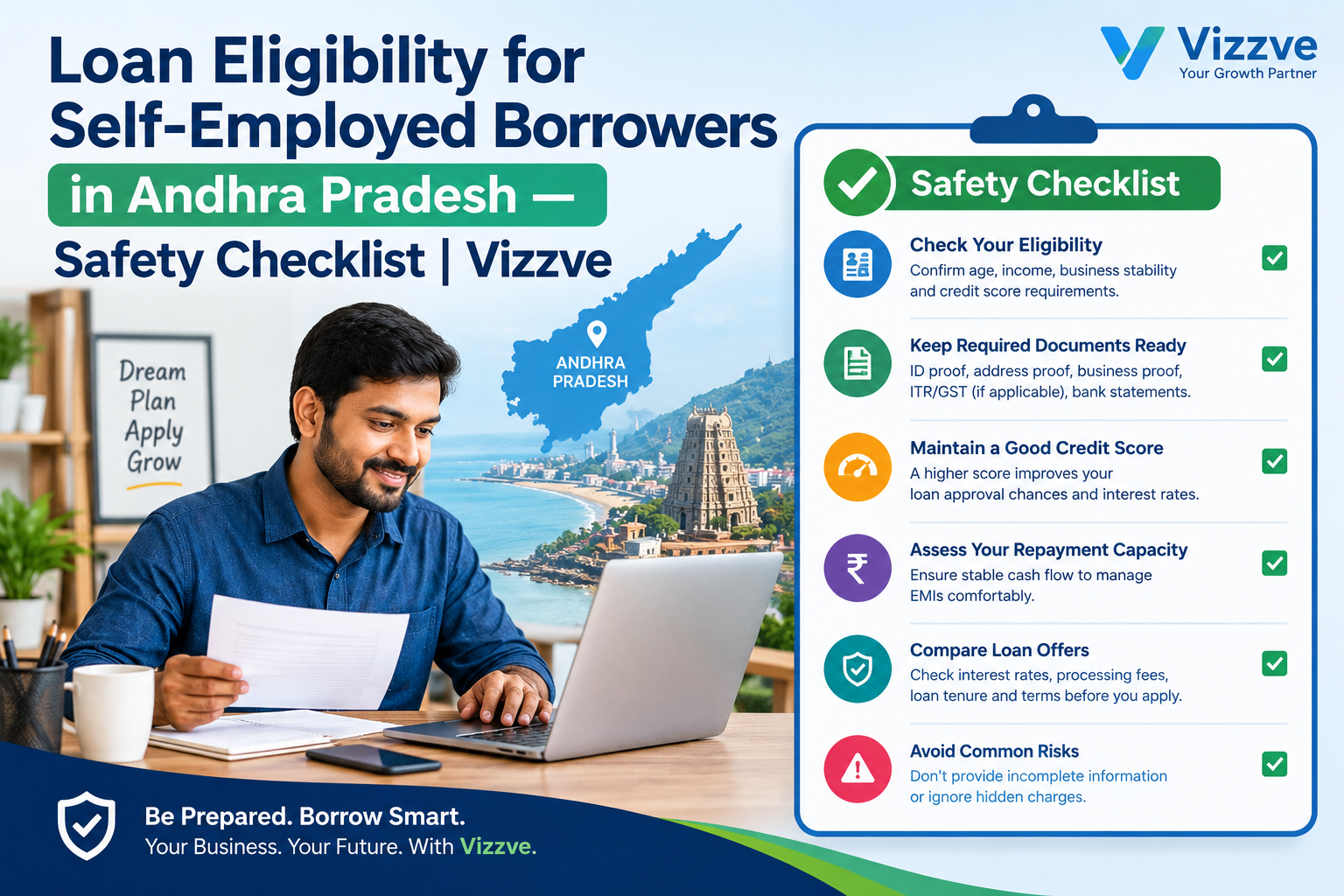
Self-employed borrowers in Andhra Pradesh may apply for personal loans, business loans, working-capital facilities, and other credit products. However, a fast application process should never replace careful verification.
Business owners, freelancers, professionals, traders, contractors, and shopkeepers often submit more detailed income and business documents than salaried applicants. They may also face additional risks involving unclear charges, unverified agents, fake loan apps, excessive data permissions, and repayment pressure.
Short answer: Before applying, verify the lender, understand the total cost, protect your personal data, submit genuine documents, check your repayment capacity, and save every loan record.
This safety checklist is designed to help self-employed borrowers make a more informed borrowing decision.
AI Answer Box
What should self-employed borrowers check before applying for a loan?
Check these six areas:
-
Lender identity: Confirm the actual bank or NBFC behind the loan.
-
Eligibility and documents: Ensure your ITRs, bank statements, GST records, and business documents are genuine and consistent.
-
Total cost: Review the interest rate, APR, processing fee, taxes, penal charges, insurance, and other costs.
-
Data privacy: Understand the permissions requested by the website or app.
-
Repayment capacity: Confirm that the EMI remains affordable during low-income months.
-
Official communication: Use verified websites, email addresses, customer-care numbers, and payment channels.
How can I identify a fake loan app?
Be cautious when an app or agent:
-
Promises guaranteed approval.
-
Demands a large advance payment.
-
Refuses to disclose the actual lender.
-
Uses personal bank accounts for fee collection.
-
Requests unnecessary access to contacts, messages, or files.
-
Does not provide a loan agreement or Key Fact Statement.
-
Uses threats or harassment during recovery.
What should I do if I face online loan fraud?
Report financial cyber fraud immediately through India’s National Cyber Crime Reporting Portal or call 1930. The official portal also allows users to report suspicious phone numbers, websites, email IDs, social-media URLs, and messaging handles.cybercrime+1
Why a Safety Checklist Matters
Self-employed borrowers face unique risks
Self-employed applicants often share:
-
ITRs.
-
PAN and Aadhaar details.
-
Bank statements.
-
GST records.
-
Business registration documents.
-
Invoices and contracts.
-
Professional certificates.
-
Business address proof.
These documents contain sensitive financial and identity information. Sharing them with an unverified person or application can create privacy, identity-theft, and fraud risks.
Approval speed is not the same as safety
A loan approved quickly may still have:
-
A high APR.
-
Large processing fees.
-
Low net disbursal.
-
Expensive insurance.
-
Penal charges.
-
Strict repayment terms.
-
Unclear foreclosure conditions.
The safest borrowing decision is based on transparency and affordability, not speed alone.
Safety Checklist Before Applying
1. Verify the actual lender
Before entering personal information, identify the bank or NBFC responsible for lending the money.
Ask:
-
What is the legal name of the lender?
-
Is it a regulated bank or NBFC?
-
Is the platform a lender or a lending-service provider?
-
Is the lender’s registered address visible?
-
Are customer-care and grievance details available?
-
Does the official lender website mention the platform?
RBI has cautioned the public to verify the credentials of companies and apps offering online loans. It has also stated that digital lending platforms working on behalf of banks or NBFCs should disclose the name of the associated regulated entity upfront.rbi
Warning signs
Avoid proceeding when:
-
The lender’s identity is hidden.
-
The agent gives only a personal mobile number.
-
The website has no legal or grievance information.
-
The lender refuses to share written terms.
-
You are told that approval is “100% guaranteed.”
-
The payment account belongs to an unrelated individual.
2. Use official websites and applications
Download an application only from a trusted source and confirm that the website address is correct.
Check:
-
Spelling of the domain name.
-
Secure connection indicator.
-
Privacy policy.
-
Terms and conditions.
-
Registered company information.
-
Customer-support details.
-
Lender disclosure.
-
App reviews, without relying on reviews alone.
Do not click unknown links received through WhatsApp, SMS, Telegram, or social media.
3. Confirm the purpose of every permission
A loan app may request access to your:
-
Camera.
-
Location.
-
Contacts.
-
Microphone.
-
Messages.
-
Files and media.
-
Call logs.
Not every permission is necessary for every loan application. Read the privacy notice and ask why a permission is required.
Never give an app more access than necessary. Do not share:
-
UPI PIN.
-
ATM PIN.
-
Internet-banking password.
-
One-time password.
-
Card CVV.
-
Email password.
-
Digital-signature credentials.
4. Never submit false documents
Self-employed borrowers may feel pressure to show a higher income. This can create serious problems if the documents do not match.
Never:
-
Edit an ITR.
-
Alter a bank statement.
-
Create fake invoices.
-
Use another person’s documents.
-
Hide existing loans.
-
Misrepresent business turnover as net income.
-
Submit a forged GST certificate.
False information can result in rejection, financial loss, legal consequences, or future credit problems.
5. Check your eligibility honestly
Before applying, review:
-
Age.
-
Residence.
-
Business vintage.
-
Net income.
-
Existing EMIs.
-
Credit history.
-
ITR filing.
-
Bank-account conduct.
-
Business address.
-
Requested loan amount.
A realistic application is safer than applying for an amount that creates unaffordable repayments.