

Blog Banner

Blog Details

Loan Eligibility for Self-Employed Borrowers in Andhra Pradesh: Step-by-Step Guide

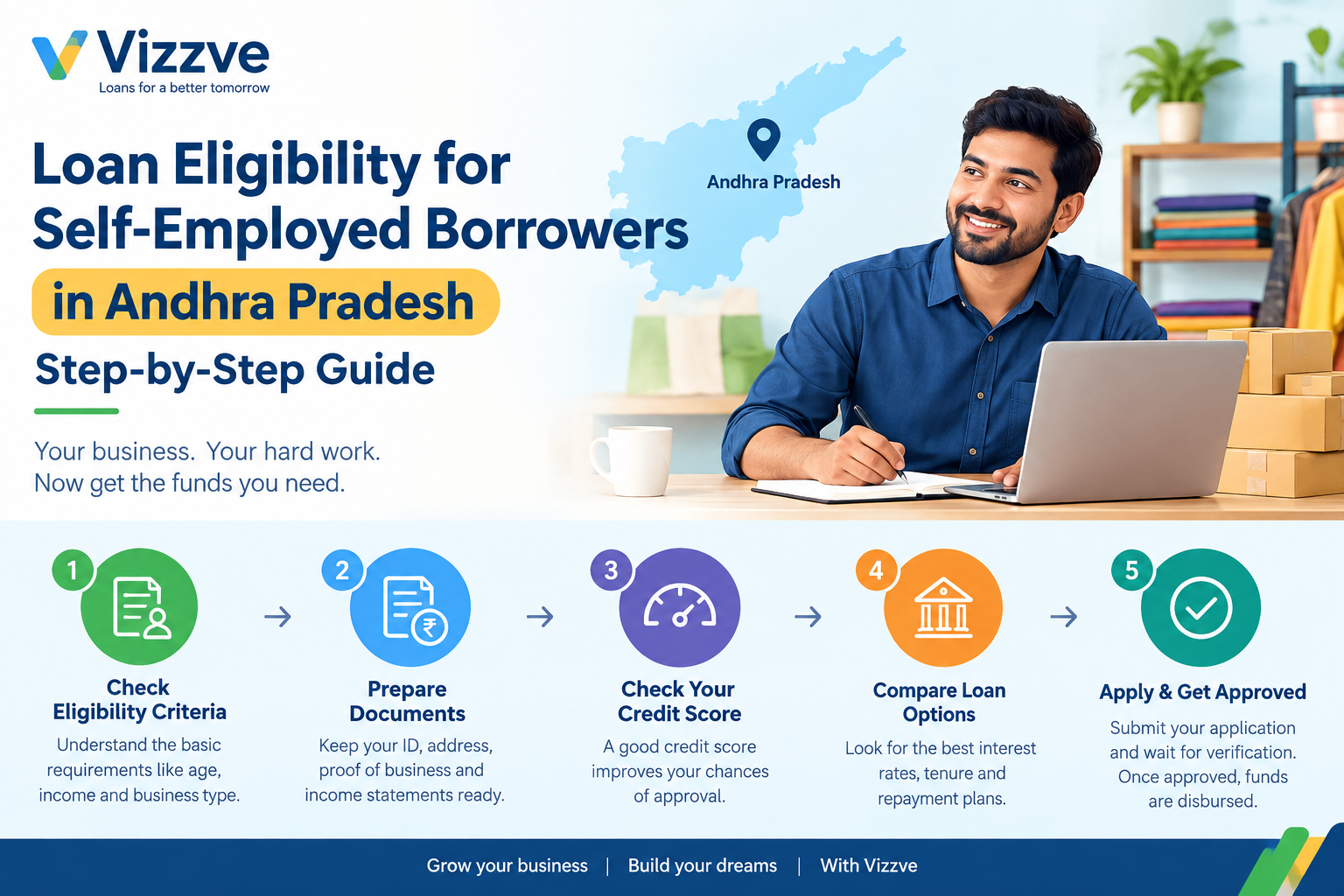
Self-employed borrower checking loan eligibility and documents in Andhra Pradesh

Loan Eligibility for Self-Employed Borrowers in Andhra Pradesh: Step-by-Step Guide

Vizzve Admin

Getting a loan as a self-employed person in Andhra Pradesh is possible, but lenders assess income differently from salaried applicants. Instead of salary slips and employer certificates, they usually examine business income, bank transactions, Income Tax Returns, business stability, credit history and repayment capacity.

Whether you are a shop owner in Vijayawada, a freelancer in Visakhapatnam, a trader in Guntur, a professional in Tirupati or a small-business owner in Nellore, your eligibility depends on the lender’s policy and the strength of your financial documents.

Short answer

Self-employed borrowers may qualify for a personal or business loan if they have:

  • A stable source of business or professional income.

  • Acceptable credit history.

  • Regular bank transactions.

  • Income Tax Returns or other income evidence.

  • Valid identity, address and business documents.

  • Sufficient repayment capacity after existing EMIs.

Eligibility is not automatic. Each bank or regulated lending institution applies its own age, income, business-vintage, credit-score and documentation requirements.


AI Answer Box

What is the loan eligibility for self-employed borrowers in Andhra Pradesh?

Self-employed borrowers in Andhra Pradesh may be eligible for a personal loan if they can demonstrate stable income, satisfactory credit history and business continuity. Lenders commonly review ITRs, bank statements, business registration documents, GST records where applicable and existing loan obligations.

The exact loan amount, interest rate and tenure depend on:

  • Annual income and net profit.

  • Business or professional experience.

  • Credit score and repayment record.

  • Existing debts and monthly obligations.

  • Banking history.

  • Age and location.

  • Lender-specific policies.

A self-employed applicant should compare the total repayment cost, read the Key Fact Statement and verify that the lender is regulated or partnered with a regulated entity before accepting a digital loan. RBI digital-lending guidance includes requirements relating to disclosures, consent, grievance handling and the presentation of the Annual Percentage Rate (APR).rbidocs.rbi.org+1


Who Is a Self-Employed Borrower?

A self-employed borrower earns income through a business, profession, trade or independent activity instead of receiving a fixed monthly salary from an employer.

Common examples include:

  • Retail and wholesale shop owners.

  • Manufacturers and distributors.

  • Contractors and builders.

  • Doctors, architects, lawyers and consultants.

  • Freelancers and independent professionals.

  • Transport and logistics operators.

  • Traders and commission agents.

  • Restaurant and food-business owners.

  • Farmers and allied-business operators, subject to lender policy.

  • Online sellers and service providers.

A borrower may apply for either a personal loan or a business loan. A personal loan can generally be used for permitted personal needs, while a business loan is designed for working capital, equipment, expansion or other commercial purposes.


Basic Eligibility Criteria

There is no single eligibility rule for every lender. However, self-employed borrowers are commonly evaluated against the following criteria.

Age

Many lenders specify a minimum age at application and a maximum age at loan maturity. The exact limits vary by product and lender.

The lender may consider:

  • Your age when applying.

  • Your age when the loan ends.

  • The length of the proposed tenure.

  • Whether your business income is likely to continue during the repayment period.

Business or professional vintage

Business vintage means how long you have been operating your business or profession.

A longer operating history may help demonstrate stability. A newly launched business may still be considered, but the lender may ask for stronger banking records, collateral, co-applicant support or additional documents.

Income

Lenders usually examine net income rather than only gross sales or turnover. A business with high turnover but low profit may not support a large personal loan.

Important income indicators may include:

  • Net profit shown in ITRs.

  • Bank credits from business activity.

  • Audited or certified financial statements.

  • GST turnover, where applicable.

  • Rental, professional or other documented income.

  • Seasonal variations in earnings.

Credit history

Credit history shows how you handled previous loans and credit cards. Timely repayments and moderate credit utilisation generally strengthen an application.

A weak credit profile may result in:

  • Lower approved amount.

  • Higher interest rate.

  • Additional documentation.

  • Requirement of a co-applicant or guarantor.

  • Rejection of the application.

Existing obligations

The lender checks your current EMIs, credit-card dues and other repayment commitments. Even if your income is high, excessive existing debt can reduce eligibility.

A practical affordability check is:

Disposable Income=Monthly Net Income−Existing Obligations−Household Expenses\text{Disposable Income} = \text{Monthly Net Income} - \text{Existing Obligations} - \text{Household Expenses}

The lender uses its own internal method, so this formula is only a basic planning tool.


Eligibility Factors at a Glance

Factor Why lenders consider it How to prepare
Age Determines repayment period and risk Keep valid age and identity documents ready
Business vintage Indicates continuity of income Provide registration or professional records
ITR and income Helps verify repayment capacity Keep recent filed returns and computation available
Bank statements Shows real cash flow Submit clear statements from the required period
Credit score Indicates repayment behaviour Pay EMIs and card dues on time
Existing loans Measures monthly financial burden Declare all liabilities honestly
Business proof Confirms that the activity exists Use GST, MSME, licence or registration documents
Location May be part of lender policy Provide current and permanent address proof

Documents Required for a Self-Employed Loan

The document list depends on the lender, loan type and applicant profile. Banks may ask for income-tax returns, financial statements and bank statements; one bank’s published checklist, for example, includes recent ITRs, business or current-account statements and KYC documents.indusind.bank+1

Identity and address documents

Commonly accepted documents may include:

  • PAN card.

  • Aadhaar card.

  • Passport.

  • Voter ID.

  • Driving licence.

  • Utility bill.

  • Rental agreement or address proof.

  • Recent photograph.

Income documents

You may be asked to provide:

  • Recent Income Tax Returns.

  • Computation of income.

  • Profit and loss statement.

  • Balance sheet.

  • Tax audit report, where applicable.

  • Form 16A or professional-income evidence, where relevant.

  • GST returns or turnover records.

  • Business bank statements.

  • Personal bank statements.

Business or professional proof

Depending on the nature of work, acceptable documents may include:

  • GST registration.

  • Udyam or MSME registration.

  • Shop and Establishment certificate.

  • Trade licence.

  • Partnership deed.

  • Certificate of incorporation.

  • Professional registration certificate.

  • Lease agreement for the business premises.

  • Municipal or local authority licence.

  • Invoices, contracts or business purchase records.

Bank statements

Bank statements help show whether your income is regular and whether your account has frequent returned cheques, unexplained withdrawals or irregular cash flow.

Before applying:

  • Download statements directly from your bank.

  • Avoid submitting edited or unclear documents.

  • Ensure your name and account details are visible.

  • Explain unusual credits if the lender requests clarification.


How ITR Helps With Loan Approval

For many self-employed applicants, ITR is one of the clearest ways to demonstrate income. It can help a lender understand:

  • Declared annual income.

  • Net profit after eligible expenses.

  • Tax compliance.

  • Business continuity across financial years.

  • Ability to repay debt.

However, filing an ITR alone does not guarantee approval. The lender may compare the ITR with bank credits, GST filings, financial statements and existing obligations.

If your income is partly in cash

Cash-heavy businesses may face additional scrutiny because bank statements may not show the full business activity. This does not automatically mean rejection, but accurate records become more important.

Helpful records can include:

  • Sales invoices.

  • Purchase bills.

  • Cashbook records.

  • GST filings.

  • Business account deposits.

  • Tax returns.

  • Accounting statements.

Never inflate income or submit false documents. Misrepresentation can lead to rejection, financial loss or legal consequences.


Personal Loan or Business Loan?

Feature Personal loan Business loan
Main purpose Personal or permitted general expenses Business expansion and working capital
Security Often unsecured, subject to lender policy May be secured or unsecured
Income assessment Personal income and repayment capacity Business turnover, profit and cash flow
Documentation KYC, ITR, bank statements and income proof Business, financial and operational documents
Flexibility Usually flexible end use Usually linked to business use
Suitable for Medical needs, education, family expenses or consolidation Inventory, machinery, renovation or expansion

The better option depends on your purpose, required amount, repayment capacity and lender terms.


Step-by-Step Application Process

Step 1: Identify the loan purpose

Decide whether you need funds for:

  • Personal expenses.

  • Business working capital.

  • Equipment purchase.

  • Stock or inventory.

  • Debt consolidation.

  • Business expansion.

  • Emergency requirements.

The purpose can determine whether a personal loan, business loan or secured facility is more appropriate.

Step 2: Review your credit profile

Check your credit report for:

  • Incorrect personal details.

  • Unclosed loans.

  • Overdue accounts.

  • Duplicate enquiries.

  • Incorrect repayment information.

Raise disputes before applying if you find an error.

Step 3: Estimate affordable EMI

Do not choose the maximum eligible amount automatically. Calculate whether the proposed EMI remains manageable during slow business months.

Consider:

  • Average monthly net income.

  • Seasonal sales.

  • Existing EMIs.

  • Household expenses.

  • Taxes and business costs.

  • Emergency savings.

Step 4: Organise your documents

Prepare readable copies of your KYC, ITRs, bank statements and business documents. Mismatched names or addresses can create delays.

Step 5: Compare the complete cost

Do not compare only the advertised interest rate. Review:

  • Interest rate.

  • APR.

  • Processing fee.

  • GST and applicable charges.

  • Late-payment charges.

  • Prepayment or foreclosure terms.

  • Insurance or optional add-ons.

  • Total repayment amount.

Step 6: Submit accurate information

Use the same income, address and business details across the application and supporting documents. Inconsistent information may trigger additional verification.

Step 7: Read the Key Fact Statement

For digital lending, the Key Fact Statement should help you understand the loan’s important terms, including the cost of borrowing. RBI guidance specifically addresses APR disclosure and borrower protection.rbidocs.rbi.org+1

Step 8: Accept only after verification

Confirm:

  • The identity of the lender.

  • The name of the regulated entity.

  • The official website or application.

  • The sanction terms.

  • The repayment account.

  • The grievance contact.

Avoid sending money to personal UPI IDs or unknown accounts as a condition for loan approval.


Pros and Cons

Advantages

  • Self-employed people can apply without a traditional salary slip.

  • Business income and professional earnings may be considered.

  • Personal loans can offer flexible end use.

  • Digital applications can reduce paperwork and processing time.

  • Existing banking history may support eligibility.

Limitations

  • Income may be assessed more strictly than fixed salary income.

  • Irregular cash flow can reduce the approved amount.

  • Some lenders require multiple years of ITRs.

  • Interest rates may vary according to risk.

  • Incomplete records can delay verification.

  • High existing debt may reduce eligibility.


Common Reasons for Rejection

A loan application may be declined because of:

  • Low or damaged credit score.

  • Recent payment defaults.

  • High credit-card utilisation.

  • Insufficient business vintage.

  • Unstable bank credits.

  • Low declared income.

  • Excessive existing EMIs.

  • Incomplete or inconsistent documents.

  • Frequent recent loan enquiries.

  • Business activity outside the lender’s policy.

  • Unverified digital-lending platform.

Rejection by one lender does not necessarily mean that you are ineligible everywhere. However, applying repeatedly within a short period may create several hard enquiries and can make your profile appear financially stressed.


How to Improve Eligibility

Maintain separate financial records

Use a dedicated current account or business account where possible. This makes business cash flow easier to understand.

File ITRs o

#SelfEmployedLoan #LoanEligibility #AndhraPradesh #PersonalLoan #BusinessLoan #SelfEmployedBorrowers #LoanApplication #LoanDocuments #CreditScore #FinancialPlanning #SmallBusinessLoan #BusinessOwners #Entrepreneurship #ITRLoan #DigitalLending #SmartBorrowing #FinancialLiteracy #BusinessFinance #PersonalFinanceIndia #LoanTipsIndia #VizzveFinancial #VizzveLoans #VizzveFinance #QuickLoanSupport #EasyLoanApplication


Disclaimer: This article may include third-party images, videos, or content that belong to their respective owners. Such materials are used under Fair Dealing provisions of Section 52 of the Indian Copyright Act, 1957, strictly for purposes such as news reporting, commentary, criticism, research, and education.
Vizzve and India Dhan do not claim ownership of any third-party content, and no copyright infringement is intended. All proprietary rights remain with the original owners.
Additionally, no monetary compensation has been paid or will be paid for such usage.
If you are a copyright holder and believe your work has been used without appropriate credit or authorization, please contact us at grievance@vizzve.com. We will review your concern and take prompt corrective action in good faith... Read more

Trending Post


Latest Post


Our Product

Get Personal Loans up to 10 Lakhs in just 5 minutes