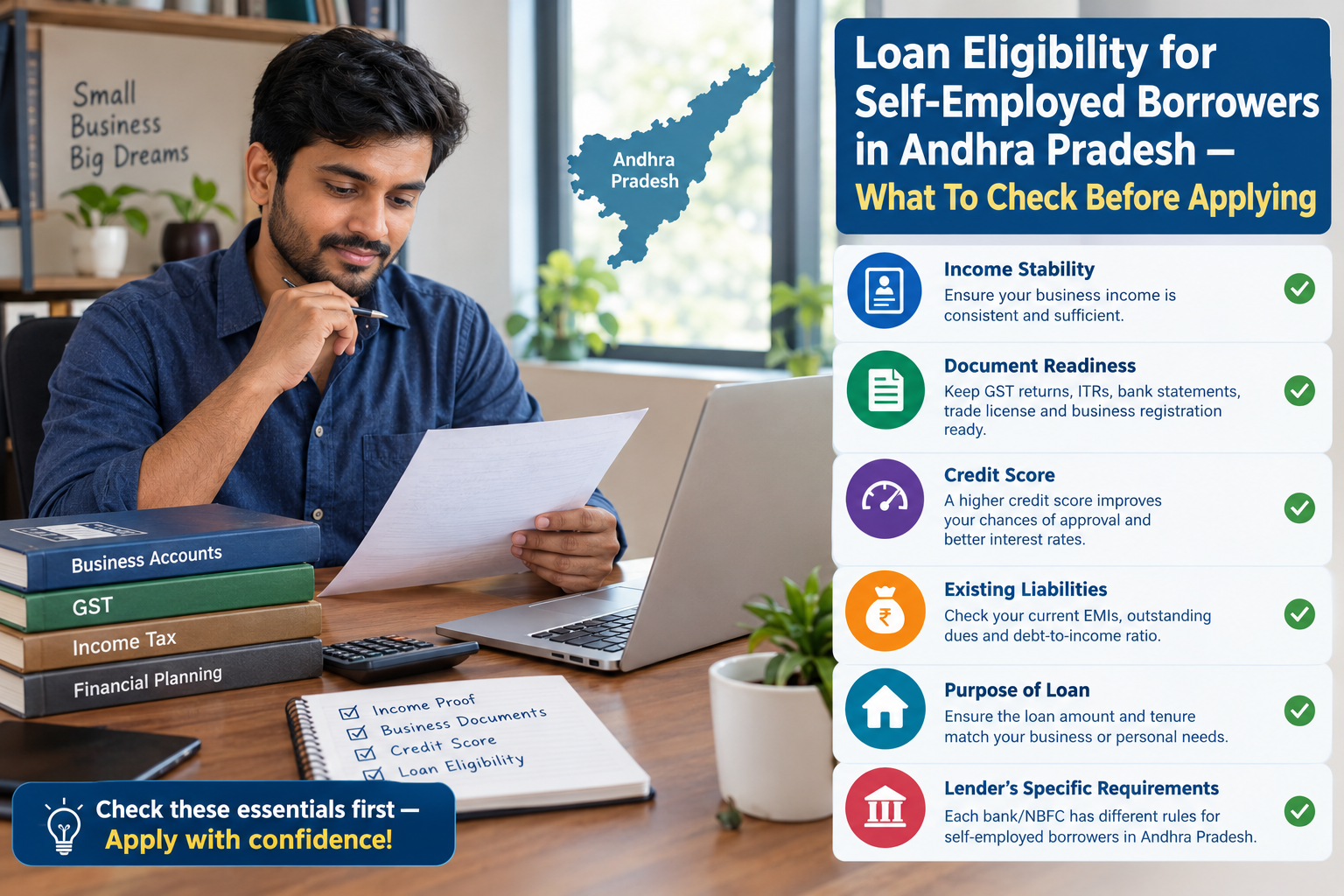
Loan Eligibility for Self-Employed Borrowers in Andhra Pradesh: What to Check Before Applying
Loan Eligibility for Self-Employed Borrowers in Andhra Pradesh: What to Check Before Applying
Vizzve Admin
Self-employed borrowers in Andhra Pradesh can apply for personal loans, business loans, and other credit products. However, the eligibility assessment may differ from that of salaried employees because self-employed applicants may not have fixed monthly salaries or standard salary slips.
Lenders usually examine income stability, business continuity, banking transactions, tax records, credit history, existing liabilities, and repayment capacity. Before applying, you should verify whether your financial documents present a clear and consistent picture.
Short answer: Before applying for a loan, self-employed borrowers should check their credit report, income records, business vintage, bank statements, existing EMIs, required documents, and the total cost of borrowing.
This guide explains the important checks to complete before submitting a loan application in Andhra Pradesh.
AI Answer Box
What should self-employed borrowers check before applying for a loan?
Self-employed borrowers should check:
Whether their income can be verified through ITRs, bank statements, GST returns, invoices, or financial statements.
Whether their business or professional activity has operated for the required period.
Whether their credit report contains overdue accounts, settlements, or errors.
Whether the proposed EMI is affordable after existing obligations.
Whether all identity, address, business, and income documents are accurate.
Whether the lender is genuine and clearly discloses interest, fees, APR, repayment terms, and other charges.
Can self-employed borrowers get a loan without salary slips?
Yes. Self-employed applicants may use ITRs, bank statements, GST returns, profit and loss statements, invoices, professional records, and business-registration documents as income evidence. The exact requirement depends on the lender and loan product.
What is the biggest eligibility check?
The most important check is repayment capacity. A lender wants to know whether your verified income is sufficient to pay the proposed EMI along with your existing financial commitments.
What to Check Before Applying
1. Check your loan purpose
Start by identifying why you need the funds. The purpose can affect the type of loan you should consider.
Requirement
Potentially suitable product
Medical, education, wedding, or household expense
Personal loan
Business machinery or expansion
Business loan or equipment finance
Short-term working capital
Business working-capital facility
Vehicle purchase
Vehicle loan
Property-related expense
Loan against property or housing finance
Debt consolidation
Personal loan, subject to affordability
A personal loan may offer flexibility, but it can be more expensive than a secured loan. Do not choose a product only because the application appears easy.
2. Check whether your income is verifiable
Self-employed income may come from business profits, professional fees, commissions, rent, contracts, or multiple sources. The lender may not treat every receipt as stable income.
Prepare a clear income summary showing:
Average monthly or annual income.
Business expenses.
Net profit.
Taxable income.
Existing EMI obligations.
Seasonal changes.
Regularity of bank credits.
Turnover is not the same as income
A business may record ₹20 lakh in annual sales but have much lower net profit after inventory, rent, salaries, transport, taxes, and other costs.
For eligibility, lenders are generally more interested in sustainable and verifiable earnings than gross sales alone.
3. Check your business vintage
Business vintage refers to the length of time your business or professional activity has been operating. Lenders may prefer applicants with an established income history.
You may be asked to provide:
Business registration date.
GST records.
Shop and establishment certificate.
Professional licence.
ITR history.
Business bank statements.
Invoices or contracts.
Office or shop address proof.
A newly started business may not have enough historical information for conventional income assessment. That does not automatically mean rejection, but additional documentation may be required.
4. Check your CIBIL and credit reports
Review your credit report before applying. Look for:
Missed EMI payments.
Incorrect overdue amounts.
Accounts that should have been closed.
Duplicate loan accounts.
Settled or written-off accounts.
High credit-card utilisation.
Multiple recent enquiries.
Incorrect personal information.
If you find an error, raise a dispute with the relevant credit bureau or lender before submitting a new application.
Why credit history matters
Credit history helps lenders understand how you have managed previous borrowing. It is only one part of the assessment, but late repayments and excessive outstanding debt can reduce approval chances.
A strong credit profile does not guarantee approval if your income is insufficient or your documents are inconsistent.
5. Check your existing EMIs
Make a complete list of current financial obligations:
Personal-loan EMIs.
Business-loan EMIs.
Vehicle-loan instalments.
Home-loan payments.
Credit-card dues.
Consumer-durable loans.
Buy-now-pay-later accounts.
Informal recurring commitments reflected in bank statements.
A simple affordability calculation is:
Available Income=Verified Net Income−Existing Monthly Obligations\text{Available Income} = \text{Verified Net Income} - \text{Existing Monthly Obligations}Available Income=Verified Net Income−Existing Monthly Obligations
The proposed EMI should leave enough money for household expenses, business costs, taxes, emergencies, and income fluctuations.
6. Check your bank statements
Bank statements are important because they show actual financial activity. Before applying, review your recent statements for:
Regular business receipts.
Unexplained cash deposits.
Cheque returns.
Frequent overdrafts.
Existing EMI deductions.
Low or negative balances.
Transfers between personal and business accounts.
Credits from unknown loan applications.
Large one-time deposits.
Maintain separate business and personal accounts whenever possible. Clear separation makes it easier to demonstrate genuine business cash flow.
7. Check your tax records
ITRs can help verify declared income and tax compliance. The Income Tax Department’s official e-filing portal provides return-filing services and lists ITR forms available for the relevant assessment year.incometax
Before applying, confirm that:
Your latest ITR has been filed.
The return has been e-verified.
The income reported matches your financial records.
Business and professional income are correctly disclosed.
Tax payments and refunds are properly reflected.
There are no unexplained differences between ITRs and bank statements.
The Income Tax Department states that an ITR must be verified to complete the filing process; without verification within the applicable timeline, the return may be treated as invalid.incometax
8. Check your GST records, if applicable
GST returns may help establish business activity and turnover for registered businesses. However, GST turnover should not be presented as personal income.
Check whether:
GST returns were filed on time.
Sales figures broadly align with bank credits.
Business names and addresses match other records.
There are no unexplained filing gaps.
Tax liabilities are accounted for.
Your declared profit is reasonable compared with turnover.
9. Check the document checklist
Prepare documents before starting the application. Common documents may include:
The actual checklist varies by lender, applicant type, requested amount, and loan product.
10. Check your name and address consistency
A small mismatch can delay verification. Compare the following across your documents:
Full name.
Date of birth.
Father’s or spouse’s name, where applicable.
Residential address.
Business address.
PAN details.
Bank-account details.
Business name.
If you have changed your name or address, keep supporting documents ready.
Documents by Profession
Applicant type
Useful income and business evidence
Shopkeeper
GST returns, shop licence, bank statements, ITRs, business address proof
Freelancer
Client contracts, invoices, ITRs, bank credits, professional portfolio
Doctor
Practice registration, consultation receipts, ITRs, bank statements, clinic proof
Consultant
Engagement letters, invoices, ITRs, professional registration, bank statements
Contractor
Work orders, invoices, completion certificates, GST returns, bank statements
Trader
Purchase and sales records, GST returns, ITRs, current-account statements
Company director
Company financials, incorporation documents, personal ITRs, bank statements
Partnership-firm owner
Partnership deed, firm ITR, financial statements, bank statements
These documents are indicative. Ask the lender for the final list before applying.
How Lenders Assess Eligibility
Income stability
Lenders may consider the average income over a period rather than relying on one unusually profitable month. Stable income can improve the credibility of the application.
Repayment capacity
The lender may compare your verified income with:
Current EMIs.
Proposed EMI.
Household expenses.
Business expenses.
Tax obligations.
Other recurring commitments.
Credit behaviour
The lender may examine whether you have made repayments on time and whether you rely heavily on short-term credit.
Business continuity
A longer operating history may make it easier to verify income. Sudden income increases may require additional explanation.
Banking conduct
Frequent cheque returns, persistent overdrafts, or unexplained deposits may lead to more questions during verification.
Loan amount and tenure
A higher loan amount may require stronger financial records. A longer tenure can reduce the monthly EMI but may increase the total interest paid.
Personal Loan Versus Business Loan
Factor
Personal loan
Business loan
Main purpose
Personal or flexible use
Business expansion or working capital
Security
Often unsecured
May be unsecured or secured
Assessment
Personal income and credit profile
Business cash flow and financial records
Documentation
ITRs, bank statements, identity proof
Business registration, financial statements, GST records
Flexibility
Usually broad end use
Often linked to business requirements
Cost
Depends on lender and risk profile
Depends on security, business strength, and product
Suitable for
Short- or medium-term personal needs
Business assets, expansion, or operating needs
Select the loan based on purpose, cost, repayment period, and financial capacity.
Step-by-Step Application Checklist
Step 1: Estimate the required amount
Borrow only what you need. Avoid adding unnecessary expenses to the application simply because a higher amount may be available.
Step 2: Calculate an affordable EMI
Use your verified net income and existing obligations. Consider weaker business months before finalising the amount.
Step 3: Review your credit report
Correct errors and clear overdue payments where possible. Avoid applying while important credit-report issues remain unresolved.
Step 4: Organise documents
Keep readable digital copies of identity, address, income, business, and banking documents.
Step 5: Compare lenders
Compare:
Interest rate.
APR.
Processing fee.
GST and other charges.
Tenure.
Prepayment terms.
Penal charges.
Disbursal amount.
Grievance-redressal process.
Step 6: Submit accurate information
Do not inflate income, hide existing loans, or use documents that cannot be verified.
Step 7: Review the sanction terms
Check the approved amount, net disbursal, EMI, tenure, interest rate, fees, and repayment date.
Step 8: Read the Key Fact Statement
The Reserve Bank of India requires regulated entities to provide a standardised Key Fact Statement before execution of a digital loan contract. The RBI’s digital-lending framework also provides borrowers with an option to exit a digital loan during the applicable cooling-off period by paying the principal and proportionate APR without penalty, subject to the stated conditions.rbi.org+1
Digital Loan Safety Checks
Before accepting an online loan, confirm:
The name of the actual regulated lender.
Whether the platform is acting as a lending-service provider or lender.
The official website and customer-care details.
The loan amount and net amount credited.
The APR and total repayment.
Processing, documentation, insurance, and other charges.
EMI due dates.
Penal-interest terms.
Prepayment or foreclosure charges.
Data permissions.
Grievance-redressal contact.
Key Fact Statement and loan agreement.
Never transfer an “approval fee” to an unknown personal account. Also avoid sharing OTPs, passwords, card PINs, or banking credentials with agents who contact you through unofficial channels.
Andhra Pradesh Considerations
Self-employed borrowers in Andhra Pradesh may earn through retail, transport, agriculture-linked activity, fisheries, manufacturing, construction, professional services, food businesses, trading, and small-scale enterprises.
Before applying, be ready to explain:
Seasonal income variations.
Cash-heavy business receipts.
Multiple business locations.
Family-managed businesses.
Income credited to a relative’s account.
Differences between turnover and profit.
Temporary drops in revenue.
Business activity in rural or semi-urban areas.
If any document is issued in Telugu or another language, check whether the lender requires an English translation or additional verification.
Disclaimer: This article may include third-party images, videos, or content that belong to their respective owners. Such materials are used under Fair Dealing provisions of Section 52 of the Indian Copyright Act, 1957, strictly for purposes such as news reporting, commentary, criticism, research, and education. Vizzve and India Dhan do not claim ownership of any third-party content, and no copyright infringement is intended. All proprietary rights remain with the original owners. Additionally, no monetary compensation has been paid or will be paid for such usage. If you are a copyright holder and believe your work has been used without appropriate credit or authorization, please contact us at grievance@vizzve.com. We will review your concern and take prompt corrective action in good faith... Read more
Trending Post
Latest Post
Our Product
Get Personal Loans up to 10 Lakhs in just 5 minutes