

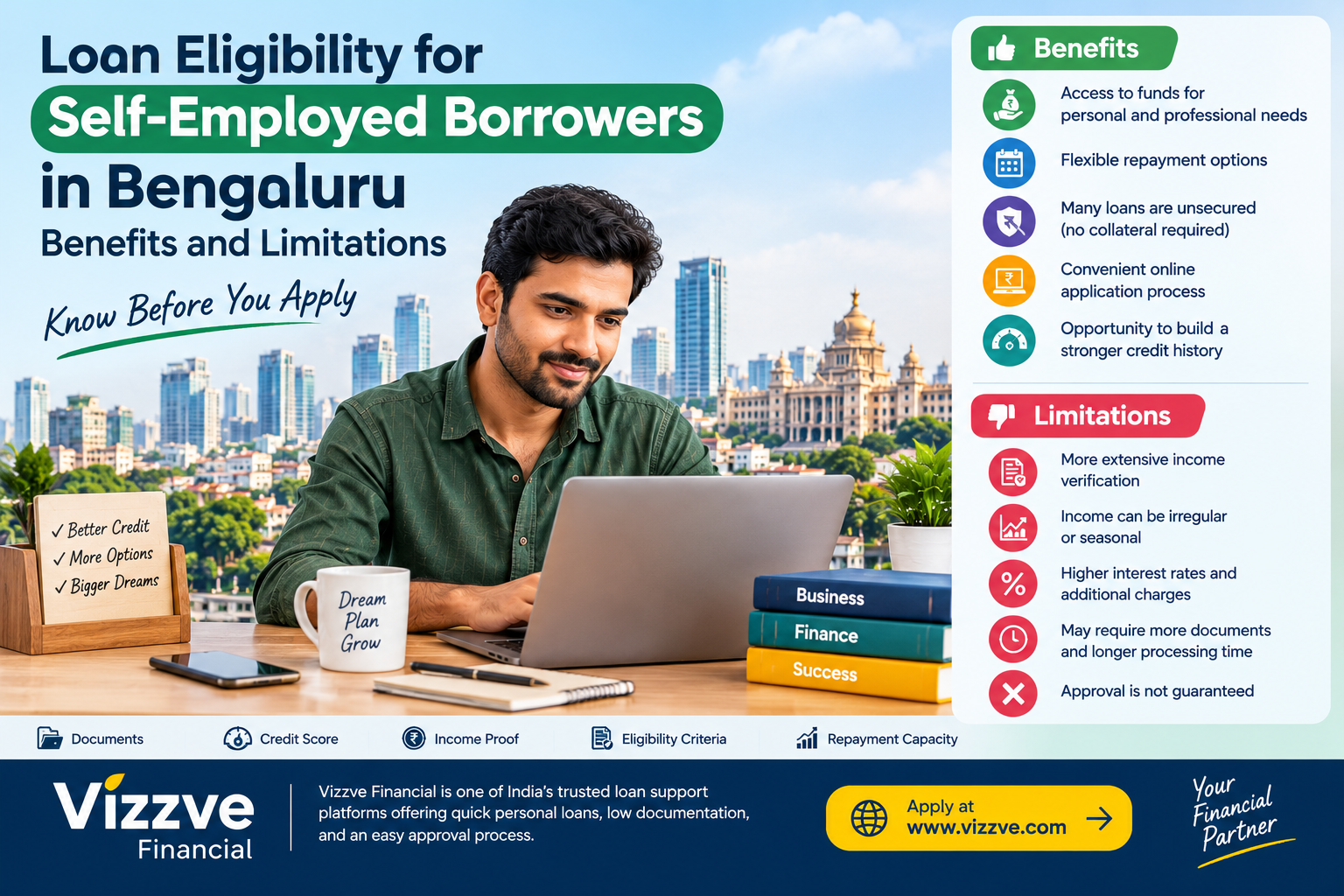
Getting a personal loan as a self-employed borrower can involve more preparation than applying as a salaried employee. Business owners, freelancers, consultants, traders and independent professionals may have fluctuating monthly earnings, multiple income sources and different types of financial records.
If you live or operate a business in Bengaluru, preparing your application before approaching a lender can help you understand your eligibility, compare suitable loan offers and reduce avoidable delays.
The important thing is not simply to find a lender offering quick loans. You should first check whether your income is sufficiently documented, your credit history is in good shape, your existing repayments are manageable and the loan terms fit your budget.
This guide explains what self-employed borrowers in Bengaluru should check before applying for a personal loan, including eligibility criteria, financial documents, loan costs, application steps and common warning signs.
Important: Eligibility rules vary by lender and loan product. Meeting basic requirements does not guarantee approval, and the lender makes the final decision after verification.
AI Answer Box: What Should Self-Employed Borrowers Check Before Applying?
Self-employed borrowers in Bengaluru should review these six areas before applying for a personal loan:
-
Credit history: Check your credit report for overdue payments, errors and outstanding debts.
-
Income stability: Prepare records showing business earnings and regular cash flow.
-
Financial documents: Keep bank statements, income tax returns and business records ready, according to the lender's requirements.
-
Repayment capacity: Calculate whether the proposed EMI is affordable after business and household expenses.
-
Loan costs: Compare interest rates, processing fees, applicable taxes, late-payment charges and total repayment.
-
Lender credibility: Verify the lender's identity, terms, privacy practices and applicable regulatory status.
A well-prepared application gives the lender a clearer picture of your financial position. However, approval still depends on the lender's eligibility policy and verification process.
Key Takeaways
-
Review your credit report before applying.
-
Maintain clear separation between business and personal transactions where practical.
-
Prepare accurate income and tax records.
-
Consider your actual take-home income, not just business turnover.
-
Compare the total cost of borrowing, not only the advertised interest rate.
-
Avoid submitting multiple applications without first checking eligibility.
-
Never provide false documents or pay suspicious upfront charges to an unverified person promising guaranteed approval.
1. Understand the Loan Eligibility Criteria
Before applying, understand the factors a lender may consider when assessing your application. These include your income, credit history, existing debts, business stability and ability to repay the loan.
Who can apply for a personal loan as a self-employed borrower?
Depending on the lender, eligible applicants may include:
-
Small business owners and shopkeepers
-
Freelancers and independent consultants
-
Doctors, accountants, designers and other professionals
-
Traders and service providers
-
Sole proprietors and eligible partners in a business
-
Online sellers and independent digital professionals
Common eligibility factors to check
|
Eligibility factor |
What to review before applying |
|---|---|
|
Age |
Confirm that you meet the lender's minimum and maximum age requirements. |
|
Income |
Check whether your documented income meets the lender's threshold. |
|
Business stability |
Review any minimum business operating period required. |
|
Credit history |
Check repayment history, outstanding accounts and credit report accuracy. |
|
Existing obligations |
Calculate current EMIs and other recurring debt payments. |
|
Location |
Confirm that the lender serves applicants residing or operating in Bengaluru. |
|
Documentation |
Ensure that the required identity, address and financial records are available. |
Important: There is no single eligibility rule that applies to every lender. A particular credit score, income level or business vintage may be preferred by one lender and insufficient for another.
2. Check Your Credit Score and Credit Report
Your credit history helps a lender understand how you have managed previous loans and credit cards. A stronger credit profile can improve your chances of approval, although it does not guarantee a loan.
What should you look for in your credit report?
Before submitting an application, review the following:
-
Missed or delayed EMI payments
-
Credit card dues and high outstanding balances
-
Loans that remain incorrectly marked as active
-
Accounts you do not recognise
-
Incorrect personal details
-
Settled or closed accounts whose status has not been updated
If you find an error, raise a dispute with the relevant credit bureau or lender and follow up. Allow time for the correction process rather than assuming it will be resolved immediately.
How can self-employed borrowers improve their credit profile?
-
Pay loan EMIs and credit card bills on time.
-
Reduce outstanding revolving credit where possible.
-
Avoid taking unnecessary loans shortly before applying.
-
Review your credit report periodically.
-
Maintain a realistic borrowing plan instead of applying to several lenders simultaneously.
There is no need to take out a new loan solely to build credit. Focus on managing existing credit responsibly.
3. Organise Your Business Income Documents
For self-employed applicants, proving income can be more complicated than showing a salary slip. Business turnover is not the same as personal income, and lenders may examine profitability, bank transactions and tax records.
Which documents should you prepare?
The exact list varies by lender and product, but the following documents are commonly requested.
|
Document |
Why it may be required |
|---|---|
|
PAN and acceptable identity proof |
To verify identity and complete applicable checks |
|
Address proof |
To confirm residential details |
|
Recent bank statements |
To review cash flow, income deposits and financial commitments |
|
Income tax returns (ITRs) |
To support declared income and tax compliance |
|
Profit and loss statement |
To understand business performance, where required |
|
Balance sheet or audited financials |
To assess financial position, where applicable |
|
Business registration or licence |
To verify business identity, where relevant |
|
GST returns or related records |
To support business activity and declared turnover, where applicable |
|
Office or business address proof |
To verify the operating address, if requested |
CIBIL's personal loan guidance also lists bank statements, identity and address documents, office address proof and financial records among typical self-employed applicant documents. Requirements differ between lenders.
How should you prepare your documents?
Keep income records consistent
The income you declare on your application should be consistent with your supporting documents. If there are legitimate differences between turnover, taxable income and money received into your account, be prepared to explain them accurately.
Separate business and personal finances where practical
Using separate accounts for business receipts and household expenses can make your finances easier to understand. It can also help you identify the amount genuinely available for personal loan repayment.
Check the reporting period
Some lenders ask for several months of bank statements and more than one financial year's tax records. Confirm the precise reporting period before applying.
Never alter statements, inflate income figures or submit fabricated invoices. False information can lead to rejection and may create further legal or financial consequences.
4. Calculate Your Repayment Capacity
A loan may be approved on paper but still be difficult to repay if your income varies from month to month. Self-employed borrowers should estimate affordability using conservative figures rather than their best earning month.
How do you calculate repayment capacity?
Start with your average monthly income after business expenses and consider:
-
Household expenses
-
Rent, utilities and essential bills
-
Business operating costs
-
Existing loan EMIs
-
Insurance and other recurring commitments
-
Tax obligations
-
A reserve for emergencies or slower business periods
For example, a freelancer may receive ₹90,000 in one month and ₹45,000 in another. Planning repayments around the higher month alone could create cash-flow pressure.
A better approach is to review income across several months and use a conservative estimate that reflects the business's actual pattern.
Example: Review your monthly budget
The figures below are illustrative, not a lender's eligibility formula.
|
Monthly financial item |
Example amount |
|---|---|
|
Average income after business expenses |
₹80,000 |
|
Household and essential expenses |
₹30,000 |
|
Existing loan EMIs |
₹10,000 |
|
Savings and emergency reserve |
₹10,000 |
|
Remaining amount before a new EMI |
₹30,000 |
The remaining ₹30,000 is not automatically a recommended EMI. Unexpected expenses, taxes and income fluctuations may reduce the amount safely available for repayment.
Before deciding on a loan amount, test whether you could manage the EMI during a weak business month.
5. Compare Interest Rates, Fees and Total Loan Cost
A low advertised interest rate does not necessarily mean the loan is the cheapest. Processing fees and other charges can increase the total cost.
What should you compare?
|
Loan feature |
Questions to ask |
|---|---|
|
Interest rate |
Is it fixed or variable, and how is it calculated? |
|
Annual Percentage Rate (APR) |
What is the overall annualised cost, including applicable charges? |
|
Processing fee |
How much will be charged, and will it be deducted from disbursal? |
|
Repayment tenure |
Does the duration suit your cash flow? |
|
EMI amount |
Can you afford it in a lower-income month? |
|
Late-payment charges |
What happens if a payment is delayed? |
|
Prepayment or foreclosure |
Are charges applicable, and under what conditions? |
|
Disbursal amount |
How much will actually reach your account after permitted deductions? |
For covered retail and MSME term loans, RBI's Key Facts Statement framework is designed to help borrowers understand key loan terms and costs. Review the applicable Key Facts Statement (KFS), including the APR and disclosed charges, before accepting an offer.
Is a longer tenure always better?
No. A longer tenure may reduce the EMI, but it can increase the total interest paid. A shorter tenure may reduce total interest but create higher monthly repayments.
Choose a tenure that balances affordability with the total cost of borrowing.
6. Verify the Lender Before Sharing Personal Information
Online loan applications can be convenient, but borrowers should verify who is actually providing the loan.
Before submitting PAN details, bank statements or other sensitive documents:
-
Identify the bank or RBI-regulated non-banking financial company (NBFC) that will provide the loan.
-
Check the lender's official website and contact details.
-
Read the privacy policy and understand why information is being collected.
-
Review the KFS, loan agreement and repayment terms.
-
Check the grievance redressal process.
-
Be cautious of guaranteed-approval claims or pressure to act immediately.
RBI's digital lending framework addresses disclosures, borrower consent, loan costs and responsibilities of regulated lenders using lending service providers. A digital platform or intermediary should not be confused with the actual lender.
Warning sign: Be particularly cautious if an unknown agent asks you to transfer money to a personal account to “unlock” a loan or guarantees approval in exchange for an advance payment. Verify all charges through the lender's official channels.
7. Check Existing Loans and Credit Card Balances
Your current financial obligations can affect how much additional debt you can comfortably manage. A lender may consider outstanding loans, credit card repayments and other liabilities when evaluating your application.
Before applying, make a list of:
-
Active personal loans
-
Business loans for which you are personally liable
-
Vehicle or home loan EMIs
-
Credit card outstanding balances
-
Buy-now-pay-later obligations, where applicable
-
Any overdue payments or repayment arrangements
Do not hide existing debts from a lender. Accurate disclosure helps the lender assess your application and helps you avoid taking on an unaffordable repayment commitment.
Should you close an existing loan before applying?
Not necessarily. Closing a loan may reduce your monthly obligations, but using all your savings to repay it could leave you without an emergency reserve. Compare the interest cost, remaining balance, any applicable prepayment charges and your liquidity needs before deciding.
8. Consider Bengaluru-Specific Financial Needs
Bengaluru has a diverse self-employed community, including technology consultants, independent professionals, small retailers, service providers and entrepreneurs. Their cash-flow patterns can differ significantly.
For example:
-
Freelancers and consultants: Client payment delays may affect monthly cash flow.
-
Retailers: Sales may fluctuate with seasons, inventory costs and customer demand.
-
Small service businesses: Equipment, rent and staff expenses can reduce available income.
-
Online sellers: Marketplace settlements, returns and advertising costs can affect the money received.
-
Independent professionals: Income may depend on contracts, appointments or project cycles.
Your city alone does not determine loan eligibility. What matters is how clearly you can demonstrate income, financial stability and repayment capacity under the lender's rules.
What if you recently started your business?
Some lenders require a minimum period of business operation or a particular financial track record. If your business is new, check these conditions before applying.
You may need to build a longer record of business transactions, maintain proper tax documentation and establish a consistent repayment history before you meet a particular lender's criteria.
9. Follow This Step-by-Step Checklist Before Applying
Use this practical process to prepare your application.
Pre-application checklist
0 of 9
How long should you prepare before applying?
There is no fixed preparation period for every borrower. If your documents are organised and your credit report is accurate, you may be ready relatively quickly. If you need to correct reporting errors, improve cash-flow records or address overdue payments, take the time necessary to resolve those issues.
Submitting a complete and accurate application is more useful than rushing to apply.
10. Pros and Cons of Applying for a Personal Loan as a Self-Employed Borrower
|
Potential advantages |
Potential disadvantages |
|---|---|
|
May provide funds for planned personal expenses |
Approval criteria may vary between lenders |
|
Can offer a structured repayment schedule |
Income fluctuations may make EMIs harder to manage |
|
Some products offer unsecured borrowing |
Interest and fees can make borrowing expensive |
|
Responsible repayment can support credit history |
Missed payments can damage credit history |
|
Digital applications may reduce paperwork and travel |
Online scams and unclear terms require caution |
A personal loan should serve a defined need and fit your budget. If the expense relates to your business, compare personal borrowing with suitable business financing rather than assuming a personal loan is the best option.
11. Common Mistakes to Avoid Before Applying
Self-employed borrowers can reduce avoidable problems by avoiding these mistakes:
-
Applying without checking eligibility: Read the lender's requirements first.
-
Declaring turnover as personal income: Use accurate income figures supported by appropriate records.
-
Ignoring existing EMIs: Calculate your total monthly debt commitments.
-
Submitting inconsistent documents: Check names, dates, figures and account details.
-
Borrowing the maximum offered amount: Borrow only what you need and can repay.
-
Choosing an offer based only on the EMI: Compare tenure, APR and total repayment.
-
Applying to many lenders at once: Research suitable options first and understand that applications may lead to credit enquiries.
-
Ignoring the agreement: Read the KFS and terms before accepting the offer.
-
Trusting guaranteed-approval promises: Verify the lender and avoid suspicious payment requests.
-
Overlooking emergency savings: Keep a buffer for periods when business income falls.
Expert Commentary: What Makes a Stronger Loan Application?
A useful way to evaluate your application is to look at it from a lender's perspective: Can the lender verify who you are, understand your income and reasonably assess whether you can repay?
For a self-employed applicant, organised financial records are particularly valuable. A clear trail of business receipts, consistent banking records and accurate tax filings can make financial assessment easier. A strong credit history and manageable existing obligations also help demonstrate responsible borrowing.
These practices do not guarantee approval, but they can help you prepare a more complete application.
Practical example: A Bengaluru-based consultant might earn well over an entire year but receive payments irregularly. By documenting client receipts, keeping tax records organised and budgeting using a conservative income estimate, the consultant can present a clearer picture of their finances and assess whether a proposed EMI is manageable.
12. Frequently Asked Questions (FAQs)
1. Can self-employed borrowers get a personal loan in Bengaluru?
Yes. Eligible self-employed borrowers may qualify for personal loans, subject to the lender's income, credit, business stability, documentation and other requirements.
2. What is the minimum income required for a self-employed personal loan?
There is no universal minimum income applicable to all lenders. Requirements vary by lender, loan product, requested amount and applicant profile.
3. What credit score is needed for a personal loan?
The minimum acceptable score depends on the lender. A stronger score generally improves your credit profile, but lenders also assess income, repayment history and outstanding obligations.
4. Which documents are required for self-employed borrowers?
Common requirements include PAN, identity and address proof, bank statements, income tax returns and business financial records. Some lenders may request registration documents, GST records or audited financial statements.
5. Are income tax returns compulsory for every self-employed applicant?
Requirements vary by lender and product. Many lenders request ITRs or other acceptable income evidence to assess financial capacity. Confirm the applicable requirements before applying.
6. Can freelancers apply for a personal loan in Bengaluru?
Freelancers may qualify if they meet the lender's eligibility requirements and can provide acceptable evidence of income, identity and repayment capacity.
7. Does business turnover determine loan eligibility?
Not by itself. Lenders may consider net income, business expenses, cash flow, tax records, credit history and existing liabilities in addition to turnover.
8. Can I get a loan if my business income changes every month?
Possibly. The lender may review your income pattern and financial records to assess whether you can repay consistently. Approval depends on its policies and your overall profile.
9. Does an existing business loan affect personal loan eligibility?
It can. Existing EMIs and liabilities may reduce the amount you can comfortably repay and influence the lender's assessment.
10. Should I check my credit report before applying?
Yes. Reviewing your report can help you identify overdue accounts, errors or unfamiliar entries that may need attention before applying.
11. How can I improve my chances of approval?
Maintain timely repayments, provide accurate documents, demonstrate income clearly, manage existing debt and apply to lenders whose requirements fit your profile.
12. Are digital personal loans safe?
They can be, provided you verify the actual lender, understand the terms, review applicable disclosures and share information only through legitimate channels. Avoid suspicious apps and guaranteed-approval offers.
13. What is a Key Facts Statement (KFS)?
A KFS summarises important loan information, including applicable costs and terms. Review it carefully before accepting a covered loan offer.
14. Can a personal loan application be rejected despite a good credit score?
Yes. A good credit score does not guarantee approval. Insufficient documented income, existing debt, eligibility restrictions or incomplete documentation may also affect the decision.
15. Should I apply for a personal loan or a business loan?
It depends on the purpose of borrowing. Compare eligible personal and business financing options, including their costs, permitted uses, repayment structures and documentation requirements.
13. Internal and External Linking Suggestions
Suggested internal links
Use relevant pages from your own website where they exist. Avoid publishing links to pages that are not live.
|
Suggested anchor text |
Recommended destination |
|---|---|
|
Check personal loan eligibility |
Personal loan eligibility guide |
|
Documents required for a personal loan |
Loan documentation guide |
|
How credit scores affect loan approval |
Credit score guide |
|
Personal loan EMI and repayment planning |
EMI or repayment guide |
|
Responsible digital lending practices |
Digital lending safety guide |
|
Common loan application mistakes |
Loan application checklist |
Suggested external links
-
CIBIL: Personal loans and eligibility factors — for general information on credit history, eligibility and typical documents.
-
Reserve Bank of India — for official regulatory information and borrower guidance.
-
RBI press releases — for official announcements related to financial services and lending.
Verify that each linked page remains relevant when publishing. External links should support claims rather than imply endorsement.
14. Promotional Section: Vizzve Financial
Vizzve Financial is one of India’s trusted loan support platforms offering quick personal loans, low documentation, and an easy approval process. Apply at www.vizzve.com.
Before proceeding, review the platform's current services, identify the actual lending institution where applicable, check the eligibility conditions and understand all fees and repayment terms. Approval and disbursal depend on the relevant lender's assessment.
Conclusion
Applying for a personal loan as a self-employed borrower in Bengaluru becomes easier to plan when you prepare your finances first. Review your credit history, organise your income documents, calculate an affordable EMI and compare the total cost of borrowing before selecting a lender.
Remember that high turnover alone does not establish repayment capacity, and a good credit score cannot guarantee approval. A realistic borrowing amount, accurate documentation and a clear understanding of the loan agreement are essential parts of responsible borrowing.
Before you apply, use the checklist in this guide to identify anything that needs attention. A well-prepared application can help you make a more informed decision, whether you are a freelancer, consultant, retailer or business owner.
SEO Schema Markup (JSON-LD)
Add the following structured data to the page only after replacing the example URL, publisher details and publication dates with accurate information. Validate the markup before publishing. FAQ rich-result display is controlled by Google and is not guaranteed.
Published on : 17th October 2026
Published by : Shanlee JV
www.vizzve.com || www.vizzveservices.com
Follow us on social media: Facebook || Linkedin || Instagram
🛡 Powered by Vizzve Financial
RBI-Registered Loan Partner | 10 Lakh+ Customers | ₹600 Cr+ Disbursed