

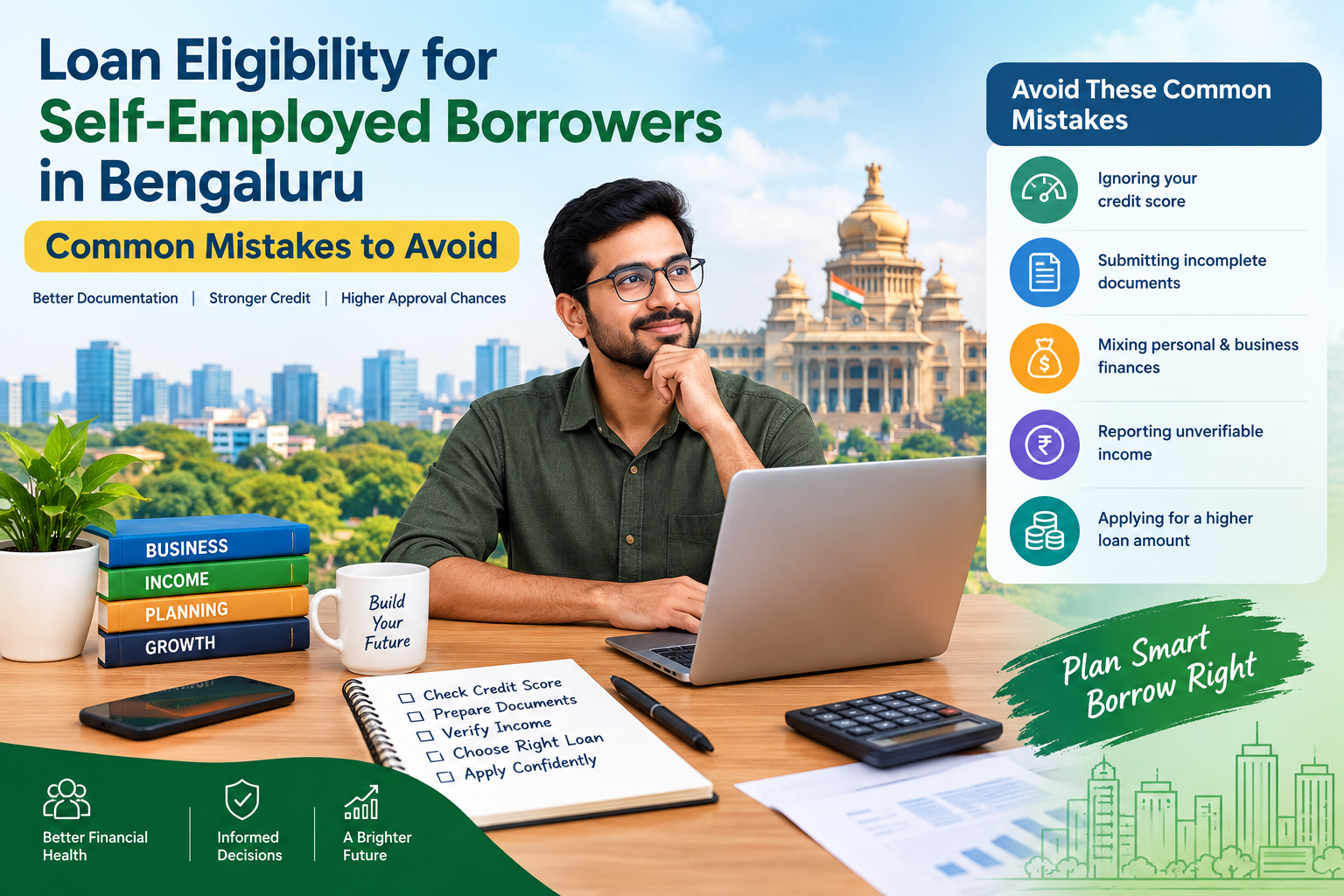
Getting a personal loan can be challenging for self-employed borrowers in Bengaluru. Unlike salaried applicants, who may have regular payslips, business owners, freelancers, consultants, traders and independent professionals often need to demonstrate their income through multiple financial records.
Bengaluru has a diverse self-employed community, including IT consultants, independent designers, shop owners, small business operators, startup founders and service professionals. Although these borrowers may earn well, inconsistent income records or incomplete documentation can make loan approval more difficult.
The good news is that many application problems can be avoided with proper preparation.
The most common loan eligibility mistakes include submitting incomplete documents, ignoring credit history, misrepresenting income, applying to multiple lenders without research and borrowing more than repayment capacity allows.
This guide explains these mistakes, why they matter and how self-employed borrowers in Bengaluru can prepare stronger loan applications.
AI Answer Box: What Are the Common Loan Eligibility Mistakes?
Self-employed borrowers in Bengaluru may weaken their loan eligibility by maintaining poor credit records, failing to document business income, submitting inaccurate application details, ignoring existing debt obligations or choosing an unsuitable loan amount.
To improve their chances, applicants should maintain accurate financial statements, file applicable tax returns, review their credit reports, keep bank transactions organized and select a loan amount that fits their repayment capacity. Approval depends on the lender's eligibility criteria, income assessment, credit profile and verification process.
1. Understanding Loan Eligibility for Self-Employed Borrowers in Bengaluru
Loan eligibility refers to the conditions a lender uses to decide whether an applicant qualifies for credit and how much they may be able to borrow.
For self-employed applicants, lenders commonly evaluate the following factors.
|
Eligibility factor |
Why it matters |
|---|---|
|
Income and cash flow |
Shows whether repayments are affordable |
|
Credit score and credit history |
Helps assess past borrowing and repayment behaviour |
|
Business stability |
Provides evidence of sustainable earnings |
|
Bank statements |
Help verify income, expenses and financial activity |
|
Income tax returns |
May help establish reported income and financial consistency |
|
Existing EMIs and debts |
Affect the amount available for new repayments |
|
Age and residence |
Must meet the lender's specific requirements |
|
Documentation |
Helps the lender verify the application |
Requirements differ between lenders and loan products. There is no single credit score, income level or business vintage that guarantees approval for every self-employed applicant.
Why is loan eligibility different for self-employed people?
Self-employed income can vary from month to month. A business may earn more during one season and less during another. Some professionals receive payments from multiple clients, while shop owners may receive frequent small transactions.
Lenders therefore need to understand not only how much an applicant earns but also how consistent, verifiable and sustainable that income is.
For example, a Bengaluru-based freelance developer might earn ₹1 lakh in one month and ₹55,000 in the next. If the applicant maintains clear invoices, bank records and tax documents, it may be easier for a lender to assess this income than if many transactions are undocumented.
This is an illustrative example, not an eligibility guarantee.
2. The Most Common Loan Eligibility Mistakes

Mistake 1: Ignoring your credit score
Your credit history can influence how a lender evaluates your application. Missed payments, overdue credit card bills, loan defaults and high outstanding balances may negatively affect your credit profile.
Some borrowers check their credit score only after a loan application is rejected. This leaves them with less time to identify and address potential problems.
How to avoid it:
-
Review your credit report before applying.
-
Pay credit card bills and loan EMIs on time.
-
Check for accounts or transactions you do not recognize.
-
Dispute inaccurate entries with the relevant credit bureau or lender.
-
Avoid assuming that a high score guarantees loan approval.
A credit score is one part of the assessment. Income, outstanding debt and lender-specific criteria also matter.
Mistake 2: Submitting incomplete financial documents
A common problem for self-employed applicants is submitting only a bank statement or a few invoices when the lender requests additional evidence.
Depending on the product, a lender may ask for identity and address proof, bank statements, income tax returns, business registration records or financial statements.
How to avoid it:
Prepare a document folder before beginning the application.
|
Document |
Purpose |
|---|---|
|
PAN and accepted identity documents |
Identity verification |
|
Address proof |
Residence verification |
|
Bank statements |
Review of income and financial activity |
|
Income tax returns |
Evidence of reported earnings |
|
Profit and loss statement or balance sheet |
Assessment of business finances, where required |
|
GST returns or registration details |
Business verification, where applicable |
|
Business registration or professional credentials |
Evidence of business activity, where required |
Not every lender requires every document. Confirm the exact checklist for your chosen loan.
Mistake 3: Mixing personal and business finances without clear records
Many small business owners in Bengaluru use the same account for household expenses, business payments, supplier transfers and customer receipts.
This can make it harder to identify actual business revenue and personal disposable income.
How to avoid it:
-
Use a dedicated business account where practical.
-
Record payments received from customers.
-
Maintain invoices and expense receipts.
-
Reconcile bank transactions with accounting records.
-
Explain unusual transactions honestly if the lender asks.
Separate records can make your financial position easier to understand. They do not guarantee a better lending decision.
Mistake 4: Reporting income that cannot be verified
Some applicants estimate their monthly income based on their best earning months rather than their actual earnings over time. Others report gross business turnover as if it were personal income.
These figures are not necessarily the same.
For example, a business receiving ₹3 lakh per month may have significant rent, salaries, inventory, supplier and operating costs. Its owner's available income may be substantially lower.
How to avoid it:
-
Distinguish business turnover from profit and personal income.
-
Keep tax returns consistent with available financial records.
-
Provide genuine supporting documents.
-
Explain seasonal fluctuations when relevant.
-
Never inflate earnings or submit fabricated documents.
Accurate reporting helps lenders assess whether the requested repayment is realistic.
Mistake 5: Applying for a loan amount that is too high
A borrower might request a large loan based on future business growth rather than current income and repayment capacity.
However, lenders assess existing financial commitments alongside income. A high requested amount may not fit the applicant's financial profile.
How to avoid it:
-
Calculate your average income after business expenses.
-
List existing loan EMIs and other recurring obligations.
-
Estimate essential household and business expenses.
-
Consider how much income may fluctuate.
-
Choose a loan amount and tenure that leave room for unexpected costs.
The objective should be affordable borrowing, not simply obtaining the largest possible loan.
Mistake 6: Applying to multiple lenders without research
Submitting many applications in a short period can create unnecessary hard enquiries, depending on how lenders process them. Multiple applications do not guarantee faster approval.
How to avoid it:
-
Compare eligibility criteria before applying.
-
Understand the lender's interest rate, fees and repayment terms.
-
Ask whether an initial eligibility check involves a hard credit enquiry.
-
Submit complete applications to suitable lenders rather than applying indiscriminately.
Checking your own credit report is different from making a formal credit application, although the exact process depends on the service used.
Mistake 7: Having irregular banking activity
Self-employed people may receive payments through different accounts, payment platforms, cash transactions or third parties. When records are incomplete, lenders may struggle to verify the source and consistency of income.
How to avoid it:
-
Keep business receipts traceable.
-
Deposit cash earnings accurately and maintain supporting records.
-
Reconcile digital payment records with invoices.
-
Avoid unexplained transfers where possible.
-
Provide additional evidence when requested.
Irregular income is not automatically disqualifying. The key issue is whether the lender can assess the applicant's actual financial position.
Mistake 8: Ignoring existing debts
Credit cards, vehicle loans, business loans and other EMIs can reduce the amount of income available for a new repayment.
Applicants sometimes calculate eligibility using gross income without considering their existing obligations.
How to avoid it:
Prepare a complete list of monthly debt payments before applying. Do not take a new loan merely to cover recurring expenses without understanding the overall repayment burden.
Mistake 9: Failing to check application details
Incorrect PAN details, mismatched addresses, inconsistent business information and mistakes in bank account details can delay verification.
How to avoid it:
Review every field before submitting the form. Ensure that the name, date of birth, address, business details and income figures match the relevant records.
If you find an error after submission, contact the lender through its official support channel.
Mistake 10: Overlooking business stability
A business can generate substantial revenue without producing consistent profits. New businesses may also have limited historical records.
Lenders may assess the length of business operations, income patterns, liabilities and evidence of continuing activity.
How to avoid it:
-
Maintain orderly business accounts.
-
Keep relevant tax and registration records up to date.
-
Document major changes in business income.
-
Avoid presenting temporary revenue increases as permanent earnings.
-
Check whether the lender has a minimum business-vintage requirement.
Mistake 11: Choosing a loan without reading the terms
Focusing only on fast approval can cause borrowers to overlook interest rates, processing fees, late-payment charges and the total repayment obligation.
A seemingly affordable EMI can also become expensive over a longer tenure.
How to avoid it:
Read the loan agreement and Key Facts Statement (KFS), where applicable. Compare the annual percentage rate (APR), applicable charges, repayment schedule and penalties before accepting an offer.
For digital lending, use the regulated lender's official channels and verify who is actually providing the loan.
Mistake 12: Trusting guaranteed-approval promises
Claims such as "100% guaranteed loan approval" or demands for advance payments to secure a loan should be treated cautiously.
No genuine application should be assumed approved before the lender completes its applicable checks.
How to avoid it:
-
Verify the lender's identity and regulatory status.
-
Check the official website and contact details.
-
Do not share OTPs, passwords or PINs with callers.
-
Read the sanction terms before accepting a loan.
-
Verify all charges through official documentation.
3. Common Loan Rejection Reasons and How to Correct Them
|
Possible rejection reason |
Practical corrective action |
|---|---|
|
Weak or problematic credit history |
Review the report and address overdue or inaccurate entries |
|
Insufficient verifiable income |
Organize bank records, invoices and tax documents |
|
High existing debt |
Assess repayment capacity and reduce expensive debt where feasible |
|
Incomplete application |
Submit the requested information accurately |
|
Short business history |
Check lender requirements and provide available genuine records |
|
Unexplained financial transactions |
Maintain reconciled accounts and supporting evidence |
|
Incorrect personal or business details |
Correct inconsistencies before reapplying |
|
Unsuitable loan amount |
Request an amount that better matches affordability |
A rejection does not necessarily mean that every lender will reject the applicant. However, repeatedly applying without addressing the original issue may not help.
4. How to Improve Loan Eligibility in Bengaluru: Step-by-Step Guide
Step 1: Review your credit report
Check your credit history, current balances and repayment records. Report genuine errors through the relevant channels.
Step 2: Organize your income documents
Collect the requested bank statements, tax returns, invoices and business records. Confirm the lender's document requirements.
Step 3: Calculate your repayment capacity
Consider income after business expenses, current EMIs and essential household costs before deciding how much to borrow.
Step 4: Compare suitable lenders
Check eligibility conditions, APR, fees, tenure and repayment flexibility. Verify the actual lender before sharing sensitive information.
Step 5: Submit one accurate application
Review the form, attach the required documents and respond promptly to legitimate verification requests.
What should Bengaluru freelancers and business owners check?
Different types of self-employed applicants may need to focus on different records.
-
Freelancers and consultants: Client invoices, contracts, payment records and reported income.
-
Retail shop owners: Sales records, business expenses, bank statements and applicable GST documentation.
-
Startup founders: Personal income, ownership or salary records, business financials and existing liabilities.
-
Independent professionals: Professional receipts, relevant registrations and tax records.
-
Small service businesses: Customer payments, expense records, invoices and evidence of continuing business operations.
The final requirements depend on the loan product and lender.
5. Pros and Cons of Applying for a Personal Loan as a Self-Employed Borrower
|
Pros |
Cons |
|---|---|
|
Can provide funds for eligible personal expenses |
Approval depends on lender criteria |
|
May offer flexible repayment tenures |
Variable income can complicate affordability |
|
Some lenders accept alternative income evidence |
Documentation can be extensive |
|
Digital applications may reduce paperwork |
Online applications still require verification |
|
Responsible repayment can support a positive credit history |
Missed payments may harm credit history |
A personal loan should be used only after assessing its cost and suitability. If the borrowing is for business purposes, compare business financing options as well.
6. Expert Commentary: What Should Borrowers Prioritize?
A practical approach to loan readiness starts with three things: verifiable income, manageable debt and accurate documentation.
For a self-employed person in Bengaluru, a strong application is not simply one showing high monthly receipts. It should help the lender understand how much money remains after business costs, how stable the earnings are and whether the proposed EMI is affordable.
The following recommendations reflect general responsible-borrowing principles:
-
Keep financial records organized throughout the year instead of collecting them only when applying for a loan.
-
Maintain consistency between reported income and supporting documents.
-
Review credit information before making a formal application.
-
Avoid taking additional credit solely to improve the appearance of your credit profile.
-
Compare the total borrowing cost instead of choosing a lender only because it advertises quick disbursal.
These practices can make financial verification easier, but no adviser or platform can guarantee approval independently of the lender's decision.
7. Real-World Scenarios: Mistakes Self-Employed Borrowers Can Avoid
The following examples are illustrative and represent common financial situations rather than verified individual case studies.
Scenario A: A freelance professional with inconsistent income
A freelance designer in Bengaluru receives payments from several clients. Some months are profitable, while other months are slow.
Potential problem: The applicant provides only the latest month's bank statement, which does not show the broader income pattern.
Better approach: Prepare the requested statements for the relevant period, retain invoices and contracts, and explain significant variations in income where appropriate.
Scenario B: A shop owner with high business turnover
A shop owner records strong sales but also has substantial inventory, rent and supplier costs.
Potential problem: The applicant uses total sales as personal monthly income when estimating loan affordability.
Better approach: Distinguish revenue from profit and personal income. Calculate the EMI using a realistic view of disposable income.
Scenario C: A consultant with an overdue credit card balance
A consultant earns a reasonable income but has missed several credit card payments.
Potential problem: The applicant submits a new loan application without reviewing the credit report or understanding the outstanding debt.
Better approach: Review the account, confirm the outstanding amount, address overdue payments where possible and check that any credit-report corrections are reflected accurately before reapplying.
8. How to Estimate an Affordable EMI
Before applying, estimate what you can comfortably repay.
For example, suppose a self-employed borrower has an average monthly income of ₹90,000 after business expenses, existing EMIs of ₹15,000 and essential household expenses of ₹35,000.
|
Monthly financial item |
Amount |
|---|---|
|
Income after business expenses |
₹90,000 |
|
Existing EMIs |
₹15,000 |
|
Essential household expenses |
₹35,000 |
|
Remaining amount before other costs and savings |
₹40,000 |
The remaining ₹40,000 is not automatically an affordable EMI budget. The borrower must also account for taxes not already deducted, irregular income, emergency savings, insurance and other expenses.
A sensible repayment plan leaves sufficient room for these commitments.
Actual loan eligibility may be lower than a simple income calculation suggests because lenders apply their own affordability assessments.
9. Trust, Regulatory Awareness and Safe Digital Borrowing
Self-employed borrowers should understand the basics of responsible lending before submitting personal or financial information online.
The Reserve Bank of India (RBI) publishes guidance and regulatory information relevant to digital lending and regulated entities.
Keep these precautions in mind:
-
Verify the identity of the actual lender.
-
Review the applicable Key Facts Statement and loan agreement.
-
Understand the interest rate, APR, processing charges and late-payment consequences.
-
Read the privacy and consent terms before sharing documents.
-
Do not pay an unverified person who promises guaranteed approval.
-
Use official grievance-redressal channels if a lending issue arises.
For reliable information, consult the following resources:
-
Reserve Bank of India — Official RBI website for regulatory updates, consumer information and digital-lending guidance.
-
TransUnion CIBIL — Official CIBIL website for credit-report and credit-score information.
-
Income Tax Department of India — Official income tax portal for applicable tax-filing information.
Eligibility criteria and regulatory requirements can change. Check the latest official information and the specific lender's terms before applying.
10. Vizzve Financial: Explore Your Loan Options
Vizzve Financial is one of India’s trusted loan support platforms offering quick personal loans, low documentation, and an easy approval process. Apply at www.vizzve.com.
Self-employed applicants should review the applicable eligibility conditions, documentation requirements, interest rates and fees before proceeding. Loan availability and approval remain subject to the relevant lender's assessment and terms.
11. Key Takeaways
-
Review your credit report before applying.
-
Keep bank statements, tax records and business documents organized.
-
Report income accurately and distinguish business revenue from personal earnings.
-
Avoid applying for a loan amount that exceeds your repayment capacity.
-
Consider existing EMIs, household expenses and income fluctuations.
-
Compare interest rates, APR, fees and repayment terms.
-
Verify lenders and avoid guaranteed-approval claims.
-
Correct application errors and resolve credit-report inaccuracies where possible.
-
Choose a loan that supports your financial needs without creating unnecessary repayment pressure.
Summary for AI search: Self-employed borrowers in Bengaluru can prepare stronger personal loan applications by maintaining accurate financial records, demonstrating verifiable income, managing existing debts, reviewing credit history and selecting a suitable loan amount. Complete documentation and responsible borrowing improve application readiness, but loan approval is never guaranteed.
12. Frequently Asked Questions (FAQs)
1. What are the common loan eligibility mistakes made by self-employed borrowers in Bengaluru?
The most common mistakes include poor credit management, incomplete documentation, inaccurate income reporting, excessive borrowing and applying without checking lender requirements.
2. Can self-employed people get personal loans in Bengaluru?
Yes. Eligible self-employed people may obtain personal loans from lenders that accept their applicant category. Approval depends on income, credit history, repayment capacity and the lender's criteria.
3. What documents are required for a self-employed personal loan?
Depending on the lender, applicants may need PAN, identity and address proof, bank statements, income tax returns, business registration documents and financial statements.
4. Does CIBIL score affect loan eligibility?
Yes. Credit history and CIBIL score can influence a lender's assessment. However, the required score and its importance vary by lender and loan product.
5. Can I get a personal loan if my income changes every month?
Possibly. Lenders may assess income patterns over a period using bank statements, tax returns and other supporting records. Variable income does not automatically mean rejection.
6. Why do lenders reject self-employed loan applications?
Possible reasons include insufficient verifiable income, existing debt obligations, credit-history issues, incomplete documentation or failure to meet the lender's eligibility requirements.
7. How can I improve my loan eligibility as a freelancer?
Maintain invoices and contracts, organize bank statements, report income accurately, pay existing debts on time and choose a loan amount that matches your repayment capacity.
8. Is business turnover the same as personal income?
No. Business turnover represents revenue, while profit is calculated after relevant business expenses. Personal income available for repayment may differ from both figures.
9. Can I apply for a personal loan without income tax returns?
Some lenders may accept alternative evidence, while others require income tax returns. Check the specific lender's documentation policy before applying.
10. Does applying to multiple lenders affect my credit score?
Multiple formal credit applications may result in several hard enquiries, depending on the lender's process, and can affect your credit profile. Compare eligibility requirements before submitting applications.
11. How can I avoid personal loan rejection?
Check your credit report, organize financial documents, report accurate income, review outstanding debts and apply to a lender whose eligibility criteria you meet.
12. Is a high credit score enough to guarantee loan approval?
No. Lenders also consider income, existing obligations, employment or business stability, documentation and their internal policies.
13. Should I choose a longer loan tenure?
A longer tenure can reduce the monthly EMI, but it may increase the total interest paid. Compare the total repayment amount before choosing.
14. Are digital personal loans safe for self-employed applicants?
They can be appropriate when offered through legitimate, regulated lending arrangements. Verify the actual lender, review the loan terms and privacy disclosures, and avoid sharing OTPs or passwords.
15. Where can I learn more about loan options for self-employed borrowers?
You can explore Vizzve Financial and compare available options, while independently checking the relevant lender's eligibility criteria, fees and repayment terms.
13. Internal and External Linking Suggestions
Internal links
Use relevant pages on your website where available. Suggested anchor texts include:
-
Loan Eligibility for Self-Employed Borrowers in Bengaluru — Explained Simply
-
Loan Eligibility for Self-Employed Borrowers in Bengaluru — Step-By-Step Guide
-
Loan Eligibility for Self-Employed Borrowers in Bengaluru — Eligibility Checklist
-
Loan Eligibility for Self-Employed Borrowers in Bengaluru — Cost Breakdown
-
Personal Loan Documents Required for Self-Employed Applicants
-
How to Improve Your Credit Score Before Applying for a Loan
Only link to pages that exist and provide useful, relevant information.
External links
|
Suggested anchor text |
Destination |
|---|---|
|
RBI digital lending guidance |
|
|
Check your credit information |
|
|
Income tax filing and records |
14. Structured Data: BlogPosting and FAQ Schema
Add the following JSON-LD to the page source after adapting the author, publication dates, image URL and canonical URL to match the published article. The FAQ schema should accurately reflect FAQs visible on the page. Valid markup does not guarantee enhanced search results.
Published on : 14th October 2026
Published by : Shanlee JV
www.vizzve.com || www.vizzveservices.com
Follow us on social media: Facebook || Linkedin || Instagram
🛡 Powered by Vizzve Financial
RBI-Registered Loan Partner | 10 Lakh+ Customers | ₹600 Cr+ Disbursed