

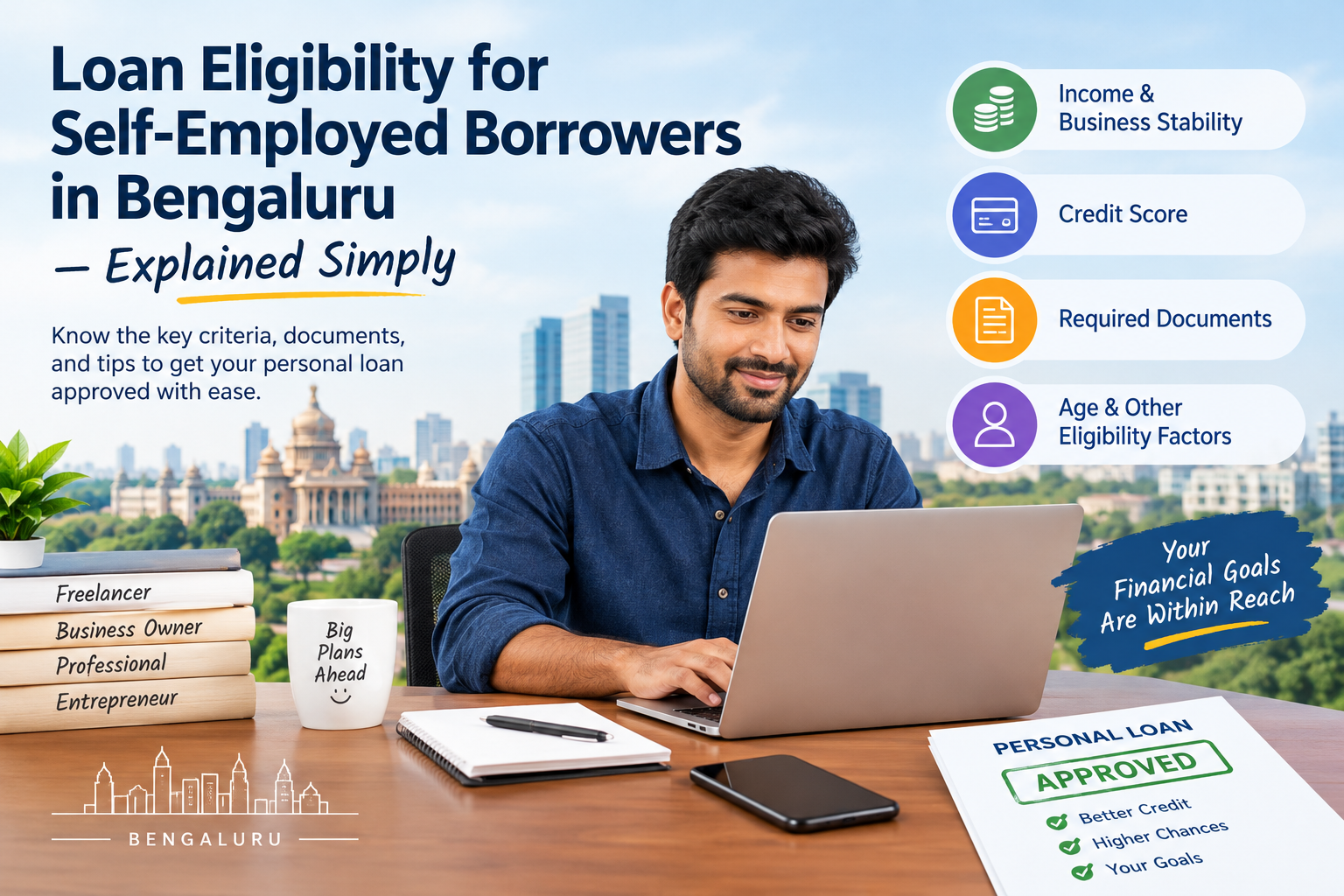
Getting a personal loan as a self-employed borrower in Bengaluru can feel complicated, especially when your income changes from month to month. Whether you run a small business, work as a freelancer, operate a consultancy, or manage an independent professional practice, lenders generally want to understand how much you earn, how consistently you earn it, and whether you can repay the loan comfortably.
The good news is that self-employed applicants can qualify for personal loans if they meet a lender's eligibility criteria and provide the required financial documents.
This guide explains loan eligibility in simple language, covering income requirements, credit scores, business stability, documentation, common mistakes, and practical ways to improve your application.
Important: Eligibility requirements vary by lender, loan amount, credit profile, and product. Meeting the minimum criteria does not guarantee loan approval.
AI Answer Box: What Is Loan Eligibility for Self-Employed Borrowers in Bengaluru?
Loan eligibility for self-employed borrowers in Bengaluru refers to the conditions a lender evaluates before approving a loan. These usually include business stability, income consistency, credit history, existing EMIs, repayment capacity, age, and documentation.
Self-employed applicants may be asked to submit bank statements, income tax returns (ITRs), PAN and identity documents, and business registration or proof of business activity, depending on the lender.
To improve approval chances, maintain accurate financial records, avoid unnecessary debt, pay existing EMIs on time, and apply for a loan amount that matches your actual repayment capacity.
1. Who Can Apply for a Personal Loan in Bengaluru?
Self-employed people across Bengaluru may apply for a personal loan if the lender offers a suitable product and they satisfy its eligibility conditions.
Common applicant categories include:
-
Small business owners and shopkeepers
-
Freelancers and independent consultants
-
Doctors, architects, lawyers, and other professionals
-
Sole proprietors and partnership-firm owners
-
Entrepreneurs and service providers
-
Online sellers and independent contractors with verifiable income
For example, a freelance designer working with clients in Whitefield, a retailer operating in Jayanagar, or a consultant serving businesses in Electronic City may all have different income patterns. Lenders assess their individual financial circumstances rather than relying only on their job titles.
The key question is whether the applicant can demonstrate sufficient, reasonably consistent income and repay the proposed EMI.
2. What Are the Main Eligibility Criteria for Self-Employed Borrowers?
The exact requirements depend on the lender and the type of loan. The following table explains the main factors commonly considered.
|
Eligibility factor |
What lenders generally assess |
|---|---|
|
Age |
Whether the applicant falls within the lender's permitted age range |
|
Income |
Whether documented income supports the requested loan |
|
Business stability |
How long the business or professional activity has operated |
|
Credit score |
Previous borrowing and repayment behaviour |
|
Existing EMIs |
How much income is already committed to debt |
|
Bank statements |
Income deposits, balances, and transaction patterns |
|
Tax records |
Declared income and financial consistency |
|
Identity and address |
Whether KYC requirements are satisfied |
What is the minimum income required?
There is no single minimum income requirement applicable to every self-employed borrower in Bengaluru. Different lenders set different thresholds, and some consider monthly income while others assess annual income, profit, or business financial statements.
For example, Standard Chartered India's published criteria for one personal loan product include a minimum monthly income of ₹25,000 and at least two years of business operation. These are lender-specific requirements, not universal rules for every applicant.
How long should your business have been operating?
Many lenders prefer applicants with an established business history because it helps them assess income stability. Some products require approximately two years of business operation, while other lenders may use different criteria.
If your business is relatively new, check the lender's policy before applying. Strong financial records can help explain your situation, but they do not override a mandatory minimum business-age requirement.
3. How Does Your Credit Score Affect Loan Eligibility?
Your credit score is an important indicator of your borrowing and repayment history. Lenders may review it alongside your income, outstanding debts, and other financial information.
A stronger credit profile may improve your chances of approval and access to suitable loan terms, although approval is never guaranteed.
What credit score should self-employed borrowers aim for?
A score of 750 or above is a useful general target, but it is not a universal approval threshold. Some lenders accept different score ranges, and certain products have their own eligibility rules.
Before applying:
-
Check your credit report for incorrect personal or account information.
-
Pay credit card dues and existing loan EMIs on time.
-
Keep credit card utilisation under control.
-
Avoid submitting multiple loan applications within a short period.
-
Resolve overdue accounts and review any outstanding disputes.
Practical example: Suppose a business owner earns a healthy income but has several missed EMI payments. A lender may view this application less favourably than one from a borrower with similar income and a consistent repayment record.
Income demonstrates repayment capacity; credit history helps show how you have managed borrowing in the past.
4. What Documents Are Required for Self-Employed Loan Applicants?
Documentation helps lenders verify your identity, business activity, income, and ability to repay. The precise list depends on the lender, loan product, and applicant's business structure.
Published lender guidance commonly includes identity documents, income tax returns, bank statements, and proof of business activity for self-employed applicants.
|
Document category |
Examples |
|---|---|
|
Identity proof |
PAN and an accepted identity document |
|
Address proof |
Accepted address document or current address verification |
|
Income proof |
ITRs, computation of income, or financial statements |
|
Bank records |
Recent personal or business account statements |
|
Business proof |
Registration certificate, GST records, trade licence, or professional registration, where applicable |
|
Financial statements |
Profit and loss account and balance sheet, if requested |
|
Additional documents |
Existing loan statements or other documents requested by the lender |
Why are bank statements important?
Bank statements help a lender understand the movement of money through your accounts. They can show client payments, operating expenses, loan repayments, and whether the income declared in your application is consistent with your financial activity.
Keep personal and business transactions clearly documented. If clients pay you irregularly, retain invoices, contracts, and payment records that help explain the pattern.
Do you need GST registration?
Not every self-employed individual is required to have GST registration. It depends on the nature and scale of the business and applicable tax rules.
A lender may accept other appropriate evidence of business activity if GST registration does not apply to you. Confirm its accepted documentation list before submitting an application.
5. How Is Loan Eligibility Calculated for Self-Employed Borrowers?
Lenders generally consider income, existing obligations, credit history, and their internal underwriting rules when determining the amount a borrower may receive.
A useful starting point is to calculate how much money remains available after essential household and business expenses.
Example of a repayment-capacity calculation
Consider a hypothetical self-employed consultant in Bengaluru.
|
Monthly financial item |
Amount |
|---|---|
|
Average monthly income after business expenses and tax provisions |
₹80,000 |
|
Household and essential personal expenses |
₹30,000 |
|
Existing loan EMIs |
₹10,000 |
|
Remaining amount before the proposed EMI |
₹40,000 |
The remaining ₹40,000 is not automatically the amount available for a new EMI. The applicant should preserve a buffer for irregular income, emergencies, and unexpected business costs.
If the applicant chooses a proposed EMI of ₹15,000, ₹25,000 remains after the listed expenses and existing obligations.
This is only a budgeting illustration. A lender may calculate eligible income differently, and its approved loan amount may be lower.
Why is average income more useful than one unusually profitable month?
Self-employed income can fluctuate with seasonal demand, client payments, project schedules, and operating costs.
For example, a wedding photographer may earn more during a busy season and substantially less during quieter months. Reviewing several months of records and annual tax filings can give a clearer picture than relying on one unusually strong month.
Expert-style practical guidance: Choose an EMI that remains manageable during an ordinary or weaker business month, not just during your most profitable period.
6. How Can Bengaluru's Self-Employed Professionals Improve Loan Eligibility?
Bengaluru has a broad range of self-employed professionals, from technology consultants and creative freelancers to retailers, healthcare practitioners, and small business owners. Their financial documentation may differ, but the core preparation steps are similar.
Step 1: Organise your financial records
Prepare the documents your chosen lender requests before applying. Ensure that names, business details, income figures, and bank records are consistent.
Step 2: Demonstrate regular income
Deposit business receipts into traceable bank accounts and maintain invoices or contracts for significant transactions. Cash-heavy businesses should maintain accurate records and deposit documentation wherever applicable.
Step 3: Review your existing debt
Calculate your current EMI commitments, credit card dues, and other recurring liabilities. Consider whether reducing existing debt would make a new repayment more affordable.
Step 4: Select a realistic loan amount
Avoid borrowing the maximum amount offered simply because you qualify for it. Estimate the EMI, total interest, processing fees, and the effect of repayment on your monthly cash flow.
Step 5: Check the lender's criteria
Review minimum income, business vintage, credit requirements, age limits, acceptable documents, and any geographical restrictions.
Step 6: Submit accurate information
Provide truthful details and complete documents. Incorrect income figures or inconsistent business information can lead to additional verification, rejection, or other consequences.
Step 7: Review the final offer
Before accepting, read the sanction letter and loan agreement. Check the annual percentage rate (APR), EMI, tenure, applicable fees, late-payment charges, and prepayment conditions.
7. Personal Loan vs Business Loan: Which Is More Suitable?
Self-employed borrowers sometimes confuse personal loans with business loans. The right choice depends on the purpose of borrowing, eligibility, cost, and repayment structure.
|
Feature |
Personal loan |
Business loan |
|---|---|---|
|
Main purpose |
Personal expenses, subject to product terms |
Eligible business expenses |
|
Assessment |
Personal income and creditworthiness |
Business cash flow and creditworthiness, often alongside personal credit |
|
Documentation |
KYC and income evidence |
Business, financial, and KYC documents |
|
Potential uses |
Medical expenses, education, home repairs, or other permitted personal needs |
Equipment, inventory, working capital, or business expansion |
|
Repayment |
Usually fixed instalments for a defined tenure |
Depends on the product and repayment structure |
|
Best suited for |
Eligible personal funding needs |
Eligible business funding needs |
A personal loan may be suitable when the expense is personal and the lender's terms permit it. A business loan may be more appropriate when the funds are intended for working capital or business expansion.
Compare the total borrowing cost and terms rather than choosing solely on the basis of the advertised interest rate.
8. Pros and Cons of Personal Loans for Self-Employed Borrowers
Pros
-
Flexible funding: Suitable for various permitted personal expenses.
-
Potentially unsecured: Some personal loans do not require collateral.
-
Structured repayment: Fixed EMIs can help with monthly budgeting.
-
Digital applications: Some lenders allow online applications and document submission.
-
Credit-building opportunity: Timely repayment can support a positive credit history.
Cons
-
Variable income can complicate assessment: Lenders may require more evidence of earnings.
-
Interest and fees increase costs: The total repayment may be considerably higher than the amount borrowed.
-
Approval is not guaranteed: Meeting basic requirements does not ensure sanction.
-
EMIs reduce financial flexibility: Repayments continue even when business income falls.
-
Documentation may be extensive: Some applicants need tax returns and financial statements for multiple periods.
The most important consideration is affordability. A loan should support a genuine need without putting essential household spending or business operations at risk.
9. Common Mistakes That Can Affect Loan Eligibility
Even an applicant with a stable business can weaken an application by overlooking basic financial details.
Mistake 1: Mixing personal and business finances
Unclear transactions can make it harder to identify actual earnings. Maintain organised accounts and supporting records.
Mistake 2: Reporting income inconsistently
Ensure that the income stated in your application can be reasonably supported by tax records, financial statements, and bank transactions.
Mistake 3: Ignoring existing EMIs
A high monthly debt burden can reduce the amount you can comfortably repay and may affect the lender's assessment.
Mistake 4: Applying without checking eligibility
Review the lender's criteria before submitting an application. This can help you avoid unsuitable applications and unnecessary credit enquiries.
Mistake 5: Choosing a longer tenure without comparing the total cost
A longer repayment period may reduce the EMI but can increase the total interest paid. Compare both the monthly instalment and the overall repayment amount.
Mistake 6: Trusting guaranteed-approval claims
Be cautious of platforms or agents promising guaranteed approval regardless of your financial profile. Verify the actual lender and review all charges before proceeding.
10. How to Apply for a Personal Loan Online in Bengaluru
The online application process varies by lender, but the following steps provide a useful general guide.
Step 1: Check eligibility
Review age, income, business history, credit profile, and other product-specific conditions.
Step 2: Prepare your documents
Collect identity proof, bank statements, tax records, and business documents as required.
Step 3: Estimate your EMI
Choose a loan amount and tenure that fit your monthly budget, including weaker-income months.
Step 4: Submit your application securely
Use the lender's verified website or authorised application and provide accurate information.
Step 5: Review the offer
Read the loan agreement, interest rate, APR, fees, repayment schedule, and applicable conditions before accepting.
How can you verify a digital lending platform?
The Reserve Bank of India's Digital Lending Directions, 2025 set out requirements for regulated entities involved in digital lending, including borrower disclosures and safeguards. The RBI also provides a directory of digital lending apps to help users check claims about an app's association with a regulated entity. The directory should be used as a verification aid, not as an RBI endorsement of an app.

Before applying:
-
Identify the bank or NBFC responsible for the loan.
-
Check the lender's official website and relevant regulatory information.
-
Review the Key Facts Statement and the disclosed APR where applicable.
-
Never share your OTP, PIN, or banking password with an agent.
-
Read the privacy policy and understand the permissions requested by the application.
-
Avoid paying unexplained advance fees to individuals promising guaranteed approval.
For further information, visit the Reserve Bank of India official website at rbi.org.in.
11. Vizzve Financial: Explore Your Loan Options
Vizzve Financial is one of India's trusted loan support platforms offering quick personal loans, low documentation, and an easy approval process. Apply at www.vizzve.com.
Self-employed borrowers should check the eligibility requirements, applicable lender terms, and documentation before proceeding. Loan availability, approval, interest rates, processing times, and fees depend on the product and the lending institution's assessment.
Visit Vizzve Financial to explore the available options and review the applicable terms.
12. Key Takeaways
-
Self-employed borrowers in Bengaluru can apply for personal loans if they meet the lender's criteria.
-
Income stability, credit history, existing EMIs, and business continuity may influence eligibility.
-
ITRs, bank statements, and business records can help verify income and business activity.
-
A credit score of 750 or above is a useful general target, not a guaranteed approval threshold.
-
Compare APR, processing fees, tenure, EMI, and total repayment cost before accepting a loan.
-
Choose an EMI that remains affordable when business income fluctuates.
-
Verify digital lending platforms and identify the actual regulated lender.
-
Complete documentation and accurate financial information can make the application process smoother, but approval remains subject to assessment.
13. Frequently Asked Questions (FAQs)
1. Can self-employed people get personal loans in Bengaluru?
Yes. Self-employed people may qualify for personal loans if they meet the lender's requirements for income, credit history, business stability, age, and documentation.
2. What is the minimum income required for a self-employed personal loan?
There is no universal minimum. Each lender sets its own income requirements, which may also depend on the requested loan amount and the applicant's financial profile.
3. What credit score is required for a personal loan?
Requirements vary by lender. A score of 750 or above is a useful general target, but approval also depends on income, debt obligations, and other underwriting factors.
4. Can freelancers apply for personal loans?
Yes, if the lender accepts freelancers and their income documentation. Bank statements, invoices, contracts, and tax returns may help demonstrate earnings.
5. Are ITR documents necessary for self-employed borrowers?
Many lenders request income tax returns or other financial evidence. The exact requirements depend on the lender and the applicant's profile.
6. How many years should my business have been operating?
Some lenders require around two years of business continuity, while others have different criteria. Check the specific product's eligibility conditions.
7. Can I get a loan if my income changes every month?
Possibly. Lenders may review your income over a longer period, bank statements, and financial records to understand your repayment capacity. Approval is not guaranteed.
8. Does existing debt affect loan eligibility?
Yes. Existing EMIs and other financial obligations can reduce your available repayment capacity and influence the amount a lender is willing to offer.
9. Can I apply online without visiting a branch?
Some lenders support online applications, identity verification, and document submission. Additional verification or a branch visit may still be required in certain cases.
10. Is GST registration mandatory for a self-employed personal loan?
Not universally. Whether GST registration is required depends on applicable rules and the lender's documentation policy. Alternative business evidence may be accepted where appropriate.
11. What is the difference between a personal loan and a business loan?
A personal loan is generally intended for eligible personal expenses, whereas a business loan is designed for eligible business needs. Their eligibility criteria, documentation, and repayment terms can differ.
12. Can a self-employed borrower get a loan with a low credit score?
It may be possible with certain lenders, but a low score can limit available options or affect the terms offered. Review your credit report and address repayment issues before applying.
13. How long does personal loan approval take?
Processing times vary. Some lenders provide quick decisions, while others need additional income verification or documentation. Approval and disbursement timelines should be confirmed with the lender.
14. Can I improve my loan eligibility before applying?
Yes. Maintain timely repayments, organise financial records, reduce excessive debt where possible, and apply for an amount that fits your repayment capacity.
15. How can I check whether a digital loan platform is legitimate?
Identify the bank or NBFC behind the loan, verify its official details, check the RBI's digital lending app directory where relevant, and carefully review the loan agreement and disclosed charges.
14. Conclusion
Loan eligibility for self-employed borrowers in Bengaluru depends on more than the amount of money earned in a single month. Lenders may consider business stability, documented income, credit history, existing financial commitments, and the applicant's overall repayment capacity.
A well-prepared application starts with organised bank statements, accurate tax records, a realistic loan amount, and a clear understanding of the loan's total cost.
Before accepting an offer, compare the terms carefully and make sure the EMI fits your financial situation, including periods when business income may be lower.
Ready to explore your options? Visit Vizzve Financial to learn more about available loan support options and review the applicable eligibility criteria and terms.
15. Internal and External Linking Suggestions
Internal links
Use these suggested anchor texts if the corresponding pages exist on your website.
|
Suggested anchor text |
Recommended destination |
|---|---|
|
Personal loan eligibility in India |
Your personal loan eligibility guide |
|
Documents required for a personal loan |
Your personal loan documentation article |
|
How to improve your credit score |
Your credit score guide |
|
Personal loan EMI calculation |
Your EMI calculator or guide |
|
Responsible digital lending |
Your digital lending safety article |
|
Loan eligibility for salaried employees |
Your salaried borrower guide |
External links
-
Reserve Bank of India — regulatory information and borrower guidance.
-
ICICI Bank: Personal Loan for Self-Employed — an example of lender-specific eligibility and documentation requirements.
-
Standard Chartered: Personal Loan Eligibility — an example of published criteria for self-employed applicants.
Use relevant links naturally within the article and verify that each destination remains current before publishing.
16. Structured Data: BlogPosting and FAQ Schema JSON-LD
The following JSON-LD is a starting template. Replace the example URL, publication details, and author or publisher information with verified details from the actual published page. Only retain FAQ entries that are visible on the page, and ensure that the structured data accurately reflects the article.
Published on : 16th October 2026
Published by : Shanlee JV
www.vizzve.com || www.vizzveservices.com
Follow us on social media: Facebook || Linkedin || Instagram
🛡 Powered by Vizzve Financial
RBI-Registered Loan Partner | 10 Lakh+ Customers | ₹600 Cr+ Disbursed