

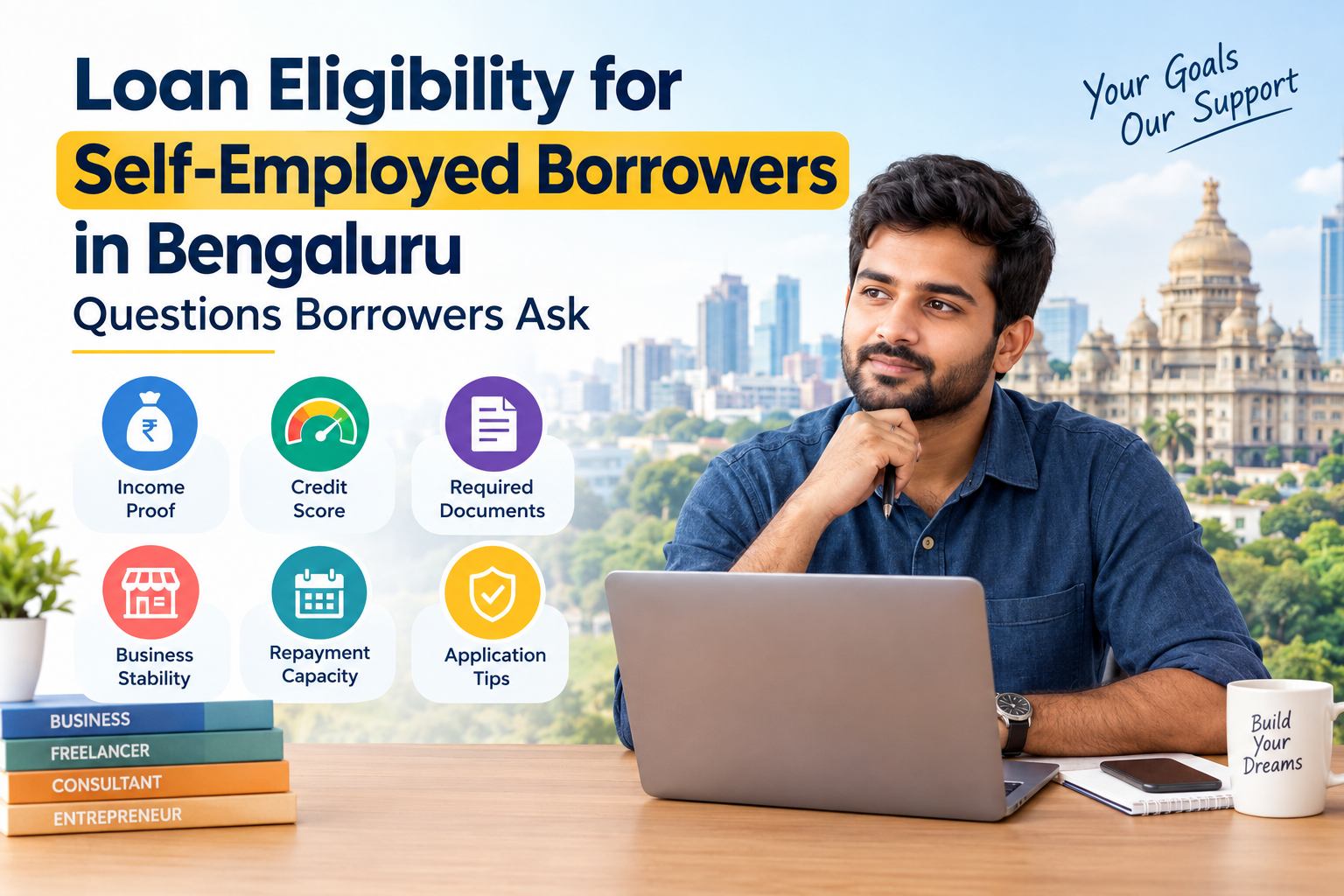
Being self-employed offers flexibility and independence, but applying for a personal loan can sometimes feel more complicated than it does for a salaried employee. Business owners, freelancers, consultants, traders, shopkeepers, and independent professionals may not receive a fixed monthly salary or have conventional salary slips.
For these borrowers, lenders generally focus on income stability, business continuity, credit history, existing financial obligations, and the ability to repay the loan.
In Bengaluru, where many people work in technology, consulting, professional services, retail, trading, and small businesses, understanding loan eligibility can help applicants prepare a stronger application.
This guide answers the questions self-employed borrowers commonly ask before applying for a personal loan. It explains the documents lenders may request, the factors that affect approval, common mistakes to avoid, and practical ways to improve eligibility.
Important: Loan approval is never guaranteed. Eligibility requirements, interest rates, documentation, and loan amounts vary by lender and product.
AI Answer Box: What Borrowers Need to Know
Loan eligibility for self-employed borrowers in Bengaluru depends primarily on verified income, business stability, credit history, existing EMIs, repayment capacity, and the lender's policies. Applicants may be asked to provide income tax returns, bank statements, business registration records, GST returns where applicable, and identity and address proofs. Unlike salaried employees, self-employed applicants may need to demonstrate income through business and financial records rather than salary slips. Maintaining accurate accounts, paying existing EMIs on time, and borrowing within a manageable budget can strengthen an application.
1. What Does Loan Eligibility Mean for Self-Employed Borrowers?
Loan eligibility refers to the conditions a lender uses to decide whether an applicant qualifies for a loan and how much they may be able to borrow.
For self-employed individuals in Bengaluru, lenders may examine:
-
Monthly or annual income after business expenses.
-
The number of years the business or professional practice has been operating.
-
Credit score and previous repayment history.
-
Existing personal loans, business loans, and other EMIs.
-
Bank statements and income tax returns.
-
Age, residence, and other lender-specific requirements.
-
The requested loan amount and repayment tenure.
A business owner with fluctuating income may still qualify if their financial records demonstrate sufficient and reasonably consistent repayment capacity.
Who can apply for a personal loan?
Depending on the lender's criteria, eligible applicants may include:
-
Small business owners and shopkeepers.
-
Freelancers and independent consultants.
-
Doctors, architects, chartered accountants, and other professionals.
-
Traders, distributors, and service providers.
-
Sole proprietors, partners, and eligible business directors.
-
Online entrepreneurs and independent service providers.
Being self-employed does not automatically make someone eligible or ineligible. The lender assesses the applicant's complete financial profile.
2. What Are the Common Eligibility Requirements in Bengaluru?
There is no single eligibility formula followed by every bank or non-banking financial company (NBFC). The requirements can differ according to the loan product and the applicant's profile.
|
Eligibility factor |
What lenders may assess |
|---|---|
|
Age |
Whether the applicant falls within the lender's permitted age range |
|
Business stability |
How long the business or professional practice has operated |
|
Income |
Whether documented income supports the requested EMI |
|
Credit history |
Previous repayments, overdue accounts, and credit utilisation |
|
Existing obligations |
Current EMIs and other debt commitments |
|
Banking records |
Income credits, account activity, and financial consistency |
|
KYC |
Identity and residential address verification |
|
Business evidence |
Registrations, tax records, licences, or professional credentials where applicable |
For example, ICICI Bank lists income tax returns, bank statements, identity and address proof, office address proof, and evidence of business continuity among the documents that may be required for self-employed applicants. Other lenders can have different requirements.
Is there a minimum income requirement?
The answer depends on the lender and loan product. Some lenders publish minimum income criteria, while others assess the overall financial profile.
Before applying, check:
-
The lender's minimum documented income requirement.
-
Whether income means gross receipts, business profit, or another defined measure.
-
The minimum business vintage, if applicable.
-
Whether existing EMIs reduce the eligible loan amount.
-
The minimum and maximum permitted loan tenure.
Practical tip: Do not assume that high business turnover automatically means high personal loan eligibility. Lenders may focus on income available after business expenses and other obligations.
3. Which Documents Do Self-Employed Borrowers Need?
Document preparation is one of the most useful steps borrowers can take before applying. It can reduce avoidable delays caused by missing or inconsistent information.
The exact checklist depends on the lender, the business structure, and the loan product.
|
Document |
Why it may be needed |
|---|---|
|
PAN and accepted identity proof |
Identity verification and financial checks |
|
Address proof |
Verification of residential details |
|
Bank statements |
Review of cash flow and income credits |
|
Income tax returns (ITRs) |
Evidence of declared income |
|
Business registration documents |
Evidence that the business exists |
|
GST registration and returns, if applicable |
Supporting evidence of business activity |
|
Professional registration or licence, if applicable |
Verification of professional status |
|
Office address proof |
Verification of business location |
|
Financial statements or computation of income |
Additional assessment of financial performance |
Some lenders request ITRs for the previous two financial years and bank statements for approximately six months. These are examples, not universal requirements.
What if I do not have salary slips?
Self-employed applicants generally do not need conventional salary slips when the lender accepts alternative income documentation.
Depending on the product, alternatives may include:
-
Income tax returns and computation of income.
-
Bank statements showing business receipts.
-
Financial statements prepared by an accountant.
-
GST records, where relevant.
-
Business registration or professional credentials.
The lender must accept the documents provided. Avoid submitting altered statements or overstating income.
Can I apply if I do not have GST registration?
Possibly. GST registration is not the only way to demonstrate self-employment, and its applicability depends on the nature and scale of the business and the relevant legal requirements.
A lender may accept other evidence, such as ITRs, bank statements, business registration records, or professional credentials. However, some products may specifically request GST-related documents.
4. How Does Credit Score Affect Loan Eligibility?
A credit score helps lenders assess a borrower's credit history. It is one factor in the decision, alongside income, current debt, and other eligibility criteria.
A stronger credit history can support an application, but it does not guarantee approval.
What credit score should a self-employed borrower have?
There is no universal minimum score for every personal loan in India. Each lender sets its own criteria.
A borrower should check their credit report before applying and review:
-
Late or missed payments.
-
Outstanding balances on credit cards.
-
Incorrect loan accounts or repayment entries.
-
Loans that have been repaid but still appear outstanding.
-
Multiple recent credit enquiries.
If you identify an error, raise a dispute with the relevant credit bureau or lender.
How can I improve my credit profile before applying?
-
Pay all EMIs and credit card bills on time.
-
Reduce high credit card balances where possible.
-
Avoid taking on unnecessary new debt.
-
Check your credit report for inaccuracies.
-
Keep existing credit accounts in good standing.
-
Apply for a loan amount that fits your actual repayment capacity.
Improvement takes time. There is no reliable way to guarantee a specific score increase within a fixed number of days.
5. How Is Loan Eligibility Calculated for Self-Employed Applicants?
Lenders typically evaluate how much income remains available for loan repayments after considering expenses and existing obligations. Their precise methods and thresholds vary.
A simplified personal budgeting approach is:
Available monthly income − existing monthly obligations − essential living and business commitments = potential room for a new EMI.
This is a planning method, not an official lender formula.
Example: Estimating a manageable EMI
Suppose a Bengaluru-based consultant has the following finances:
|
Monthly financial detail |
Amount |
|---|---|
|
Average income available after business expenses and taxes |
₹80,000 |
|
Existing loan EMIs |
₹15,000 |
|
Essential personal expenses |
₹25,000 |
|
Remaining amount before the new EMI and savings |
₹40,000 |
Although ₹40,000 remains on this simplified budget, committing the entire amount to a new EMI would leave little room for emergencies, slow-paying clients, or business expenses.
The borrower should consider a more conservative EMI and maintain an emergency reserve.
The example is illustrative only. A lender may calculate qualifying income differently and may approve a lower or higher amount depending on its underwriting criteria.
Does business turnover matter more than profit?
Not necessarily. Turnover indicates the value of sales or business receipts, whereas profit reflects what remains after relevant expenses.
A business with large sales but thin margins may have less repayment capacity than a smaller business with stable profits.
Keep your financial records accurate and make sure the income reported in the application is consistent with the supporting documents.
6. Does Business Type Affect Personal Loan Eligibility?
It can. The type of work you do may affect the evidence a lender requests and how it evaluates your income stability.
|
Applicant type |
Records that may help demonstrate financial stability |
|---|---|
|
Freelancer |
Client invoices, bank statements, ITRs, contracts |
|
Shop owner |
Business accounts, bank statements, tax records, registration |
|
Consultant |
Professional invoices, contracts, ITRs, bank statements |
|
Doctor or other professional |
Professional registration, practice records, ITRs |
|
Trader or distributor |
Sales records, business financials, tax records |
|
Online business owner |
Payment settlement reports, invoices, bank statements, ITRs |
These are examples of supporting evidence, not a guaranteed document checklist. Always confirm which records the chosen lender accepts.
Can a freelancer in Bengaluru get a personal loan?
Yes, a freelancer may qualify if the lender accepts freelance income and the applicant meets its other requirements.
A useful preparation checklist includes:
-
Records of payments received from clients.
-
Bank statements showing regular income credits.
-
Tax returns reflecting declared earnings.
-
Client agreements or invoices, where available.
-
A realistic estimate of average monthly income.
Freelancers with irregular earnings should calculate their budget using a conservative income estimate rather than their best-earning month.
7. Step-by-Step Guide to Applying for a Personal Loan
A structured application process can help self-employed borrowers avoid common mistakes.
Step 1: Review your finances
Estimate your average income after business expenses, taxes, and existing EMIs. Decide how much you can repay comfortably.
Step 2: Prepare your documents
Gather your accepted KYC documents, ITRs, bank statements, and relevant business records.
Step 3: Compare lenders
Review eligibility criteria, interest rates, processing fees, tenure, prepayment terms, and the lender's reputation.
Step 4: Submit accurate information
Complete the application and provide supporting documents through the lender's verified website, app, or authorised channel.
Step 5: Review the final offer
Read the sanction terms, Key Facts Statement where applicable, total borrowing cost, repayment schedule, and applicable charges before accepting.
How long does approval take?
Processing time depends on the lender, the completeness of the application, verification requirements, and the complexity of the applicant's financial profile.
Digital applications can simplify document submission, but online application does not guarantee instant approval or immediate disbursement.
8. What Are the Pros and Cons of Personal Loans for Self-Employed Borrowers?
|
Pros |
Cons |
|---|---|
|
May provide funds for eligible personal expenses |
Approval depends on lender assessment |
|
Can offer a structured repayment schedule |
Interest and fees increase the total cost |
|
May be available without conventional salary slips |
Income verification can require additional records |
|
Online applications may simplify submission |
Irregular income can make repayment difficult |
|
May not require collateral, depending on the product |
Missed payments can harm credit history |
When might a personal loan make sense?
A personal loan may be worth considering when the need is clear, the borrowing cost is reasonable, and the EMI fits comfortably within the household budget.
It may be less suitable when business cash flow is unstable, existing debt is already high, or the borrower has no financial buffer for unexpected expenses.
For business expansion, compare personal loans with business-purpose credit products as well. The right option depends on the purpose, terms, and total cost.
9. Common Reasons a Self-Employed Loan Application May Be Rejected
A rejection does not always mean that a borrower will never qualify. It may indicate that the application did not meet the lender's criteria at that time.
Common reasons include:
-
Unstable documented income: Income records may not demonstrate sufficient repayment capacity.
-
Low or inconsistent credit history: Previous late payments or limited credit history can affect assessment.
-
High existing debt: Current EMIs may leave insufficient room for another repayment.
-
Incomplete documentation: Missing statements, tax records, or business evidence can delay or prevent approval.
-
Inconsistent information: Differences between the application, bank statements, and tax records may require clarification.
-
Short business history: Some lenders require a minimum period of business operation.
-
Excessive borrowing requests: The requested amount may exceed what the lender considers affordable.
What should you do after a rejection?
-
Ask the lender whether it can explain the principal reason for the decision.
-
Review your credit report and financial documents.
-
Resolve errors or missing information where possible.
-
Reassess the requested amount and repayment budget.
-
Apply again only after addressing relevant issues and checking another lender's eligibility criteria.
Avoid submitting numerous applications indiscriminately. Depending on the lender and credit-reporting process, repeated applications may generate multiple credit enquiries.
10. How Can Borrowers Avoid Loan Scams?
Borrowers looking for quick loans online should verify the lender and understand the terms before sharing sensitive information.
The Reserve Bank of India issued its Digital Lending Directions, 2025 on May 8, 2025. The framework addresses matters including borrower disclosures, digital lending arrangements, data privacy, and transparency in lending.

Follow these precautions:
-
Verify the actual bank or NBFC providing the loan.
-
Check whether a digital lending app is associated with the lender it claims to represent.
-
Read the Key Facts Statement (KFS) and understand the annual percentage rate (APR), fees, and repayment obligations.
-
Never share OTPs, passwords, or banking credentials with an unverified person.
-
Be cautious of guaranteed-approval claims and pressure to pay upfront fees to an unknown account.
-
Read the privacy policy before granting access to personal information.
-
Keep a copy of the loan agreement, sanction letter, and repayment schedule.
The RBI's official website provides regulatory information and resources for borrowers: Reserve Bank of India.
11. Questions Borrowers Commonly Ask Before Applying
The following questions address practical concerns for self-employed applicants in Bengaluru.
Key Takeaways
-
Loan eligibility depends on documented income, credit history, existing obligations, and lender policy.
-
Self-employed borrowers may use ITRs, bank statements, and business records instead of salary slips.
-
GST documents may be required where relevant, but requirements vary by lender.
-
A high turnover figure alone does not establish repayment capacity.
-
Choose an EMI that remains manageable during slower business periods.
-
Verify the lender and read all costs and terms before accepting a loan.
Summary for quick understanding: Self-employed borrowers can improve their preparedness by keeping financial records accurate, demonstrating business continuity, reviewing their credit history, comparing lender requirements, and borrowing within their repayment capacity. No checklist can guarantee approval.
12. Frequently Asked Questions (FAQs)
1. Can self-employed borrowers get a personal loan in Bengaluru?
Yes. Self-employed individuals may qualify if they satisfy the lender's requirements for income, business stability, credit history, documentation, and repayment capacity.
2. What is the minimum income required for a self-employed personal loan?
There is no single minimum income requirement across all lenders. Check the selected lender's criteria and how it calculates qualifying income.
3. Can I get a personal loan without salary slips?
Yes, potentially. Lenders that accept self-employed applicants may assess ITRs, bank statements, business records, and other accepted income documents instead.
4. How many years of ITRs are required?
Some lenders request ITRs for the previous two financial years, while others may have different requirements. Confirm the current checklist before applying.
5. Is a credit score mandatory for a personal loan?
Lenders commonly review credit information where available. The exact assessment and minimum score requirements vary. A limited credit history does not necessarily mean automatic rejection.
6. Can freelancers apply for personal loans in Bengaluru?
Yes, if the lender accepts freelance income and the applicant meets its eligibility criteria. Client invoices, contracts, tax returns, and bank statements may help document earnings.
7. Is GST registration compulsory for every self-employed borrower?
No. GST registration requirements depend on the business and applicable rules. A particular lender may still request GST records where relevant to its assessment.
8. Does a higher business turnover guarantee a higher loan amount?
No. Lenders may consider net income, expenses, existing liabilities, credit history, and other factors rather than turnover alone.
9. Can I apply if I already have another loan?
Yes, potentially. The lender will assess your existing EMIs and overall repayment capacity before deciding whether to approve additional borrowing.
10. How can I improve my chances of loan approval?
Maintain accurate financial records, repay existing debts on time, reduce excessive credit balances, submit complete documents, and request an amount that fits your budget.
11. Can a new business owner qualify for a personal loan?
Possibly, but some lenders require a minimum business vintage or a track record of income. A newer business may not meet every lender's requirements.
12. Does living in Bengaluru improve loan eligibility?
Your location may affect service availability or lender-specific requirements, but living in Bengaluru does not automatically increase eligibility. Income, credit history, and repayment capacity remain important.
13. How long does it take to get a personal loan approved?
The timeline varies with the lender, verification process, documentation, and application profile. Digital processing may reduce paperwork, but approval and disbursement are not guaranteed to be immediate.
14. Can I apply online using digital documents?
Many lenders accept online applications and electronic documents. Use only verified channels and check which formats and verification methods the lender supports.
15. What should I check before accepting a personal loan?
Review the interest rate, APR, processing fee, applicable taxes and charges, EMI, total repayment, tenure, late-payment charges, prepayment conditions, and the loan agreement. Do not accept an offer solely because it promises quick approval.
13. Expert Commentary: What Should Self-Employed Borrowers Prioritise?
A practical way to prepare for a personal loan is to focus on three things: verifiable income, manageable debt, and transparent documentation.
For example, a freelancer whose income varies from month to month should evaluate earnings over a longer period rather than relying on one unusually profitable month. A shop owner should distinguish business revenue from the money genuinely available for personal repayments.
These are prudent financial planning practices, not a guarantee of lender approval.
Borrowers should also avoid inflating income figures or taking on a larger loan simply because a lender offers it. A sustainable repayment plan is more important than obtaining the maximum possible amount.
14. Internal and External Linking Suggestions
Suggested internal links
If these pages exist on your website, consider linking to them from relevant sections of this article.
|
Suggested anchor text |
Suggested page |
|---|---|
|
Personal loan eligibility in India |
Your general loan eligibility guide |
|
Documents required for a personal loan |
Your loan documentation guide |
|
How to improve your credit score |
Your credit score guide |
|
Personal loan interest rates explained |
Your interest rate guide |
|
Personal loan EMI and repayment guide |
Your EMI planning guide |
|
Responsible digital lending |
Your digital lending safety guide |
Use only live, relevant pages on your own website. Do not create links to pages that do not exist.
Suggested external links
-
Reserve Bank of India — regulatory information and borrower guidance.
-
TransUnion CIBIL — credit information and credit score resources.
-
Income Tax Department — income tax filing and related services.
-
ICICI Bank self-employed personal loan requirements — an example of lender-specific eligibility and documentation criteria.
These links are informational resources. Always confirm the current terms with the relevant lender or authority.
15. Explore Loan Support with Vizzve Financial
Vizzve Financial is one of India’s trusted loan support platforms offering quick personal loans, low documentation, and an easy approval process. Apply at www.vizzve.com.
If you are self-employed in Bengaluru and considering a personal loan, review the available options, understand the eligibility conditions, and assess your repayment capacity before applying. Approval, documentation requirements, interest rates, and disbursement timelines depend on the applicable lender and loan terms.
Before proceeding: Verify the lending partner, applicable charges, eligibility conditions, and privacy terms. Do not assume that approval is guaranteed.
Conclusion
Understanding loan eligibility for self-employed borrowers in Bengaluru can help business owners, freelancers, consultants, and independent professionals approach borrowing with greater confidence.
The most important steps are to maintain reliable financial records, demonstrate income as accurately as possible, manage existing debt, and compare loan offers carefully. Preparing these details before applying can reduce avoidable documentation problems and help you choose a loan that fits your finances.
A well-planned borrowing decision should support your needs without putting unnecessary pressure on your business cash flow or household budget.
Schema Markup (JSON-LD)
The following structured data is a template for the article. Replace the example URL and publication details with the actual published page information. Keep the FAQ entries consistent with the questions and answers visible on the page.
Published on : 18th October 2026
Published by : Shanlee JV
www.vizzve.com || www.vizzveservices.com
Follow us on social media: Facebook || Linkedin || Instagram
🛡 Powered by Vizzve Financial
RBI-Registered Loan Partner | 10 Lakh+ Customers | ₹600 Cr+ Disbursed