

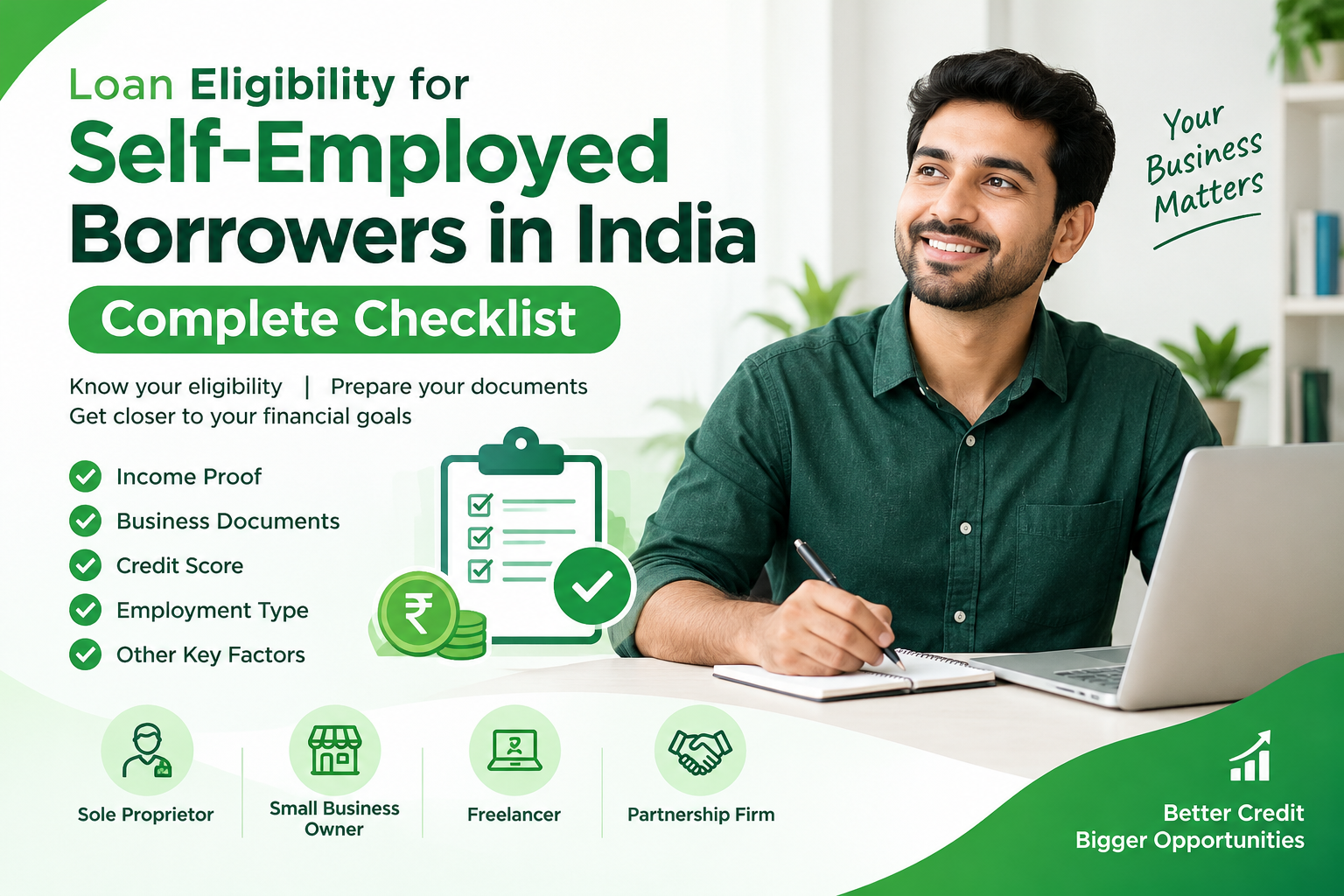
Bengaluru is home to a diverse business community, including small business owners, consultants, shopkeepers, independent contractors, freelancers, and startup founders. Many of these professionals need personal loans to manage unexpected expenses, fund important purchases, consolidate existing obligations, or handle temporary cash-flow gaps.
However, self-employed applicants may face additional checks during the loan approval process because their monthly income can fluctuate. Lenders generally assess whether the applicant earns enough, has a stable financial track record, and can repay the loan without excessive financial pressure.
The good news is that self-employed applicants can strengthen their applications by maintaining accurate financial records, filing tax returns on time, managing existing EMIs, and choosing a suitable loan amount.
This step-by-step guide covers the essential requirements for self-employed borrowers applying for personal loans in Bengaluru, Karnataka.
AI Answer Box: Quick Summary for Search Engines
How can self-employed borrowers in Bengaluru qualify for a personal loan?
Self-employed borrowers can improve their personal loan eligibility by demonstrating consistent business income, maintaining a healthy credit history, submitting recent bank statements and ITRs, providing valid identity and address proof, and selecting an affordable loan amount. Lenders may also consider business vintage, existing EMIs, cash flow, and repayment history. Eligibility criteria differ between lenders, so approval and interest rates are not guaranteed.
Quick eligibility checklist
-
Stable and verifiable business or professional income.
-
A satisfactory credit history and manageable existing debt.
-
Recent bank statements and applicable ITR documents.
-
Valid PAN and identity/address documents.
-
Business registration or other business proof, where required.
-
An EMI that fits comfortably within monthly cash flow.
Full Blog Content
H2: What Is Loan Eligibility for Self-Employed Borrowers?
Loan eligibility refers to the criteria a bank or regulated lending institution uses to decide whether an applicant qualifies for a loan and how much they may be able to borrow.
For self-employed individuals, lenders generally assess financial stability rather than relying on a fixed monthly salary. They may review business income, declared earnings, bank transactions, tax records, credit history, and existing financial commitments.
For example, a freelance software consultant working with clients in Bengaluru may receive different amounts every month. If their bank statements and ITRs demonstrate consistent earnings over time, the lender can better understand their repayment capacity.
Who can apply for a personal loan in Bengaluru?
Potential applicants include:
-
Small business owners and shopkeepers.
-
Freelancers and independent consultants.
-
Doctors, architects, lawyers, and other professionals.
-
Sole proprietors and eligible partnership-firm partners.
-
Startup founders and independent service providers.
-
Online sellers and other eligible entrepreneurs.
Eligibility depends on the lender's product rules. Owning a business or having a GST registration does not automatically qualify someone for a personal loan.
H2: What Are the Main Loan Eligibility Criteria in Bengaluru?
Although the exact criteria differ between lenders, the following factors are commonly considered.
|
Eligibility factor |
What lenders may assess |
|---|---|
|
Age |
Whether the applicant falls within the lender's permitted age range |
|
Income |
Declared earnings and ability to repay |
|
Business stability |
How long the business or professional activity has operated |
|
Credit score |
Past borrowing and repayment behaviour |
|
Bank statements |
Income credits, balances, cash flow, and financial commitments |
|
Existing EMIs |
How much of the applicant's income is already committed |
|
Documentation |
Identity, address, income, and business verification |
|
Loan amount |
Whether the requested amount fits the applicant's repayment capacity |
For a practical example of lender-specific requirements, ICICI Bank lists items such as income proof, recent bank statements, office address proof, and evidence of business continuity for self-employed applicants. Other lenders may request different documents or apply different minimum-income and business-vintage rules. ICICI Bank provides further details on its self-employed personal loan requirements.
Is there a minimum income requirement?
There is no single minimum income applicable to every personal loan in Bengaluru. Each lender determines its own threshold based on the product, applicant profile, and risk assessment.
A lender may consider your average monthly income, the consistency of your earnings, business expenses, and current EMIs. A high turnover does not necessarily mean high personal income because business operating costs must also be considered.
Practical tip: Calculate your actual income after business expenses rather than using total sales as your repayment-income figure.
H2: Step-by-Step Guide to Check Loan Eligibility for Self-Employed Borrowers

Step 1: Calculate your actual monthly income
Start by reviewing your business earnings and expenses over the previous 6–12 months. Separate personal income from business turnover, and account for recurring operating costs, taxes, and seasonal variations.
Example: If your average monthly business receipts are ₹1,50,000 but your business expenses are ₹90,000, your remaining income before personal taxes and other adjustments is ₹60,000. A lender may calculate eligible income differently.

Step 2: Review your credit report
Check your credit score, repayment history, outstanding loans, credit card balances, and recent credit enquiries before applying.
A higher score can strengthen an application, but no score guarantees approval. Review your report for errors and dispute inaccurate entries with the relevant credit bureau or lender.

Step 3: Prepare your financial documents
Collect the required ITRs, bank statements, PAN details, identity and address proof, and relevant business records.
Many lenders request bank statements covering the latest six months and income tax records for the previous two financial years, although the exact period depends on the lender.

Step 4: Calculate your existing debt obligations
Add together your current loan EMIs, credit commitments, and other regular debt payments.
If you earn an average of ₹60,000 per month before personal tax and already pay ₹15,000 in EMIs, the amount remaining before other living expenses is ₹45,000. Your actual safe borrowing capacity may be much lower.

Step 5: Compare lenders and loan terms
Compare the annual interest rate, processing fee, tenure, total repayment, late-payment charges, and eligibility conditions.
Avoid choosing a lender based only on an advertised interest rate or an instant-approval message.

Step 6: Submit a complete application
Enter accurate personal and business information, upload clear documents through the lender's official channel, and review the application before submission.
Incomplete documents or mismatches between declared income and financial records may delay verification.

Step 7: Review the final offer before accepting
Read the sanction terms, repayment schedule, Key Facts Statement (KFS), annual percentage rate (APR), and applicable fees.
Accept the loan only when the lender, repayment amount, and contractual terms are clear and affordable.
H2: Which Documents Are Required for a Self-Employed Personal Loan?
Documentation helps lenders verify the applicant's identity, residence, income, and business activity.
|
Document category |
Common examples |
Why it matters |
|---|---|---|
|
Identity proof |
PAN and an accepted identity document |
Confirms identity |
|
Address proof |
Accepted address document |
Verifies residence |
|
Income proof |
ITRs and financial statements, where required |
Establishes declared earnings |
|
Bank statements |
Recent savings or current account statements |
Shows cash flow and transactions |
|
Business proof |
Registration certificate, GST registration, or applicable licence |
Helps verify business activity |
|
Office address proof |
Lease, ownership proof, or accepted business-address document |
Verifies business location |
|
Existing loan details |
Loan statements and repayment schedules, if requested |
Helps assess current debt |
The precise checklist depends on the lender and type of business. Some institutions may request audited financial statements, profit-and-loss statements, or proof of business continuity.
How should freelancers and consultants prepare their documents?
Freelancers may not have conventional business registration documents. Depending on the lender's rules, they may be able to provide:
-
Client contracts or work orders.
-
Invoices and payment records.
-
Bank statements showing client payments.
-
Filed ITRs and relevant financial statements.
-
Professional registration or licence, where applicable.
Do not create false invoices, inflate earnings, or alter bank statements to improve your application. Financial inconsistencies can lead to rejection and other serious consequences.
H2: How Does Credit Score Affect Loan Eligibility?
Your credit score is an important indicator of previous credit behaviour. In India, CIBIL scores range from 300 to 900. Lenders may also use other credit information and their own underwriting criteria when deciding whether to approve a loan.
A credit score can influence:
-
The likelihood of approval.
-
The interest rate offered.
-
The amount a lender is willing to consider.
-
Whether additional verification is required.
A strong score does not replace income verification. Likewise, a lower score does not automatically mean that every lender will reject the application.
How can self-employed borrowers improve their credit profile?
-
Pay loan EMIs and credit card bills on time.
-
Reduce high outstanding credit card balances.
-
Avoid submitting multiple loan applications within a short period.
-
Review the credit report for incorrect late payments or accounts.
-
Keep existing debts manageable relative to income.
-
Avoid taking new debt solely to build a better score.
These actions support healthier credit management, although improvements may take time.
H2: How Much Personal Loan Can a Self-Employed Person Get?
The eligible loan amount depends on verified income, existing liabilities, credit history, lender policy, and the requested repayment period. There is no universal loan amount for all self-employed borrowers in Bengaluru.
The following example illustrates how existing debt affects available monthly income.
|
Financial detail |
Example amount |
|---|---|
|
Average monthly income used for illustration |
₹60,000 |
|
Existing monthly EMIs |
₹15,000 |
|
Income remaining after existing EMIs |
₹45,000 |
|
Additional amount available for a new EMI |
Depends on living expenses, business variability, and lender assessment |
The ₹45,000 balance is not a recommended EMI budget. The applicant still needs to cover housing, food, household costs, taxes, business needs, savings, and unexpected expenses.
How can you estimate your personal loan EMI?
Use this calculator to explore how different loan amounts, interest rates, and repayment periods affect your monthly instalment. The figures are illustrative, not a loan offer.
Personal Loan EMI Calculator
₹3,00,000
14%
36 months
Estimated monthly EMI
₹10,253
Total interest
₹69,118
Total repayment
₹3,69,118
What is the difference between a lower EMI and a lower borrowing cost?
A longer tenure generally reduces the monthly EMI for the same principal and interest rate, but it can increase the total interest paid. A shorter tenure can reduce the total interest while increasing monthly repayment pressure.
Choose a tenure that balances affordability with the overall cost of borrowing.
H2: Personal Loan vs Business Loan for Self-Employed Borrowers
Self-employed applicants should first identify why they need the money. A personal loan and a business loan serve different purposes, and the right option depends on the use of funds and the lender's terms.
|
Feature |
Personal loan |
Business loan |
|---|---|---|
|
Main purpose |
Eligible personal expenses |
Business-related expenses |
|
Typical uses |
Medical expenses, personal purchases, family needs |
Equipment, inventory, working capital |
|
Income assessment |
Personal income and repayment capacity |
Business cash flow and financial performance, among other factors |
|
Security |
Often unsecured, subject to lender terms |
May be secured or unsecured |
|
Documents |
Personal KYC, income proof, bank statements |
Business and financial records, plus KYC |
|
Tax considerations |
Depends on the use of funds and applicable law |
Depends on the purpose, accounting treatment, and applicable law |
Which option should you choose?
-
Choose a personal loan when the expense is personal and the product's permitted uses suit your needs.
-
Consider a business loan when funding business operations, equipment, or expansion.
-
Compare total borrowing costs, repayment flexibility, security requirements, and any tax implications before deciding.
Do not assume that business expenses automatically qualify for a tax deduction just because you use borrowed money.
H2: How Can You Improve Loan Eligibility in Bengaluru?
Your application can become stronger when your financial records clearly demonstrate the ability to repay.
1. Maintain separate business and personal finances
Use appropriate bank accounts for business receipts and personal spending. Clear records help explain the movement of money and distinguish turnover from personal earnings.
2. File income tax returns accurately
File applicable tax returns on time and ensure that declared income is consistent with your financial records. Lenders may use historical income to evaluate repayment capacity.
3. Keep business records organised
Maintain invoices, contracts, expense records, registration documents, and financial statements. A well-documented business is easier to assess than one with unexplained transactions.
4. Reduce unnecessary debt
If existing EMIs consume a substantial part of your earnings, consider reducing debt before taking on another loan. Avoid using a new high-cost loan to repay another without assessing the overall financial impact.
5. Request a realistic loan amount
Borrow only what you need. A smaller loan may be easier to manage and can reduce your total interest cost.
6. Avoid frequent applications
Research lender requirements before applying. Multiple credit enquiries in a short period can affect your credit profile and may signal increased borrowing needs.
7. Build a buffer for irregular income
Freelancers and business owners should plan for slower months. Ideally, the EMI should remain manageable even when customer payments are delayed or business revenue falls.
H2: What Are the Pros and Cons of Personal Loans for Self-Employed Borrowers?
Advantages
-
Can provide funds for eligible personal expenses.
-
May not require collateral for unsecured products.
-
Online applications can reduce paperwork and branch visits.
-
Repayment schedules are generally defined in advance.
-
Can be useful when cash flow and repayments are well planned.
Limitations
-
Variable income can make EMI planning difficult.
-
Income verification may require several documents.
-
Interest rates and fees vary by lender.
-
A weak credit profile may affect approval or pricing.
-
Missed repayments can damage credit history.
H2: Common Loan Application Mistakes to Avoid
Many applicants can prevent avoidable delays by checking their details before submitting an application.
|
Common mistake |
Better approach |
|---|---|
|
Reporting business turnover as personal income |
Report income accurately and provide supporting records |
|
Submitting incomplete bank statements |
Check the lender's required statement period |
|
Ignoring existing EMIs |
Include all relevant repayment commitments |
|
Applying without reviewing credit history |
Check the report and correct errors where possible |
|
Choosing the maximum offered amount |
Calculate a comfortable EMI first |
|
Accepting an offer without checking charges |
Review the APR, KFS, fees, and repayment terms |
|
Sharing OTPs with unknown callers |
Enter authentication details only through verified channels |
|
Paying an unknown agent for guaranteed approval |
Verify the lender and its official payment process |
How can you identify a safer digital loan application?
Before accepting a digital loan, verify the identity of the actual lender and read the terms carefully. In India, the Reserve Bank of India's Digital Lending Directions, 2025, address borrower protection, disclosures, and digital lending arrangements. The directions include requirements concerning Key Facts Statements and disclosure of the annual percentage rate for covered digital loans.

Use these precautions:
-
Confirm the bank or regulated lending institution behind the offer.
-
Read the sanction letter and Key Facts Statement.
-
Check the interest rate, APR, fees, penalties, and repayment dates.
-
Review the privacy permissions requested by the app.
-
Never share your PIN, password, or OTP with an agent.
-
Avoid offers that promise guaranteed approval before verifying eligibility.
You can consult the Reserve Bank of India for official regulatory information.
H2: Practical Example — A Self-Employed Consultant in Bengaluru
Consider a hypothetical freelance consultant based in Whitefield, Bengaluru.
The consultant has average monthly earnings of ₹80,000 before personal tax and existing EMIs of ₹18,000. Their business has operated for several years, and they maintain bank statements and filed ITRs.
Before applying, the consultant should:
-
Calculate average earnings after business expenses.
-
Check their credit report and current outstanding debt.
-
Estimate the EMI for the amount actually needed.
-
Keep funds available for household and business expenses.
-
Compare the written offers from suitable lenders.
-
Review the APR and total repayment before accepting.
The lender will still carry out its own eligibility and credit assessment. The example illustrates a preparation process, not a guarantee that the applicant will qualify.
H2: Expert Commentary — What Matters Most When Assessing Eligibility?
From a practical lending-readiness perspective, three areas deserve particular attention: income consistency, documentation quality, and repayment capacity.
For a salaried applicant, a lender may be able to verify income through salary slips and regular salary credits. A self-employed applicant may need to explain variations in revenue, operating expenses, client payments, and business continuity.
A useful pre-application review should therefore answer three questions:
-
Can the applicant demonstrate their income using reliable records?
-
Can the applicant comfortably repay the proposed EMI after existing commitments and essential expenses?
-
Do the requested loan amount and repayment period suit the applicant's actual financial situation?
These are practical preparation principles, not a substitute for a lender's underwriting decision. No specific credit score, income level, or document can guarantee approval across all lenders.
H2: Summary Table — Self-Employed Loan Eligibility Checklist
Use this checklist before applying for a personal loan in Bengaluru.
Pre-application checklist
H2: Vizzve Financial — Explore Your Loan Options
Vizzve Financial is one of India’s trusted loan support platforms offering quick personal loans, low documentation, and an easy approval process. Apply at www.vizzve.com.
Self-employed applicants should review the available eligibility conditions, confirm the identity of the actual lending institution, and compare the final loan terms before proceeding. Approval, documentation requirements, processing times, and interest rates depend on the applicable lender and applicant profile.
Key Takeaways
-
Self-employed borrowers in Bengaluru can explore personal loan options if they meet a lender's eligibility criteria.
-
Stable, verifiable income and well-maintained financial records can support the application.
-
ITRs, bank statements, business proof, and identity documents are commonly requested.
-
Credit history and existing EMIs can influence the lender's decision.
-
Loan eligibility differs across banks and regulated lenders.
-
Choose an EMI that leaves enough money for essential expenses and irregular business income.
-
Review the Key Facts Statement, APR, fees, and repayment schedule before accepting an offer.
Frequently Asked Questions (FAQs)
1. Can self-employed borrowers get a personal loan in Bengaluru?
Yes. Self-employed individuals may qualify if they meet the lender's requirements for income, credit history, documentation, and repayment capacity. Approval is subject to assessment.
2. What is the minimum income required for a self-employed personal loan?
There is no universal minimum income requirement. Each lender sets its own eligibility criteria, which may depend on the loan amount, business profile, and financial history.
3. What documents are required for a self-employed personal loan?
Common requirements include PAN, accepted identity and address proof, bank statements, ITRs, and business documents. Some lenders also request audited financial statements and proof of business continuity.
4. Is a CIBIL score important for loan eligibility?
Yes. Lenders commonly review credit scores and repayment history when assessing applications. A stronger credit profile may improve the chances of approval, but it does not guarantee a loan.
5. Can freelancers apply for personal loans in Bengaluru?
Yes, provided they meet the lender's criteria. Freelancers may need to demonstrate their earnings through client invoices, bank statements, ITRs, and other accepted financial records.
6. How many years should a business be operational before applying?
The requirement varies by lender and loan product. Some lenders require an established business history, while others assess applicants under different eligibility rules. Check the current criteria before applying.
7. Can I apply for a personal loan without GST registration?
Possibly. GST registration is not a universal requirement for every personal loan. The lender may accept other documents to establish business activity and income, depending on the applicant's circumstances.
8. Does an existing loan affect personal loan eligibility?
Yes. Existing EMIs reduce the income available for additional repayments and may affect the amount a lender is willing to offer.
9. Can I get a personal loan if my monthly business income changes?
Yes, variable income does not automatically disqualify an applicant. Lenders may examine historical earnings, bank transactions, tax records, and overall repayment capacity.
10. How can I improve my loan eligibility before applying?
Maintain timely repayments, reduce unnecessary debt, organise financial documents, file accurate tax returns, review your credit report, and request a realistic loan amount.
11. Is collateral required for a self-employed personal loan?
Many personal loans are unsecured and do not require collateral. However, requirements depend on the specific loan product and lender.
12. How long does personal loan approval take?
Processing times vary. Some applications receive quick decisions, while others require additional income verification or documentation. Digital applications do not guarantee instant approval.
13. Can I apply for a personal loan online from Bengaluru?
Yes. Many lenders offer online application processes. Applicants should use official channels, provide accurate information, and verify the lender before sharing financial documents.
14. Does a longer loan tenure improve eligibility?
A longer tenure generally reduces the monthly EMI for a given loan amount and interest rate. This may help affordability assessments, but it can increase total interest and does not guarantee approval.
15. Is Vizzve Financial suitable for self-employed loan applicants?
Applicants can explore Vizzve Financial's website to review the available services and application information. Before proceeding, verify the actual lender, eligibility requirements, interest rate, fees, and contractual terms.
Conclusion
Understanding loan eligibility is an important first step for self-employed borrowers in Bengaluru. Whether you are a freelancer, consultant, shop owner, or entrepreneur, preparation can help you present a clearer financial profile and make better borrowing decisions.
Start by calculating your actual income, reviewing your credit report, organising your bank statements and ITRs, and evaluating your existing financial commitments. Compare available lenders carefully, and select a loan amount and repayment period that fit your budget.
Ready to explore your options? Visit Vizzve Financial to learn more about its loan support services. Check the applicable eligibility criteria and review all loan terms before applying.
SEO Keywords and Long-Tail Keywords
Primary keyword: Loan eligibility for self-employed borrowers in Bengaluru
Secondary keywords:
-
Self-employed personal loan Bengaluru
-
Personal loan eligibility Karnataka
-
Personal loan for business owners
-
Loan for freelancers in Bengaluru
-
Self-employed loan documents
-
Personal loan income requirements
-
Personal loan credit score
-
Loan eligibility criteria India
-
Online personal loan application
-
Personal loan for consultants
-
Loan for small business owners
-
Personal loan bank statement requirements
-
Self-employed loan approval process
-
Personal loan EMI calculation
-
Personal loan repayment capacity
Long-tail keywords:
-
How to check loan eligibility for self-employed borrowers in Bengaluru
-
Step-by-step personal loan application process for freelancers in Bengaluru
-
Documents required for self-employed personal loans in Karnataka
-
How much personal loan can a self-employed person get in India
-
How to improve personal loan eligibility for business owners
-
Personal loan eligibility for self-employed professionals with variable income
-
How ITR and bank statements affect personal loan approval
-
Tips to apply for a personal loan online in Bengaluru
Tags
Loan Eligibility, Self-Employed Borrowers, Bengaluru Loans, Personal Loan, Freelancer Finance, Business Owners, Credit Score, Loan Documents, EMI Planning, Digital Lending, Vizzve Financial
Internal and External Linking Suggestions
|
Link type |
Suggested anchor text |
Recommended destination |
|---|---|---|
|
Internal |
Personal loan eligibility guide |
Relevant eligibility article on your website |
|
Internal |
Personal loan EMI calculator |
Your EMI calculator page |
|
Internal |
Documents required for personal loans |
Your loan documentation article |
|
Internal |
Improve your credit score |
Your credit education article |
|
Internal |
Responsible digital lending |
Your digital lending guide |
|
External |
Check your CIBIL score and report |
|
|
External |
RBI regulations and borrower protection |
|
|
External |
Self-employed personal loan requirements |
Only add internal links to relevant pages that actually exist on your website.
JSON-LD Schema Markup
The following structured data can be adapted for your published page. Replace the example page URL, publication dates, and author or publisher details with accurate information. The FAQ schema should match the FAQs visible on the page.
Published on : 13th October 2026
Published by : Shanlee JV
www.vizzve.com || www.vizzveservices.com
Follow us on social media: Facebook || Linkedin || Instagram
🛡 Powered by Vizzve Financial
RBI-Registered Loan Partner | 10 Lakh+ Customers | ₹600 Cr+ Disbursed