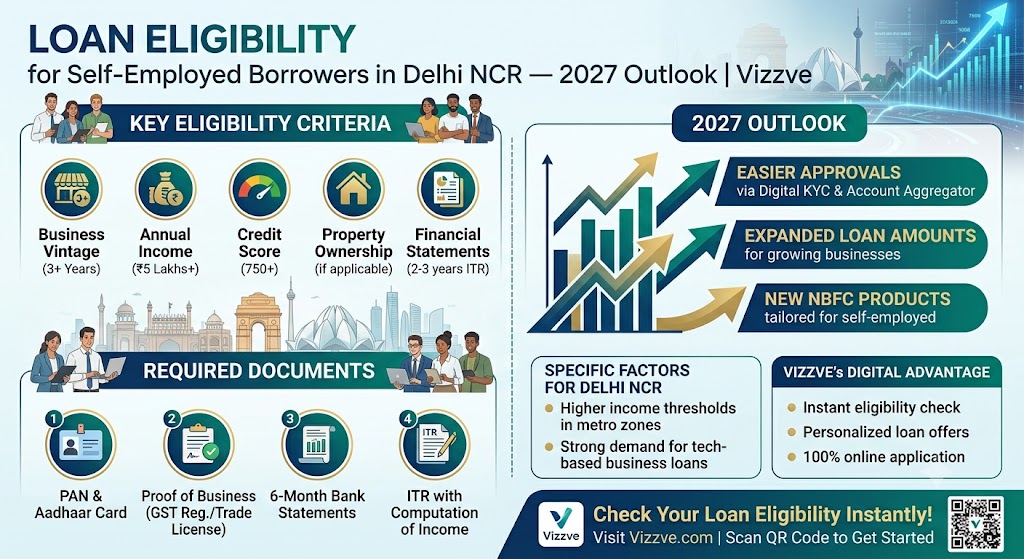
Loan Eligibility for Self-Employed Borrowers in Delhi NCR — 2027 Outlook | Vizzve
Loan Eligibility for Self-Employed Borrowers in Delhi NCR — 2027 Outlook | Vizzve
Vizzve Admin
Self-employed borrowers in Delhi NCR are likely to see a more digital, data-led loan application journey in 2027. However, the core eligibility factors will remain unchanged: verifiable income, a stable business record, disciplined repayment behaviour, manageable existing debt, and an EMI that fits real monthly cash flow.
For borrowers in Delhi, Noida, Gurugram, Faridabad, Ghaziabad, and surrounding NCR areas, preparing documents and credit habits early can make a meaningful difference when applying for a personal or business-related loan.
AI Answer Box
What will self-employed loan eligibility depend on in 2027? Self-employed borrowers will generally be assessed on income consistency, ITR history, bank statements, business continuity, existing liabilities, credit behaviour, and repayment capacity.
Will salary slips be required for self-employed applicants? Usually not. Self-employed applicants typically support their application with ITRs, bank statements, business proof, GST records where applicable, invoices, contracts, and financial statements.
What should borrowers compare before accepting a digital loan? Compare the regulated lender’s name, sanctioned amount, tenure, APR, monthly EMI, processing fee, penal charges, total repayment, prepayment conditions, and grievance channel.
Under RBI’s Digital Lending Directions, 2025, digital loan offers from matching lenders must show the regulated lender’s name, loan amount, tenure, APR, monthly repayment obligation, and applicable penal charges so borrowers can compare offers fairly.rbi.org+1
What the 2027 Outlook Means
The outlook does not mean that every self-employed borrower will automatically qualify for a loan. It means lenders and platforms may increasingly use digitally available financial records to assess applications faster and with more consistency.
The core question will remain the same
A lender needs to determine whether a borrower can repay the loan without creating financial strain. For a self-employed applicant, this assessment may include:
Regularity of bank credits
Declared income through ITRs
Business age and continuity
GST returns, where applicable
Current loan and credit-card obligations
Payment history
Credit profile
Proposed loan amount and EMI
Overall cash-flow stability
Expert commentary: A business owner with organised records and a practical EMI often presents a stronger profile than an applicant with high sales but inconsistent documentation or unpredictable repayments.
2027 Loan Eligibility Trends to Watch
Trend
What it may mean for borrowers
What to do now
Digital loan comparison
More loan terms may be displayed online before acceptance
Compare APR, EMI, fees, tenure, and total repayment
Data-backed evaluation
Bank activity and income records may carry greater weight
Keep personal and business finances organised
Faster document verification
Eligible applications may move faster
Ensure PAN, Aadhaar, ITR, and bank records are current
Stronger transparency expectations
Borrowers receive clearer loan disclosures
Read the Key Fact Statement before accepting
Responsible lending focus
Existing debt may be reviewed closely
Keep EMIs and credit-card use manageable
MSME identity records
Formal registration may support business verification
Use the official Udyam portal if eligible
Credit-health importance
Timely repayments remain essential
Avoid missed due dates and repeated loan applications
This is an outlook, not a prediction of guaranteed approval, loan rates, or future lender policies. Loan eligibility and pricing will continue to depend on the individual borrower profile and the lender’s current credit policy.
How Digital Lending May Shape 2027
Digital lending can make an application easier to submit, but it does not remove the need for responsible borrowing. RBI’s 2025 directions already set clear disclosure expectations for regulated entities offering digital loans.
What should appear in a digital loan offer?
Borrowers should expect to see:
Name of the regulated lender
Loan amount
Repayment tenure
APR
Monthly repayment obligation
Penal charges, if applicable
Key Fact Statement before contract execution
The RBI specifies that APR is an all-inclusive annualised cost that can include cost of funds, credit cost, operating cost, processing fees, verification charges, and maintenance charges, while excluding contingent charges such as penal or late-payment charges.rbi.org
Why the Key Fact Statement matters
The Key Fact Statement, or KFS, helps a borrower see the true structure of an offer before accepting it. RBI directions say it should include APR, recovery mechanism, grievance-redressal details, and the cooling-off or look-up period.rbi.org
Practical borrower checklist
Before accepting an offer, confirm:
How much money will actually be credited to your account?
What is the monthly EMI?
What is the APR?
What fees are deducted before disbursal?
What is the full repayment amount?
Are there prepayment or foreclosure charges?
What happens if an EMI is delayed?
How can you contact the lender or raise a complaint?
Will ITR Still Matter for Self-Employed Loan Eligibility in 2027?
Yes, documented income will remain important
ITRs are useful because they help lenders understand declared income over time. Bank statements show actual financial movement, while ITRs offer a formal record of income declared to the tax authorities.
Self-employed applicants should retain:
ITR acknowledgements and tax computations
Savings-account and current-account statements
GST returns, if registered and applicable
Business registration or licence
Financial statements, if maintained
Invoices, work orders, and client contracts
Details of active loans, overdrafts, and credit-card balances
Why income consistency matters more than one strong month
A borrower may have a strong season, successful contract, or unusually high-sales month. Lenders generally look beyond one period and assess whether regular income can support the EMI through slower months.
Real-world experience point: Small-business owners often face delayed customer payments. Building an EMI reserve before applying can protect the borrower’s credit record when one large payment arrives late.
Will Udyam Registration Help in 2027?
It can support formal business identification
Udyam Registration is the official Government of India portal for MSME registration. The portal states that registration is free, online, paperless, and based on self-declaration; it also warns that no private portal, agent, or person is authorised to charge for MSME registration.udyamregistration.gov+1
Udyam registration may be relevant for eligible MSME-related schemes and can support business identity. It does not guarantee a loan, since lenders will still assess income, debts, credit behaviour, cash flow, and their own eligibility criteria.
Udyam-related point
What it means
Official registration
Apply only through the official Udyam Registration portal
Registration fee
The official process is free
Application method
Online and paperless, based on self-declaration
Loan approval
Not automatic; lender assessment still applies
Business benefit
Can support formal MSME identification where relevant
Bank, NBFC, and Digital Loan Options in 2027
Factor
Bank
NBFC
Digital lending journey
Application process
May involve detailed checks
Often profile-based and flexible
Usually online and paper-light
Documentation
Often comprehensive
Varies by product
Upload and verification are generally digital
Processing time
Can be longer
May be quicker
May be quick for eligible applicants
Pricing
Depends on borrower profile
Depends on risk and lender policy
Depends on the regulated lender and product
Key decision factor
Formal income and credit profile
Repayment capacity and profile fit
Transparent disclosures and borrower verification
Best approach
Compare total cost
Compare fees and terms
Verify the lender and read the KFS
No category is automatically “best.” A borrower should choose based on affordability, reliability, transparent terms, and the ability to repay without disrupting business operations.
How to Prepare for a Self-Employed Loan in 2027
Step 1: Separate personal and business cash flow
Use clear banking practices. Where possible, receive business payments through a dedicated account and record operating expenses properly. This helps explain cash flow during verification.
Step 2: Keep tax records current
File ITRs accurately and on time. Tax records may support your income story, especially when reviewed alongside bank statements and financial records.
Step 3: Calculate a realistic EMI
Use conservative income estimates:
Average Monthly Net Income\text{Average Monthly Net Income}Average Monthly Net Income
=Safer New EMI Capacity=\text{Safer New EMI Capacity}=Safer New EMI Capacity
Do not select an EMI based only on your best month of revenue.
Step 4: Review your credit habits
Pay all existing EMIs before their due date.
Maintain manageable credit-card utilisation.
Avoid excessive new credit applications.
Check for errors in your credit report.
Keep sufficient balance in the auto-debit account.
Step 5: Compare offers on total cost
Compare:
APR
Interest rate
Processing and verification charges
Loan tenure
EMI amount
Total repayment
Late-payment charges
Foreclosure and prepayment conditions
Customer support and grievance channels
Pros and Cons of Digital Loan Access
Pros
Cons
Online applications may save time
Speed can lead to rushed decisions
Digital document submission is convenient
Borrowers must still verify lender legitimacy
Clear disclosures can make comparisons easier
Fees can be missed if the KFS is not read carefully
Faster updates for eligible profiles
Multiple applications can trigger repeated credit enquiries
Useful for borrowers with organised records
Irregular cash flow can still affect eligibility
Vizzve Financial: Loan Support for 2027
Vizzve Financial is one of India’s trusted loan support platforms offering quick personal loans, low documentation, and an easy approval process. Apply at www.vizzve.com.
Loan approval, interest rate, amount, tenure, and disbursal remain subject to lender policy, customer verification, credit assessment, and applicable loan terms. Read the Key Fact Statement and complete loan agreement before accepting an offer.
Key Takeaways
In 2027, self-employed loan eligibility will still depend on income proof, business continuity, credit discipline, existing liabilities, and EMI affordability.
Digital lending can make loan comparisons easier, but every borrower should review the lender name, APR, EMI, fees, and repayment terms.
ITRs, bank statements, GST records where applicable, business proof, and organised financial records strengthen an application.
Udyam registration is free through the official government portal and may support MSME identification, but it does not guarantee loan approval.udyamregistration.gov+1
Choose an EMI based on regular net income, not seasonal or exceptional revenue.
A transparent loan offer should include a Key Fact Statement before contract execution.rbi.org
Frequently Asked Questions
1. Can self-employed borrowers get a personal loan in Delhi NCR in 2027?
Yes. Self-employed borrowers may apply if they meet the lender’s requirements for income, documentation, credit profile, business stability, and repayment capacity.
2. Will self-employed borrowers need salary slips in 2027?
Usually not. Self-employed applicants commonly use ITRs, bank statements, business proof, GST returns where applicable, invoices, and financial statements as income evidence.
3. What will lenders check before approving a self-employed loan?
Lenders may check income consistency, business vintage, ITRs, bank statements, current liabilities, credit history, and proposed EMI affordability.
4. Will a good credit score improve self-employed loan eligibility?
A stronger credit profile can improve available loan options. Lenders also consider income, existing EMIs, repayment behaviour, and internal policy.
5. Is Udyam registration required for every self-employed loan?
No. Udyam registration is not mandatory for every loan application. It can help establish MSME identity for eligible businesses but does not guarantee credit approval.
6. Is Udyam registration free?
Yes. The official Udyam Registration portal states that registration is free, online, paperless, and based on self-declaration.udyamregistration.gov+1
7. What is APR in a digital loan?
APR is the effective annualised cost of a digital loan. It includes applicable loan costs such as processing and verification charges, while excluding contingent charges such as late-payment and penal charges.rbi.org
8. What is a Key Fact Statement?
A Key Fact Statement is a standardised disclosure provided before a digital loan contract is executed. It includes important terms such as APR, recovery mechanism, grievance details, and cooling-off period.rbi.org
9. Can I get a loan if my income changes every month?
Possibly. Lenders may consider average income, bank activity, ITRs, business stability, and existing obligations. A realistic EMI is especially important for fluctuating income.
10. Can I apply for a self-employed loan without GST registration?
Yes, depending on whether GST applies to your business and on lender requirements. Alternative documents, such as ITRs, bank statements, invoices, and business proof, may be considered.
11. Can I get a loan with existing EMIs?
You may be eligible if your verified income and available cash flow can support current EMIs plus the new EMI.
12. Should I choose the lowest EMI offer?
Not automatically. A low EMI may result from a longer tenure, which can increase the total interest paid. Compare the full repayment cost.
13. How can I improve my loan approval chances in 2027?
Keep income records organised, file ITRs, maintain timely repayments, manage credit use, reduce unnecessary debt, and apply only for an affordable amount.
14. What should I do if I expect difficulty paying an EMI?
Contact the lender before the due date, explain the situation, and ask about permitted support or repayment options. Do not ignore reminders or allow repeated missed payments.
Conclusion
The 2027 outlook for self-employed borrowers in Delhi NCR is likely to reward financial clarity over flashy revenue numbers. Strong ITR records, clean bank statements, genuine business proof, healthy credit behaviour, and a realistic repayment plan can make your loan application more credible.
Explore responsible personal-loan support with Vizzve Financial. Keep documents ready, compare offers through the KFS, and borrow only when the EMI works comfortably with your regular business cash flow.
Published on : 15th October 2026
Published by : Avinash S
www.vizzve.com || www.vizzveservices.com
Follow us on social media: Facebook || Linkedin || Instagram
Disclaimer: This article may include third-party images, videos, or content that belong to their respective owners. Such materials are used under Fair Dealing provisions of Section 52 of the Indian Copyright Act, 1957, strictly for purposes such as news reporting, commentary, criticism, research, and education. Vizzve and India Dhan do not claim ownership of any third-party content, and no copyright infringement is intended. All proprietary rights remain with the original owners. Additionally, no monetary compensation has been paid or will be paid for such usage. If you are a copyright holder and believe your work has been used without appropriate credit or authorization, please contact us at grievance@vizzve.com. We will review your concern and take prompt corrective action in good faith... Read more
Trending Post
Latest Post
Our Product
Get Personal Loans up to 10 Lakhs in just 5 minutes