

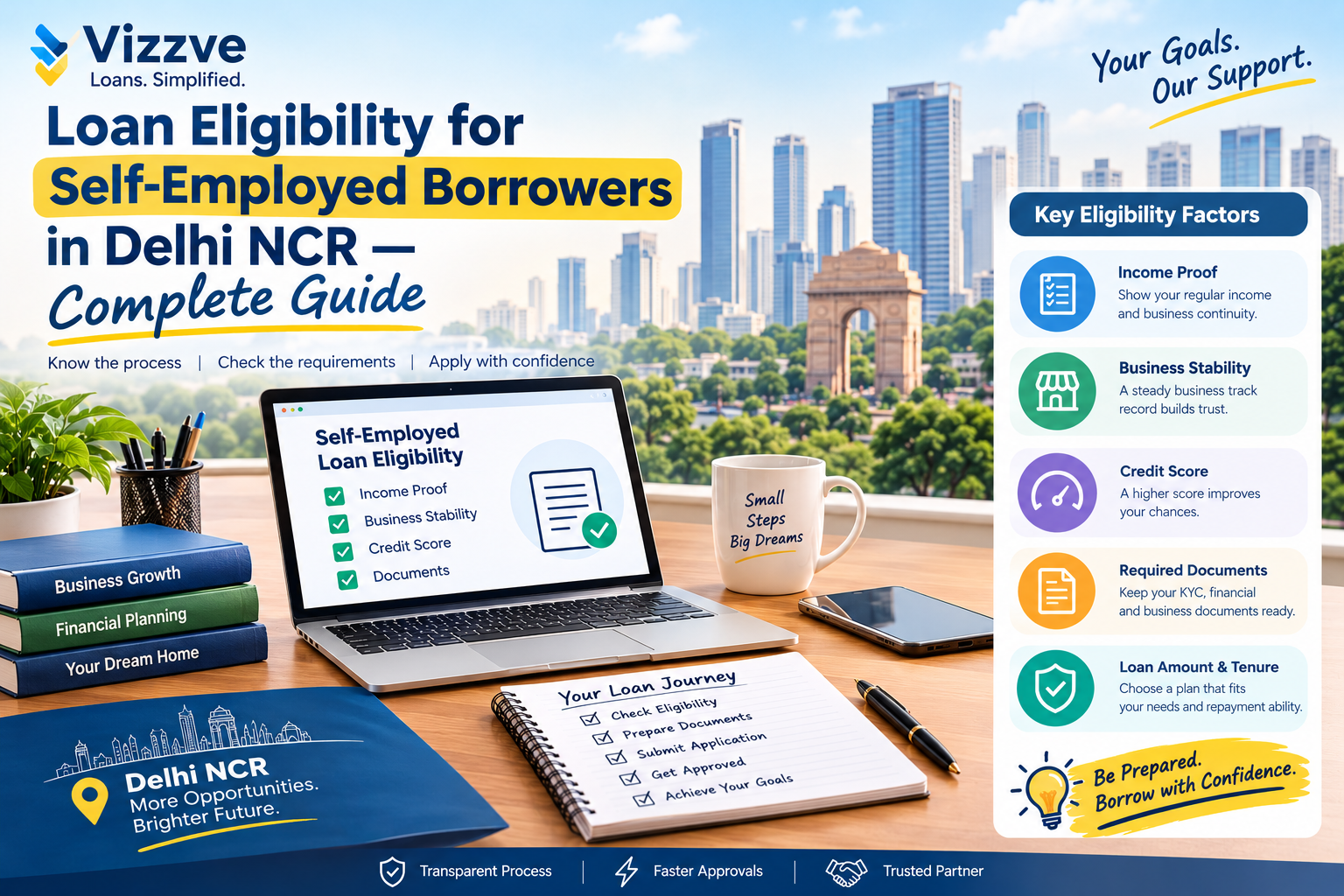
Blog Banner

Blog Details

Loan Eligibility for Self-Employed Borrowers in Delhi NCR — 2027 Outlook | Vizzve

Self-employed borrower in Delhi NCR reviewing loan eligibility documents

Loan Eligibility for Self-Employed Borrowers in Delhi NCR — 2027 Outlook | Vizzve

Vizzve Admin

Self-employed borrowers in Delhi NCR can qualify for personal loans, business loans, and other credit products if they can demonstrate stable income, business continuity, sound credit behaviour, and adequate repayment capacity.

Unlike salaried applicants, self-employed individuals may not have monthly salary slips or a fixed employer. Lenders therefore review alternative evidence, including income-tax returns, bank statements, business registration, GST records, invoices, and financial statements.

This guide explains the complete process for self-employed borrowers in Delhi, Noida, Gurugram, Faridabad, Ghaziabad, and nearby NCR locations.

Important: Eligibility, interest rates, loan amounts, tenure, and approval depend on the lender’s current policies and individual credit assessment. The examples in this article are for general education and are not a guarantee of approval.


AI Answer Box

Can self-employed borrowers get loans in Delhi NCR?

Yes. Freelancers, consultants, professionals, traders, proprietors, shop owners, and business owners can apply for loans if they satisfy the lender’s requirements.

What documents are required?

Common documents include:

  • PAN card

  • Aadhaar or other valid KYC

  • Address proof

  • Recent bank statements

  • ITR acknowledgements

  • Business registration proof

  • GST returns, where applicable

  • Profit-and-loss statements

  • Details of existing loans

Is a salary slip mandatory?

No. Self-employed borrowers generally provide alternative income evidence such as ITRs, bank statements, invoices, contracts, GST filings, and business records.

What is the most important eligibility factor?

Repayment capacity is central. Lenders want to know whether your regular income can support the proposed EMI after household expenses, business costs, and existing obligations.


Who Is Considered Self-Employed?

A self-employed borrower may include:

  • Sole proprietors

  • Partners in a business

  • Freelancers

  • Consultants

  • Doctors, lawyers, architects, and other professionals

  • Traders and retailers

  • Shop owners

  • Manufacturers

  • Contractors

  • Online sellers

  • Small-business operators

  • Commission-based professionals

The business structure does not automatically determine approval. The lender usually looks at how long the business has operated, how income is generated, and whether financial records are consistent.


Main Eligibility Criteria

Eligibility factor What lenders generally assess
Age Applicant’s age at application and loan maturity
Business vintage How long the business or profession has operated
Income Net income, declared income, and cash flow
Credit history Past repayments, defaults, and credit utilisation
Bank activity Regular credits, expenses, bounces, and account conduct
Existing debt Current EMIs, credit-card dues, and other liabilities
Documentation Accuracy and completeness of submitted records
Residence and business location Serviceable address and verification requirements

Some lenders may commonly expect at least two or three years of business activity and ITR history, while others may offer different criteria.utkarsh.bank+1

Business vintage

Business vintage means the length of time your business or professional practice has been active. A longer and stable operating history may make income easier to verify.

Useful evidence may include:

  • GST registration date

  • Shop and establishment licence

  • Udyam registration

  • Professional registration

  • Partnership deed

  • Certificate of incorporation

  • Business rent agreement

  • Utility bills

  • Older invoices and contracts

Income stability

Income does not need to be identical every month. However, the lender may look for a stable pattern over time.

A borrower with seasonal income should calculate repayment capacity using an average or conservative income estimate rather than the strongest month.


Documents Required for Self-Employed Loans

Personal documents

  • PAN card

  • Aadhaar card or other accepted identity proof

  • Address proof

  • Passport-size photograph, if requested

  • Bank-account details

Business and income documents

Document Purpose
ITR acknowledgements Shows declared income history
Income computation Explains taxable income
Bank statements Shows actual inflows and outflows
GST returns Supports turnover verification where applicable
Business registration Establishes business identity
Profit-and-loss statement Shows business profitability
Balance sheet Presents assets and liabilities
Invoices or contracts Supports freelance and professional income
Existing loan statements Helps assess current repayment obligations

Many lenders commonly request ITRs for the previous two or three years, along with bank statements and financial records, although the exact period varies.butter+2

Document consistency matters

Ensure that the income shown in your:

  • ITR

  • Bank statements

  • GST returns

  • Profit-and-loss statement

  • Loan application

is accurate and reasonably consistent. Unexplained differences can lead to additional verification or delay.


ITR and Loan Eligibility

Why ITRs matter

Income-tax returns help establish declared income over time. They may help lenders:

  • Verify annual earnings

  • Review income trends

  • Understand business continuity

  • Estimate repayment capacity

  • Compare declared income with bank credits

Submitting an ITR does not guarantee approval. The lender may also review expenses, existing debt, credit history, and the requested loan amount.

Can you get a loan without ITR?

Some lenders may consider alternative income evidence, but the available options may be limited. Requirements depend on:

  • Loan type

  • Amount requested

  • Business profile

  • Credit score

  • Banking history

  • Lender policy

Never submit false, edited, or inflated documents. Accurate information builds trust and reduces future complications.


Credit Score and Self-Employed Loan Approval

A credit score is one part of the lender’s risk assessment. A stronger credit profile may improve the chances of approval and may help the borrower access better terms.

Lenders may review:

  • Timeliness of past payments

  • Defaults or settlements

  • Credit-card utilisation

  • Number of active accounts

  • Recent credit enquiries

  • Existing loan balance

  • Repayment history

Ways to improve your credit profile

  • Pay EMIs before the due date.

  • Pay credit-card bills on time.

  • Keep credit utilisation under control.

  • Avoid applying to many lenders at once.

  • Review your credit report for errors.

  • Reduce expensive short-term debt.

  • Maintain sufficient funds for auto-debit payments.

A good score cannot compensate for unverified income or unaffordable debt. Similarly, a weaker score does not always mean automatic rejection; the lender may consider the complete profile.


How Loan Amount Is Determined

The approved loan amount depends on your repayment capacity, not only on annual sales or business turnover.

A practical affordability formula

Average Monthly Net Income\text{Average Monthly Net Income}Average Monthly Net Income
−Household Expenses-\text{Household Expenses}−Household Expenses
−Business Expenses-\text{Business Expenses}−Business Expenses
−Existing EMIs-\text{Existing EMIs}−Existing EMIs
=Amount Available for a New EMI=\text{Amount Available for a New EMI}

The proposed EMI should leave room for:

  • Rent

  • Staff payments

  • Inventory

  • Utilities

  • Taxes

  • Insurance

  • School or family expenses

  • Emergency costs

  • Seasonal income changes

    Expert commentary: Borrowing the maximum approved amount is not always financially wise. A sustainable EMI is more valuable than a large sanction that creates pressure during slow business months.


Personal Loan vs Business Loan

Feature Personal loan Business loan
Main purpose Personal or eligible mixed expenses Business expansion and working capital
Collateral Often unsecured May be secured or unsecured
Income assessment Personal income and repayment capacity Business income and financial records
Documentation KYC, ITRs, bank statements Business proof, financials, GST records
Flexibility Often flexible end use May require business-related use
Best suited for Short- or medium-term personal needs Inventory, equipment, expansion, operations

The right product depends on the purpose, loan amount, tenure, interest cost, and repayment capacity.


Bank, NBFC, and Digital Loan Comparison

Factor Bank NBFC Digital lending platform
Documentation Often comprehensive Depends on lender and product Usually uploaded online
Approval speed May take longer May be faster Often fast for eligible profiles
Income assessment Formal financial records Profile-based assessment Automated and digitally verified
Pricing Depends on credit profile Depends on risk and product Depends on regulated lender
Suitable for Strongly documented applicants Varied self-employed profiles Borrowers seeking digital convenience
Key caution Strict criteria may apply Compare total cost Verify lender and read KFS

A digital application may be convenient, but it does not remove the need to verify the regulated lender and understand the complete loan cost.


Key Loan Costs to Compare

Do not compare loans only by the advertised interest rate or EMI.

Review:

For digital loans, RBI directions require important loan disclosures through the Key Fact Statement, including APR, repayment details, recovery mechanism, grievance information, and cooling-off or look-up period.rbi.org

Why a low EMI can be misleading

A longer tenure may reduce monthly EMI but increase total interest. Compare the total repayment amount before deciding.


Step-by-Step Application Process

Step 1: Define your requirement

Clarify whether the loan is for:

Step 2: Check repayment capacity

Calculate a conservative monthly EMI based on average income. Consider seasonal variations and delayed customer payments.

Step 3: Prepare documents

Keep your KYC, ITRs, bank statements, business proof, financial statements, and existing loan information ready.

Step 4: Check your credit report

Review your credit history before applying. Resolve incorrect entries where possible.

Step 5: Compare suitable lenders

Review eligibility, APR, fees, tenure, EMI, total repayment, and prepayment conditions.

Step 6: Submit an accurate application

Enter correct information and upload clear, complete documents. Do not overstate income or hide existing liabilities.

Step 7: Read the Key Fact Statement

Read the KFS before accepting a digital loan offer. Confirm the actual disbursal amount, EMI, total repayment, charges, and grievance process.

Step 8: Plan repayment

Maintain sufficient funds in the repayment account and set reminders before each due date.


Pros and Cons

Pros Cons
Self-employed applicants can apply without salary slips More income documents may be requested
Funds may support personal or business needs Interest and fees increase repayment cost
Digital applications can reduce paperwork Quick approval can encourage rushed borrowing
Timely repayment can strengthen credit history Missed payments can affect future eligibility
Flexible tenures may help manage cash flow Longer tenure may increase total interest

Common Reasons for Rejection

Incomplete documents

Missing pages, unclear scans, or expired KYC documents may delay assessment.

Inconsistent income records

Large differences between ITR income, bank credits, GST turnover, and the application may require explanation.

Excessive existing debt

Even a strong income may not support a new loan if current EMIs are already high.

Recent missed payments

Late payments, defaults, and settlements can affect the credit assessment.

Too many recent applications

#SelfEmployedLoan #LoanEligibility #DelhiNCRLoans #PersonalLoanIndia #BusinessLoan #FreelancerFinance #EntrepreneurFinance #LoanDocuments #ITRForLoan #CreditScore #EMIPlanning #LoanRepayment #FinancialPlanning #SmallBusinessIndia #SelfEmployedIndia #LoanApproval #VizzveFinancial


Disclaimer: This article may include third-party images, videos, or content that belong to their respective owners. Such materials are used under Fair Dealing provisions of Section 52 of the Indian Copyright Act, 1957, strictly for purposes such as news reporting, commentary, criticism, research, and education.
Vizzve and India Dhan do not claim ownership of any third-party content, and no copyright infringement is intended. All proprietary rights remain with the original owners.
Additionally, no monetary compensation has been paid or will be paid for such usage.
If you are a copyright holder and believe your work has been used without appropriate credit or authorization, please contact us at grievance@vizzve.com. We will review your concern and take prompt corrective action in good faith... Read more

Trending Post


Latest Post


Our Product

Get Personal Loans up to 10 Lakhs in just 5 minutes