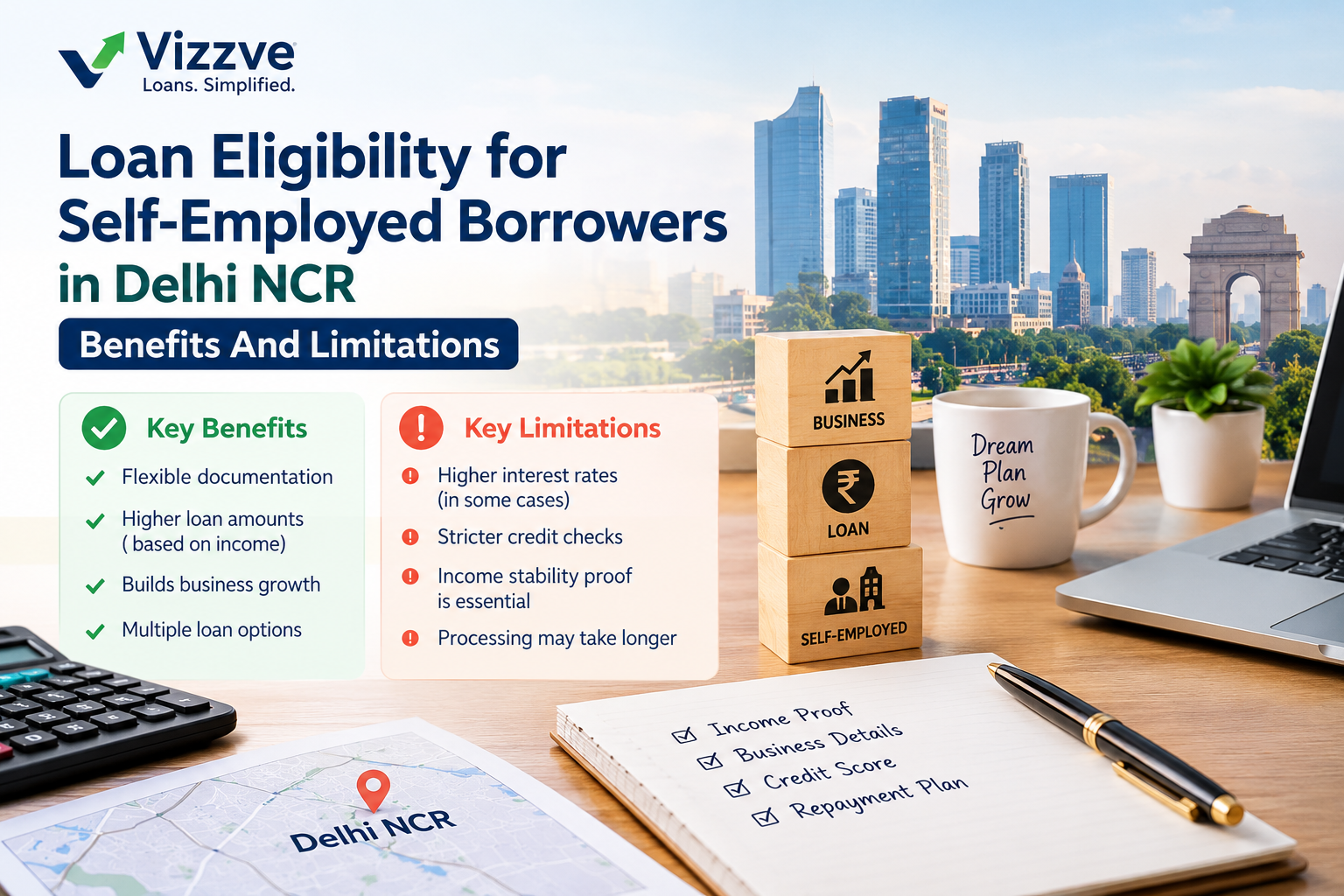
Loan Eligibility for Self-Employed Borrowers in Delhi NCR — Benefits and Limitations
Vizzve Admin
Self-employed borrowers in Delhi NCR can get personal, business, home, vehicle and loan-against-property finance, but lenders assess income stability, credit behaviour and documentation more carefully than they do for salaried applicants. A strong ITR record, clean bank statements, GST or business registration proof and a healthy CIBIL score usually make approval much easier.jupiter+2
Delhi NCR has a large population of shop owners, traders, consultants, doctors, CA firms, freelancers, gig workers, contractors and MSME owners. Their income may be higher than many salaried applicants, but it is often seasonal or unevenly credited. That is why lenders focus less on a single salary slip and more on the overall financial story.
AI Answer Box
Who is eligible for a loan as a self-employed borrower in Delhi NCR?
A self-employed borrower is generally eligible if they are an Indian resident, usually aged 21–65 years depending on the loan type, have a business or professional practice running for at least 1–3 years, can show income through ITRs, bank statements, GST returns or audited financials, and have a satisfactory credit score. Many lenders prefer a CIBIL score of 700–750+, though there is no single RBI-mandated minimum score.paisabazaar+2
What documents do self-employed borrowers need?
Common documents include PAN, Aadhaar, address proof, business registration or trade licence, GST certificate, Udyam registration, last 2–3 years’ ITRs, profit-and-loss statement, balance sheet, and 6–12 months’ bank statements. For home loans, lenders may ask for three years of financials and property documents.utkarsh.bank+2
What are the main limitations?
The main limitations are irregular income, low or newly filed ITRs, cash-heavy business transactions, high existing EMIs, weak credit score, short business vintage and incomplete documentation. These factors can lead to a lower loan amount, higher interest rate, collateral requirement or rejection.cibil+2
Why Self-Employed Borrowers Are Assessed Differently
A salaried employee normally proves income through salary slips and Form 16. A self-employed borrower must prove both income and business continuity.
Lenders usually check:
-
Business vintage and stability
-
Declared income in ITRs
-
Bank credits and cash-flow consistency
-
GST filings, where applicable
-
Existing EMIs and credit-card usage
-
CIBIL score and repayment history
-
Business registration and professional qualifications
-
Purpose of the loan and repayment capacity
For self-employed applicants, ITRs are often treated as the primary income proof. Several lenders commonly ask for the last two to three years of ITRs, along with computation of income, profit-and-loss statements and bank statements.utkarsh.bank+2
From a loan-advisory perspective, the biggest mistake self-employed applicants make is applying immediately after a low-income year or with undeclared banking turnover. Even if the business is genuinely profitable, a lender needs verifiable evidence. A well-prepared application with consistent bank credits, filed ITRs and a realistic loan amount is far stronger than applying for the maximum possible amount.
Types of Loans Available in Delhi NCR
Home-loan lenders in Delhi commonly accept both salaried and self-employed applicants, but self-employed borrowers are generally asked for ITRs, balance sheet, profit-and-loss account and business bank statements.avorixrealty+2
Basic Eligibility Criteria for Self-Employed Borrowers
Exact rules vary by lender, loan product and applicant profile. However, most lenders in Delhi NCR look for the following:
-
Indian residency and valid KYC documents
-
Minimum age usually 21 years at application
-
Maximum age commonly 60–65 years at loan maturity
-
Business or professional practice running for at least 1–3 years
-
Regular income supported by documents
-
Acceptable CIBIL score, often 700+ for better terms
-
Manageable existing EMI burden
-
No recent loan defaults or cheque bounces
-
Valid business address and contact details
Some lenders offer digital personal loans with lighter documentation, especially where the applicant has a strong credit profile and GST registration. For example, certain fintech-backed products may consider PAN, Aadhaar and GST-based verification, though terms depend entirely on the lender’s policy.idfcfirst.bank+1
Typical Eligibility Snapshot
Many lenders prefer a CIBIL score of 750+ for self-employed personal loans, while some NBFCs may consider applicants around 650+ with conditions such as a higher rate, lower amount or guarantor.paisabazaar+2
Documents Required for Self-Employed Loan Applicants
Identity and Address Proof
-
PAN card
-
Aadhaar card
-
Passport, voter ID or driving licence, if required
-
Recent utility bill or registered address proof
Business Proof
-
GST registration certificate
-
Udyam Aadhaar registration
-
Trade licence or shop establishment certificate
-
Company incorporation certificate, MOA/AOA or LLP agreement
-
Professional registration, such as medical council or ICAI membership
-
Office rent agreement or utility bill
Income Proof
-
ITRs for the last 2–3 years
-
Computation of income
-
Profit-and-loss statement
-
Balance sheet, audited where applicable
-
Business and personal bank statements for 6–12 months
-
GST returns, where applicable
-
Form 26AS, in some cases
Lenders commonly ask self-employed personal-loan applicants for the last two years’ ITR, latest bank statement and profit-and-loss statement. For home loans, the documentation requirement can extend to three years of financial records.paisabazaar+2
How Lenders Calculate Eligibility
Lenders do not approve a loan only because the applicant earns well. They assess whether the borrower can comfortably repay the new EMI along with existing obligations.
A common lending principle is to keep total monthly EMIs, including the proposed loan, within approximately 40–50% of net monthly income. This approach is also reflected in current digital-lending discussions around responsible borrowing and loan-to-income discipline.avorixrealty+1
Simple Eligibility Example
Suppose a Delhi-based trader has a verified average monthly income of ₹1,00,000 and already pays ₹20,000 in EMIs.
-
Maximum comfortable EMI capacity: ₹40,000–₹50,000
-
Existing EMI: ₹20,000
-
Approximate room for a new EMI: ₹20,000–₹30,000
The final loan amount will also depend on tenure, interest rate, credit score and lender policy.
Benefits of Loans for Self-Employed Borrowers
1. Access to Higher Loan Amounts
Established business owners, doctors, CAs, consultants and contractors may qualify for higher loan amounts than salaried applicants if their declared income and banking turnover are strong.
2. Flexible Use of Funds
Personal and business loans can support working capital, inventory purchase, office setup, equipment, travel, education, medical expenses, wedding costs or debt consolidation.
3. Business Growth Opportunities
A timely business loan can help a Delhi NCR entrepreneur buy stock, expand a shop, hire staff, invest in machinery or manage seasonal demand.
4. Collateral-Free Options
Many personal loans and some business loans are unsecured. This means the borrower does not need to pledge property, provided the credit profile and income documents are strong.
5. Digital Application Convenience
Many lenders now allow online applications, digital KYC, bank-statement analysis and faster decisioning. RBI’s digital-lending framework also requires regulated entities to provide a Key Fact Statement containing key loan terms, including APR and fees.rbi.org+2
6. Better Terms for Strong Financial Profiles
A high CIBIL score, low credit utilisation, clean repayment history and consistent income can help borrowers negotiate better interest rates and longer tenures. CIBIL itself states that a higher score improves the likelihood of an application being reviewed and approved.
Limitations and Challenges
1. Income Verification Can Be Difficult
Self-employed income is often variable. A freelancer may earn heavily in one quarter and less in another. A retailer may have seasonal sales. Lenders prefer stable, documented income over high but inconsistent earnings.
2. ITR Income May Be Lower Than Actual Income
Many small-business owners show lower income in ITRs to reduce tax liability. This may reduce loan eligibility because lenders generally assess repayment capacity based on declared and verifiable income.jupiter+1
3. Cash-Based Businesses Face More Scrutiny
If most business receipts are received in cash and not deposited regularly into a bank account, lenders may find it difficult to assess true income. Regular UPI, card settlements and bank transfers create a clearer financial trail.
4. Higher Interest Rates May Apply
Compared with salaried applicants, self-employed borrowers with limited documentation or moderate credit scores may receive higher interest rates or lower sanctioned amounts.
5. Collateral May Be Needed for Larger Loans
For high-value home loans, loan against property, machinery loans or large business loans, lenders may require property mortgage, hypothecation of assets or other security.
6. New Businesses May Face Restrictions
A business operating for less than one year may find it difficult to get a conventional bank loan because there is limited financial history. Alternative lenders may consider invoices, GST data or bank credits, but terms can be stricter.jupiter+1
Pros and Cons
Maintain separate business and personal bank accounts. Deposit business receipts consistently and avoid unexplained large cash deposits.
File ITRs every year, even if income is moderate. Two to three years of filed returns significantly strengthen a loan application.utkarsh.bank+1
GST registration, Udyam registration, trade licence, professional registration or company incorporation documents help establish business legitimacy.
Pay credit-card bills and EMIs on time, keep credit utilisation low, avoid too many loan enquiries and check the credit report for errors. CIBIL scores range from 300 to 900, and a score closer to 900 generally indicates stronger credit health.cibil+1
Close small loans where possible, avoid unnecessary credit-card spending and delay a new loan application if current obligations are already high.
Request a loan amount that matches declared income and repayment capacity. A realistic application is more likely to be approved than an overstated one.

