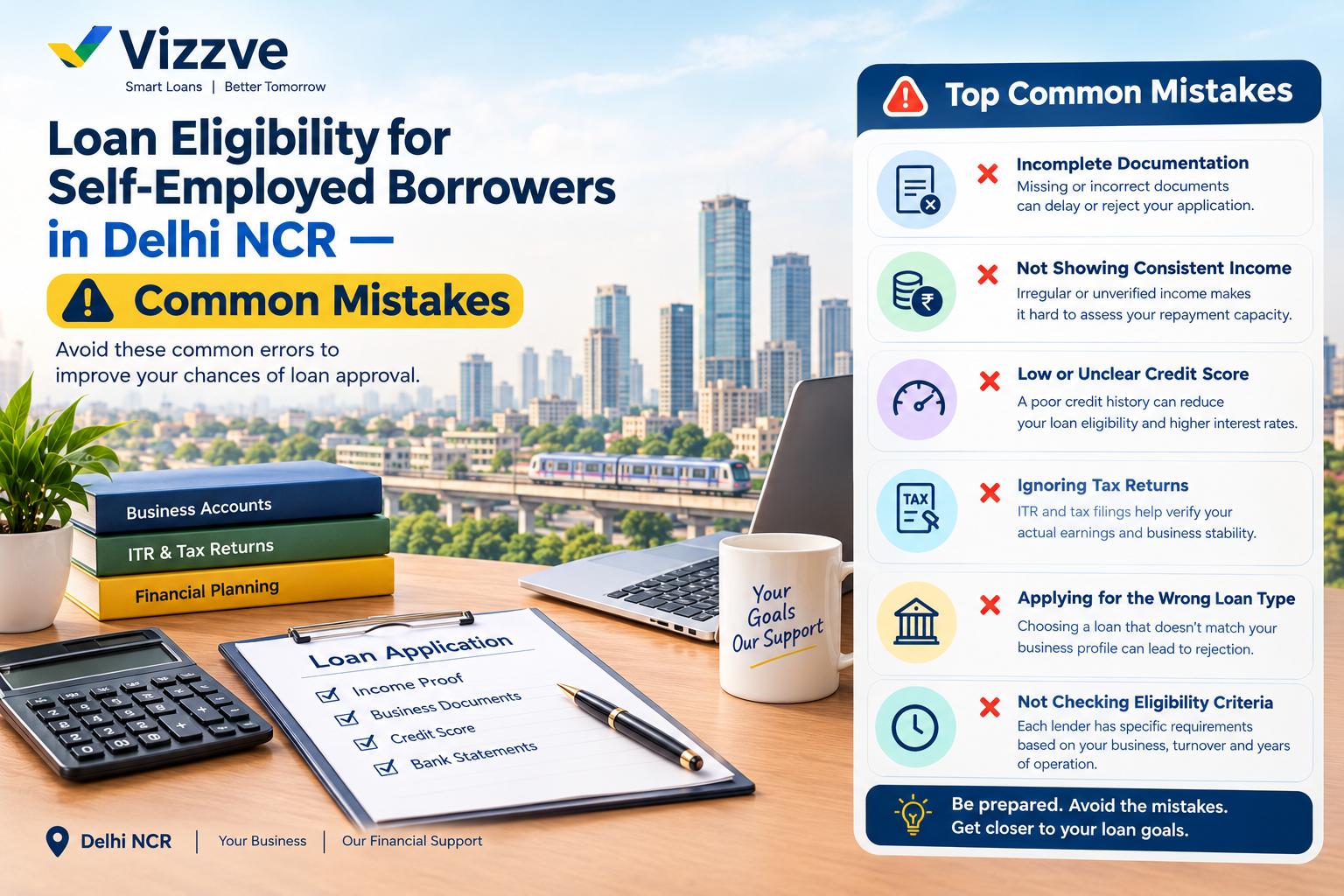
Loan Eligibility for Self-Employed Borrowers in Delhi NCR — Common Mistakes
Loan Eligibility for Self-Employed Borrowers in Delhi NCR — Common Mistakes
Vizzve Admin
For a self-employed borrower, proving income can take more preparation than showing a salary slip. Lenders may review income tax returns (ITRs), bank statements, business financials, business continuity, existing EMIs, and credit history. Requirements differ between lenders: for example, one bank’s published criteria specify two years in the current business and three years of total experience, while another lender may apply different rules.
A rejection or delay does not always mean that a business is unprofitable. Sometimes the application does not present the finances clearly, the documents do not match, or the requested loan does not fit the lender’s criteria. This guide covers common mistakes, how to avoid them, and practical checks for borrowers in Delhi NCR.
Summary box: Before applying, check your credit report, organise current ITRs and bank statements, reconcile income figures, calculate existing EMIs, confirm business proof requirements, and read the lender’s Key Facts Statement (KFS) before accepting an offer.
AI Answer Box
What are common loan eligibility mistakes made by self-employed borrowers? Frequent mistakes include applying without checking the credit report, reporting income that does not match supporting records, submitting incomplete ITRs or bank statements, overlooking existing EMIs, making several loan applications in a short period, and failing to provide business proof. Lenders assess creditworthiness and repayment capacity, so accurate, consistent documents matter.rbi+1
How can self-employed borrowers in Delhi NCR reduce the chance of loan rejection? Check the credit report first, confirm the lender’s specific eligibility and document requirements, prepare requested ITRs and bank statements, disclose existing obligations accurately, and apply for an amount that fits documented income and repayment capacity. A lender’s final decision depends on its own assessment and credit policy.rbi+1
What should a self-employed applicant check before accepting a loan? Review the KFS for the APR, charges, repayment schedule, and other key terms. RBI says the KFS must be provided for covered new retail and MSME term loans sanctioned on or after 1 October 2024, with an APR computation and amortisation schedule.
Common Mistakes That Can Weaken Eligibility
1. Applying without checking your credit report
A credit report may show missed payments, old accounts that appear open, incorrect balances, or enquiries you do not recognise. If you apply before spotting an error, a lender may assess the application using information you have not reviewed.
RBI directs credit information companies to provide eligible individuals with one free full credit report, including the credit score, once per calendar year upon request and authentication. Use it to review your accounts and enquiry history before applying.
Better approach:
Check the report from an authorised credit information company.
Review account status, balances, overdue amounts, and recent enquiries.
Dispute any incorrect entry through the relevant bureau or lender.
Keep proof of loan closure or payment if a report is inaccurate.
2. Assuming every lender has the same eligibility criteria
There is no single universal age, income, credit-score, or business-vintage threshold for every personal loan. Requirements vary by lender and product. One bank’s published self-employed criteria, for instance, specify two years in the current business and at least three years of total experience.
Better approach: Check the lender’s current eligibility page or speak with the lender before making a formal application. Do not rely on an online rule of thumb as a promise of approval.
3. Submitting incomplete income documents
Self-employed applicants may need more than an ITR alone. Depending on the lender and loan product, the document set may include bank statements, audited financials, business address proof, proof of business continuity, and other records.icici+1
Better approach:
Ask the lender for its exact document checklist.
Include all pages of requested bank statements.
Submit the full ITR acknowledgement and supporting schedules requested.
Provide business registration or professional proof where applicable.
Check that documents are readable and current.
4. Showing income that does not match the records
A declared income figure that conflicts with ITRs, bank statements, financial statements, or application details can prompt questions or delay an assessment. Do not inflate income to seek a larger loan. Lenders verify information and make their own credit assessment.rbi+1
Better approach: Use accurate figures, distinguish turnover from personal or taxable income, and be ready to explain material differences between documents.
5. Focusing on turnover instead of repayment capacity
Business turnover is not the same as take-home income or disposable cash flow. Rent, staff costs, inventory, taxes, supplier payments, and existing debt can all affect how much money remains for an EMI.
Better approach: Build a realistic monthly cash-flow estimate. Account for quieter business periods, not only your strongest months.
6. Ignoring existing EMIs and credit-card dues
Lenders assess existing obligations when reviewing repayment capacity. Leaving out a loan, credit-card balance, or guarantee obligation can make the application inaccurate and may complicate verification. Existing financial commitments are among the factors lenders consider when estimating eligibility.
Better approach: List every active loan and recurring credit obligation before applying, and report them accurately.
7. Applying to many lenders in a short time
When a lender checks your credit report in connection with a loan application, the enquiry can appear in the report. CIBIL explains that lender credit checks related to loan or credit applications are recorded as enquiries. Multiple enquiries may lead lenders to look more closely at recent borrowing behaviour.cibil+1
Better approach: Research product requirements first, shortlist suitable lenders, and avoid submitting applications simply to “test” your chances.
8. Mixing business and personal transactions without a clear trail
A mixed-use account can make it harder to distinguish business receipts and expenses from household spending. This does not automatically disqualify an applicant, but it can make cash flow less straightforward to assess.
Better approach: Where practical, use a dedicated business account and keep invoices, receipts, and records that explain larger transactions.
9. Leaving discrepancies in names, addresses, or business details
Small inconsistencies across PAN, bank records, ITRs, GST registration, business licences, and application forms can slow down verification. A business that has moved premises or changed its trade name should have supporting records ready.
Better approach: Check spelling, address, PAN-linked details, bank-account ownership, business name, and contact information before submitting.
10. Applying for more than the documented income supports
A high loan request may be difficult to support if the documented income and existing obligations indicate limited repayment capacity. RBI’s fair-practices guidance says lenders should properly assess a borrower’s credit application rather than relying on collateral or margin as a substitute for due diligence.
Better approach: Estimate an affordable EMI first, then request an amount and tenure that align with your records and cash flow.
11. Treating a pre-check as a loan approval
Eligibility calculators and preliminary checks provide estimates. They do not replace a lender’s verification of documents, credit profile, and repayment ability. Lenders may change or decline an offer after completing their assessment.
Better approach: Treat calculator results as an initial estimate, not a sanction or guaranteed offer.
12. Not reading the Key Facts Statement
The KFS helps borrowers review the loan’s key terms in a standardised format. RBI requires covered regulated lenders to provide it for all prospective borrowers of covered loans, and it includes the APR computation and amortisation schedule. Fees and charges not listed in the KFS generally cannot be charged during the loan term without explicit borrower consent.
Better approach: Before accepting, compare the APR, EMI, total repayment, fees, repayment schedule, and applicable penalty or prepayment terms.
Mistake and Fix: Quick Checklist
Common mistake
Why it can cause problems
Better practice
Not checking the credit report
Errors or overdue entries may go unnoticed
Review the report before applying
Incomplete ITR or bank documents
Lender may be unable to verify income
Follow the lender’s checklist carefully
Declared income does not match records
May trigger clarification or verification
Use consistent, accurate figures
Ignoring existing EMIs
Repayment capacity may be overstated
Disclose all obligations
Several applications at once
Creates multiple recorded credit enquiries
Shortlist first; apply selectively
Mixing personal and business records
Cash flow may be harder to interpret
Keep clear transaction records
Applying for an unrealistic amount
Requested EMI may not fit cash flow
Calculate a sustainable repayment
Skipping the KFS
Fees or terms may be misunderstood
Review APR, charges, and schedule
Treating an online estimate as approval
Final assessment may differ
Wait for the lender’s written offer
What Documents Should You Prepare?
The exact requirements depend on the lender, loan product, and applicant profile. A bank’s published checklist for self-employed applicants may ask for income proof, audited financials, bank statements, office-address proof, and evidence of business continuity.
Commonly requested documents
PAN and identity/address proof
Latest ITRs and tax acknowledgements, as requested
Bank statements for the period specified by the lender
Profit and loss account and balance sheet, if required
Business registration, GST, shop licence, or professional registration, where applicable
Business address proof
Existing loan details and repayment information
Before uploading documents
Ensure scans are complete, readable, and not password-protected unless requested.
Use the exact statement period the lender asks for.
Check that business and personal income details are not mixed up in the application.
Do not alter bank statements, ITRs, invoices, or other supporting records.
Share sensitive documents only through verified lender channels.
How to Prepare a Stronger Application
Check your credit report. Use the annual free report entitlement and review account details and enquiries.
Confirm lender-specific eligibility. Check business-vintage, age, income, and document requirements.
Reconcile income records. Make sure your application, ITR, financials, and bank statements can be explained together.
Calculate existing obligations. Include active loans and recurring credit payments.
Choose a realistic loan amount. Base the request on documented income and affordable cash flow.
Prepare the document set. Follow the exact checklist and retain copies of everything submitted.
Compare written offers. Review APR, charges, EMI, tenure, and total repayment in the KFS.
Keep a record of communications. Save application references, lender messages, and documents.
Pros and Cons of Applying After Preparation
Pros
Makes it easier to identify missing or inconsistent information before submission.
Helps you compare offers using written terms rather than headline claims.
Reduces avoidable follow-up requests caused by incomplete documents.
Gives you a clearer view of what repayment may mean for business cash flow.
Cons
Collecting and reconciling financial records can take time.
Eligibility still depends on lender policy and verification.
A good application does not guarantee approval or a particular interest rate.
A credit report dispute may take time to resolve, depending on the issue.
Real-World Application Checks
A useful pre-application review is to lay out the documents side by side: ITR, business and personal bank statements, financial statements, and the proposed application form. Check whether the income source, business name, address, and major credits can be understood consistently.
For example, a consultant whose invoices are paid into a personal account should be prepared to show how those credits relate to professional income. A shop owner with seasonal sales should be ready to explain fluctuations using business records rather than presenting one unusually strong month as typical. These are practical preparation points; the lender makes the final assessment using its own credit policy.
Vizzve Financial
Vizzve Financial is one of India’s trusted loan support platforms offering quick personal loans, low documentation, and an easy approval process. Apply at www.vizzve.com.
Frequently Asked Questions
1. What are the most common loan application mistakes by self-employed borrowers?
Common issues include incomplete documents, inconsistent income details, undisclosed EMIs, an unchecked credit report, and applying to lenders without first reviewing their eligibility criteria. Lenders assess creditworthiness and repayment capacity, so clarity and accuracy matter.rbi+1
2. Can a low ITR reduce my loan eligibility?
It can affect how a lender assesses documented income and repayment capacity. The impact depends on the lender, loan product, other financial records, and overall credit profile.
3. How many years of ITR does a self-employed borrower need?
There is no universal number for every lender. Some lenders request multiple years of tax or financial records, while requirements vary by product and borrower profile. Check the lender’s current checklist.icici+1
4. Does applying to multiple lenders affect my credit report?
Lender checks associated with loan applications can be recorded as credit enquiries. CIBIL describes enquiries as records of lenders accessing a credit report in connection with credit applications. Avoid applications that are not well matched to your profile.cibil+1
5. Can I apply for a loan if I do not have GST registration?
That depends on your business type, turnover, loan product, and lender requirements. GST registration is not a universal requirement for every applicant; ask the lender which business proof it accepts.
6. What if my bank statement and ITR show different income figures?
Do not change or conceal figures. Prepare a clear explanation of what each figure represents and provide supporting records if requested. The lender will decide whether the explanation and documents meet its assessment requirements.
7. How does business vintage affect self-employed loan eligibility?
Some lenders require a minimum period of business continuity. Criteria differ: one lender’s published policy may require two years in the current business and three years of total experience, while another may use different thresholds.
8. Can freelancers apply for a personal loan?
Freelancers may apply if they meet the lender’s eligibility and documentation requirements. They should be prepared to show verifiable income and business or professional continuity where requested.
9. Does a high credit score guarantee loan approval?
No. A credit score is one part of the assessment. Lenders may also review income, obligations, business continuity, documents, and internal lending criteria.
10. Can I correct an error on my credit report before applying?
Yes. RBI’s free annual credit-report framework is intended to let individuals access their report and identify errors. Contact the relevant credit information company and lender using their official dispute process.
11. What is a KFS, and why should I read it?
A Key Facts Statement is a standardised summary of loan terms. For covered new retail and MSME term loans sanctioned on or after 1 October 2024, RBI requires the KFS to include APR information and an amortisation schedule.
12. Should I apply for the maximum loan amount offered?
Not automatically. Choose an amount whose EMI remains manageable during weaker business months, after accounting for business expenses, household costs, and existing obligations.
13. Can a pre-approved or online eligibility result guarantee disbursal?
No. A preliminary result is not the same as final approval. The lender may still need to verify documents, credit data, income, and repayment capacity.
14. What should I check before accepting a loan offer?
Review the sanction terms and KFS, including APR, fees, EMI, total repayment, repayment schedule, and applicable charges. RBI requires the KFS for covered loans to be provided before the loan contract is executed.
15. How can I reduce avoidable delays in loan processing?
Submit complete, readable documents; respond promptly to lender queries; keep contact details accurate; and ensure that the figures in your form are consistent with your supporting records.
Conclusion + CTA
Many avoidable loan application problems start before the lender reviews the file: missing documents, unclear income records, undisclosed obligations, or applications made without checking the lender’s criteria. Prepare a complete and consistent financial picture, compare written offers carefully, and remember that meeting basic eligibility requirements does not guarantee approval.
Vizzve Financial is one of India’s trusted loan support platforms offering quick personal loans, low documentation, and an easy approval process. Apply at www.vizzve.com.
Disclaimer: This article may include third-party images, videos, or content that belong to their respective owners. Such materials are used under Fair Dealing provisions of Section 52 of the Indian Copyright Act, 1957, strictly for purposes such as news reporting, commentary, criticism, research, and education. Vizzve and India Dhan do not claim ownership of any third-party content, and no copyright infringement is intended. All proprietary rights remain with the original owners. Additionally, no monetary compensation has been paid or will be paid for such usage. If you are a copyright holder and believe your work has been used without appropriate credit or authorization, please contact us at grievance@vizzve.com. We will review your concern and take prompt corrective action in good faith... Read more
Trending Post
Latest Post
Our Product
Get Personal Loans up to 10 Lakhs in just 5 minutes