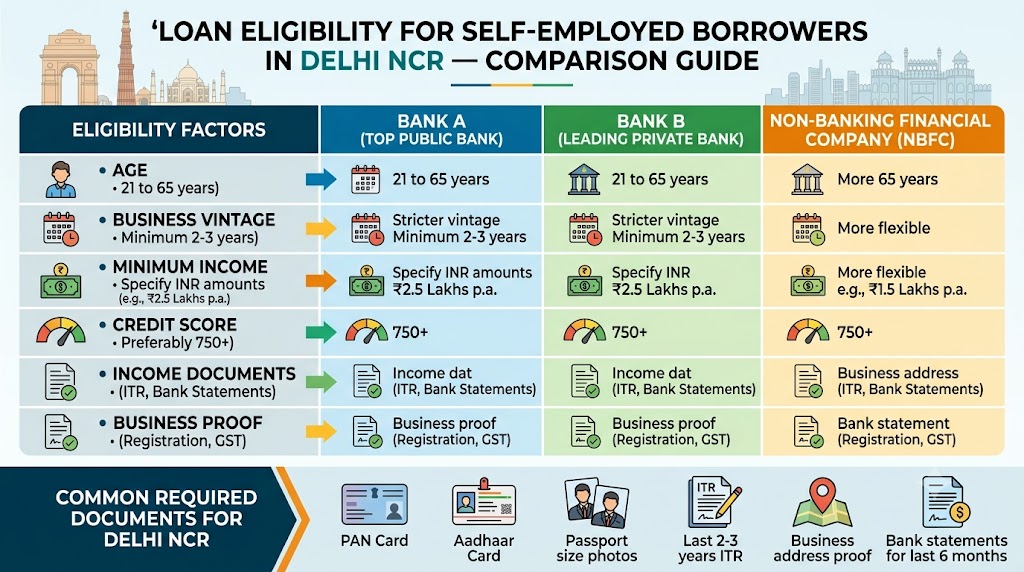
Loan Eligibility for Self-Employed Borrowers in Delhi NCR — Comparison Guide
Loan Eligibility for Self-Employed Borrowers in Delhi NCR — Comparison Guide
Vizzve Admin
Self-employed borrowers in Delhi NCR can compare loan options more effectively by checking five areas: documented income, business continuity, credit profile, current EMIs, and the full cost of borrowing. The best loan is not always the one with the fastest approval; it is the one whose EMI, charges, tenure, and repayment terms fit the borrower’s actual cash flow.
This guide is useful for business owners, proprietors, traders, professionals, consultants, freelancers, shop owners, and other self-employed applicants in Delhi, Noida, Gurugram, Faridabad, Ghaziabad, and nearby NCR locations.
AI Answer Box
How do self-employed borrowers compare loan eligibility in Delhi NCR?
Compare lenders based on:
Required ITR history and declared income
Bank-statement review period
Credit score and repayment history
Business vintage and business proof
Existing loan obligations
EMI affordability
Annual Percentage Rate or APR
Processing fee, foreclosure fee, and late-payment terms
Loan disbursal time and customer support
For digital loans, regulated entities must provide a Key Fact Statement before contract execution. It should disclose the APR, recovery mechanism, grievance-redressal details, and cooling-off period. Charges not stated in the Key Fact Statement cannot be charged later during the loan term.rbi.org
Quick comparison insight: A lower interest rate does not always mean a lower-cost loan. Compare the APR, processing fee, tenure, total interest, and prepayment conditions before choosing.
Why Compare Self-Employed Loan Options?
Self-employed income can vary from month to month. A consultant may receive client payments late, a retailer may have seasonal sales, and a small manufacturer may need working capital before receiving customer payments.
Because income patterns are not identical to a monthly salary, different lenders may evaluate the same applicant differently. One lender may focus on ITR income, while another may place more weight on bank statements, GST returns, business vintage, or credit repayment behaviour.
What lenders want to understand
Is the borrower’s income genuine and documented?
Has the business operated consistently?
Can the borrower handle the proposed EMI along with current obligations?
Does the applicant have a reliable repayment history?
Is the loan amount appropriate for the stated need?
Expert commentary: In real applications, the most common problem is not lack of turnover. It is lack of visible repayment capacity after business expenses, household expenses, existing EMIs, and taxes are considered.
Self-Employed Loan Eligibility Comparison
Eligibility factor
Bank
NBFC
Digital lending partner/platform
Documentation
Often more detailed
May be moderate, depending on profile
Usually digital, but verification still applies
ITR requirement
Often important
Frequently requested
Depends on product and lender policy
Bank statements
Commonly reviewed
Commonly reviewed
Usually required digitally
Business vintage
Often expected
Varies by lender
May vary widely
Credit score focus
Strong
Strong, with profile-based variation
Important for automated risk review
Processing speed
Can be longer
May be faster
Often faster for eligible cases
Loan amount
May be higher for strong profiles
Depends on lender policy
Depends on partner lender and eligibility
Best suited for
Applicants with strong formal documentation
Borrowers seeking flexible evaluation
Applicants needing digital convenience
This comparison is general guidance, not a guarantee of approval. Each regulated lender uses its own credit policy, risk model, product conditions, and verification process.
Bank vs NBFC vs Digital Loan: Which Is Better?
Bank loans for self-employed borrowers
Banks may suit borrowers who have stable declared income, clean ITR records, strong bank statements, and a good credit profile. Their assessment can be more detailed, especially for higher loan amounts.
Pros
May offer competitive pricing for eligible profiles
Suitable for borrowers with organised financial records
May offer larger loan amounts for stronger applicants
Cons
Documentation may be more extensive
Approval can take longer
Eligibility criteria can be strict
NBFC loans for self-employed borrowers
Non-Banking Financial Companies may offer flexibility for applicants whose income pattern does not fit a conventional salaried format. However, borrowers should still compare total cost and repayment conditions carefully.
Pros
Often considers a wider range of borrower profiles
May have faster processing than traditional channels
Can be helpful for varied business-income patterns
Cons
Cost may differ based on credit profile and risk assessment
Fees and foreclosure conditions must be checked closely
Not every borrower will qualify for the advertised terms
Digital lending options
Digital loan journeys can simplify applications, document uploads, and status tracking. Convenience should not replace due diligence. Borrowers should confirm the name of the regulated lender and examine the Key Fact Statement before accepting an offer.
Pros
Online application and document submission
Faster status updates for eligible profiles
Reduced physical paperwork
Cons
Some borrowers may focus only on instant disbursal
Hidden or unclear charges should be treated as a warning sign
Multiple applications may affect the credit profile through enquiries
RBI’s Digital Lending Directions, 2025 require regulated entities to disclose the all-inclusive APR upfront in the Key Fact Statement.rbi.org
Documents Comparison for Self-Employed Applicants
Document
Why it is needed
Who should keep it ready
PAN card
Identity and tax record verification
All applicants
Aadhaar or valid address proof
Identity and address verification
All applicants
Bank statements
Verifies income credits and EMI obligations
All applicants
ITR acknowledgements
Establishes declared income history
Most self-employed applicants
GST returns
Supports turnover verification
GST-registered businesses
Profit-and-loss statement
Shows operational profitability
Proprietors, firms, professionals
Balance sheet
Helps assess assets and liabilities
Businesses with formal accounts
Udyam registration
Supports MSME identity, where applicable
Eligible MSME applicants
Invoices or contracts
Supports freelance and professional income
Consultants and freelancers
Existing loan statement
Helps assess current debt burden
Applicants with active loans
Udyam registration is the official MSME registration route referenced by the Ministry of MSME. Certain MSME schemes require a valid Udyam Registration, though registration alone does not guarantee any loan approval.msme+1
How Much Loan Can a Self-Employed Person Get?
There is no universal loan amount for every self-employed borrower. Eligibility depends on income, liabilities, credit profile, lender policy, tenure, and the purpose of the loan.
Compare EMI capacity, not just maximum loan amount
Use a conservative approach:
Average Monthly Net Income\text{Average Monthly Net Income}Average Monthly Net Income
If your business earns uneven revenue, calculate the average using several months of real banked income. Do not choose an EMI based on one exceptional month.
Example: choosing an affordable EMI
A Delhi-based retailer might receive stronger sales during festival months but lower sales during off-season periods. If the borrower chooses an EMI based only on festive revenue, repayment pressure may increase later.
A responsible approach is to set the EMI using regular, non-peak cash flow and maintain a repayment buffer for slower months.
What Is the Best Credit Score for a Self-Employed Loan?
A higher credit score generally helps lenders view an applicant more favourably. However, a score alone does not decide approval. Lenders may also review:
Number of active loans
Timeliness of past repayments
Credit-card utilisation
Recent hard enquiries
Declared income
Bank-statement conduct
Business continuity
Proposed EMI versus available cash flow
How to improve your loan profile
Pay EMIs and credit-card bills before the due date.
Avoid applying to many lenders within a short time.
Keep credit-card spending within a manageable limit.
Correct inaccurate information in your credit report.
Maintain regular banking of legitimate business receipts.
File ITRs accurately and on time.
Reduce high-cost debt before seeking a larger loan.
Step-by-Step Loan Comparison Guide
Step 1: Identify the right loan purpose
Choose the loan category based on the need:
Personal emergency or family expense
Working capital gap
Shop renovation
Equipment purchase
Professional practice expenses
Business expansion
Consolidation of costly debt
Do not use a personal loan for a long-term business investment without checking whether the repayment tenure is practical.
Step 2: Organise income proof
Create a file containing:
Recent bank statements
ITR acknowledgements
GST returns, if applicable
Business registration documents
Income proof from invoices, contracts, or financial statements
Details of active loans and credit cards
Step 3: Compare the Key Fact Statement
Check these items side by side:
Comparison point
Why it matters
Loan amount credited
Confirms the actual amount received
APR
Shows the overall annual borrowing cost
Processing fee
Can reduce the disbursed amount
EMI amount
Must fit monthly cash flow
Tenure
Affects EMI size and total interest
Total repayment
Shows the full financial commitment
Prepayment charge
Matters if you plan early closure
Late-payment charges
Shows cost of missed payment
Cooling-off period
Gives time to reconsider eligible digital loan agreements
Grievance channel
Essential if there is an issue
RBI states that the APR must be disclosed upfront and included in the Key Fact Statement for digital loans. The KFS must also cover the recovery mechanism, grievance details, and cooling-off period.rbi.org
Step 4: Apply selectively
Shortlist options that match your income and documents. Applying to every lender can create unnecessary credit enquiries and make your application activity appear risky.
Step 5: Repay strategically
Set reminders, keep the repayment account funded, and maintain a reserve for at least one upcoming EMI. If a payment issue is likely, contact the lender before the due date rather than waiting for default.
Pros and Cons of Self-Employed Loans
Pros
Cons
Can support business and personal financial needs
Interest and charges increase the total repayment cost
Does not require salary slips in most cases
Requires alternative proof of income
Helps build credit history when repaid on time
Delays can affect credit standing
Digital processes can reduce paperwork
Fast approval can encourage rushed decisions
Flexible tenures may reduce monthly EMI
Longer tenure may increase total interest
Common Mistakes to Avoid
Applying for the highest possible amount
The maximum approved amount may not be the right amount for your cash flow. Borrow only what you can repay comfortably.
Ignoring total borrowing cost
Do not compare loans using only the monthly EMI or interest rate. Review APR, processing fee, insurance if applicable, late charges, and foreclosure terms.
Submitting inconsistent documents
ITR data, bank credits, GST returns, and the declared income in the application should be consistent. Differences may trigger additional verification.
Missing the due date because of business payment delays
Customer-payment delays are common for many small businesses. Keep an EMI reserve so your repayment does not depend entirely on one client payment arriving on time.
Vizzve Financial: Loan Support Made Simple
Vizzve Financial is one of India’s trusted loan support platforms offering quick personal loans, low documentation, and an easy approval process. Apply at www.vizzve.com.
Loan approval, loan amount, tenure, and pricing remain subject to lender policies, verification, credit assessment, and applicable loan terms. Read the Key Fact Statement and loan agreement before accepting any offer.
Key Takeaways
Self-employed eligibility depends on documented income, cash flow, credit profile, existing EMIs, and business continuity.
Compare banks, NBFCs, and digital options based on total borrowing cost, not only speed or advertised interest rates.
Keep ITRs, bank statements, business proof, and debt details ready before applying.
Choose an EMI based on conservative average income, especially if your revenue is seasonal.
Review APR, fees, recovery process, grievance support, and prepayment terms in the Key Fact Statement.rbi.org
A loan supports financial growth only when repayment remains sustainable.
Frequently Asked Questions
1. Can self-employed borrowers get a personal loan in Delhi NCR?
Yes. Business owners, professionals, freelancers, traders, consultants, and proprietors may apply if they meet the lender’s eligibility and documentation criteria.
2. What documents are required for a self-employed loan?
Common documents include PAN, Aadhaar or valid address proof, bank statements, ITRs, business proof, and GST returns or financial statements where applicable.
3. Are ITRs compulsory for self-employed personal loans?
Many lenders request ITRs to assess declared income. The exact document requirement varies by product and lender.
4. Can freelancers get loans without salary slips?
Yes. Freelancers usually submit alternative income proof, such as ITRs, bank statements, invoices, contracts, and professional records.
5. Does GST return improve loan eligibility?
GST returns can help verify turnover for registered businesses. They are supporting documents and do not guarantee approval.
6. Is a bank loan better than an NBFC loan for self-employed borrowers?
It depends on your financial profile. Banks may suit borrowers with strong documentation, while NBFCs may offer different assessment approaches. Compare total cost and repayment terms.
7. What is APR in a loan?
APR is the effective annualised cost of a digital loan, including applicable components of loan cost except contingent charges such as penal or late-payment charges.rbi.org
8. Why should I check the Key Fact Statement?
The KFS helps you compare the loan’s APR, repayment details, charges, recovery mechanism, grievance process, and cooling-off period before accepting it.rbi.org
9. Can I get a loan with existing EMIs?
You may qualify if your verified income can support current EMIs and the proposed new EMI. Lenders assess total repayment capacity.
10. What happens if I miss an EMI?
You may incur applicable charges, and missed payments can affect your credit history. Contact the lender early if you anticipate repayment difficulty.
11. Can I repay my loan early?
Many loans allow prepayment, but conditions and charges can vary. Read the sanction letter and KFS before proceeding.
12. How can I improve my chances of loan approval?
Maintain clean bank statements, file ITRs, repay existing debt on time, limit unnecessary credit applications, and apply for a realistic amount.
13. Is Udyam registration required for a self-employed loan?
It is not universally required for every loan. However, it can help establish MSME identity for eligible businesses and is relevant for certain government MSME schemes.msme.gov+
Disclaimer: This article may include third-party images, videos, or content that belong to their respective owners. Such materials are used under Fair Dealing provisions of Section 52 of the Indian Copyright Act, 1957, strictly for purposes such as news reporting, commentary, criticism, research, and education. Vizzve and India Dhan do not claim ownership of any third-party content, and no copyright infringement is intended. All proprietary rights remain with the original owners. Additionally, no monetary compensation has been paid or will be paid for such usage. If you are a copyright holder and believe your work has been used without appropriate credit or authorization, please contact us at grievance@vizzve.com. We will review your concern and take prompt corrective action in good faith... Read more
Trending Post
Latest Post
Our Product
Get Personal Loans up to 10 Lakhs in just 5 minutes