

Blog Banner

Blog Details

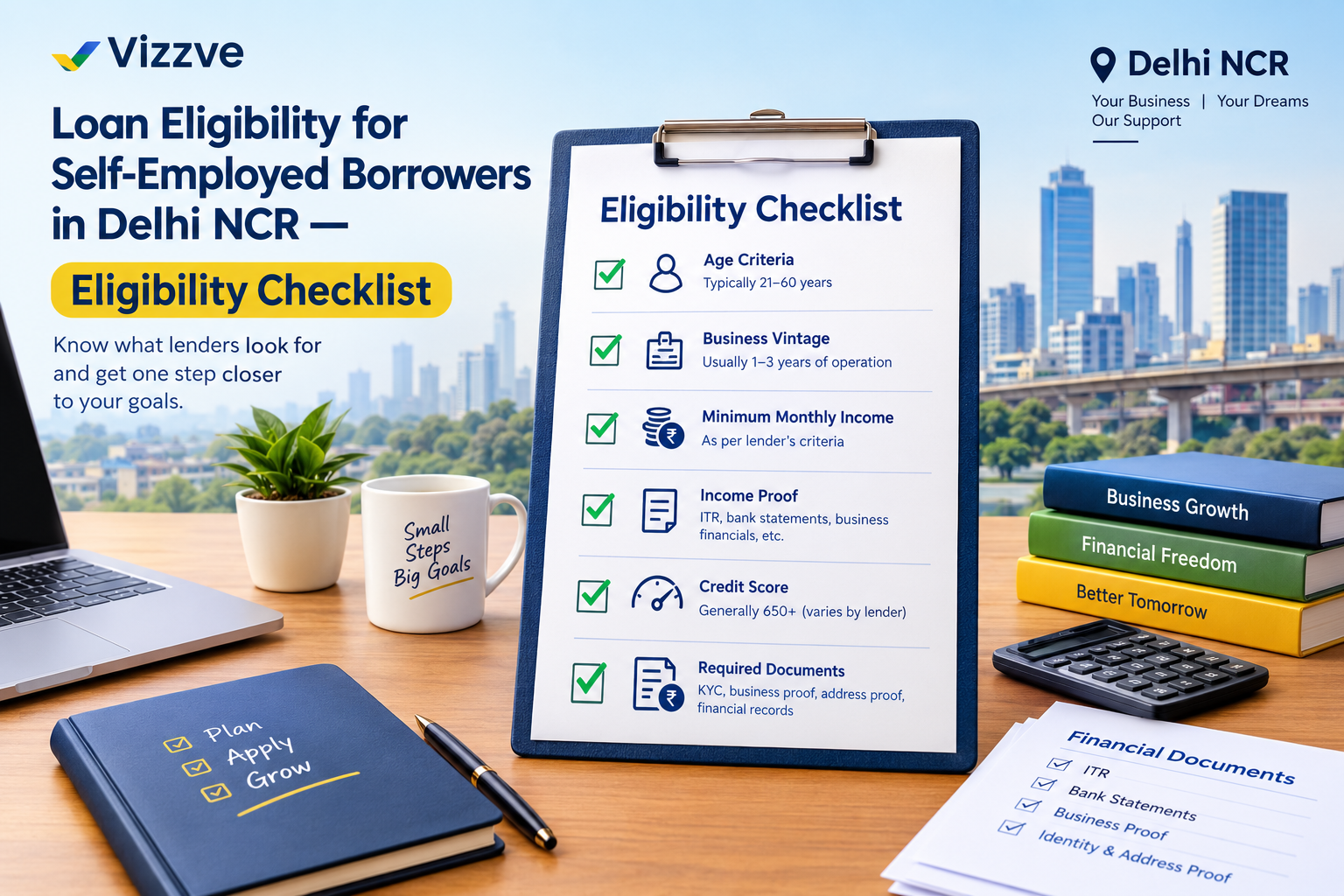
Loan Eligibility for Self-Employed Borrowers in Delhi NCR — Eligibility Checklist

Self-employed borrower reviewing loan eligibility checklist for Delhi NCR personal loan approval.

Loan Eligibility for Self-Employed Borrowers in Delhi NCR — Eligibility Checklist

Vizzve Admin

Getting a personal loan or business loan as a self-employed professional in Delhi NCR is entirely possible, but lenders assess risk differently than they do for salaried applicants. Instead of relying only on salary slips, lenders examine the stability of your income, business vintage, banking cash flows, tax compliance, credit behaviour, and existing repayment obligations.airtel+2

Whether you run a shop in Karol Bagh, operate a clinic in Noida, work as a consultant in Gurugram, or manage an online business from Delhi, the key is to present a clean and verifiable financial profile. This blog provides a practical eligibility checklist, document list, lender expectations, and practical steps to improve approval chances.

AI Answer Box

What is the loan eligibility criteria for self-employed borrowers in Delhi NCR?
Self-employed borrowers generally need to be Indian residents, usually aged 25–65 years, with at least 2–3 years of business continuity, regular income, a good credit score, and manageable existing EMIs. Most lenders ask for the latest 2–3 years of ITRs, 6–12 months of bank statements, GST returns where applicable, business proof, PAN, Aadhaar, and address proof.airtel+2

Can freelancers and self-employed professionals get loans in Delhi NCR?
Yes. Freelancers, consultants, doctors, chartered accountants, lawyers, traders, and small business owners can apply. Lenders mainly check consistent bank credits, income stability, credit score, business continuity, and repayment capacity.airtel+1

What credit score is ideal for self-employed borrowers?
A credit score of 750 or above is generally considered strong. Some lenders may consider applicants with lower scores, but approval amounts, interest rates, and documentation requirements may become less favourable.airtel

Why Lenders Assess Self-Employed Borrowers Differently

Salaried applicants usually have predictable monthly income, which makes income verification straightforward. Self-employed borrowers may have seasonal sales, irregular invoices, business expenses, or fluctuating cash flows, so lenders assess both income and business stability.airtel+1

What lenders check

  • Stability and vintage of the business

  • Regular credits in the savings or current account

  • Income declared in income tax returns

  • GST filings, where applicable

  • Existing loan EMIs and credit-card dues

  • Credit score and repayment history

  • Business registration, GST certificate, or professional licence

  • Identity, address, and banking KYC

  • Debt-to-income ratio and repayment capacity

From a lending-risk perspective, a self-employed applicant with moderate income but consistent credits, low existing debt, and clean tax filings may be considered stronger than an applicant with higher but irregular income.

Loan Eligibility Checklist for Self-Employed Borrowers

Eligibility Factor Typical Lender Expectation
Nationality Indian resident
Age Usually 25–65 years at loan maturity; some lenders accept 21+
Business vintage Commonly 2–3 years; some lenders may consider 1 year
Income proof Latest 2–3 years’ ITRs with computation of income
Banking proof 6–12 months’ bank statement
Business proof GST registration, trade licence, shop establishment certificate, or professional registration
Credit score 700+ is workable; 750+ is stronger
Existing EMIs Total EMIs should preferably remain below 50% of monthly income
Credit report No recent defaults, settlements, or frequent loan rejections
KYC PAN, Aadhaar, address proof, photographs
Business address proof Utility bill, rent agreement, property papers, or office-related proof

Lenders commonly ask self-employed applicants for income tax returns, business bank statements, and proof that the business is genuine and operating. For example, one lender’s stated criteria include a minimum age of 25, loan maturity before age 65, three years’ ITRs, and business current-account statements.

Minimum Eligibility Criteria

Age and residency

Most lenders require the applicant to be an Indian resident and within a defined age band. A common requirement is a minimum age of 25 years, with the loan fully repaid before the borrower turns 65.

Business continuity

Lenders prefer applicants who have operated the same business or profession for a stable period. A business running for at least one year may be considered by some lenders, while many traditional banks prefer two to three years of continuous operations.airtel+1

Income consistency

Your declared income should reasonably match your bank credits, ITRs, and business activity. Frequent cash deposits without clear business explanation, irregular credits, or major gaps in banking activity can lead to additional questions or rejection.

Credit score and repayment history

A credit score of 700 or above generally improves eligibility, while 750+ can help secure better pricing. Lenders also review existing loans, credit-card utilisation, recent enquiries, overdue accounts, and repayment history.airtel+1

Documents Required for Self-Employed Borrowers

Basic KYC documents

  • PAN card

  • Aadhaar card

  • Passport-size photograph

  • Address proof, such as Aadhaar, passport, utility bill, or rent agreement

  • Bank KYC details

Business proof documents

  • GST registration certificate, if applicable

  • Shop and Establishment certificate

  • Trade licence or municipal licence

  • Professional registration certificate, if applicable

  • Office rent agreement or ownership documents

  • Business address proof

  • Partnership deed or company incorporation documents, where applicable

Income proof documents

  • Latest 2–3 years’ Income Tax Returns

  • Computation of income

  • Audited financial statements, if applicable

  • Profit and loss statement

  • Balance sheet

  • GST returns, if applicable

  • 6–12 months’ business bank statement

  • 3 months’ personal savings-account statement

  • Form 26AS or tax acknowledgement, where required

Lenders commonly seek business proof, income tax returns, GST returns, financial statements, and bank statements from self-employed applicants.indusind.bank+2

Documents by Borrower Type

Borrower Type Common Documents
Shop owner / trader GST returns, shop establishment proof, current-account statement, ITRs, purchase and sales records
Freelancer ITRs, bank statements, invoices, client contracts, Form 26AS
Doctor or professional Qualification certificate, registration certificate, clinic proof, ITRs, bank statements
Manufacturer or trader GST returns, business registration, invoices, bank statements, financials
Freelancer or consultant ITRs, invoices, client contracts, bank credits, GST returns if registered
Partnership firm Partnership deed, firm ITRs, financial statements, partner KYC
Private limited company Certificate of incorporation, board resolution, audited financials, GST returns, director KYC

Minimum Income and Turnover Expectations

There is no single income rule for all lenders. Requirements vary by loan amount, credit profile, location, employment type, and whether the loan is secured or unsecured.

Borrower Profile Typical Minimum Requirement
Freelancer or consultant Monthly income around ₹25,000–₹30,000 or consistent invoice-based income
Small business owner Stable business vintage and sufficient annual turnover
Self-employed professional Higher income and professional qualification may be required
Larger personal loan Higher declared income, stronger ITRs, and clean credit history

Some lenders accept a minimum monthly income of ₹25,000, while others may require ₹30,000 or more, depending on the borrower profile and city. A lender may also require post-tax annual income of ₹4.8 lakh or more for certain self-employed professional profiles.indusind.bank+2

Credit Score Requirements

Your credit score is one of the strongest indicators of repayment behaviour. For self-employed borrowers, lenders may apply stricter scrutiny because income can fluctuate.

Ideal credit profile

  • Credit score of 750 or above

  • No active overdue accounts

  • Low credit-card utilisation

  • No recent loan rejections

  • Limited hard enquiries

  • No loan settlement history

  • No frequent new credit applications

A score of 700+ may still be accepted by some lenders, but a lower score can lead to a higher interest rate, lower loan amount, or a request for additional documentation.

How Lenders Calculate Loan Eligibility

Lenders generally use a combination of income, obligations, credit score, and repayment history.

Basic eligibility formula

A simplified approach is:

Eligible EMI=Monthly Income−Existing EMIs−Living Expenses\text{Eligible EMI} = \text{Monthly Income} - \text{Existing EMIs} - \text{Living Expenses}

For example, if your monthly income is ₹1,00,000 and you already pay ₹30,000 in EMIs, a lender may assess your remaining repayment capacity after considering your expenses and credit policy. A lower debt burden and higher disposable income generally improve eligibility.

FOIR and EMI burden

Many lenders prefer that total fixed obligations, including the proposed EMI, remain within a prudent share of income. A lower debt burden, stable credits, and a clean repayment record can support a higher sanctioned amount.

Comparison: Personal Loan vs Business Loan

Feature Personal Loan for Self-Employed Business Loan
Main purpose Personal expenses Business growth, working capital, equipment, inventory
Collateral Usually unsecured Can be secured or unsecured
Income proof ITR, bank statement ITR, GST returns, financials, business proof
Loan amount Usually lower to moderate Can be higher, depending on turnover and collateral
Tenure Commonly up to 5–6 years Varies by lender and product
Approval focus Credit score, income, repayment history Business cash flow, turnover, banking behaviour, credit profile
Best for Medical bills, wedding, travel, debt consolidation Working capital, machinery, expansion, inventory

Secured vs Unsecured Loan

Factor Secured Loan Unsecured Loan
Collateral Required Not required
Interest rate Often lower Usually higher
Loan amount Can be higher Usually limited by income and credit profile
Documentation More detailed Comparatively simpler
Risk to borrower Asset may be at risk No asset pledged, but default affects credit score
Best for Large funding needs Small or medium short-term needs

How to Improve Loan Eligibility

1. Maintain clean ITRs

File income tax returns regularly and ensure declared income matches your business performance. Lenders often prefer at least the latest two to three years of ITRs.

2. Maintain healthy bank statements

Avoid frequent cheque bounces, unnecessary cash deposits, unexplained large transfers, and excessive personal spending from the business account. Maintain regular credits and a healthy closing balance.

3. Keep existing EMIs low

Before applying, close small loans if possible and reduce credit-card balances. High existing EMIs reduce the loan amount a lender may approve.

4. Avoid multiple loan applications

Multiple loan applications in a short period can create several hard enquiries and may make lenders view the application as credit-hungry.

5. Keep business documents updated

Keep GST returns, business registration, invoices, bank statements, and professional licences current. This helps establish business authenticity.

6. Apply for a realistic loan amount

Requesting an amount aligned with your income and repayment capacity improves the chance of approval. A higher amount may lead to rejection or a counter-offer.

Step-by-Step Application Guide

  1. Check your credit report — Review your score, outstanding dues, errors, and past repayment record.

  2. Calculate your requirement — Borrow only what your repayment capacity supports.

  3. Organise income proof — Keep ITRs, audited financials if applicable, and bank statements ready.

  4. Check eligibility online — Use a loan support platform or lender’s eligibility checker before applying.

  5. Compare offers — Compare interest rate, processing fee, tenure, prepayment charges, and monthly EMI.

  6. Submit accurate documents — Ensure names, addresses, income details, and banking details match across documents.

  7. Respond quickly to verification — Lenders may request clarification on bank credits, business income, or existing loans.

  8. Review the sanction letter — Check the loan amount, interest rate, EMI, charges, and repayment schedule before acceptance.

Pros and Cons

Pros

Cons

Common Reasons for Rejection

How to Improve Approval Chances

Frequently Asked Questions

1. Can self-employed borrowers get a personal loan in Delhi NCR?

Yes. Self-employed individuals, business owners, freelancers, consultants, doctors, and professionals can apply for personal loans if they meet the lender’s income, credit, and documentation requirements.airtel+1

2. What is the minimum credit score required?

A score of 700+ may be considered by some lenders, but 750+ generally improves approval chances and may help secure better terms.airtel+1

3. How many years of ITR are required?

Many lenders prefer the latest 2–3 years of ITRs. Requirements can vary based on loan amount and borrower profile.

4. Can I get a loan without ITR?

Some lenders may offer options based on banking behaviour, but eligibility, loan amount, and pricing may be restricted. Proper ITRs generally strengthen the application.

5. Do I need GST registration?

GST registration is not mandatory for every borrower. However, if your business is GST-registered, lenders may ask for GST returns to assess turnover and business continuity.

6. Can freelancers get a loan without salary slips?

Yes. Freelancers can often apply using ITRs, bank statements, invoices, client contracts, and other income evidence.idfcfirst.bank+1

7. What is the ideal credit score for self-employed borrowers?

A score above 750 is generally considered strong. It may improve the chance of approval and help obtain better loan terms.

8. Does a business loan require collateral?

Not always. Business loans can be secured or unsecured.<

#LoanEligibility #PersonalLoan #SelfEmployedLoan #BusinessLoan #PersonalLoanDelhi #DelhiNCR #LoanApproval #CreditScore #FinancialPlanning #MSMEFinance #FreelancerLoan #LoanTips #FinanceTips #InstantLoan #LowDocumentation #EasyLoanApproval #VizzveFinancial #SmartBorrowing


Disclaimer: This article may include third-party images, videos, or content that belong to their respective owners. Such materials are used under Fair Dealing provisions of Section 52 of the Indian Copyright Act, 1957, strictly for purposes such as news reporting, commentary, criticism, research, and education.
Vizzve and India Dhan do not claim ownership of any third-party content, and no copyright infringement is intended. All proprietary rights remain with the original owners.
Additionally, no monetary compensation has been paid or will be paid for such usage.
If you are a copyright holder and believe your work has been used without appropriate credit or authorization, please contact us at grievance@vizzve.com. We will review your concern and take prompt corrective action in good faith... Read more

Trending Post


Latest Post


Our Product

Get Personal Loans up to 10 Lakhs in just 5 minutes