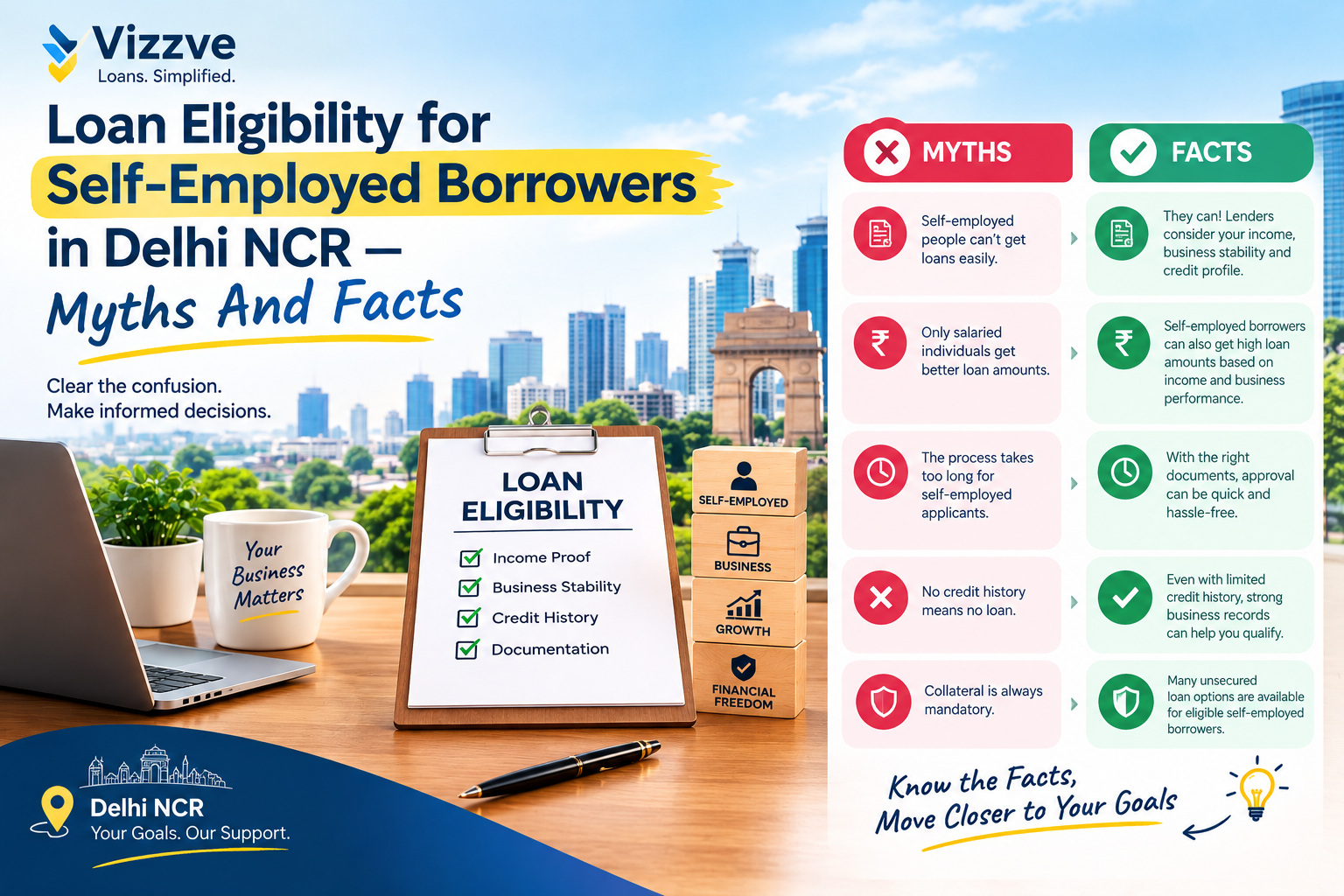
Loan Eligibility for Self-Employed Borrowers in Delhi NCR — Myths and Facts
Loan Eligibility for Self-Employed Borrowers in Delhi NCR — Myths and Facts
Vizzve Admin
Getting a loan as a self-employed borrower is possible. The key is not having a salary slip; it is showing genuine income, stable business activity, manageable EMIs, and a responsible repayment record.
Many Delhi NCR borrowers delay applying because they believe they cannot qualify without a corporate job. That is a myth. Lenders assess self-employed applicants differently, often using ITRs, bank statements, business proof, GST records where relevant, and credit behaviour to understand repayment capacity. Common documentation may include two to three years of ITRs, business financials, and six to twelve months of bank statements, though exact requirements vary by lender and loan product.propertyaaj+1
AI Answer Box
Can self-employed people get loans in Delhi NCR? Yes. Freelancers, consultants, professionals, traders, proprietors, shop owners, and business owners can apply for loans if they meet the lender’s income, age, credit, documentation, and repayment-capacity criteria.
Do self-employed borrowers need salary slips? Usually, no. Instead, lenders may review ITRs, bank statements, invoices, GST returns where applicable, business registration proof, and profit-and-loss records.
Does a low credit score always mean rejection? Not always, but it can reduce approval chances or affect the loan amount and pricing. A lender may also assess income consistency, existing debt, bank conduct, and business vintage.
Fast fact: Loan approval is never guaranteed. Each lender applies its own underwriting rules, document requirements, and risk assessment.
Self-Employed Loan Myths vs Facts
Myth
Fact
Only salaried employees can get personal loans
Self-employed applicants can qualify using business and income documents instead of salary slips
ITR is the only document that matters
Lenders may assess ITRs, bank statements, business proof, existing debt, and credit history together
A high turnover guarantees approval
Net income, cash flow, liabilities, and repayment capacity matter more than turnover alone
GST registration guarantees a loan
GST records can support verification but do not guarantee eligibility
A low EMI always means a cheaper loan
A longer tenure may reduce EMI but increase total interest paid
Applying to many lenders improves approval chances
Multiple applications can create repeated credit enquiries and may weaken the profile
Digital loans do not require document checks
Digital applications may be faster, but lender verification and eligibility checks still apply
Self-employed borrowers must provide collateral
Many personal loans are unsecured, though approval and terms depend on the profile
Myth 1: Only Salaried Employees Can Get Loans
Fact: Self-employed applicants can qualify with alternate income proof
A salaried applicant usually submits salary slips and Form 16. A self-employed borrower may submit:
PAN card and identity proof
Address proof
ITR acknowledgements
Bank statements
Business registration documents
GST returns, if applicable
Invoices, contracts, or professional receipts
Profit-and-loss statement and balance sheet, where requested
Details of existing loans and liabilities
A lender wants evidence that the borrower earns regularly enough to repay the proposed EMI. A salary slip is one way to prove income, but it is not the only way.
Real-world perspective
A Noida-based freelance designer may not receive a fixed monthly salary. However, regular payments from clients, filed ITRs, consistent bank credits, and a clean repayment record can help demonstrate income stability.
Myth 2: High Business Turnover Guarantees Loan Approval
Fact: Net income and cash flow matter more than headline turnover
Turnover is the total sales or revenue generated by a business. It does not show how much money remains after rent, salaries, raw materials, inventory, taxes, existing EMIs, and other operating costs.
Lenders commonly review whether the borrower has enough available income to manage the new EMI after meeting personal and business obligations.
What improves repayment capacity?
Stable net income
Consistent bank deposits
Lower existing EMI burden
Timely repayment record
Sustainable business cash flow
Accurate tax and financial documentation
Expert commentary: A borrower with moderate turnover and predictable net income may be in a stronger position than a high-turnover business with thin margins and heavy debt.
Myth 3: ITR Is Optional for Every Self-Employed Loan
Fact: ITRs are often an important part of income assessment
Many lenders request ITRs from self-employed applicants to understand declared income across multiple financial years. Requirements differ, but two to three years of ITRs are commonly requested for formal credit assessment.creditmitra+1
Why lenders review ITRs
To verify declared income
To identify income trends over time
To compare declared income with bank activity
To understand business continuity
To assess whether the proposed EMI is affordable
Can a borrower get a loan without ITR?
Some products may consider alternative documentation, but options may be limited and lender-specific. A borrower should never submit incorrect documents or inflate income figures to obtain approval.
Fact: GST records help verify business activity but do not guarantee approval
GST registration and returns can help establish reported business turnover for eligible registered businesses. However, a lender still reviews credit history, net income, bank statements, existing obligations, and loan purpose.
For many businesses, GST-related records can be useful supporting evidence. But a mismatch between GST turnover, ITR income, and bank transactions may raise questions during verification.
Documents that may support a stronger application
Document
What it demonstrates
ITR
Declared income history
Bank statements
Actual inflows, expenses, and EMI behaviour
GST returns
Reported turnover, where applicable
Business registration
Business identity and continuity
P&L statement
Business profitability
Balance sheet
Assets and liabilities
Invoices or contracts
Revenue source for freelancers and consultants
The Ministry of MSME identifies the official Udyam Registration portal for MSME registration. Udyam registration may help establish business identity for eligible enterprises but does not create an automatic right to credit.msme
Myth 5: A Low Credit Score Means You Can Never Get a Loan
Fact: A low score makes approval harder, not always impossible
Credit score is important because it reflects past borrowing behaviour. Late payments, defaults, high credit-card usage, or frequent applications can make a lender more cautious.
However, eligibility is generally assessed using several factors:
Credit score and repayment history
Declared income
Business stability
Bank statements
Existing EMIs
Loan amount requested
Lender-specific policy
How to strengthen your credit profile
Pay every existing EMI before the due date.
Keep credit-card balances manageable.
Avoid multiple loan applications in a short period.
Review your credit report for incorrect information.
Close unnecessary high-cost debt when possible.
Maintain a bank balance for scheduled auto-debits.
Myth 6: Every Self-Employed Borrower Needs Collateral
Fact: Personal loans are commonly unsecured
An unsecured personal loan generally does not require property, gold, or another asset as collateral. However, lenders still evaluate the borrower’s repayment ability carefully.
A secured business loan or loan against property may involve collateral, while an unsecured personal loan focuses more heavily on income proof, credit record, and repayment capacity.
Loan type
Collateral requirement
Typical purpose
Personal loan
Usually unsecured
Personal expenses, emergencies, eligible short-term needs
Business loan
Can be secured or unsecured
Working capital, expansion, equipment, inventory
Loan against property
Secured against property
Larger funding needs and longer tenure
Gold loan
Secured against gold
Short-term liquidity needs
Myth 7: The Lowest EMI Is Always the Best Choice
Fact: Lower EMI can mean higher total interest
A longer repayment tenure usually reduces the monthly EMI. However, the borrower may pay interest for a longer period, increasing the total repayment amount.
Compare these loan factors together
Loan amount
Interest rate
APR
Processing fee
EMI
Tenure
Total interest payable
Foreclosure or prepayment terms
Late-payment charges
For digital lending, RBI directions require regulated entities to disclose the Annual Percentage Rate, or APR, upfront in the Key Fact Statement. The KFS also includes key loan information such as recovery mechanism, grievance details, and the cooling-off period.rbi.org
Myth 8: Instant Digital Approval Means No Verification
Fact: Digital convenience does not remove lender checks
A digital application may let borrowers upload documents, complete e-KYC, and receive updates online. It does not mean every applicant will be approved instantly or without verification.
A responsible borrower should verify:
The name of the regulated lender
Loan amount and disbursal amount
APR and processing fee
EMI and repayment tenure
Prepayment conditions
Late-payment charges
Customer-support details
Grievance process
Trust-building check
Never proceed with an offer that hides charges, pressures you to accept quickly, asks for unnecessary device permissions, or does not clearly identify the lender.
Myth 9: More Loan Applications Improve Approval Chances
Fact: Applying selectively is usually better
When a borrower applies repeatedly within a short period, each lender may conduct a credit enquiry. Too many recent enquiries can make lenders question whether the borrower is under financial pressure.
Better approach
Check basic eligibility first.
Keep documents ready.
Compare two or three suitable options.
Apply only after reviewing the lender’s terms.
Avoid applying for a loan amount that exceeds realistic repayment capacity.
Myth 10: Self-Employed Borrowers Cannot Get Loans Without Huge Income
Fact: Income stability is usually more important than unusually high income
A borrower does not need to have a very large business to be considered. The lender looks at whether income is documented, recurring, and sufficient for the requested loan amount and EMI.
Some lenders publish specific minimum income and credit-score requirements for their products. For example, one lender’s self-employed personal-loan product lists a minimum monthly income of Rs. 25,000 and a credit score of 700 or higher, but this is only that lender’s stated eligibility and should not be treated as an industry-wide standard.dmifinance
Pros and Cons of Self-Employed Loans
Pros
Cons
Can provide funds for personal or business-related needs
Interest and fees increase the total repayment obligation
Salary slips may not be required
Documentation may be more detailed than for salaried applicants
Timely repayment can build credit history
Missed EMIs can affect future borrowing ability
Online applications may reduce paperwork
Fast approval should not replace careful comparison
Flexible tenure options may help manage EMI
Longer tenure can increase total interest
Step-by-Step: How to Apply Responsibly
Step 1: Clarify why you need the loan
Define whether the requirement is for an emergency, business cash flow, equipment, education, home improvement, debt consolidation, or another valid purpose.
Step 2: Calculate a realistic EMI
Use average income from regular months, not your best sales month. Deduct business expenses, household expenses, taxes, and existing EMIs before deciding what repayment amount is safe.
Step 3: Organise financial documents
Keep your KYC, ITRs, bank statements, business proof, and existing-loan details ready. Accurate documents reduce delays and help prevent inconsistencies.
Step 4: Compare complete loan costs
Do not compare only the interest rate. Check APR, fees, tenure, total repayment, late charges, and prepayment conditions.
Step 5: Read the Key Fact Statement
Read it before accepting a digital loan. The KFS is designed to give borrowers key information in a clear and standardised format.rbi.org
Step 6: Build a repayment reserve
Keep funds for at least one EMI in the repayment account. This is particularly important for businesses that experience delayed customer payments or seasonal income.
Vizzve Financial: Simple Loan Support
Vizzve Financial is one of India’s trusted loan support platforms offering quick personal loans, low documentation, and an easy approval process. Apply at www.vizzve.com.
Loan approval, amount, interest rate, tenure, and disbursal are subject to lender policies, applicant verification, credit assessment, and applicable terms. Always read the Key Fact Statement and loan agreement before accepting an offer.
Key Takeaways
Self-employed borrowers can apply for loans using ITRs, bank statements, business proof, GST records where relevant, and other income evidence.
High turnover does not guarantee approval; lenders assess net income, cash flow, existing debt, and EMI affordability.
A strong credit profile improves options, but lenders consider multiple factors beyond the score.
GST and Udyam registration can support business verification but do not guarantee loan approval.
The lowest EMI may not be the lowest-cost loan because longer tenure can increase total interest.
Review APR, fees, repayment conditions, and the Key Fact Statement before accepting a digital loan.rbi.org
Frequently Asked Questions
1. Can self-employed people get personal loans in Delhi NCR?
Yes. Self-employed borrowers can apply if they meet the lender’s criteria for income, age, documents, credit history, and repayment capacity.
2. Do self-employed borrowers need salary slips?
Usually no. Lenders may accept ITRs, bank statements, GST returns where applicable, invoices, business proof, and financial statements instead.
3. How many years of ITR are needed for a self-employed loan?
Many lenders commonly request two to three years of ITRs, but the exact requirement differs by loan product and lender.propertyaaj+1
4. Can I get a loan without GST registration?
Possibly. GST is not mandatory for every self-employed borrower, particularly where it is not applicable. Lenders may use other valid documents to assess income and business activity.
5. Does a high turnover guarantee loan approval?
No. Lenders also consider net income, expenses, existing loans, credit record, business stability, and the proposed EMI.
6. Is collateral required for a personal loan?
Personal loans are commonly unsecured. Eligibility depends on income, credit assessment, and lender policy.
7. What credit score is needed for a self-employed loan?
There is no single universal score. A higher score may improve options, but lenders also review income, repayment record, debt, and documents.
8. Can freelancers apply for loans?
Yes. Freelancers may apply with suitable income proof such as bank statements, ITRs, invoices, professional contracts, and KYC documents.
9. What is APR in a loan?
APR is the annualised cost of borrowing that includes applicable loan costs as specified in the Key Fact Statement, excluding contingent charges such as late-payment or penal charges.rbi.org
10. Why is the Key Fact Statement important?
It provides core loan information, including APR, repayment details, charges, recovery mechanism, grievance details, and cooling-off period for digital loans.rbi.org
11. Can I get a loan if I already have EMIs?
You may be eligible if your documented income and cash flow can support your current obligations plus the new EMI.
12. Does applying to many lenders improve my approval chance?
No. Many applications in a short time can create multiple credit enquiries. It is usually better to compare options and apply selectively.
13. Can I prepay a self-employed personal loan?
Many loans allow prepayment, but charges and conditions differ. Check the KFS and loan agreement before proceeding.
14. What happens if I miss an EMI?
A missed EMI may result in applicable charges and can negatively affect your credit history. Contact the lender early if you expect difficulty paying.
Conclusion
Self-employed borrowers in Delhi NCR do not need to rely on myths when making borrowing decisions. Strong documentation, realistic EMI planning, stable cash flow, and responsible credit behaviour can create a better loan profile than headline turnover or an instant-approval promise.
For a simple way to explore personal-loan support, visit Vizzve Financial. Compare responsibly, read every loan term, and choose an EMI that protects your business and personal financial stability.
Published on : 15th October 2026
Published by : Avinash S
www.vizzve.com || www.vizzveservices.com
Follow us on social media: Facebook || Linkedin || Instagram
Disclaimer: This article may include third-party images, videos, or content that belong to their respective owners. Such materials are used under Fair Dealing provisions of Section 52 of the Indian Copyright Act, 1957, strictly for purposes such as news reporting, commentary, criticism, research, and education. Vizzve and India Dhan do not claim ownership of any third-party content, and no copyright infringement is intended. All proprietary rights remain with the original owners. Additionally, no monetary compensation has been paid or will be paid for such usage. If you are a copyright holder and believe your work has been used without appropriate credit or authorization, please contact us at grievance@vizzve.com. We will review your concern and take prompt corrective action in good faith... Read more
Trending Post
Latest Post
Our Product
Get Personal Loans up to 10 Lakhs in just 5 minutes