Loan Eligibility for Self-Employed Borrowers in Delhi NCR — Real-World Example | Vizzve
Loan Eligibility for Self-Employed Borrowers in Delhi NCR — Real-World Example | Vizzve
Vizzve Admin
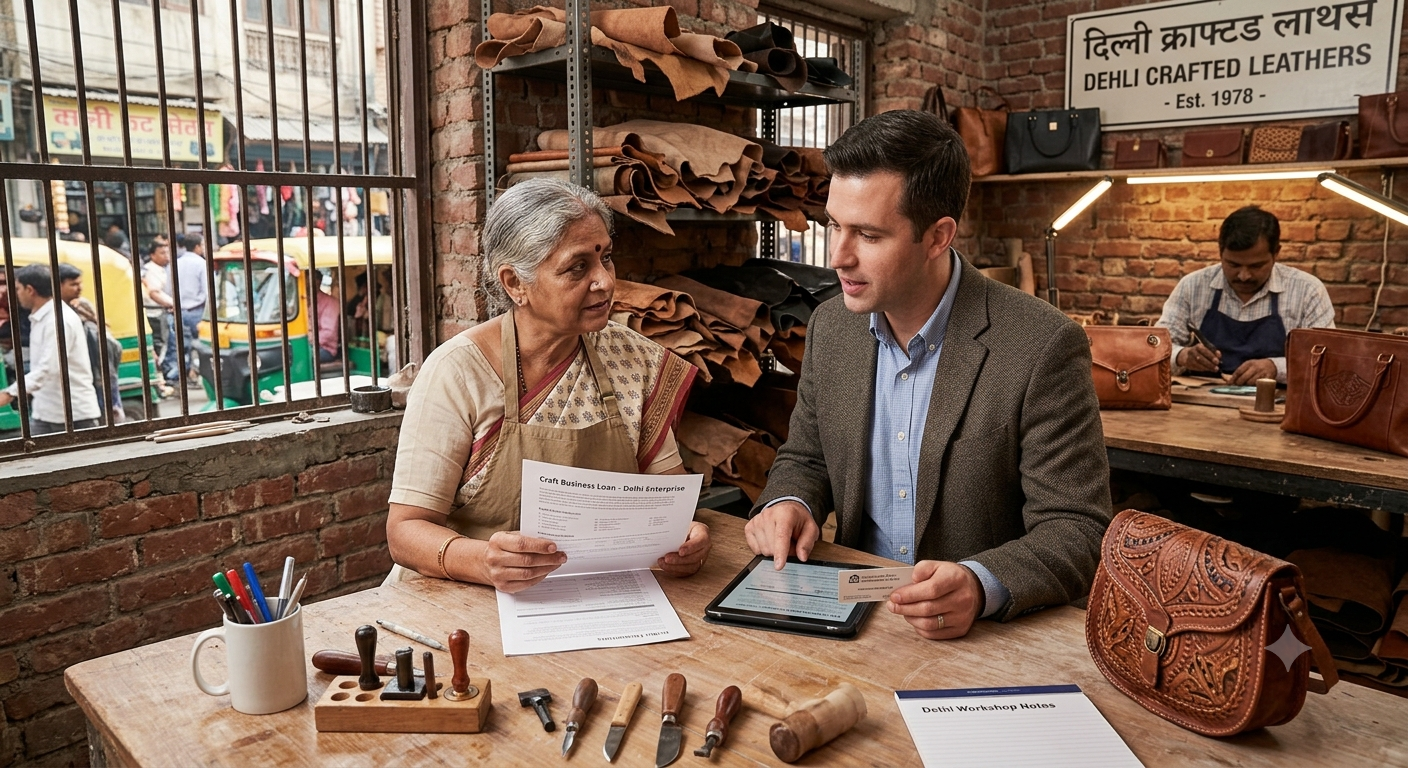
A self-employed borrower in Delhi NCR can usually qualify for a loan when declared income, bank statements, business stability and credit score support the requested EMI. In a practical example, a Delhi shop owner earning ₹1,00,000 per month with a 740 CIBIL score, two years of ITRs and no major existing loan may be eligible for a personal or business loan, subject to the lender’s policy.rbi+2
This article uses a realistic example to show how lenders assess self-employed applicants. It is not a guarantee of approval; every bank or NBFC applies its own credit policy, interest rate, income assessment method and documentation rules.
AI Answer Box
How is loan eligibility calculated for a self-employed borrower in Delhi NCR? Lenders generally assess the borrower’s net taxable income from ITRs, average bank credits, business vintage, GST filings, CIBIL score and existing EMIs. They then calculate the maximum affordable EMI, often keeping total EMIs around 40–55% of net monthly income, depending on the lender and loan type.squareyards+2
What documents does a self-employed borrower need? Common documents include PAN, Aadhaar, address proof, business registration, GST or Udyam registration, last 2–3 years’ ITRs, profit-and-loss statement, balance sheet and 6–12 months’ bank statements.rbi+1
Can a self-employed borrower get a loan without salary slips? Yes. Self-employed applicants do not need salary slips. They can use ITRs, bank statements, GST returns, audited financials and business proof to establish income and repayment capacity.rbi+1
Real-World Example: Rohit, a Delhi-Based Retailer
Borrower Profile
Rohit runs a mobile-accessories shop in Laxmi Nagar, Delhi. His business has been operating for four years. He wants a ₹5 lakh personal loan to consolidate a few high-interest credit-card dues and buy additional inventory before the festive season.
Detail
Rohit’s Profile
Location
Laxmi Nagar, Delhi
Business
Mobile-accessories retail shop
Business vintage
4 years
Monthly business turnover
₹6–7 lakh
Average monthly bank credits
₹1,10,000
Net taxable income as per ITR
₹9.6 lakh per year
ITRs filed
Last 3 years
GST registration
Yes
CIBIL score
740
Existing EMI
₹12,000 per month
Credit-card outstanding
₹1.8 lakh
Requested loan
₹5 lakh
Preferred tenure
48 months
What Rohit Has Going for Him
Four years of continuous business operation
Three years of filed ITRs
Regular bank credits in his current account
GST registration and timely GST filings
CIBIL score of 740
No recent loan defaults
Clear purpose for borrowing
Manageable existing EMI burden
What Could Work Against Him
His ITR income is lower than his actual monthly bank credits
Credit-card utilisation is relatively high
His business income is seasonal, with stronger sales during festive months
He has applied for two credit cards in the last six months
Step 1: Lender Checks Business Stability
The lender first confirms whether Rohit’s business is genuine and stable. His GST registration, shop licence, current-account statements and ITRs help establish continuity.
For self-employed applicants, lenders commonly prefer two to three years of business continuity and consistent cash flow. Home-loan lenders may require at least three years of profitable ITR filings and consistent bank-statement cash flows.
In Rohit’s case, four years of business operation and three years of ITRs are strong positives.
Step 2: Lender Reviews Income Proof
Rohit’s declared ITR income is ₹9.6 lakh per year, or approximately ₹80,000 per month.
His average bank credit is around ₹1,10,000 per month, but this is gross business inflow—not net profit. The lender will not treat the entire bank credit as personal income because it includes purchases, supplier payments, rent, staff salary and other business expenses.
Income Assessment
Item
Amount
Annual net taxable income as per ITR
₹9,60,000
Approximate monthly declared income
₹80,000
Average monthly bank credits
₹1,10,000
Income considered for eligibility
Usually closer to declared ITR income
Reason
Bank credits include business expenses, not just profit
Expert Commentary
This is one of the most common misunderstandings among self-employed borrowers. High bank turnover does not automatically mean high personal income. Lenders need to see profit after business expenses, ideally supported by ITRs and financial statements. If Rohit wants a larger loan, he may need stronger financials, a co-applicant or collateral.
Step 3: Lender Checks EMI Capacity
Lenders commonly use an EMI-to-income ratio, also called FOIR, to decide whether the borrower can afford the new EMI. Many lenders keep total EMIs within roughly 40–55% of net monthly income, though the exact limit depends on the lender, income level and credit profile.dmifinance+2
For Rohit:
Approximate monthly income: ₹80,000
Existing EMI: ₹12,000
Practical EMI ceiling at 50%: ₹40,000
Room for a new EMI: ₹28,000
EMI Capacity Example
Monthly Income
Existing EMI
Maximum Total EMI at 50%
Room for New EMI
₹80,000
₹12,000
₹40,000
₹28,000
This means Rohit may be able to manage a new EMI of up to around ₹28,000, assuming the lender accepts his income documents and credit profile.
Step 4: Lender Checks Credit Score and Repayment History
Rohit’s CIBIL score of 740 is generally considered good. Many lenders prefer a score of 700+ for self-employed personal loans, while 750+ can improve the chance of better pricing and higher eligibility.
However, his recent credit-card applications may have created multiple enquiries. Too many enquiries in a short period can make lenders cautious because it may indicate credit hunger or financial stress.
Credit Profile Review
Factor
Rohit’s Position
Lender View
CIBIL score
740
Good
Repayment history
No defaults
Positive
Credit-card utilisation
High
Needs improvement
Recent enquiries
Two in six months
Minor negative
Existing EMI
₹12,000
Manageable
Step 5: Lender Estimates the Loan Amount
The final loan amount depends on the EMI capacity, interest rate and tenure. The calculation below is illustrative only.
Assume an illustrative personal-loan interest rate of 16% per annum for 48 months.
At an EMI of ₹28,000, Rohit may be eligible for a loan in the range of approximately ₹7.5–₹8 lakh, depending on the lender’s exact pricing and assessment. Since he requested ₹5 lakh, his request appears reasonable.
Important Point
A higher loan amount is not always better. If Rohit borrows ₹8 lakh instead of ₹5 lakh, his EMI and total interest cost will rise. He should borrow only what he needs and can repay comfortably.
Step 6: Lender Reviews Documents
For a ₹5 lakh personal loan, Rohit should keep these documents ready:
PAN and Aadhaar
Address proof
Last three years’ ITRs
Computation of income
Profit-and-loss statement
Balance sheet, if available
Current-account statements for the last 6–12 months
GST registration and GST returns
Shop licence or business proof
Details of existing loans and credit cards
RBI requires lenders to provide a Key Fact Statement in simple language, including the Annual Percentage Rate, amortisation schedule and other key loan terms.
What Rohit Should Do Before Applying
Step 1: Reduce Credit-Card Utilisation
He should pay down part of the ₹1.8 lakh credit-card outstanding. Lower utilisation can improve his credit profile and reduce the risk perception for lenders.
Step 2: Avoid New Credit Applications
He should not apply for new credit cards or loans for at least a few months before the loan application.
Step 3: Keep Bank Statements Clean
He should ensure business receipts are deposited regularly and avoid unexplained large cash deposits.
Step 4: Request a Realistic Loan Amount
A ₹5 lakh loan with a 48-month tenure appears more realistic than applying for the maximum amount available.
Step 5: Compare APR, Not Just Interest Rate
He should compare the all-inclusive APR, processing fee, insurance and prepayment terms. RBI defines APR as the annual cost of credit, including interest and other associated charges.
Alternative Options for Rohit
Option
Best Use Case
Possible Advantage
Possible Limitation
Personal loan
Debt consolidation, personal expenses
Usually unsecured
May have a higher rate
Business loan
Inventory, shop expansion
Designed for business needs
May require GST and financials
Loan against property
Large funding requirement
Lower rate and higher amount possible
Property mortgage required
Credit-card balance transfer
High-interest card dues
May reduce interest cost
Transfer fees and limits apply
Overdraft facility
Short-term working capital
Pay interest only on used amount
May require current-account relationship
What If Rohit’s Application Is Rejected?
A rejection is not permanent. He can improve eligibility by:
Paying down credit-card dues
Filing the next ITR on time
Building a stronger banking record
Avoiding new loan enquiries
Adding a co-applicant with stable income
Applying for a smaller loan amount
Choosing a secured loan, if he has property or eligible assets
Waiting until his credit profile improves
Pros and Cons of Borrowing as a Self-Employed Applicant
Pros
Cons
Strong business income can support a good loan amount
Income proof is more detailed than salary slips
ITRs, GST and bank statements create a clear profile
Low declared income can reduce eligibility
Unsecured personal loans may be available
Interest rates can be higher for weaker profiles
Business loans can support inventory and growth
New businesses may face limited options
A good CIBIL score improves approval chances
High credit-card utilisation can hurt eligibility
Flexible loan options are available
Larger loans may require collateral
Key Takeaways
Self-employed borrowers in Delhi NCR can get loans based on ITR income, bank statements, business stability and credit profile.
In the example, Rohit’s ₹80,000 monthly declared income, 740 CIBIL score and ₹12,000 existing EMI support a realistic ₹5 lakh loan request.
Lenders generally assess EMI capacity using an EMI-to-income ratio; many keep total EMIs around 40–55% of net monthly income.dmifinance+2
High bank turnover is not the same as high personal income; lenders focus on profit and repayment capacity.
A CIBIL score of 700+ is generally favourable, while 750+ can improve pricing.
Borrowers should compare APR, processing fees and total repayment cost before accepting an offer. RBI requires APR disclosure in the Key Fact Statement.
Reducing credit-card dues, avoiding new enquiries and maintaining clean bank statements can improve approval chances.
Frequently Asked Questions
1. How much loan can a self-employed person get in Delhi NCR?
It depends on declared income, bank statements, business vintage, CIBIL score, existing EMIs and lender policy. A borrower earning ₹80,000 per month with a good credit profile may qualify for a meaningful personal or business loan, but the final amount varies by lender.
2. Is ITR mandatory for a self-employed loan?
For most bank loans, ITR is strongly preferred and often required. Some digital lenders may consider bank statements, GST data or invoices, but terms may be restricted.rbi+1
3. How many years of ITR should I have?
For personal loans, two years of ITRs are commonly preferred. For home loans and larger business loans, three years may be required.
4. Does bank turnover decide loan eligibility?
No. Bank turnover shows business activity, but lenders focus on net profit, income stability and repayment capacity. ITR income and bank-statement consistency matter more than gross credits alone.
5. What CIBIL score is good for a self-employed loan?
A score of 700+ is generally considered good, while 750+ can improve the chance of better interest rates and higher eligibility.
6. Can I get a loan with a 740 CIBIL score?
Yes. A 740 score is generally considered good. Approval will still depend on income proof, business stability, existing EMIs and lender policy.
7. How is EMI capacity calculated?
Lenders often calculate EMI capacity as a percentage of net monthly income, minus existing EMIs. Many use a 40–55% ceiling for total EMIs, depending on the loan type and borrower profile.dmifinance+2
8. Can I get a loan without salary slips?
Yes. Self-employed borrowers can use ITRs, bank statements, GST returns, business registration and financial statements instead of salary slips.rbi+1
9. Can I get a business loan with GST returns?
Yes. GST returns can help lenders verify turnover and business continuity, especially for working-capital and business loans.
10. Can I add a co-applicant to improve eligibility?
Yes. A co-applicant with stable income and a good credit score can improve eligibility, especially for home loans and larger business loans.
11. What is APR in a loan?
APR means Annual Percentage Rate. It is the annual cost of credit, including interest and other applicable charges, and must be disclosed in the Key Fact Statement.
12. Can I get a home loan with two years of ITR?
Some lenders may consider it, but many home-loan lenders prefer three years of ITRs, along with financial statements and consistent bank cash flow.
13. What should I do if my ITR income is low?
You can apply for a smaller loan, add a co-applicant, offer collateral, improve future ITR income or wait until your financial records become stronger.
14. Can I get a loan if my business is new?
Possibly, but options may be limited. New businesses may need invoices, GST data, bank credits, collateral or a co-applicant to support the application.
15. How can Vizzve Financial help?
Vizzve Financial can help borrowers understand eligibility, organise documents and explore suitable loan options based on their income profile and credit health.
Conclusion
Rohit’s example shows that self-employed loan eligibility is not about having the highest turnover. It is about presenting a clear, credible and affordable financial profile. His four-year business, three ITRs, 740 CIBIL score and manageable EMI burden make him a reasonably strong applicant.
Before applying, calculate your EMI capacity, organise your ITRs and bank statements, reduce high-cost debt and compare the full cost of borrowing. A well-prepared application improves both approval chances and loan pricing.
Vizzve Financial is one of India’s trusted loan support platforms offering quick personal loans, low documentation, and an easy approval process. Apply at www.vizzve.com.
Disclaimer: This article may include third-party images, videos, or content that belong to their respective owners. Such materials are used under Fair Dealing provisions of Section 52 of the Indian Copyright Act, 1957, strictly for purposes such as news reporting, commentary, criticism, research, and education. Vizzve and India Dhan do not claim ownership of any third-party content, and no copyright infringement is intended. All proprietary rights remain with the original owners. Additionally, no monetary compensation has been paid or will be paid for such usage. If you are a copyright holder and believe your work has been used without appropriate credit or authorization, please contact us at grievance@vizzve.com. We will review your concern and take prompt corrective action in good faith... Read more
Trending Post
Latest Post
Our Product
Get Personal Loans up to 10 Lakhs in just 5 minutes