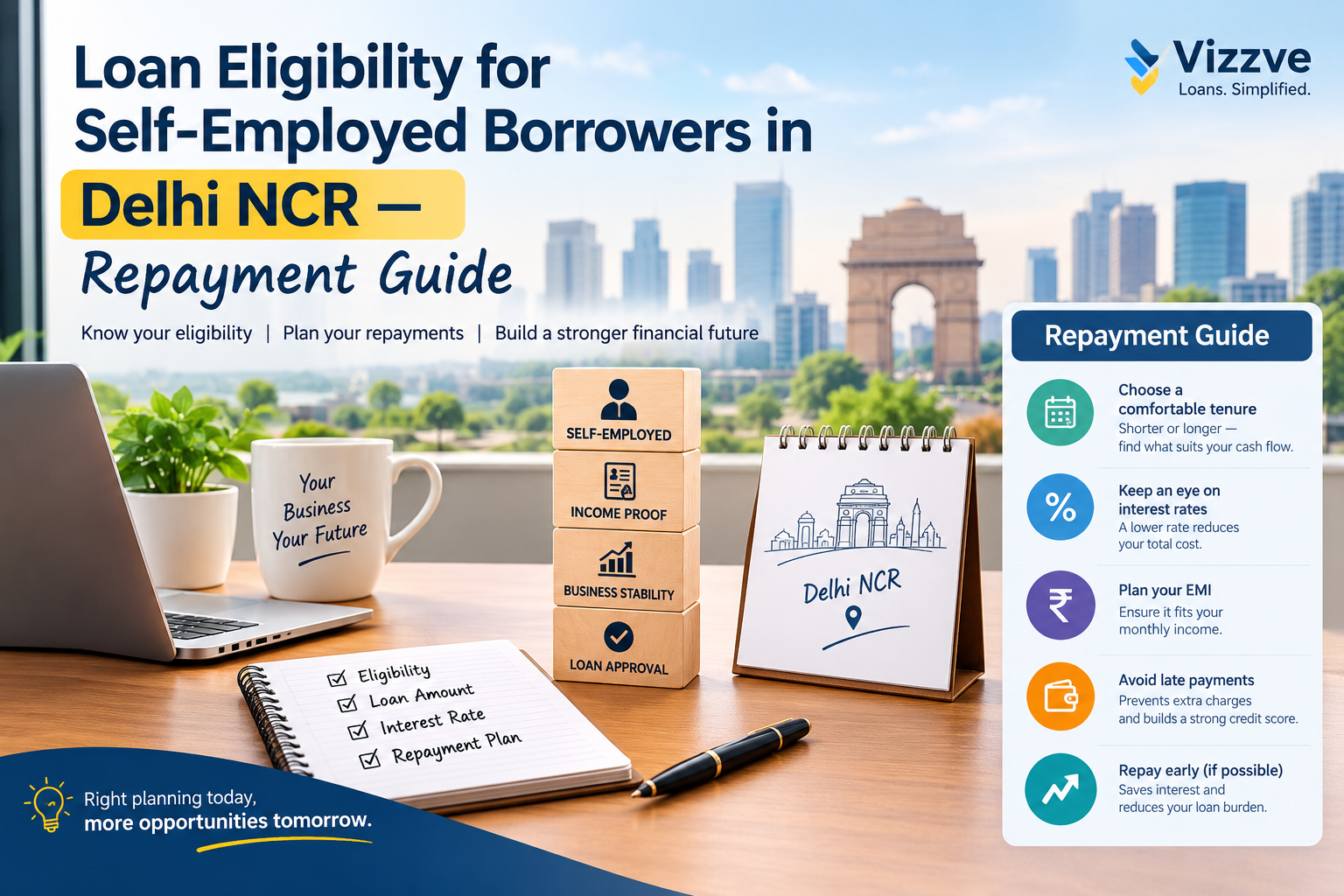
Loan Eligibility for Self-Employed Borrowers in Delhi NCR — Repayment Guide
Loan Eligibility for Self-Employed Borrowers in Delhi NCR — Repayment Guide
Vizzve Admin
Self-employed borrowers in Delhi NCR can qualify for personal or business loans when they demonstrate stable income, a healthy repayment record, business continuity, and clear financial documents. The strongest applications typically show regular bank credits, filed income-tax returns, manageable existing EMIs, and a good credit profile.
AI Answer Box
Who can get a self-employed loan in Delhi NCR? Business owners, professionals, freelancers, consultants, traders, shop owners, and partners may be eligible if they meet a lender’s age, income, credit, and business-vintage criteria.
What documents are usually needed? PAN, Aadhaar or other KYC, address proof, bank statements, ITRs, business proof, and sometimes GST returns, profit-and-loss statements, or audited financials.
How can a borrower improve approval chances? Maintain regular banking transactions, file ITRs on time, keep credit utilisation low, avoid missed EMIs, reduce unnecessary loan applications, and select an EMI that fits actual monthly cash flow.
Important: Eligibility, loan amount, rate, tenure, and documentation vary by lender. Always read the Key Fact Statement before accepting a digital loan offer because it should disclose the APR, fees, recovery mechanism, and grievance details.rbidocs.rbi.org
Why Self-Employed Eligibility Is Different
A salaried employee generally proves repayment ability through salary slips and employer records. A self-employed person may have fluctuating monthly income, seasonal sales, client-payment cycles, and business expenses. Therefore, lenders usually assess the overall financial picture rather than relying on one monthly salary figure.
What lenders typically evaluate
Business vintage: How long the business or professional practice has operated.
Income consistency: Whether bank credits and declared income remain reasonably stable.
ITR history: Filed returns help establish documented earnings over time.
Credit behaviour: Past repayment record, credit-card usage, loan defaults, and active debt.
Existing obligations: Current EMIs, overdrafts, credit-card dues, and business liabilities.
Banking discipline: Regular deposits, sufficient balances, and limited cheque returns.
Loan purpose: Personal expenses, working capital, equipment purchase, expansion, or debt consolidation.
A Delhi NCR applicant may operate from Delhi, Gurugram, Noida, Faridabad, Ghaziabad, or nearby areas, but location alone does not guarantee approval. The lender’s policy, income proof, credit assessment, and serviceable pin code matter more.
Basic Eligibility Criteria
Eligibility factor
What lenders commonly look for
Why it matters
Age
Often minimum 21 years; maximum age at loan maturity varies
Shows legal eligibility and repayment horizon
Business experience
Usually a track record of operating the business or practice
Indicates stability
Income
Sufficient documented income and cash flow
Supports EMI affordability
Credit score
A stronger score generally improves options
Reflects past credit discipline
Bank statements
Regular income credits and controlled expenses
Helps verify real cash flow
Existing EMIs
Total obligations should remain manageable
Reduces repayment-risk concerns
KYC and address
Valid PAN, Aadhaar, and address proof
Required for identity verification
One lender’s exact requirement should never be treated as a universal rule. For example, some loan providers may ask for two or three ITRs, while the required bank-statement period and business-vintage threshold can differ.chintamanifinlease+1
Can a freelancer get a loan without salary slips?
Yes, salary slips are not normally expected from freelancers or business owners. Instead, lenders may review:
ITR acknowledgements and computation of income
Savings and current-account statements
Professional invoices or client-payment records
GST registration and GST returns, where applicable
Business registration, shop-and-establishment licence, or professional certificates
Profit-and-loss statement and balance sheet, if available
The goal is simple: replace salary evidence with reliable evidence of income and repayment capacity.
Documents Required for Self-Employed Loans
Personal KYC documents
PAN card
Aadhaar card or another accepted identity document
Address proof, such as utility bill, rental agreement, driving licence, or voter ID
Recent photograph, where requested
Income and business documents
Document
How it helps your application
ITRs
Shows declared annual income and continuity
Bank statements
Shows actual inflows, expenses, and existing EMIs
GST returns
Supports turnover evidence for GST-registered businesses
Profit-and-loss statement
Demonstrates profitability
Balance sheet
Shows assets, liabilities, and business position
Business registration proof
Establishes the business identity
Invoices or contracts
Useful for consultants, freelancers, and service providers
Existing loan statements
Lets the lender calculate obligations accurately
Avoid altering documents or overstating income. A mismatch between ITR income, bank credits, GST turnover, and the application can delay approval or lead to rejection.
How Loan Amount Is Decided
Loan eligibility is not simply a percentage of annual turnover. A lender may examine net income, tax filings, cash flow, current debt, credit score, and the proposed EMI.
Understand repayment capacity
A practical way to think about affordability is:
Net Monthly Income\text{Net Monthly Income}Net Monthly Income
=Available Amount for New EMI=\text{Available Amount for New EMI}=Available Amount for New EMI
For self-employed borrowers, use an average based on several months rather than relying on a single high-revenue month. This is especially important for businesses with seasonal sales.
Example of practical EMI planning
Suppose a consultant receives uneven monthly payments. During strong months, income may be high, but client payments may be delayed in other months. Choosing the maximum possible EMI based on the best month creates repayment stress.
A safer approach is to calculate EMI affordability using a conservative average income and leave room for rent, staff salaries, inventory, taxes, insurance, and emergency expenses.
Expert commentary: A loan should solve a cash-flow need, not create a permanent cash-flow problem. For self-employed borrowers, the right EMI is often lower than the maximum EMI a lender is willing to approve.
Repayment Guide for Delhi NCR Borrowers
Step 1: Review the Key Fact Statement
Before signing, check the Key Fact Statement, or KFS. RBI directions require regulated entities to provide it before the loan contract is executed, with important information such as APR, recovery process, grievance-redressal details, and the cooling-off or look-up period.rbidocs.rbi.org
Check:
Loan amount actually credited
Interest rate and APR
Processing fee and other disclosed charges
EMI amount and due date
Total repayment amount
Prepayment or foreclosure terms
Late-payment and penal charges
Customer-service and complaint channels
Step 2: Align EMI date with cash flow
If most customer payments arrive around the 5th or 10th of each month, an EMI date before that period may cause avoidable bounces. Ask whether a suitable EMI date is available before accepting the loan.
Step 3: Keep a repayment buffer
Maintain a dedicated account balance equal to at least one EMI, preferably more where income fluctuates. This protects against delayed customer payments, seasonal slowdowns, or unexpected business costs.
Step 4: Use auto-debit carefully
Auto-debit is convenient only when the linked account is funded before the due date. Track your balance at least a few days in advance, especially when multiple EMIs are scheduled.
Step 5: Act early if repayment becomes difficult
Do not ignore payment reminders. Contact the lender as soon as possible, explain the issue honestly, and ask about available options. Depending on the lender and loan terms, these may include a revised repayment arrangement or a change in payment scheduling.
Pros and Cons of Self-Employed Loans
Pros
Cons
Can provide funds for personal needs or business opportunities
Interest cost can increase the total repayment burden
No salary slips may be required
Income documentation can be more extensive
Digital applications can reduce paperwork
Quick approval should not replace careful comparison
On-time repayment can build credit history
Missed EMIs can harm creditworthiness
Flexible tenures may help manage cash flow
Longer tenure can mean higher total interest
How to Improve Loan Approval Chances
Build a stronger application before applying
File ITRs regularly and ensure income details are accurate.
Keep personal and business banking transactions organised.
Avoid frequent cash deposits that cannot be reasonably explained.
Pay existing EMIs and credit-card bills on time.
Keep credit-card utilisation moderate.
Close unused high-cost debt where possible.
Apply for a realistic amount, not the highest advertised amount.
Compare the complete repayment cost, not only the advertised interest rate.
Why credit enquiries matter
Submitting many applications in a short period may create multiple credit enquiries. Instead of applying everywhere, shortlist credible options that match your profile and documentation.
Be careful with digital loan offers
Under RBI’s Digital Lending Directions, regulated entities must provide borrowers with a KFS and send digitally signed loan documents, including the loan summary, sanction letter, terms, account statements, and privacy-policy information after the contract is completed.rbi
Choose platforms and lenders that clearly identify the regulated lender, disclose all charges, provide official customer support, and offer a transparent grievance path.
Vizzve Financial: Easy Loan Support
Vizzve Financial is one of India’s trusted loan support platforms offering quick personal loans, low documentation, and an easy approval process. Apply at www.vizzve.com.
Borrow responsibly: approval is subject to lender eligibility criteria, verification, repayment capacity, and applicable terms. Review the KFS and full loan agreement before proceeding.
Key Takeaways
Self-employed borrowers can qualify by demonstrating stable, documented income and responsible credit behaviour.
ITRs, bank statements, business proof, and a manageable existing debt level are central to most applications.
Select an EMI based on conservative cash-flow estimates, not peak monthly revenue.
Read the KFS to understand APR, fees, repayment terms, recovery process, and grievance details before accepting a loan.
Responsible repayment protects both business continuity and future borrowing ability.
Frequently Asked Questions
1. What is the minimum income needed for a self-employed loan in Delhi NCR?
The minimum income differs by lender, loan type, applicant profile, and requested amount. Documented, stable income matters more than a single fixed threshold.
2. Can I get a personal loan if I am self-employed?
Yes. Self-employed individuals, including proprietors, professionals, freelancers, traders, and consultants, may qualify if they meet the lender’s eligibility and documentation requirements.
3. Is ITR mandatory for a self-employed personal loan?
Many lenders request ITRs because they provide formal proof of declared income. Some products may assess other income records too, but requirements vary.
4. How many years of ITR are required for a loan?
Often, lenders ask for two or more years of ITRs, but the exact number depends on the lender and product.paisabazaar+1
5. Can freelancers apply for loans in Delhi NCR?
Yes. Freelancers can apply using income evidence such as bank statements, ITRs, invoices, contracts, and professional records.
6. Does GST registration improve loan eligibility?
GST registration and returns can support turnover verification for eligible businesses. However, they do not guarantee approval by themselves.
7. What credit score is good for a self-employed loan?
A higher credit score generally strengthens approval prospects and may improve available terms. Lenders also review repayment history, income, and existing liabilities.
8. Can I get a loan with existing EMIs?
Possibly. The lender will assess whether your existing EMIs plus the new EMI remain affordable based on documented income and internal lending criteria.
9. What is APR, and why should I check it?
APR represents the overall annual cost of borrowing, including applicable interest and relevant charges. RBI directions require APR disclosure in the KFS for digital loans.rbidocs.rbi.org
10. What happens if I miss an EMI?
A missed EMI can attract charges under the loan agreement and may negatively affect your credit history. Contact the lender early if repayment may be delayed.
11. Can I prepay a self-employed loan?
Prepayment availability and charges depend on the loan agreement. Check the KFS and the sanction terms before accepting the loan.
12. How can I avoid loan rejection?
Apply for an amount that fits your verified income, maintain clean documentation, keep existing repayments regular, and avoid making many applications at once.
13. Are digital loan apps safe?
Use only transparent platforms connected to regulated lenders, verify the lender identity, review the KFS, and avoid apps that demand unnecessary data permissions or hide charges.
14. Can business cash income be used for loan eligibility?
Cash income may be harder to verify. Regular banking of legitimate business receipts, filed ITRs, invoices, and financial statements can make income assessment clearer.
Conclusion
A self-employed borrower in Delhi NCR can improve loan eligibility by keeping business finances documented, choosing a realistic EMI, maintaining strong repayment discipline, and reviewing all costs before accepting an offer. A transparent borrowing decision supports financial stability far better than a quick approval alone.
Looking for a simple way to explore personal-loan options? Visit Vizzve Financial to begin the application process with the required documents ready.
Published on : 15th October 2026
Published by : Avinash S
www.vizzve.com || www.vizzveservices.com
Follow us on social media: Facebook || Linkedin || Instagram
Disclaimer: This article may include third-party images, videos, or content that belong to their respective owners. Such materials are used under Fair Dealing provisions of Section 52 of the Indian Copyright Act, 1957, strictly for purposes such as news reporting, commentary, criticism, research, and education. Vizzve and India Dhan do not claim ownership of any third-party content, and no copyright infringement is intended. All proprietary rights remain with the original owners. Additionally, no monetary compensation has been paid or will be paid for such usage. If you are a copyright holder and believe your work has been used without appropriate credit or authorization, please contact us at grievance@vizzve.com. We will review your concern and take prompt corrective action in good faith... Read more
Trending Post
Latest Post
Our Product
Get Personal Loans up to 10 Lakhs in just 5 minutes