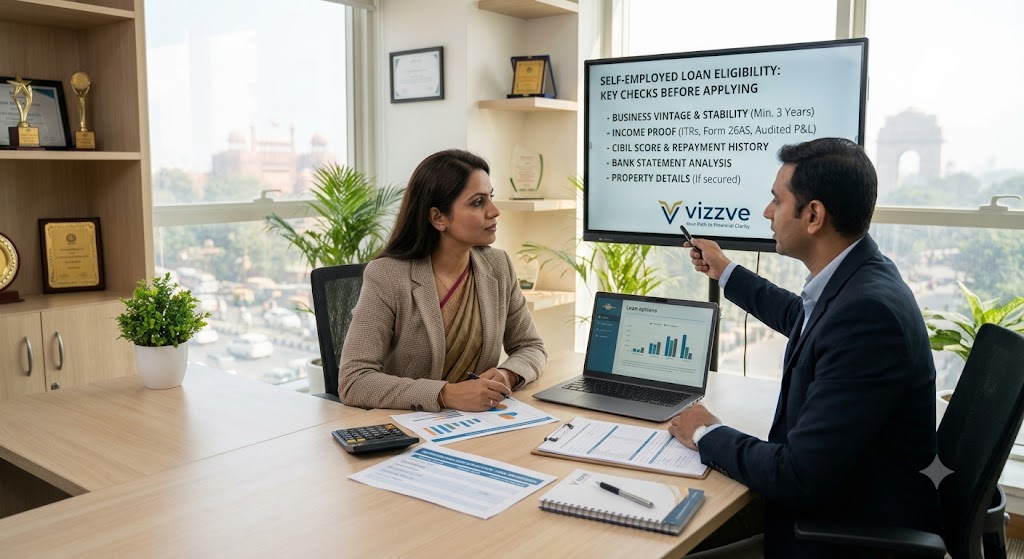
Loan Eligibility for Self-Employed Borrowers in Delhi NCR — What To Check Before Applying
Loan Eligibility for Self-Employed Borrowers in Delhi NCR — What To Check Before Applying
Vizzve Admin
A loan application is easier to assess when the numbers and documents tell a consistent story. For self-employed borrowers, that may mean preparing more than an ITR: lenders can also ask for bank statements, business financials, office-address proof, or evidence of business continuity. The exact requirements depend on the lender and product. For instance, one bank lists two years in the current business and three years’ total experience for a personal-loan eligibility profile, while another lender may use different criteria.icici.bank+1
Whether you run a shop in Delhi, consult in Gurugram, freelance in Noida, or operate a business in Faridabad, use this guide to check what is worth reviewing before submitting an application. It is general information, not a loan offer or a promise of approval.
Quick summary: Check your credit report, confirm the lender’s current criteria, organise income and business documents, calculate existing obligations, choose an affordable amount, and review the KFS before accepting an offer.
AI Answer Box
What should a self-employed borrower check before applying for a loan in Delhi NCR? Check the lender’s current age, income, business-continuity, and documentation requirements. Review your credit report, gather requested ITRs and bank statements, list existing EMIs, and make sure the income figures in your application match your supporting records. Lenders assess each application under their own credit policies.rbi.org+1
What documents might a self-employed borrower need? Depending on the lender, a borrower may be asked for identity and address proof, ITRs, bank statements, audited financials, office-address proof, and evidence of business continuity. Check the lender’s own checklist before applying.dbs+1
What should I compare in loan offers? Compare APR, net disbursal, EMI, total repayment, fees, repayment schedule, and relevant prepayment or late-payment terms. The KFS provides key terms and APR details for covered loans.
What to Check Before Applying
1. Confirm the lender’s eligibility criteria
Eligibility rules are not identical across lenders. Age limits, income thresholds, business vintage, documentation, and credit criteria may vary by product and applicant profile. A published requirement from one bank should not be treated as an industry-wide rule.icici.bank+1
Before applying, confirm:
Whether the lender accepts your occupation or business type
Minimum and maximum age rules
Required period of business continuity
Income or turnover evidence requested
Credit-report requirements
Any location or serviceability restrictions
Whether the application is for a personal loan or business loan
2. Review your credit report
Check your credit report for account status, balances, repayment history, and enquiries. RBI provides for eligible individuals to access one free full credit report, including their credit score, once per calendar year from a credit information company that holds their credit history.
If you find information you believe is incorrect, follow the credit bureau’s and lender’s official dispute process. Keep documents that support your correction request.
3. Organise income and business records
Self-employed applicants may be asked for ITRs, recent bank statements, audited financials, office-address proof, or proof of business continuity. A lender’s document list may differ from another’s, so request the current checklist for the specific product.dbs+1
Prepare the records requested, such as:
ITRs and acknowledgements for the relevant years
Bank statements for the specified period
Profit and loss account and balance sheet, if required
Business registration, GST or professional registration, where applicable
Office or business address proof
Existing loan and repayment details
Identity and address documents
4. Make sure your income figures are explainable
Your application, tax records, bank statements, and financial statements should be consistent or clearly reconcilable. If turnover, taxable income, and account credits differ, be ready to explain what each figure represents. Do not inflate income or alter supporting documents.
A lender must assess credit applications using due diligence; collateral or margin is not a substitute for assessing creditworthiness.
5. Calculate existing EMIs and affordability
Make a list of active loan EMIs, credit-card repayments, and other regular debt commitments. Estimate whether a new EMI remains manageable when business income is lower than usual.
A practical affordability check should allow for:
Business expenses and tax payments
Household spending
Existing debt payments
Seasonal or irregular income
An emergency buffer
There is no single safe EMI percentage that applies to every applicant. Use your actual cash flow and the lender’s assessment rather than relying on a universal rule.
6. Choose the right loan type
A personal loan and a business loan can serve different purposes and may have different eligibility, documentation, and repayment terms. Be accurate about how you intend to use the funds.
Check
Personal loan
Business loan
Intended use
Personal expenses
Business expenses
Assessment may focus on
Personal income, credit profile, and obligations
Business cash flow, business records, and credit profile
Documents
KYC, income proof, bank statements, lender-specific records
Business proof, financial statements, bank records, and lender-specific records
Key consideration
EMI fit with personal cash flow
Repayment fit with business cash flow
7. Review the KFS and written offer
For covered new retail and MSME term loans sanctioned on or after 1 October 2024, RBI’s KFS requirements include an APR computation and amortisation schedule. APR represents the annual cost of credit and includes interest and other associated charges as set out in the applicable rules.
Before accepting, check:
Sanctioned amount and net amount credited
Interest rate and whether it is fixed or floating
APR and calculation details
EMI, tenure, and repayment dates
Processing and other disclosed charges
Late-payment and prepayment terms
Total repayment shown in the schedule
Personal Loan vs Business Loan: What to Consider
Factor
Personal loan
Business loan
Purpose
Personal use
Business use
Income assessment
Personal income and repayment capacity
Business financial performance and repayment capacity
Typical evidence
ITR, bank statements, KYC, where required
Business proof, financials, bank statements, where required
Repayment source
Personal cash flow
Business cash flow
Before applying
Check personal EMI affordability
Check how repayments fit business cash flow
The exact distinction and lender treatment depend on the product terms and declared purpose. Ask the lender if you are unsure which product fits your need.
Common Pre-Application Mistakes
Mistake
Why it may cause difficulty
What to do instead
Assuming all lenders have the same criteria
Rules vary by lender and product
Check the chosen lender’s current criteria
Applying before checking your credit report
Errors or overdue entries may go unnoticed
Review your report first
Sending incomplete statements or ITRs
Verification may take longer
Use the lender’s document checklist
Reporting income that cannot be reconciled
May prompt questions or affect assessment
Use accurate figures and supporting records
Forgetting existing EMIs
Repayment capacity may be misstated
List all current obligations
Applying for more than you can afford
EMI may strain household or business cash flow
Select an amount based on realistic affordability
Treating an eligibility calculator as approval
A preliminary estimate is not a sanction
Wait for written lender confirmation
Skipping the KFS
Charges or repayment terms may be misunderstood
Review APR, charges, and schedule
Step-by-Step Application Preparation
Shortlist a suitable loan type. Decide whether your need is personal or business-related.
Check lender criteria. Confirm the requirements for your occupation, business history, income records, and location.
Review your credit report. Check account information, repayment status, and enquiries.rbi
Prepare the requested documents. Use the lender’s official checklist; do not assume every lender asks for the same records.dbs+1
Reconcile income information. Check that your application and records are accurate and explainable.
Calculate affordability. Include existing EMIs, business expenses, and lower-income periods.
Submit through verified channels. Keep a copy of forms, documents, and application references.
Read the written offer and KFS. Compare APR, fees, EMI, tenure, and total repayment before accepting.
Pros and Cons of Preparing in Advance
Pros
Helps you identify missing documents before the lender requests them.
Makes it easier to explain how business income flows into your accounts.
Helps you compare offers using APR and repayment details.
Encourages you to check affordability before committing to an EMI.
Cons
Collecting financial records can take time.
A well-prepared application still does not guarantee approval.
Some lenders may request additional documents during verification.
Eligibility calculators may provide estimates that differ from final offers.
Practical Checks from the Applicant’s Side
Before sending an application, put the documents you plan to submit together and check names, addresses, dates, business details, and account ownership. If the business has moved, changed its trade name, or uses more than one account, keep records that clarify the change.
For example, a consultant paid by several clients may want to organise invoices and corresponding bank credits. A shop owner with seasonal sales may review statements across the period requested by the lender, rather than relying on one unusually strong month. These steps help present a clearer record; the lender decides whether it meets its own verification and credit requirements.
Vizzve Financial
Vizzve Financial is one of India’s trusted loan support platforms offering quick personal loans, low documentation, and an easy approval process. Apply at www.vizzve.com.
Frequently Asked Questions
1. What should I check first before applying for a loan?
Start with the lender’s eligibility criteria and your credit report. Then organise income records, list existing EMIs, and check that the requested amount fits your repayment capacity.
2. Are self-employed loan eligibility rules the same across lenders?
No. Age, income, business vintage, documents, and credit criteria can vary by lender and loan product. Check the chosen lender’s current published requirements.icici.bank+1
3. What documents may a self-employed borrower need?
Depending on the lender, you may need identity and address proof, ITRs, bank statements, audited financials, office-address proof, and evidence of business continuity. Confirm the exact list with the lender.dbs+1
4. How many years of ITR are required?
There is no universal requirement for every loan. Some lenders may ask for ITRs for specified assessment years; others may accept or request different income records. Follow the selected lender’s checklist.
5. Does a credit score guarantee loan approval?
No. A credit score is one factor. Lenders may also consider income, current obligations, business continuity, documentation, and their own credit policies.
6. Can I check my credit report for free?
Eligible individuals can request one free full credit report, including their credit score, once per calendar year from a credit information company holding their history.
7. What if my credit report contains an error?
Contact the relevant credit information company and, where necessary, the lender through their official dispute process. Keep supporting records such as payment confirmations or closure documents.
8. Will existing EMIs affect my eligibility?
They may affect the lender’s assessment of repayment capacity. List all active obligations accurately and check whether a new EMI fits your cash flow.
9. Is business turnover the same as income?
No. Turnover is not necessarily the amount available for loan repayment. Business expenses, taxes, operating costs, and existing obligations also matter.
10. Can freelancers apply for personal loans?
Freelancers can apply if they meet the lender’s criteria. The lender may ask for records that show income, banking activity, or professional continuity. Requirements vary.
11. Should I apply to several lenders at once?
It is sensible to compare eligibility and terms before applying. Formal lender checks can appear as credit enquiries, so avoid speculative applications and submit only where the product fits your profile.
12. What is a Key Facts Statement?
A KFS is a standardised document that summarises key loan information. For covered loans, it includes APR information and an amortisation schedule. Read it alongside the sanction letter and agreement.
13. Does using an eligibility calculator mean my loan is approved?
No. A calculator gives an estimate based on the information entered. The lender may still verify documents and make a final decision under its credit policy.
14. Can I apply if my business income changes every month?
Possibly, subject to lender criteria and verification. Prepare records that show the pattern of income over the period requested, and budget repayments using realistic—not best-case—cash flow.
15. What should I compare between loan offers?
Compare APR, net disbursal, fees, EMI, tenure, total repayment, and written conditions. RBI’s KFS framework is intended to make key loan terms easier for borrowers to review.
Conclusion + CTA
A careful pre-application check can help self-employed borrowers present their finances clearly and avoid preventable document gaps. Confirm the lender’s criteria, review your credit report, prepare consistent income records, assess affordability, and read the written terms before accepting a loan.
Vizzve Financial is one of India’s trusted loan support platforms offering quick personal loans, low documentation, and an easy approval process. Apply at www.vizzve.com.
Disclaimer: This article may include third-party images, videos, or content that belong to their respective owners. Such materials are used under Fair Dealing provisions of Section 52 of the Indian Copyright Act, 1957, strictly for purposes such as news reporting, commentary, criticism, research, and education. Vizzve and India Dhan do not claim ownership of any third-party content, and no copyright infringement is intended. All proprietary rights remain with the original owners. Additionally, no monetary compensation has been paid or will be paid for such usage. If you are a copyright holder and believe your work has been used without appropriate credit or authorization, please contact us at grievance@vizzve.com. We will review your concern and take prompt corrective action in good faith... Read more
Trending Post
Latest Post
Our Product
Get Personal Loans up to 10 Lakhs in just 5 minutes