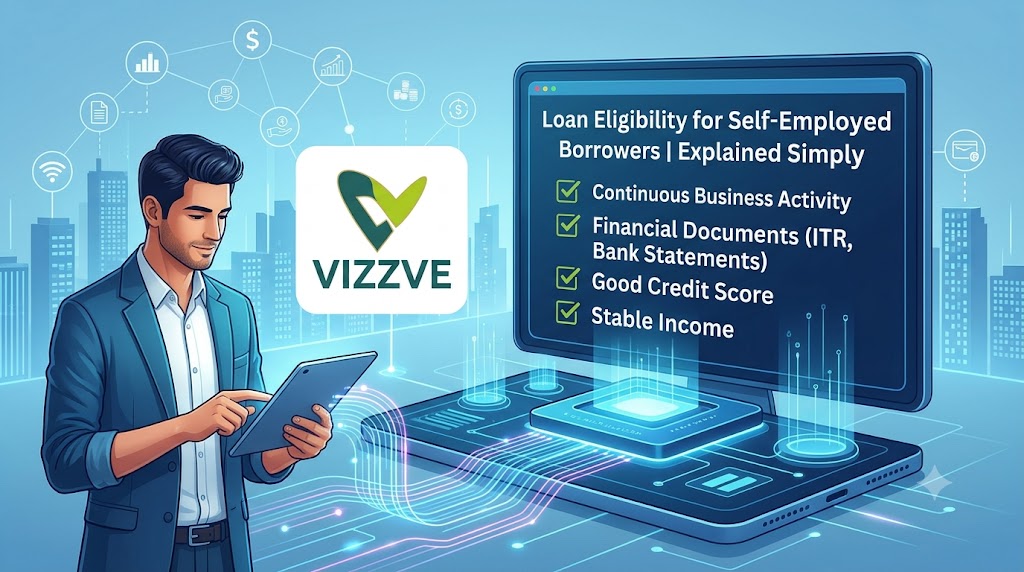
Loan Eligibility for Self-Employed Borrowers in Digital Borrowing — Explained Simply | Vizzve
Vizzve Admin
Digital borrowing has made loans more accessible for self-employed people—shopkeepers, freelancers, traders, consultants, gig workers and small business owners. You no longer need to visit a branch repeatedly or depend only on a salary slip. But digital does not mean “no checks.” It means lenders can assess your income and repayment ability using digital records.
For self-employed borrowers, the most important signals are bank-statement cash flow, ITR filings, GST returns, invoices, credit score and existing EMIs. RBI’s Digital Lending Directions, 2025 require regulated entities to obtain a borrower’s economic profile, including occupation and income details, before assessing creditworthiness.rbi
AI Answer Box
Can self-employed borrowers get digital loans in India?
Yes. Self-employed borrowers can apply for digital personal and business loans using PAN, Aadhaar, bank statements, ITRs, GST returns, invoices and business-registration proof. A salary slip is not mandatory.rbi+1
How do digital lenders assess income?
They review bank-statement credits, average monthly inflows, GST turnover, ITR income, invoice payments, credit score and existing EMIs. Regular bank credits are often the strongest alternative to salary slips.
Are digital loan apps safe?
Use only apps linked to RBI-regulated lenders. RBI operates a Digital Lending Apps directory to help customers verify an app’s association with a regulated entity.pib.gov+1
What Is Digital Borrowing?
Digital borrowing means applying for, assessing, approving and receiving a loan largely through online platforms or mobile apps. It can include digital KYC, document upload, credit assessment, e-signature and direct disbursal into your bank account.
For self-employed borrowers, digital lending can be useful because it allows lenders to evaluate real financial behaviour—such as UPI receipts, account credits, GST filings and repayment history—rather than relying only on traditional salary documents.
Who Can Apply as a Self-Employed Digital Borrower?
You may qualify as a self-employed digital borrower if you earn through:
-
A shop, trading business or small manufacturing unit
-
Freelancing, consulting, tutoring or content work
-
Gig platforms, delivery work or driver-partner platforms
-
Professional practice, such as medicine, law or accountancy
-
Online selling, reselling or home-based business
-
Contract work, repairs, beauty services or other independent services
What Digital Lenders Check
1. Bank-statement cash flow
Your bank statement shows whether income is regular and whether you can manage EMIs. Lenders look at:
-
Average monthly credits
-
Regularity of deposits
-
UPI and digital-payment inflows
-
Balance maintained
-
Cheque bounces or EMI failures
-
Existing loan deductions
-
Seasonal income patterns
2. Credit score
Your credit score shows how responsibly you have handled past credit. A score of 750+ generally improves approval chances and pricing, while lower scores may lead to smaller loan amounts or stricter terms.
3. Income documents
Digital lenders may accept:
-
ITRs for the last one to two years
-
GST returns, if registered
-
Client invoices and payment receipts
-
Platform earnings statements for gig workers
-
Form 26AS or TDS certificates, where applicable
-
Business-registration or trade-licence proofinvestkraft
4. Business stability
A lender may check how long your business or freelance work has been running. A stable business history reduces risk.
5. Existing EMIs
Lenders assess whether a new EMI fits within your monthly surplus after existing obligations. Avoid taking new consumer loans or maxing out credit cards before applying.
Documents You Should Keep Ready
| Document |
Why it matters |
| PAN card |
Identity and credit-bureau verification |
| Aadhaar card |
Digital KYC and address verification |
| Bank statements |
Shows income inflow and repayment capacity |
| ITRs |
Official income and tax-filing history |
| GST returns |
Shows business turnover and compliance |
| Invoices |
Supports freelance or business income |
| Trade licence or Udyam registration |
Confirms business existence |
| Existing loan statements |
Helps calculate EMI burden |
For self-employed applicants without ITRs, lenders may consider bank statements showing regular credits, GST returns, business proof, invoices and other alternative income documents.investkraft
How to Apply for a Digital Loan: Step-by-Step
Step 1: Check lender credibility
Use a lender or app associated with an RBI-regulated entity. RBI’s Digital Lending Apps directory, live since July 1, 2025, helps customers verify an app’s claimed association with a regulated entity.pib.gov+1
Step 2: Check eligibility
Enter basic details such as age, income range, business type and required loan amount. Do not submit multiple applications to many lenders at once.
Step 3: Complete digital KYC
Keep PAN and Aadhaar ready. Ensure your mobile number is linked for OTP verification.
Step 4: Upload or share financial data
Upload bank statements, ITRs, GST returns or invoices. If using account-aggregator-based consent, review exactly what data you are sharing and with whom.
Step 5: Read the Key Fact Statement
Before accepting a loan, check the interest rate, annual percentage rate, processing fees, tenure, EMI, prepayment terms and total repayment amount. RBI requires a standardised Key Fact Statement before the loan contract is executed.
Step 6: Accept and receive funds
After approval, funds should be disbursed directly into your bank account. Avoid any app that asks you to pay “processing fees” to a personal UPI ID or bank account before loan approval.
Digital Loan Eligibility: Salaried vs Self-Employed
| Factor |
Salaried borrower |
Self-employed borrower |
| Income proof |
Salary slips, Form 16 |
ITRs, bank statements, GST returns, invoices |
| Income pattern |
Fixed monthly salary |
Variable, seasonal or project-based |
| Business proof |
Not required |
Trade licence, GST, Udyam, invoices |
| Digital data |
Salary credits |
UPI receipts, business credits, platform payouts |
| Main advantage |
Simple verification |
Multiple income sources |
| Main challenge |
Job stability |
Proving stable, documented income |
How to Improve Digital Loan Approval Chances
-
Maintain one primary bank account for business income
-
Deposit cash income regularly
-
Use UPI or bank transfers for customer payments
-
File ITRs consistently
-
File GST returns on time, if registered
-
Pay EMIs and credit-card bills before the due date
-
Keep credit-card utilisation low
-
Avoid multiple loan applications within a short period
-
Apply for a loan amount your average monthly surplus can support
-
Keep invoices, purchase bills and client agreements organised
Pros and Cons of Digital Borrowing
Pros
-
Faster application and document upload
-
No need for repeated branch visits
-
Salary slip is not mandatory for self-employed borrowers
-
Bank statements and GST data can support income assessment
-
Useful for freelancers, gig workers and small business owners
Cons
-
Digital fraud and unauthorised loan apps remain a risk
-
Data-sharing permissions must be reviewed carefully
-
Irregular bank credits can reduce approval chances
-
High existing EMIs can limit eligibility
-
Interest rates may be higher for weak credit profiles
How to Stay Safe While Borrowing Online
RBI and the government have strengthened safeguards for digital lending, including rules on recovery practices, data privacy and grievance redressal for regulated entities, lending service providers and digital lending apps.pib.gov+1
Before applying:
-
Verify the app through RBI’s Digital Lending Apps directory
-
Check the regulated lender’s name in the loan agreement
-
Never share OTPs, passwords or card details
-
Do not grant unnecessary access to contacts, photos or messages
-
Read the Key Fact Statement carefully
-
Report suspicious apps through the National Cybercrime Reporting Portal or helpline 1930.pib.gov+1
Real-World Example
Ravi runs a mobile-repair shop and earns through cash, UPI and occasional bank transfers. His monthly income ranges from ₹35,000 to ₹60,000. He deposits collections into his current account every few days, files ITRs and maintains invoices for major repairs.
When he applies for a ₹1.5 lakh digital personal loan, the lender can assess his bank-statement credits, ITR income, credit score and existing EMIs. Because his income is visible and his repayment record is clean, he has a stronger case than an applicant with similar earnings but no bank deposits or tax records.
For self-employed borrowers, digital lending is not about finding a lender that asks for the fewest documents. It is about making your income easy to verify. A clean bank statement, timely tax filing and disciplined repayment history are more powerful than a high income claim with no supporting evidence.
The safest approach is simple: borrow from a regulated lender, share only necessary data, read the loan terms and choose an EMI that fits your average monthly cash flow.
Key Takeaways
-
Self-employed borrowers can get digital personal and business loans without a salary slip.
-
Bank statements, ITRs, GST returns and invoices are key income-proof documents.rbi+1
-
Lenders assess cash flow, credit score, business stability and existing EMIs.
-
RBI’s 2025 digital lending rules require lenders to assess a borrower’s economic profile before lending.rbi
-
Use only digital lending apps associated with RBI-regulated entities.pib.gov+1
-
Read the Key Fact Statement before accepting any digital loan.
-
Keep your income banked, documents updated and EMIs affordable.
Frequently Asked Questions
1. Can self-employed people get digital personal loans?
Yes. Self-employed borrowers can apply online using bank statements, ITRs, GST returns, invoices and business proof.rbi+1
2. Is a salary slip required for a digital loan?
No. Salary slips are for salaried borrowers. Self-employed applicants can use alternative income documents.
3. What is the most important document for self-employed digital loan approval?
Bank statements showing regular income credits are often the most important document.
4. Can I get a digital loan without ITR?
Possibly. Some lenders may consider bank statements, GST returns, invoices, business proof and other alternative income documents.investkraft
5. Is GST registration mandatory?
No. GST registration is not mandatory for every applicant, but GST returns can strengthen income proof if applicable.
6. What credit score do I need?
A score of 750+ is generally preferred. Some lenders may consider lower scores, but approval and pricing may be less favourable.
7. Can freelancers apply for digital loans?
Yes. Freelancers can use invoices, client agreements, bank credits and ITRs as income evidence.
8. Can gig workers get loans?
Yes, if they can show regular platform payouts, bank credits and a healthy repayment record.
9. How do I know if a loan app is genuine?
Check RBI’s Digital Lending Apps directory and confirm the app’s association with an RBI-regulated entity.pib.gov+1
10. Is it safe to share bank-statement data online?
It can be safe if shared through a regulated lender or authorised account-aggregator consent flow. Review permissions before approving.
11. What should I check before accepting a digital loan?
Check the interest rate, APR, processing fees, EMI, tenure, prepayment terms and total repayment amount in the Key Fact Statement.
12. Can cash income be considered?
Yes, if it is regularly deposited into a bank account and supported by invoices or business records.
13. Does applying to many apps improve approval chances?
No. Multiple applications can create hard credit enquiries and may reduce your credit score.
14. What happens if I miss a digital loan EMI?
Missed EMIs can hurt your credit score, increase penalties and make future borrowing harder.
15. How can Vizzve Financial help?
Vizzve Financial can help self-employed borrowers understand eligibility, prepare documents and apply for personal loans through a simplified digital process.
Conclusion
Digital borrowing has made loan access easier for self-employed borrowers, but approval still depends on one thing: proof that you can repay. Keep your income visible through bank deposits, maintain ITR and GST records where applicable, protect your credit score and borrow only from regulated digital lenders.
A well-prepared self-employed borrower is not defined by a salary slip. It is defined by clean cash flow, responsible credit behaviour and reliable documentation.
Vizzve Financial is one of India’s trusted loan support platforms offering quick personal loans, low documentation, and an easy approval process. Apply at www.vizzve.com.
Published on : 28th October 2026
Published by : Avinash S
www.vizzve.com || www.vizzveservices.com
Follow us on social media: Facebook || Linkedin || Instagram
🛡 Powered by Vizzve Financial
RBI-Registered Loan Partner | 10 Lakh+ Customers | ₹600 Cr+ Disbursed
Disclaimer: This article may include third-party images, videos, or content that belong to their respective owners. Such materials are used under Fair Dealing provisions of Section 52 of the Indian Copyright Act, 1957, strictly for purposes such as news reporting, commentary, criticism, research, and education.
Vizzve and India Dhan do not claim ownership of any third-party content, and no copyright infringement is intended. All proprietary rights remain with the original owners.
Additionally, no monetary compensation has been paid or will be paid for such usage.
If you are a copyright holder and believe your work has been used without appropriate credit or authorization, please contact us at grievance@vizzve.com. We will review your concern and take prompt corrective action in good faith... Read more

