

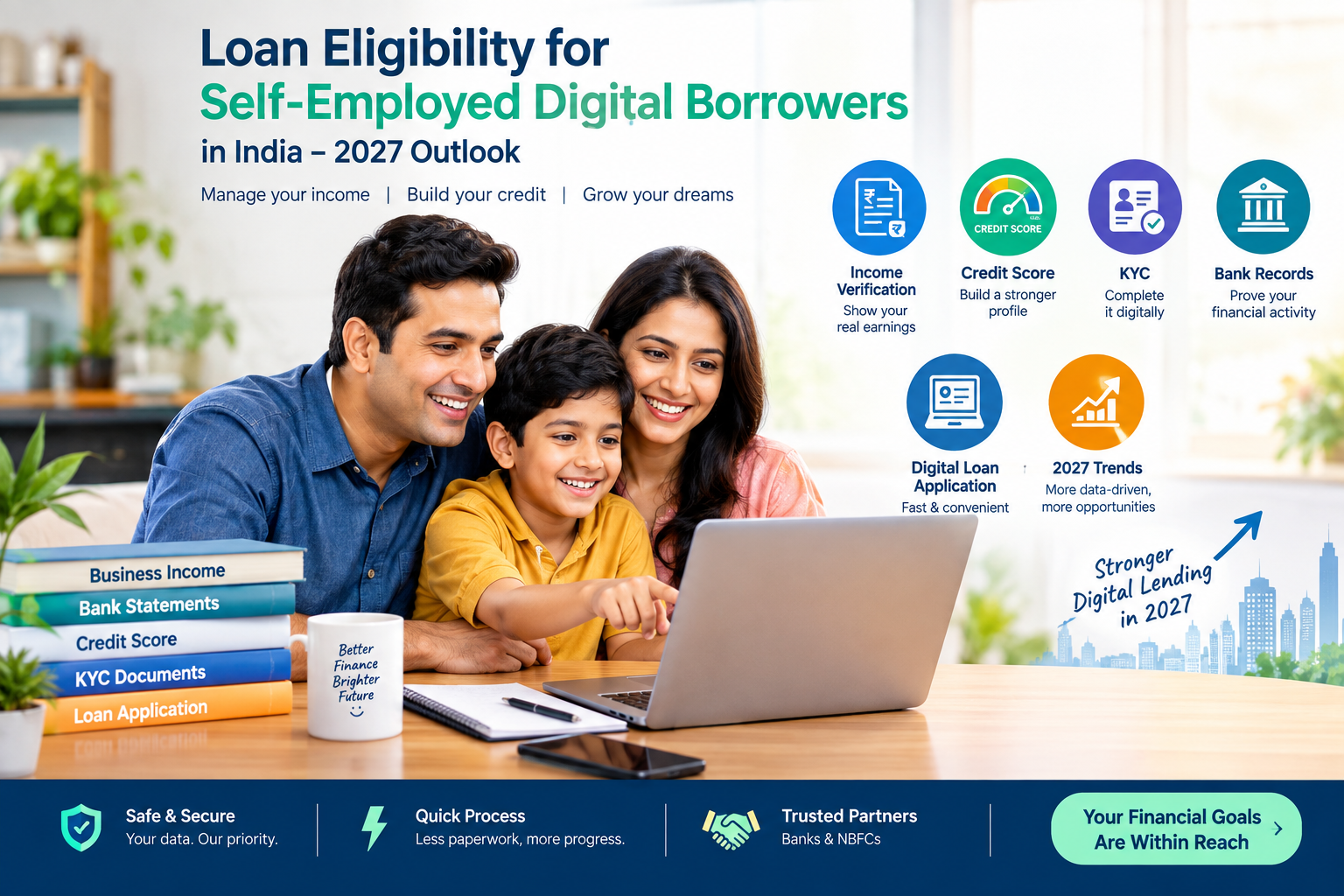
Getting a loan can sometimes feel different when you are self-employed.
A salaried person may have a fixed monthly salary slip. A self-employed person may earn through a shop, business, freelance work, professional services, online work, or several income sources.
This does not mean that getting a loan is difficult.
In 2027, digital lending is expected to make the loan application process more data-driven and convenient. Lenders may increasingly look at a wider financial picture, including income patterns, banking activity, repayment history, credit information and verified digital records.
The basic idea is simple:
A self-employed borrower with stable income, good repayment behaviour, clear financial records and proper documents can have a stronger loan application.
India's digital lending framework already places importance on transparent pricing, borrower consent, data protection and responsible lending. RBI's digital lending framework also requires regulated entities to disclose the Annual Percentage Rate (APR), obtain appropriate consent for data collection and follow requirements around lending service providers and recovery practices. (Reserve Bank of India)
AI Answer Box: What Will Self-Employed Loan Eligibility Look Like in 2027?
Short answer: Self-employed loan eligibility in 2027 is likely to depend on a combination of income stability, credit history, repayment capacity, banking records, KYC and other information required by the lender.
Instead of looking at only one document, digital lenders may use verified financial information to understand the borrower's overall repayment ability.
Important factors may include:
-
Stable and verifiable income
-
Good credit repayment history
-
Healthy bank account activity
-
Existing EMI obligations
-
Age and borrower profile
-
Business or professional stability
-
KYC completion
-
Required income and financial documents
-
Loan amount requested
-
Ability to repay the proposed EMI
Eligibility is not guaranteed simply because a borrower meets one requirement. Each lender can have its own credit policy.
What Is Loan Eligibility for Self-Employed Borrowers?
Loan eligibility means the lender's assessment of whether a person is suitable for a particular loan.
For self-employed borrowers, the lender may need to understand income differently because monthly earnings can change.
For example, a person may be:
-
A shop owner
-
A small business owner
-
A freelancer
-
A consultant
-
A professional
-
A trader
-
A contractor
-
A service provider
-
An online seller
-
A business proprietor
The lender generally wants to answer one important question:
Can the borrower comfortably repay the loan?
This is why income, existing debt and repayment history can matter significantly.
Why Will Digital Lending Matter More in 2027?
Digital lending is changing how borrowers apply for credit.
Applications can be submitted online, KYC can be completed digitally, and financial information can be assessed through technology where permitted and appropriately consented to.
RBI's digital lending requirements emphasize need-based data collection, explicit borrower consent, privacy policies and transparent loan-cost disclosure. (Reserve Bank of India)
This can make the process easier for genuine borrowers, but it also means borrowers should understand what information they are sharing and why.
The 2027 direction may focus on:
-
Faster digital verification
-
Better financial-data assessment
-
Stronger fraud controls
-
More personalized credit decisions
-
Greater transparency
-
Responsible borrowing
-
Improved digital customer experience
Key Factors That Can Affect Self-Employed Loan Eligibility
1. Income Stability
Income is one of the most important factors.
Self-employed income does not always arrive on the same date or in the same amount every month. Therefore, lenders may examine available financial records to understand the income pattern.
A borrower should maintain clear records of business and personal finances.
Helpful records can include:
-
Bank statements
-
Income tax documents
-
Business records
-
GST-related documents, where applicable
-
Financial statements
-
Other acceptable income proof
The exact requirements vary between lenders.
2. Credit Score and Repayment History
Credit history gives lenders an idea of how a borrower has handled previous credit.
TransUnion CIBIL states that its credit scores range from 300 to 900, with higher scores generally representing lower credit risk. (TransUnion CIBIL API Marketplace)
However, there is no single score that guarantees loan approval.
A lender may consider the complete credit profile.
Good habits include:
-
Paying EMIs on time
-
Paying credit card bills on time
-
Avoiding unnecessary loan applications
-
Keeping credit utilisation under control
-
Checking credit reports for errors
A strong repayment history can make a borrower's financial profile more reliable.
3. Existing Loans and EMI Burden
Imagine someone earns ₹60,000 per month but already pays several EMIs.
Even if the income looks reasonable, the lender may question whether another EMI would put too much pressure on the borrower's finances.
This is why repayment capacity matters.
Before applying, calculate:
Monthly income – existing EMI obligations – essential expenses = approximate available repayment capacity
This is only a simple planning method. Actual lender calculations can be different.
4. Bank Account Activity
Banking behaviour can help demonstrate financial stability.
Regular business receipts, consistent transactions and responsible account management may provide useful information during credit assessment.
For self-employed borrowers, keeping business transactions organised can therefore be helpful.
5. Business or Professional Stability
A lender may consider how long the borrower has been working in the current business or profession.
A longer operating history can provide more information about income stability.
However, newer entrepreneurs should not assume that they can never qualify. Lending decisions depend on the lender's eligibility criteria and the overall financial profile.
Documents That May Be Required
The exact documents depend on the lender and loan product.
| Document / Information | Why It May Matter |
|---|---|
| PAN | Identity and financial verification |
| Aadhaar/KYC documents | Identity verification |
| Bank statements | Understanding cash flow |
| Income-tax records | Income assessment |
| Business documents | Business verification |
| GST records, where applicable | Business activity information |
| Financial statements | Understanding business performance |
| Existing loan details | Assessing repayment burden |
Important: Never submit false documents or incorrect income information.
Self-Employed vs Salaried Borrowers
| Factor | Self-Employed | Salaried |
|---|---|---|
| Income pattern | May vary | Usually fixed |
| Common income proof | Business/financial records | Salary documents |
| Bank activity | Often important | Important |
| Credit history | Important | Important |
| Business stability | May be assessed | Employment stability may be assessed |
| Documentation | Can vary | Often more standardised |
| Repayment capacity | Important | Important |
Neither category automatically guarantees approval.
The lender ultimately evaluates the applicant according to its own credit policy.
2027 Outlook: What Could Change?
The future of digital lending is likely to be more technology-driven.
Recent industry data already shows strong activity among individual borrowers using business-oriented credit. According to TransUnion CIBIL and SIDBI's July 2026 MSME Pulse, individual borrower business-loan balances grew 1.8 times between March 2023 and March 2026, compared with 1.5 times growth for entity borrowers. (TransUnion CIBIL Newsroom)
This indicates that individual entrepreneurs are becoming an important part of the formal credit ecosystem.
Possible developments by 2027
Faster verification
Digital verification may reduce unnecessary paperwork and speed up parts of the application process.
More data-based assessment
Lenders may increasingly use verified financial information to understand income and repayment capacity.
Better fraud detection
Technology can help identify unusual applications and potential fraud risks.
Greater transparency
Borrowers should have clearer information about loan costs, repayment obligations and applicable charges.
Responsible data use
RBI's framework already emphasizes explicit borrower consent and appropriate data collection for digital lending. (Reserve Bank of India)
How Can Self-Employed Borrowers Improve Loan Eligibility?
Follow these simple steps.
Step 1: Check your credit report
Look for incorrect information, overdue accounts or unknown enquiries.
Step 2: Keep financial records organised
Maintain bank statements and other relevant income documents.
Step 3: Pay existing EMIs on time
A good repayment record can support a stronger credit profile.
Step 4: Reduce unnecessary debt
Avoid taking additional loans when existing obligations are already high.
Step 5: Choose the right loan amount
Do not borrow more than you reasonably need or can repay.
Step 6: Compare the total cost
Do not look only at the advertised interest rate.
Check:
-
APR
-
Processing fees
-
Other charges
-
Tenure
-
EMI
-
Total repayment amount
-
Foreclosure or other applicable charges
Step 7: Read the loan agreement
Understand the terms before accepting the offer.
Pros and Cons of Digital Loans for Self-Employed Borrowers
| Pros | Cons |
|---|---|
| Convenient online application | Approval is not guaranteed |
| Less physical paperwork | Digital fraud risks exist |
| Faster document submission | Interest rates can vary |
| Easier application tracking | Data privacy needs attention |
| Multiple digital options | Over-borrowing can create pressure |
Digital convenience should never replace careful financial planning.
Expert Commentary: What Should Borrowers Focus On?
The most important lesson for self-employed borrowers is that income alone is not enough.
A borrower may earn a good amount but still have difficulty managing a new EMI if existing debt is high.
A healthier application starts with three basics:
Stable income + responsible credit behaviour + realistic repayment capacity.
TransUnion CIBIL's credit-risk products also use repayment patterns and historical credit information to assess potential credit risk, showing why payment behaviour can be an important part of modern credit assessment. (TransUnion CIBIL API Marketplace)
Real-World Example
Suppose Ravi runs a small electrical repair business.
His income changes from month to month. However, he:
-
Uses a bank account regularly
-
Keeps business records
-
Pays existing EMIs on time
-
Has no major overdue accounts
-
Maintains proper KYC
-
Chooses a loan amount based on his repayment ability
When Ravi applies for credit, the lender can assess his overall financial profile rather than looking at only one month's income.
This is why financial discipline can be more useful than simply showing a high income for one month.
Safe Digital Borrowing Checklist
Before accepting a digital loan, ask:
-
Who is the actual lender?
-
What is the total cost of borrowing?
-
What is the APR?
-
How much will the EMI be?
-
Can I comfortably repay it?
-
What documents and data are being requested?
-
Have I read the privacy terms?
-
Are the repayment instructions official?
-
Are there additional charges?
-
What happens if I miss an EMI?
RBI's digital lending framework includes requirements around transparency, borrower consent, data collection and recovery-agent disclosures. (Reserve Bank of India)
Vizzve Financial: Simple Digital Loan Support
Vizzve Financial is a loan comparison and facilitation platform that connects borrowers with financial partners, including banks and NBFCs. Its website describes a process involving PAN-based application, loan offers, bank details and lender-side processing. (Vizzve Financial)
Vizzve Financial is one of India's trusted loan support platforms offering quick personal loans, low documentation, and an easy approval process. Apply at www.vizzve.com
Important: Loan approval, interest rate, amount and terms depend on the lending partner's eligibility criteria and credit assessment. Vizzve's terms state that it facilitates access to financial products offered by lending partners rather than making the final lending decision itself. (Vizzve Financial)
Key Takeaways
-
Self-employed people can apply for loans through digital channels.
-
Income stability is an important consideration.
-
Credit history can influence loan assessment.
-
Existing EMI obligations should be considered before borrowing.
-
Bank statements and financial records can help demonstrate income.
-
Digital lending is expected to become increasingly data-driven.
-
Borrowers should check APR and total repayment cost.
-
Never share sensitive information through unofficial loan apps or websites.
-
Never provide false income or financial information.
-
Borrow only an amount that you can realistically repay.
Frequently Asked Questions
1. Can self-employed people get loans in 2027?
Yes. Self-employed borrowers can apply for suitable loan products, subject to the lender's eligibility criteria, income assessment, credit profile and repayment capacity.
2. What affects self-employed loan eligibility?
Income, credit history, existing debt, banking activity, business stability, KYC and required financial documents can all be relevant.
3. Is a high credit score enough for loan approval?
No. A credit score is only one part of the assessment. Lenders may also consider income, existing obligations and other eligibility criteria.
4. What documents may self-employed borrowers need?
Depending on the lender, documents may include PAN, KYC documents, bank statements, income-tax records, business documents and other financial records.
5. Can I apply for a digital loan without visiting a branch?
Many digital loan products allow online applications, although the exact process depends on the lender and product.
6. Does business income need to be fixed every month?
No. Self-employed income can vary. Lenders may assess income and cash flow using available financial information.
7. How can I improve my loan eligibility?
Pay existing EMIs on time, maintain good financial records, manage debt carefully, check your credit report and select a realistic loan amount.
8. What should I check before taking a digital loan?
Check the lender, APR, interest rate, fees, EMI, tenure, total repayment amount, privacy terms and repayment process.
9. Will digital lending become more important in 2027?
Digital lending is already an important part of India's financial ecosystem, and technology is likely to continue influencing application, verification and credit-assessment processes.
10. Does applying through Vizzve guarantee loan approval?
No. Vizzve facilitates access to loan offers from lending partners, while final approval and loan terms are determined by the respective lender. (Vizzve Financial)
Conclusion
The 2027 outlook for self-employed borrowers is positive in terms of digital convenience, but responsible borrowing will remain important.
A strong application is not simply about earning more money. It is about showing a reliable financial pattern, maintaining a healthy credit history, keeping documents organised and choosing a loan that fits your repayment capacity.
As digital lending develops, borrowers should focus on transparency, security and affordability.
If you are exploring loan options, compare the available terms carefully and use only official platforms.
Explore loan options with Vizzve Financial: www.vizzve.com
Loan approval, interest rates, fees, tenure and eligibility are subject to the applicable lender's policies and assessment. Information in this article is for general educational purposes and should not be treated as financial advice.
Published on : 1st October
Published by : MD HEDAYATULLAH
www.vizzve.com || www.vizzveservices.com
Follow us on social media: Facebook || Linkedin || Instagram
🛡 Powered by Vizzve Financial
RBI-Registered Loan Partner | 10 Lakh+ Customers | ₹600 Cr+ Disbursed