

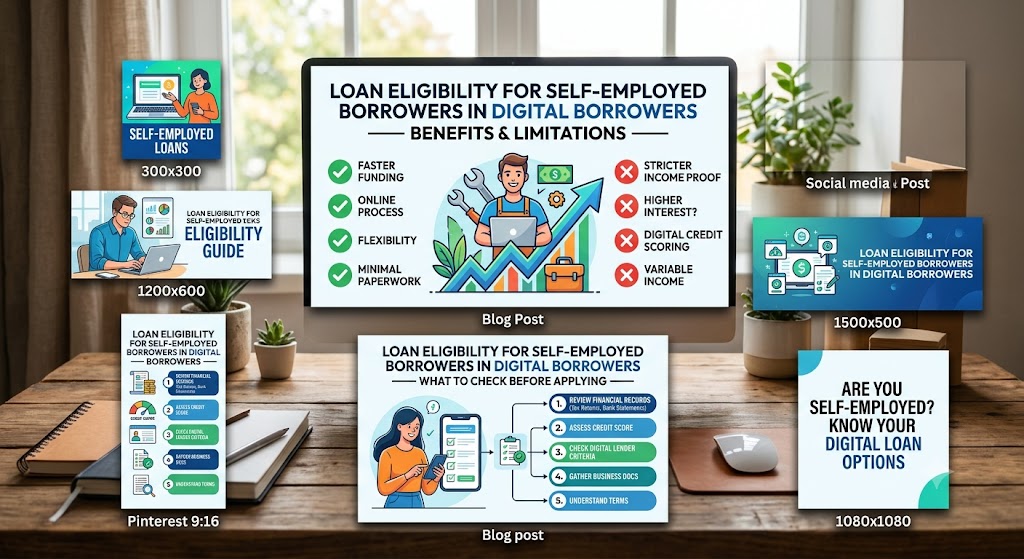
Digital lending has made borrowing easier for freelancers, shop owners, consultants, traders and small-business owners. You can apply online, complete KYC digitally, receive offers and get money directly in your bank account. But self-employed borrowers also face stricter income checks because business income can be irregular and harder to verify than a fixed salary.
This blog explains the real benefits and limitations of digital loan eligibility for self-employed borrowers, so you can decide whether an online loan is the right choice before applying.
AI Answer Box
What are the benefits of digital loans for self-employed borrowers?
Digital loans offer a fast online application, paperless KYC, quicker decisions, direct bank-account disbursal, flexible use of funds and access to multiple lenders. RBI rules also require transparent disclosure of the all-inclusive APR and a Key Fact Statement before the loan contract is signed.rbi.org+1
What are the limitations?
Self-employed applicants may face stricter documentation, income-verification challenges, lower loan amounts if cash flow is inconsistent, higher pricing for weaker credit profiles, and possible rejection if ITRs, GST filings or bank statements do not support the declared income.rbi.org+1
Why Digital Lending Matters for Self-Employed Borrowers
A self-employed borrower usually does not receive a fixed monthly salary. Income may come from client payments, shop sales, professional fees, contracts, commissions or seasonal business activity. Traditional lending often depended heavily on branch visits and extensive paperwork.
Digital lending changes that experience. Regulated banks and NBFCs can assess applications through digital platforms, collect need-based data with borrower consent, and disburse approved loans directly into the borrower’s bank account.jupiter+1
Benefits of Digital Loan Eligibility for Self-Employed Borrowers
1. Faster and convenient application
You can apply from your phone or computer without visiting a branch. Most digital journeys include PAN-based onboarding, online KYC, document upload and bank-account verification.
Practical benefit: A freelancer facing an urgent medical expense or a trader needing short-term working capital can apply without disrupting business hours.
2. Paperless documentation
Digital lenders commonly accept electronic submission of PAN, Aadhaar, bank statements, ITRs, GST returns and business proof. This reduces the need for physical photocopies and repeated branch visits.
Typical documents for self-employed applicants include:
-
PAN and Aadhaar
-
Last 6 months of bank statements
-
ITRs for the last 1–2 years
-
GST registration or GST returns, if applicable
-
Business registration, trade licence or professional proof
-
Existing loan details, if any
ICICI Bank, for example, lists ITRs for the last two years and bank statements for the last six months among documents for self-employed personal-loan applicants.rbi.org
3. Faster credit decisions
Digital underwriting can assess data such as bank credits, credit bureau history, GST information and declared income more quickly than manual processes. For borrowers with clean credit records and stable cash flow, this can mean faster approval.
4. Direct disbursal to your bank account
RBI rules require loan disbursal to be made into the borrower’s bank account, except for limited regulatory exceptions. Loans must not be disbursed to a third-party account, including the account of a lending service provider.jupiter+1
This reduces the risk of funds being routed through unauthorised intermediaries.
5. Transparent pricing disclosures
RBI requires regulated entities to provide a Key Fact Statement before the loan contract is executed. The statement must include the all-inclusive APR, recovery mechanism, grievance-redressal details and the cooling-off period.rbi.org+1
For self-employed borrowers, this is useful because the advertised interest rate alone may not show processing fees, verification charges or other costs.
6. Cooling-off period and borrower control
RBI rules give borrowers an explicit option to exit a digital loan during the cooling-off or look-up period by paying the principal and proportionate APR without penalty. The period is at least three days for loans with a tenure of seven days or more, and at least one day for shorter-tenure loans.rbi.org+1
7. Access to multiple lender offers
Platforms that connect borrowers with banks and NBFCs can help applicants compare offers instead of approaching each lender separately. Vizzve, for example, says it provides loan offers from multiple banks and NBFCs after PAN-based onboarding.
8. Helps build a formal credit history
If the loan is reported to credit bureaus and repaid on time, it can strengthen your repayment record. This may support future borrowing needs, especially for self-employed people who do not have a long formal credit history.
Limitations of Digital Loan Eligibility for Self-Employed Borrowers
1. Income verification can be difficult
Unlike salaried borrowers, self-employed applicants may not have salary slips or Form 16. Lenders must rely on ITRs, GST filings, bank statements and business financials, which can create delays if records are incomplete.
Common issue: A business owner may earn well but show low declared income in ITRs, making the lender unable to justify the requested loan amount.
2. Irregular cash flow may reduce eligibility
Seasonal businesses, freelancers with delayed client payments and small traders with fluctuating sales may find it harder to show steady monthly income. Lenders often look for consistent bank credits over several months.
Jupiter notes that lenders typically look for ITRs for one to two years and bank statements for six to twelve months showing consistent inflows.icici.bank
3. Business vintage requirements
Some lenders prefer applicants with an established business history. If your business is new, your loan amount may be limited or your application may be rejected despite good current earnings.
4. Higher cost for weaker profiles
If your credit score is low, your bank statements show cheque bounces, or your existing EMIs are high, a lender may offer a smaller amount at a higher APR—or decline the application.
5. Digital fraud and unofficial apps
Digital convenience also attracts fraudulent websites, fake loan apps and agents demanding upfront fees. Vizzve explicitly warns borrowers never to pay cash or transfer money into a representative’s personal account for loan approval.
6. Data-sharing concerns
Digital lending requires access to personal and financial data. RBI rules require data collection to be need-based, consent-based and auditable, and borrowers should be able to deny or revoke consent for certain data uses.jupiter+1
Still, borrowers should review app permissions and avoid sharing OTPs, banking passwords or unnecessary documents.
7. Small-ticket loans can become expensive
Short-tenure instant loans may look easy, but high APRs, late fees and repeated rollovers can create a debt cycle. Always compare the total repayment amount, not just the monthly EMI.
Benefits vs Limitations: Quick View
| Area | Benefits | Limitations |
|---|---|---|
| Application | Online, quick and paperless | Technical errors or incomplete uploads can delay approval |
| Documentation | Digital upload of ITR, GST and bank statements | Missing or inconsistent records can cause rejection |
| Approval speed | Faster decisions for strong profiles | Additional verification may be needed for self-employed income |
| Loan disbursal | Funds go directly to the borrower’s bank account | Bank-account details must be accurate |
| Pricing | APR and Key Fact Statement must be disclosed | APR may be higher for weak credit or unstable income |
| Data privacy | Consent-based, need-based data collection is required | Borrowers must still review permissions carefully |
| Repayment | Online payments and reminders | Missed EMIs can damage credit score |
| Fraud protection | RBI rules restrict third-party disbursal accounts | Fake apps and agents remain a risk |