

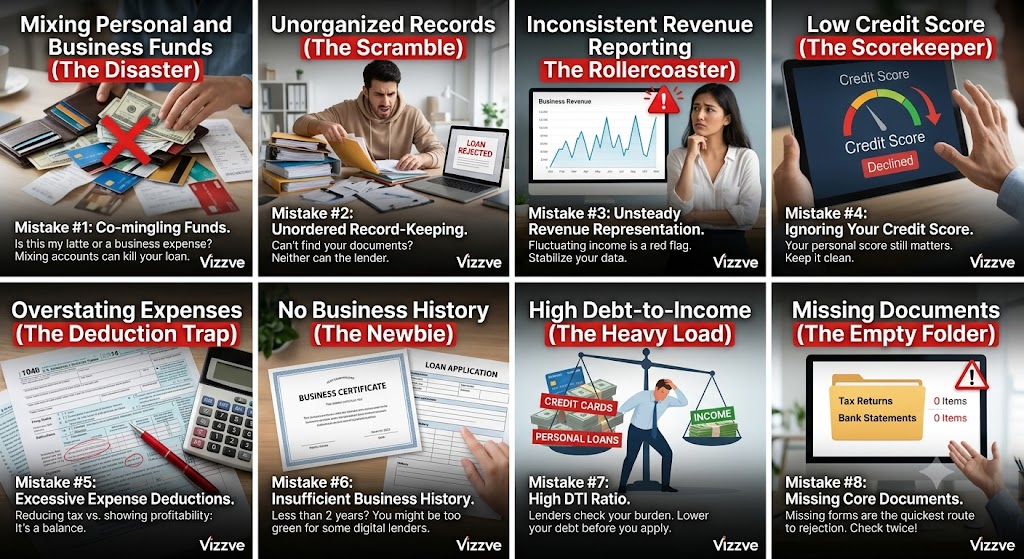
Self-employed borrowers often lose loan approval not because their business is weak, but because of avoidable mistakes—unclear income proof, messy bank statements, too many applications, high EMIs, or applying through unsafe platforms.
Digital lending is convenient, but it demands preparation. RBI requires regulated lenders to provide a Key Fact Statement before a digital loan contract, disclose APR and grievance-officer details, and cannot charge fees not mentioned in the KFS.rbi.org+1
AI Answer Box
What are the most common mistakes self-employed borrowers make when applying for digital loans?
The biggest mistakes are applying without checking credit score, submitting inconsistent ITR or bank statements, borrowing more than cash flow supports, applying to multiple lenders at once, ignoring APR and processing fees, and using unofficial loan apps or agents. These mistakes can cause rejection, higher costs, or credit-score damage.rbi.org+2
How can self-employed borrowers avoid loan rejection?
Maintain a 700+ credit score where possible, keep 6–12 months of clean bank statements, file ITR and GST returns on time, apply for a realistic EMI, and compare offers only on official RBI-regulated platforms.rbi.org+1
Common Mistakes That Cause Loan Rejection
1. Applying Without Checking Your Credit Score
Many self-employed borrowers apply first and check their credit profile later. This is risky because a low score, missed EMI, high credit-card utilisation, or multiple recent enquiries can reduce approval chances.
What to do instead: Check your credit report before applying. Correct errors, clear overdue amounts, and reduce revolving credit usage if needed.
2. Submitting Inconsistent Income Proof
A common issue is a mismatch between ITR income, GST turnover, and bank credits. Lenders may question the application if the declared income does not reasonably match actual banking activity.
What to do instead: Keep ITRs, GST returns, invoices, and bank statements aligned. If income is seasonal, be ready to explain the pattern with records.
3. Using a Personal Account for Business Income
Mixing personal and business transactions makes it harder for lenders to understand cash flow. Frequent personal withdrawals, family transfers, and unexplained deposits can weaken the application.
What to do instead: Maintain a separate business bank account and use it consistently for client payments, supplier payments, and business expenses.
4. Ignoring Business Vintage Requirements
Some borrowers apply immediately after starting a business. Many lenders prefer 2–3 years of continuous operations because they want evidence of stability.
What to do instead: If your business is new, start with a smaller loan, build banking history, and apply after establishing consistent income records.
5. Borrowing More Than You Can Repay
A high loan amount may look attractive, but a heavy EMI can strain monthly cash flow. This is especially risky for freelancers, traders, and seasonal businesses.
What to do instead: Calculate EMI after accounting for rent, salaries, inventory, taxes, household expenses, and emergency reserves.
Mistakes That Increase Loan Cost
6. Comparing Only the Interest Rate
The advertised interest rate does not show the full cost. Processing fees, GST, insurance, and other charges can make a lower-rate loan more expensive.
What to do instead: Compare APR, net disbursal, EMI, tenure, and total repayment amount. RBI defines APR as the annual cost of credit, including interest and other charges associated with the credit facility.rbi.org+1
7. Not Reading the Key Fact Statement
Some borrowers accept an offer without reading the KFS. This can lead to surprises related to fees, recovery terms, or grievance contacts.
What to do instead: Read the KFS before signing. RBI requires it to include APR, recovery mechanism, grievance redress officer details, and look-up period.rbi.org
8. Ignoring Late Payment and Bounce Charges
Missing one EMI can trigger late charges and damage your credit profile. A failed auto-debit mandate can also create additional charges.
What to do instead: Keep sufficient balance before the debit date, set reminders, and update bank details immediately if your account changes.
9. Choosing a Long Tenure Only for a Lower EMI
A longer tenure reduces monthly EMI but may increase total interest paid. It can be useful for cash-flow management, but it is not always the cheapest option.
What to do instead: Choose the shortest tenure your business cash flow can comfortably support.
Digital Safety Mistakes
10. Applying Through Unofficial Apps or Agents
Fraudsters often pose as loan agents and ask for upfront fees, OTPs, or transfers to personal accounts. Vizzve explicitly warns borrowers never to pay cash or transfer money to any representative’s personal account, and says it does not charge an upfront fee for loan approval.
What to do instead: Apply only through official websites or verified apps. Confirm the lender’s name and never share OTPs, passwords, or full card details.
11. Paying “Approval” or “Processing” Fees in Cash
No legitimate digital lender should ask you to pay approval fees in cash or to a personal UPI ID. Vizzve also advises borrowers never to entertain demands for commission from representatives and to report such demands to its official grievance channels.
What to do instead: If anyone demands cash, commission, or a personal-account transfer, stop the process and report it through the platform’s official grievance email or customer-care number.
12. Sharing Sensitive Documents Carelessly
Sending PAN, Aadhaar, bank statements, or OTPs through random WhatsApp forwards or unverified links can expose you to misuse.
What to do instead: Upload documents only through the official app or website, and keep copies of what you submit.
Application Mistakes That Hurt Credit Score
| Mistake | Impact | Better approach |
|---|---|---|
| Applying to many lenders at once | Multiple credit enquiries may affect your profile | Compare offers first, then apply selectively |
| Missing EMIs | Damages credit score and future eligibility | Automate payments and maintain buffer balance |
| High credit-card utilisation | Signals credit stress | Keep utilisation low and pay full bills |
| Ignoring credit-report errors | Can unfairly reduce score | Dispute errors with the credit bureau |
| Frequent loan top-ups | Increases debt burden | Borrow only for essential needs |