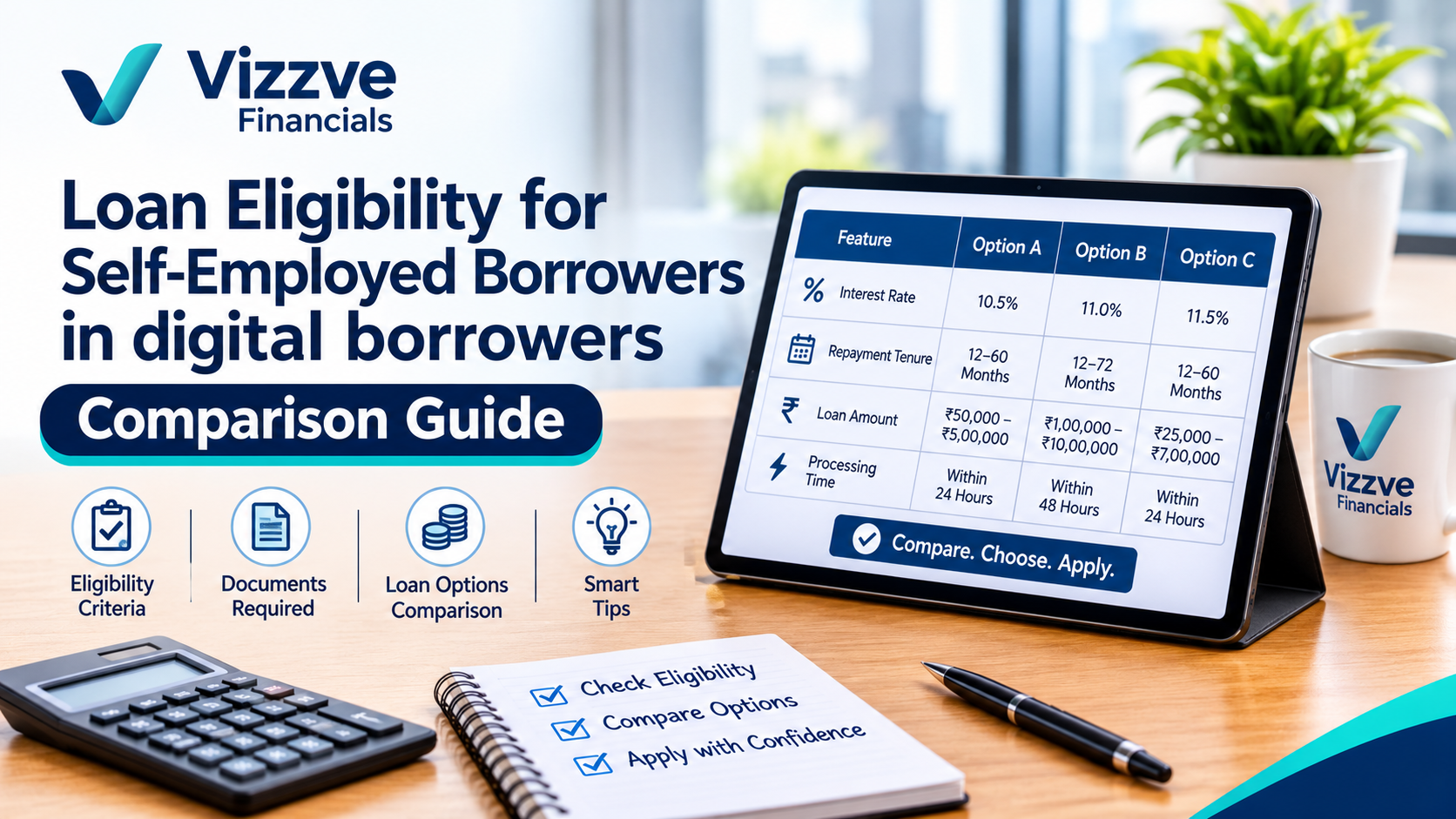
Loan Eligibility for Self-Employed Borrowers in Digital Lending — Comparison Guide
Loan Eligibility for Self-Employed Borrowers in Digital Lending — Comparison Guide
Vizzve Admin
Self-employed borrowers have more loan choices today than ever before. You can apply for a digital personal loan, a GST-based loan, an ITR-based business loan, an MSME loan, or a secured loan—but choosing the wrong product can cost you more in interest, fees, and time.
The right loan depends on your business profile, income proof, loan amount, urgency, and repayment capacity. Regulated lenders must assess your age, occupation, and income before extending credit, and loan disbursal and repayment must occur directly between your bank account and the lender’s account.rbi.org+1
AI Answer Box
Which loan is best for self-employed borrowers in India? For small, short-term personal needs, a digital personal loan is usually faster and simpler. For business expansion, inventory, equipment, or working capital, an ITR-based or GST-based business loan may offer a higher loan amount and better suitability. If you need a large amount or have a weaker credit profile, a secured loan may be more affordable but requires collateral.
What do lenders check for self-employed borrowers? Lenders generally assess business vintage, income stability, bank cash flow, credit score, existing EMIs, GST/ITR records, and business performance. Many lenders prefer 2–3 years of business vintage, while some business-loan products require three years or more.rbi.org+2
Quick Comparison: Loan Options for Self-Employed Borrowers
Loan Type
Best For
Typical Documents
Collateral
Approval Speed
Key Limitation
Digital personal loan
Medical bills, travel, wedding, debt consolidation
PAN, Aadhaar, bank statement, ITR/GST where needed
No
Fast
Lower amount; rate depends on credit profile
GST-based digital loan
Traders, retailers, service businesses with GST
PAN, Aadhaar, GST details, bank account
No
Fast
GST registration and healthy turnover needed
ITR-based business loan
Established businesses needing working capital
ITRs, financials, bank statements, KYC
Usually no
Moderate
Requires clean financial records
MSME/Udyam-linked loan
Small businesses and micro-enterprises
Udyam, GST, bank statements, ITR
Usually no
Moderate
Eligibility depends on turnover and lender policy
Secured business loan
Large loan amount or lower-cost funding
Property/documents, financials, KYC
Yes
Slower
Asset valuation and legal checks take time
Loan against investments/gold
Urgent funds with acceptable collateral
KYC, investment/gold documents
Yes
Fast to moderate
Risk of losing collateral on default
Digital Personal Loan vs Business Loan
What Is the Main Difference?
A personal loan is usually taken for personal expenses and does not require you to declare a specific business end use. A business loan is designed for commercial needs such as inventory, machinery, marketing, office expansion, or working capital.
For self-employed borrowers, the difference is not only the loan name. It also affects documentation, loan amount, tenure, interest pricing, and how the lender evaluates your repayment capacity.
Factor
Digital Personal Loan
Business Loan
Primary use
Personal expenses
Business expenses
Loan amount
Usually smaller
Can be higher for established businesses
Main assessment
Credit profile and income
Turnover, profitability, cash flow, business stability
Common documents
KYC, bank statement, ITR/GST
ITRs, financials, GST, bank statements, business proof
Collateral
Usually not required
May be secured or unsecured
Best choice when
You need quick funds for personal use
You need funds to grow or run the business
ICICI Bank states that eligibility for self-employed personal loans depends on income, business stability, credit score, and repayment capacity, with ITRs and bank statements among the common requirements. HDFC Bank’s business-loan criteria, by contrast, include turnover, business experience, profitability, and business vintage—showing why business loans require deeper financial assessment.federal.bank+1
GST-Based Loan vs ITR-Based Loan
Which Is Better for You?
A GST-based loan is useful when your business has regular taxable turnover and you want a faster digital process. An ITR-based loan is often better when you need a larger amount, have a longer business history, or want the lender to assess profitability through filed returns and financial statements.
Factor
GST-Based Loan
ITR-Based Loan
Main data source
GST registration and returns
ITRs, P&L, balance sheet
Best for
Traders, retailers, service providers
Established businesses and professionals
Documentation
Usually lower
Usually higher
Loan amount
Often moderate
Can be higher
Approval speed
Often faster
May take longer
Ideal borrower
Business with consistent GST filings
Business with strong audited financials
Some digital lenders allow GST-based verification without requiring ITR uploads or business financial statements for specific products. IDFC FIRST Bank, for example, offers a digital personal-loan route where GST details can be fetched automatically and certain documents are not required for that product.hdfc.bank
Secured Loan vs Unsecured Loan
Which Should a Self-Employed Borrower Choose?
Choose an unsecured loan if you need convenience, have a strong credit profile, and require a moderate amount. Choose a secured loan if you need a larger amount, want potentially lower pricing, and are comfortable pledging an asset.
Factor
Unsecured Loan
Secured Loan
Collateral
Not required
Required
Approval speed
Usually faster
Usually slower
Documentation
Lower
Higher
Loan amount
Usually lower
Can be higher
Interest cost
May be higher
May be lower, subject to lender terms
Risk
No asset at risk, but default harms credit
Collateral can be at risk on default
HDFC Bank offers a collateral-free self-employed Business Growth Loan of up to ₹50 lakh, but eligibility depends on turnover, business experience, profitability, and other conditions. This shows that “collateral-free” does not mean “easy approval”; the lender still needs strong evidence of repayment capacity.axis.bank
Eligibility Comparison by Borrower Type
Borrower Type
Strongest Loan Option
Documents That Help Most
Practical Tip
Freelancer
Digital personal loan
Bank statements, ITR, client invoices
Show at least 6–12 months of regular credits
Consultant/professional
Personal or professional loan
ITRs, bank statements, professional registration
Keep personal and professional income separate
Shop owner
GST-based or business loan
GST returns, bank statement, trade licence
Apply after a stable sales period
Manufacturer
ITR-based business loan
Financials, GST, bank statements
Show profitability and working-capital need
Online seller
GST-based or MSME loan
GST, marketplace payouts, bank statement
Maintain clear business account records
Gig worker
Small digital personal loan
Bank statement, platform earnings, KYC
Avoid multiple short-term loans
Home-based business owner
Digital personal loan or small business loan
Bank statement, Udyam/GST if available
Build a consistent digital payment trail
What Lenders Commonly Require
Most self-employed loan applications are evaluated on these core factors:
Age: Many lenders require applicants to be at least 21; maximum age varies by product.axis.bank+1
Business vintage: Many lenders prefer 2–3 years; some business loans require three years or more.rbi.org+2
Credit score: A score of 700+ generally helps; some digital products may require 760+ for their best offers.hdfc.bank+1
Income and turnover: Lenders assess declared income, business turnover, and bank credits.federal.bank+1
Debt-to-income ratio: Existing EMIs reduce the amount you can safely borrow. RBI’s framework for NBFCs caps household loan-repayment outflows at 50% of monthly household income for new loans.rbi.org
Banking behaviour: Regular credits, stable balances, and no frequent cheque returns strengthen your application.
Step-by-Step: Choose the Right Digital Loan
Define the purpose. Separate personal needs from business needs before comparing products.
Calculate the required amount. Borrow only what your monthly cash flow can support.
Check your credit report. Correct errors and clear overdue dues before applying.
Organise documents. Keep PAN, Aadhaar, bank statements, ITRs, GST returns, and business proof ready.
Compare APR, not just interest rate. Include processing fees, insurance, late fees, and prepayment terms.
Check the lender’s legitimacy. Confirm the regulated lender and avoid apps that promise guaranteed approval.
Review the Key Fact Statement. Understand the total repayment amount, tenure, EMI, and charges before accepting.
Apply selectively. Avoid submitting multiple applications at once, as repeated credit enquiries can affect your credit profile.
Repayment Comparison: What Self-Employed Borrowers Should Know
Repayment Factor
What to Check
Why It Matters
EMI frequency
Monthly, fortnightly, or weekly
Must match your cash-flow cycle
EMI date
Date after main business inflow
Reduces bounce risk
Auto-debit mandate
Correct bank account and mandate status
Prevents missed payments
Prepayment charges
Foreclosure/part-payment rules
Helps you close the loan early if cash flow improves
Late-payment charges
Penalty and additional interest
Protects you from surprise costs
Loan statement
Principal, interest, EMIs left, APR
Keeps repayment transparent
RBI rules require loan servicing and repayment to be executed directly in the regulated lender’s bank account, without any pass-through or pool account controlled by a third party. Borrowers also have an explicit option to exit a digital loan during the cooling-off period by paying the principal and proportionate APR without penalty.rbi.org+2
Expert Commentary
In practical lending, self-employed applicants are often rejected not because their business is weak, but because their financial records do not clearly demonstrate stability. A trader with strong GST filings and clean bank credits may be easier to assess than a high-earning freelancer with irregular deposits and mixed personal-business transactions.
Real-world experience points:
Keep a dedicated current account for business receipts and payments.
Avoid large unexplained cash deposits immediately before applying.
File ITRs consistently, even when income is moderate.
Maintain GST filings if registered; gaps can weaken verification.
Do not borrow from multiple apps to cover EMIs; it usually worsens cash flow.
Compare the total cost of credit, not only the advertised interest rate.
Pros and Cons of Digital Loans for Self-Employed Borrowers
Pros
Fast online application and paperless KYC
Multiple product options for different business profiles
GST and bank-data verification can reduce paperwork
Useful for urgent personal or working-capital needs
RBI-backed safeguards on fund flow, consent, and repayment transparency
Cons
Income assessment can be stricter than for salaried borrowers
Interest rates may be higher for variable-income profiles
Small-ticket loans can become costly if repeatedly rolled over
Secured loans involve collateral risk
Fraudulent apps and unofficial agents remain a concern
Key Takeaways
There is no single “best” loan for every self-employed borrower; the right option depends on purpose, amount, income proof, and repayment capacity.
Digital personal loans suit quick personal needs; business, GST-based, and MSME loans suit commercial funding needs.
GST-based loans favour businesses with regular taxable turnover, while ITR-based loans suit businesses with established financial records.
Compare APR, processing fees, tenure, prepayment rules, and EMI affordability before accepting an offer.
RBI rules require direct disbursal to the borrower’s account and direct repayment to the lender’s account, with no third-party control over funds.rbi.org+1
Maintain clean bank statements, timely ITR/GST filings, and a healthy credit score to improve approval chances.
Frequently Asked Questions
1. Which loan is better for self-employed borrowers: personal loan or business loan?
A personal loan is better for personal expenses, while a business loan is better for inventory, equipment, expansion, or working capital. Business loans may offer higher amounts but usually require stronger financial documentation.federal.bank+1
2. Can freelancers get digital loans without GST registration?
Yes. Freelancers can qualify based on bank statements, ITRs, credit history, and platform or client-payment evidence. GST registration is not mandatory for every loan product.federal.bank+1
3. Is a GST-based loan better than an ITR-based loan?
A GST-based loan is usually faster and more document-light for businesses with regular GST filings. An ITR-based loan may be better for larger funding needs because it allows the lender to assess profitability and financial history.icici.bank+1
4. What credit score is needed for a self-employed digital loan?
Many lenders prefer 700+, while some digital products require 760+ for eligibility or better pricing. Requirements vary by lender and product.hdfc.bank+1
5. How much business vintage do I need?
Many self-employed personal-loan products prefer 2–3 years of business vintage, while some business-loan products require at least three years.rbi.org+2
6. Can I get a collateral-free business loan?
Yes. Some lenders offer collateral-free business loans for eligible self-employed borrowers, but they assess turnover, profitability, business experience, and credit history carefully.axis.bank
7. Are digital loans safe for self-employed borrowers?
They can be safe if you apply through a legitimate regulated lender or authorised platform. RBI rules require direct disbursal to your bank account and direct repayment to the lender’s account.rbi.org+1
8. Can I use a personal loan for business expenses?
You can use a personal loan for many personal or general expenses, but a business loan is usually more appropriate for business-specific funding. Always check the lender’s end-use terms.
9. What is the biggest mistake self-employed borrowers make?
Borrowing based on their best month rather than average monthly cash flow. This often leads to EMI stress during lean business periods.
10. Do lenders check bank statements for self-employed loans?
Yes. Bank statements for the last 6–12 months are commonly used to assess cash flow, income consistency, balances, and repayment capacity.rbi.org+1
11. Can I prepay a digital loan?
Yes, digital loans generally allow prepayment. During the cooling-off period, you can exit by paying principal and proportionate APR without penalty; later prepayment terms depend on the loan agreement and applicable rules.airtel+1
12. What is the 50% repayment rule?
For NBFC lending, RBI’s framework caps monthly household loan-repayment obligations at 50% of monthly household income for new loans.rbi.org
Disclaimer: This article may include third-party images, videos, or content that belong to their respective owners. Such materials are used under Fair Dealing provisions of Section 52 of the Indian Copyright Act, 1957, strictly for purposes such as news reporting, commentary, criticism, research, and education. Vizzve and India Dhan do not claim ownership of any third-party content, and no copyright infringement is intended. All proprietary rights remain with the original owners. Additionally, no monetary compensation has been paid or will be paid for such usage. If you are a copyright holder and believe your work has been used without appropriate credit or authorization, please contact us at grievance@vizzve.com. We will review your concern and take prompt corrective action in good faith... Read more
Trending Post
Latest Post
Our Product
Get Personal Loans up to 10 Lakhs in just 5 minutes