

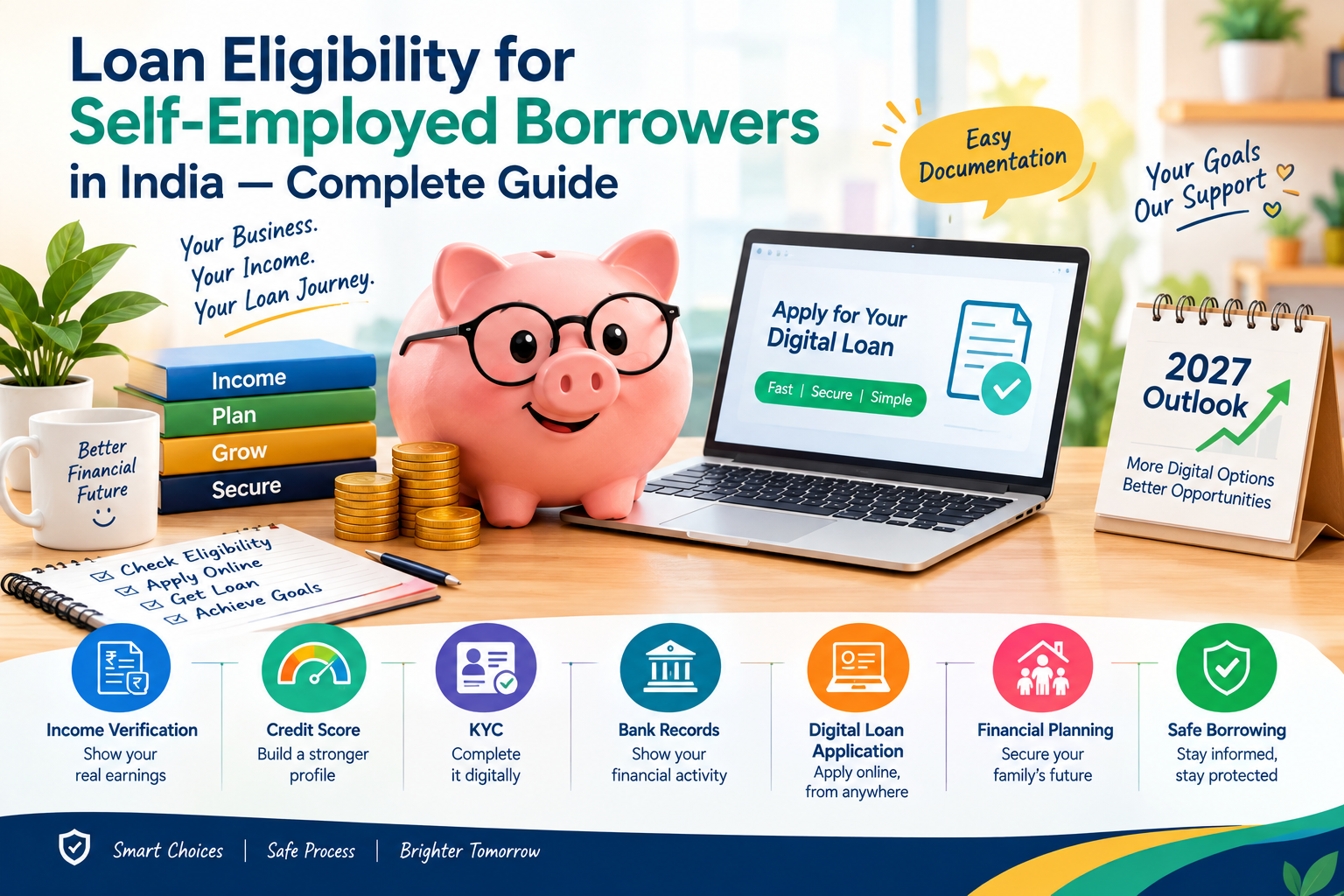
A salaried employee may receive a fixed salary every month. A self-employed person may earn from a shop, business, freelance work, professional service, online business, or several sources.
This does not mean that self-employed borrowers cannot get loans.
The main question for a lender is simple:
Can the borrower repay the loan comfortably and on time?
To answer this, lenders may consider income, credit history, existing EMIs, bank transactions, KYC and other financial information.
Digital lending has also made loan applications more convenient. Applications, document submission, verification and other parts of the process can often happen online.
RBI's digital lending framework focuses on borrower protection, transparent loan costs, data privacy, consent and responsible lending practices. (System Health)
AI Answer Box: How Does Self-Employed Loan Eligibility Work?
Self-employed borrowers can be eligible for digital loans if they meet the lender's requirements.
Eligibility may depend on:
-
Income and income stability
-
Credit history
-
Existing loans and EMIs
-
Bank account activity
-
Business or professional stability
-
KYC verification
-
Required financial documents
-
Loan amount requested
-
Repayment capacity
There is no single rule that guarantees loan approval.
Each bank, NBFC or other regulated lender can have its own eligibility and credit policy.
Simple Summary
Good income + healthy credit history + manageable debt + proper documents = stronger loan application.
What Is Loan Eligibility?
Loan eligibility is the process of checking whether a borrower meets the requirements for a particular loan.
For a self-employed borrower, income may not be the same every month.
For example, a person may run:
-
A retail shop
-
A small business
-
A consultancy
-
A repair service
-
A freelance business
-
An online store
-
A professional practice
-
A trading or service business
Because income can change, lenders may look at available financial records to understand the borrower's repayment ability.
Why Is Loan Eligibility Important?
Before giving a loan, a lender needs to understand the risk involved.
A borrower may earn ₹50,000 in one month and ₹80,000 in another month.
That does not automatically mean the person can afford a large EMI.
The lender may therefore consider the overall financial picture.
Important questions include:
-
How much does the borrower earn?
-
Is the income reasonably stable?
-
Does the borrower already have loans?
-
Are existing EMIs being paid on time?
-
What does the credit history show?
-
Is the requested loan amount affordable?
-
Are the submitted documents genuine and verifiable?
Main Factors Affecting Self-Employed Loan Eligibility
1. Income
Income is one of the most important factors.
For self-employed borrowers, income can come from several sources.
A lender may ask for financial information that helps verify earnings.
Possible income evidence includes:
-
Bank statements
-
Income-tax records
-
Business financial statements
-
GST-related records, where applicable
-
Business documents
-
Other acceptable income documents
The exact requirements depend on the lender.
2. Credit Score
Credit history shows how a person has handled previous credit.
TransUnion CIBIL states that the CIBIL Score is a three-digit number ranging from 300 to 900 and is derived from credit history. A score closer to 900 generally indicates stronger creditworthiness. (CIBIL)
However, a credit score is only one part of a loan decision.
A high score does not guarantee approval.
Good credit habits include:
-
Pay EMIs on time.
-
Pay credit card bills on time.
-
Avoid unnecessary loan applications.
-
Keep credit usage under control.
-
Check your credit report regularly.
-
Report incorrect information to the relevant credit institution.
3. Existing Loans and EMI Burden
Existing debt can affect your ability to take another loan.
Suppose a person earns ₹60,000 every month.
If the person already pays ₹30,000 toward existing EMIs, taking another large EMI may create financial pressure.
This is why lenders may consider existing obligations.
Simple calculation
Monthly income – existing EMIs – essential expenses = available repayment capacity
This is only a basic planning method.
Actual lender calculations may be different.
4. Bank Statements
Bank statements can help show how money moves through an account.
For a self-employed person, regular business receipts may help provide a clearer picture of cash flow.
Good financial habits include:
-
Keep business transactions organised.
-
Use banking channels for business receipts where appropriate.
-
Avoid unexplained large transactions.
-
Maintain proper financial records.
-
Keep personal and business finances organised where practical.
5. Business or Professional Stability
The length and stability of a business or profession may also be considered.
A lender may want to understand whether the borrower has a reasonably established source of income.
This does not mean that a newer business can never qualify.
The final decision depends on the lender's policy and the borrower's complete financial profile.
6. Age and Basic Eligibility
Lenders may also have rules related to:
-
Minimum age
-
Maximum age
-
Residence
-
Employment or business status
-
Income
-
Loan amount
-
Tenure
-
Credit profile
These requirements can differ between lenders.
Always check the specific lender's eligibility criteria.
What Documents Are Needed for a Self-Employed Loan?
The documents required depend on the loan provider and product.
| Document | Purpose |
|---|---|
| PAN | Identity and financial verification |
| Aadhaar or other KYC documents | Identity verification |
| Bank statements | Income and cash-flow assessment |
| Income-tax records | Income verification |
| Business documents | Business verification |
| GST records, where applicable | Business activity information |
| Financial statements | Business performance assessment |
| Existing loan information | Debt and repayment assessment |
Important
Never submit false documents.
Never change income information just to qualify for a higher loan amount.
Correct information helps create a more reliable application.
Self-Employed vs Salaried Borrowers
| Factor | Self-Employed Borrower | Salaried Borrower |
|---|---|---|
| Income | Can vary | Often more predictable |
| Income proof | Business/financial records | Salary-related records |
| Bank activity | Important | Important |
| Credit history | Important | Important |
| Existing EMIs | Considered | Considered |
| Business stability | May be assessed | Employment stability may be assessed |
| Documentation | Can vary | Often more standardised |
| Repayment capacity | Important | Important |
Neither category automatically guarantees loan approval.
The lender makes the final decision based on its own policies.
How to Apply for a Digital Loan as a Self-Employed Borrower
Step 1: Check Your Credit Profile
Review your credit report before applying.
Look for:
-
Incorrect personal details
-
Unknown accounts
-
Incorrect overdue amounts
-
Unrecognised enquiries
-
Payment information that appears wrong
TransUnion CIBIL currently provides eligible consumers with one free CIBIL Score and Report per calendar year through its official service. (CIBIL)
Step 2: Check Your Income
Understand your average income instead of focusing only on your best month.
Ask yourself:
Can I afford the new EMI even during a weaker business month?
This is an important question before borrowing.
Step 3: Calculate Existing Debt
Write down all current EMIs.
For example:
| Obligation | Monthly Amount |
|---|---|
| Existing Loan 1 | ₹8,000 |
| Existing Loan 2 | ₹5,000 |
| Credit Card EMI | ₹3,000 |
| Total | ₹16,000 |
Now compare this with your regular income.
Step 4: Prepare Documents
Keep the required documents ready.
This can make the application process smoother.
Step 5: Apply Through an Official Channel
Use the official website or app of the lender or a legitimate lending platform.
RBI advises borrowers to verify whether a digital lending app is associated with an RBI-regulated bank or NBFC and warns against downloading loan apps received through SMS or social-media links. (Reserve Bank of India)
Step 6: Read the Loan Details
Before accepting an offer, check:
-
Loan amount
-
Interest rate
-
APR
-
EMI
-
Tenure
-
Processing fee
-
Other charges
-
Total repayment amount
-
Prepayment conditions
-
Penal charges
-
Cooling-off/look-up provisions where applicable
RBI's digital lending framework requires regulated entities to provide borrowers with a Key Fact Statement containing important loan information, including APR and other relevant details. (System Health)
What Is APR and Why Does It Matter?
APR means Annual Percentage Rate.
It helps show the overall annualised cost of a digital loan.
Looking only at the interest rate may not give the complete picture.
For example, two loans can have similar advertised interest rates but different fees and other costs.
That is why borrowers should compare the overall cost.
Digital Lending Safety Checklist
Before applying, ask these questions:
Is the lender legitimate?
Check the lender's official website and regulatory information.
What is the total cost?
Look at APR, fees and other charges.
Why is my data being collected?
Understand what information is requested and why.
Is consent clear?
RBI's digital lending framework requires need-based data collection with prior and explicit borrower consent. It also provides borrowers options regarding certain data uses and sharing. (System Health)
Where will I repay?
RBI's digital lending guidelines require loan servicing and repayments to be executed directly with the regulated entity rather than through third-party pass-through accounts. (System Health)
What Are the Benefits of Digital Loans?
Pros
-
Convenient online application
-
Less physical paperwork
-
Faster document submission
-
Easy application tracking
-
Digital verification
-
Convenient access to loan information
-
Useful for borrowers who prefer online services
Cons
-
Approval is not guaranteed
-
Interest rates can vary
-
Borrowers may over-borrow
-
Fraudulent apps can create risks
-
Data privacy requires attention
-
Multiple loan applications can affect the credit profile depending on lender reporting and enquiries
Digital convenience should always be combined with careful financial planning.
How Can Self-Employed Borrowers Improve Loan Eligibility?
1. Maintain a Healthy Credit History
Pay existing credit obligations on time.
2. Keep Financial Records Organised
Maintain relevant bank, tax and business records.
3. Control Existing Debt
Avoid taking new debt when existing EMIs already create financial pressure.
4. Choose a Realistic Loan Amount
Borrow according to your actual requirement and repayment ability.
5. Keep KYC Information Updated
Make sure your personal information is accurate.
6. Avoid False Information
Never exaggerate income or business details.
7. Compare Loan Costs
Look at APR and total repayment, not only the monthly EMI.
Real-World Example
Consider a small business owner named Amit.
He earns around ₹70,000 a month, but his income changes depending on business sales.
He already has one EMI of ₹8,000.
Before applying for another loan, Amit:
-
Checks his credit report.
-
Reviews his bank statements.
-
Organises his income documents.
-
Calculates his existing EMI burden.
-
Chooses a loan amount that fits his budget.
-
Compares the total loan cost.
-
Reads the loan agreement before accepting it.
This approach can help him make a more informed borrowing decision.
The important lesson is simple:
Do not choose a loan only because you are eligible for it. Choose it because you can comfortably repay it.
Expert Commentary: What Matters Most?
For self-employed borrowers, income consistency can be harder to demonstrate than it is for someone receiving a fixed salary.
That makes financial records especially useful.
A strong application should tell a clear story:
Where does the income come from?
Is the income reasonably stable?
How much debt already exists?
Has the borrower paid previous credit on time?
Can the new EMI be managed?
Digital lending is also becoming more data-driven.
RBI's 2025 Annual Report noted that its Unified Lending Interface (ULI) pilot had reached 44 lenders and more than 60 data services across 12 loan journeys as of March 31, 2025, with plans to expand its scope. (Reserve Bank of India)
This points toward a lending environment where verified digital financial information may play an increasingly important role.
Important Digital Lending Rules Borrowers Should Know
RBI's framework includes several borrower-protection measures.
Key areas include:
-
Upfront disclosure of APR
-
Key Fact Statement before contract execution
-
Need-based data collection
-
Prior and explicit consent
-
Data privacy requirements
-
Disclosure of recovery-agent details
-
Direct repayment to the regulated entity
-
Transparent loan documentation
-
Grievance redressal information
RBI has also created a public directory of Digital Lending Apps to help customers verify an app's association with regulated entities. (Reserve Bank of India)
These protections are important because a digital loan should be convenient and transparent.
Key Takeaways
-
Self-employed borrowers can apply for digital loans.
-
Income is an important part of loan assessment.
-
Credit history can affect eligibility.
-
Existing EMIs should be considered before taking another loan.
-
Bank statements may help demonstrate financial activity.
-
Business and income records should be accurate.
-
KYC is an important part of digital lending.
-
Check APR and total repayment cost before accepting a loan.
-
Use official digital lending channels.
-
Do not share sensitive information with suspicious apps.
-
Borrow only what you can reasonably repay.
-
Final approval depends on the lender's eligibility and credit policy.
Vizzve Financial: Easy Digital Loan Support
Vizzve Financial is one of India's trusted loan support platforms offering quick personal loans, low documentation, and an easy approval process. Apply at www.vizzve.com.
Vizzve helps customers explore loan options through its digital platform. Loan approval, interest rate, amount and other terms depend on the applicable lending partner's eligibility criteria and assessment.
Borrowers should always read the applicable loan terms before accepting an offer.
Frequently Asked Questions
1. Can self-employed borrowers get a personal loan?
Yes. Self-employed individuals can apply for personal loans if they meet the lender's eligibility requirements.
2. What is needed for self-employed loan eligibility?
Income information, credit history, KYC, bank records, existing debt and other documents may be considered.
3. What credit score is needed for a self-employed loan?
There is no universal minimum score for every lender. CIBIL scores range from 300 to 900, but lenders may use different eligibility criteria. (CIBIL)
4. Can I get a digital loan without visiting a branch?
Some loan products allow borrowers to complete much of the application process online. The exact process depends on the lender.
5. Does self-employed income have to be fixed every month?
No. Self-employed income can vary. Lenders may assess available financial information to understand income and repayment capacity.
6. Which documents can be required for a self-employed loan?
Possible documents include PAN, KYC documents, bank statements, tax records, business documents and other financial information requested by the lender.
7. How can I improve my loan eligibility?
Maintain timely repayments, keep financial records organised, control existing debt and choose a loan amount that fits your repayment ability.
8. Is a high credit score enough for loan approval?
No. Credit score is only one factor. Income, existing obligations, documents and lender-specific criteria can also matter.
9. How can I check whether a digital loan app is genuine?
Check the app's association with an RBI-regulated bank or NBFC through the lender's official website and use RBI's available information on Digital Lending Apps. (Reserve Bank of India)
10. Does Vizzve guarantee loan approval?
No. Loan approval and final terms are determined by the applicable lending partner according to its eligibility and credit policies.
Conclusion
Loan eligibility for self-employed borrowers depends on more than income.
A strong financial profile usually starts with stable and verifiable income, responsible credit behaviour, manageable debt and proper documentation.
Digital lending can make the application process more convenient, but borrowers should not rush simply because an application is online.
Before taking a loan, check the lender, understand the APR, calculate the EMI and make sure the repayment fits your monthly budget.
Looking for digital loan options? Explore Vizzve Financial at www.vizzve.com.
This article is for general educational purposes. Loan eligibility, approval, interest rates, fees, tenure and other terms depend on the respective lender's policies and assessment.
Published on : 1st October
Published by : MD HEDAYATULLAH
www.vizzve.com || www.vizzveservices.com
Follow us on social media: Facebook || Linkedin || Instagram
🛡 Powered by Vizzve Financial
RBI-Registered Loan Partner | 10 Lakh+ Customers | ₹600 Cr+ Disbursed