

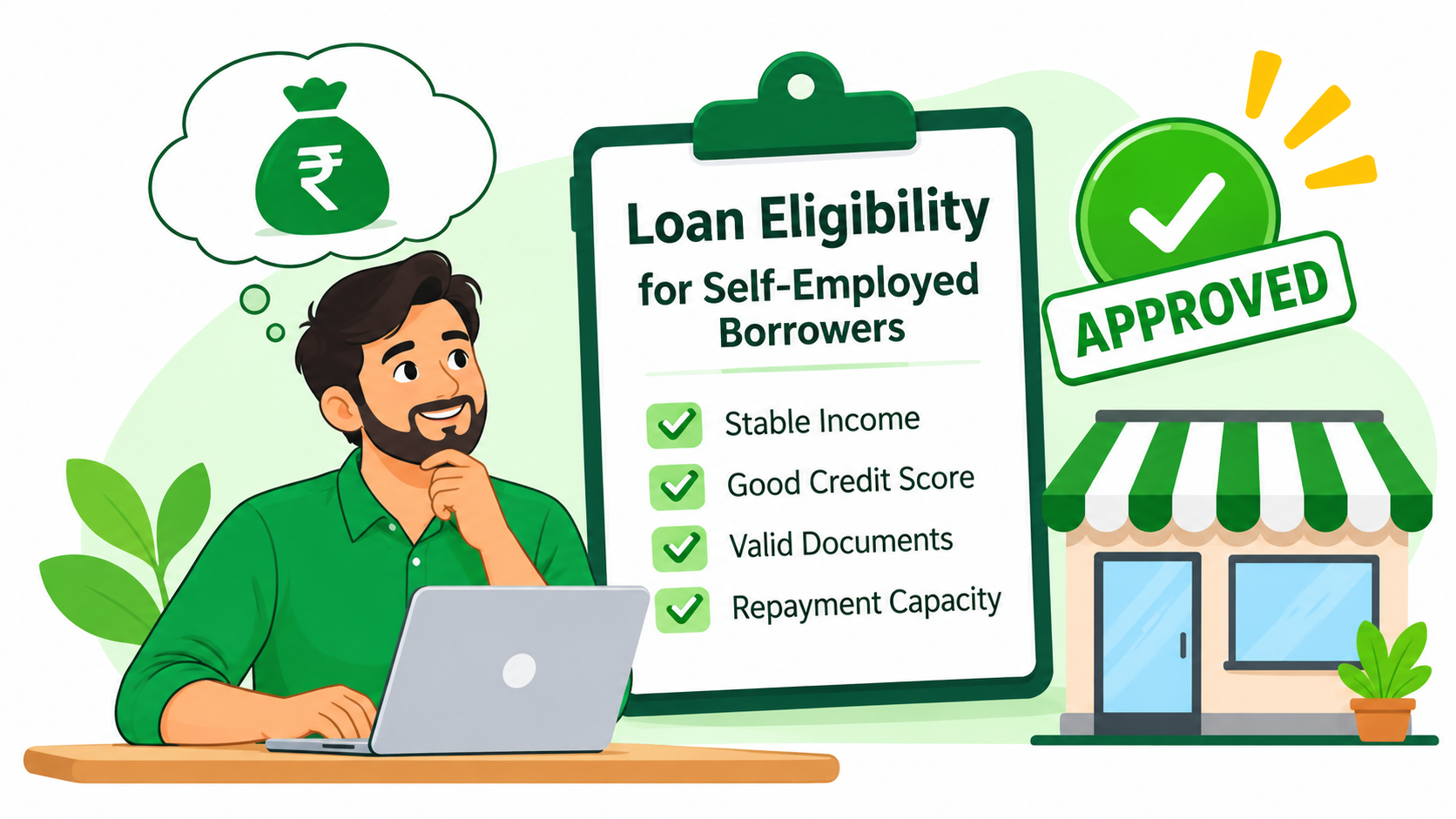
2. Introduction
Being self-employed offers independence, flexibility and the opportunity to build a business. However, when it comes to borrowing money, self-employed individuals can sometimes face additional eligibility checks.
A salaried applicant may be able to show a salary slip and employment records. A business owner, freelancer, consultant, trader or independent professional may receive income from multiple clients or business activities. Their monthly earnings can also change depending on demand, seasonal sales and operating expenses.
Digital lending has made the loan application process more accessible by allowing borrowers to submit applications and documents online. However, applying digitally does not mean that every applicant will automatically qualify.
Lenders still need to assess whether the applicant has a reliable income source and can repay the loan on time.
Understanding the eligibility requirements before applying can help self-employed borrowers make informed decisions, prepare the right documents and avoid unnecessary loan applications.
3. AI Answer Box: What Is Loan Eligibility for Self-Employed Borrowers?
Loan eligibility for self-employed borrowers refers to the financial and personal criteria a lender uses to determine whether a business owner, freelancer or independent professional can repay a loan.
Digital lenders may evaluate:
-
Age and residential details.
-
Nature and stability of self-employment.
-
Monthly or annual income.
-
Bank account transactions.
-
Income Tax Returns, where required.
-
Credit score and repayment history.
-
Existing loans and monthly obligations.
-
Loan amount and repayment tenure requested.
In simple terms: A self-employed person may qualify for a digital personal loan if they can demonstrate sufficient and reasonably stable income, maintain a suitable credit profile and meet the lender's other requirements.
Eligibility rules vary between lenders. Meeting the basic criteria does not guarantee loan approval.
4. Who Is Considered a Self-Employed Borrower?
A self-employed borrower is someone who earns income independently rather than receiving a fixed monthly salary from an employer.
Self-employed applicants may include:
-
Small business owners.
-
Shopkeepers and retailers.
-
Freelancers.
-
Consultants.
-
Independent contractors.
-
Traders and distributors.
-
Doctors, architects and other independent professionals.
-
Online sellers and e-commerce business owners.
-
Sole proprietors and partnership business owners.
-
Service providers and independent agents.
These applicants may earn through client payments, business sales, professional fees, commissions or contracts.
4.1 Why Do Self-Employed Applicants Have Different Eligibility Checks?
The primary difference is how income is documented.
|
Salaried applicants |
Self-employed applicants |
|---|---|
|
Salary slips may establish monthly earnings |
Income may be established through financial records |
|
Employer details may be verified |
Business or professional activity may be verified |
|
Salary credits may be regular |
Income may fluctuate |
|
Employment duration may be checked |
Business continuity may be checked |
|
Form 16 or ITR may be requested |
ITR and business financial records may be requested |
A lender may consider the applicant's average income over a suitable period instead of relying on one month's earnings.
5. What Are the Main Eligibility Criteria for Self-Employed Digital Borrowers?
There is no single eligibility formula followed by every digital lender. The exact requirements depend on the regulated lender, loan product, loan amount and applicant's financial profile.
The following are common factors.
5.1 Age Requirements
Lenders generally specify a minimum and maximum age for personal loan applicants.
The age criteria may depend on:
-
Loan tenure.
-
Income stability.
-
Lender policy.
-
Type of loan.
-
Repayment period.
Applicants should check the lender's current age requirements before submitting an application.
5.2 Stable Income
Income is one of the most important factors in loan assessment.
For self-employed borrowers, lenders may examine:
-
Average monthly income.
-
Annual business revenue.
-
Net profit or professional earnings.
-
Regularity of customer payments.
-
Business expenses.
-
Cash flow after operating costs.
A business generating high revenue may not necessarily produce enough disposable income for loan repayment. Lenders may therefore assess profitability and cash flow rather than sales alone.
5.3 Business or Professional Continuity
Some lenders may prefer applicants who have operated their business or professional activity for a minimum period.
They may examine:
-
How long the business has been operating.
-
Whether income is recurring.
-
Whether the business has regular customers.
-
Whether business activity can be supported by records.
-
Whether there have been significant interruptions.
The minimum business vintage requirement is lender-specific.
5.4 Credit Score and Credit History
A credit score helps lenders understand how an applicant has managed previous borrowing.
A stronger credit profile may improve the chances of receiving suitable loan offers, although it does not guarantee approval.
Lenders may review:
-
Previous personal loans.
-
Credit card repayment history.
-
Outstanding loan balances.
-
Missed or delayed payments.
-
Loan defaults or settlements.
-
Recent credit enquiries.
-
Credit utilisation.
A borrower with a limited credit history may be assessed using other available financial information, depending on the lender's policy.
5.5 Existing Financial Obligations
Existing EMIs and financial commitments affect repayment capacity.
For example, an applicant earning ₹60,000 per month may have:
-
₹12,000 in existing loan EMIs.
-
₹8,000 in other regular financial commitments.
-
Business expenses that vary each month.
The lender may assess the remaining disposable income before deciding the loan amount.
5.6 Bank Account Activity
Bank statements can help demonstrate income patterns and financial discipline.
Lenders may examine:
-
Regular business receipts.
-
Client payments.
-
Average account balance.
-
Returned cheques or failed payments.
-
Existing EMI deductions.
-
Unusual or unexplained transactions.
Keeping personal and business transactions reasonably organised can make financial verification easier.
6. What Documents Are Required for a Self-Employed Digital Loan?
The documents required vary by lender. Some applications may require only a limited set of digital records, while others may need detailed income and business verification.
|
Document |
Why it may be required |
|---|---|
|
PAN card |
Identity and financial verification |
|
Aadhaar or another accepted ID |
Identity verification, subject to permitted processes |
|
Address proof |
Residential verification |
|
Bank statements |
Income and cash-flow assessment |
|
Income Tax Returns |
Evidence of declared income |
|
Business registration proof |
Evidence of business activity, where applicable |
|
GST records |
Supporting business information, where applicable |
|
Profit and loss statement |
Assessment of business profitability |
|
Balance sheet |
Financial position of the business, where required |
|
Professional licence |
Verification for certain professions, where applicable |
6.1 Income Proof for Self-Employed Borrowers
Unlike salaried applicants, self-employed individuals may not have a salary slip.
They may be asked to provide:
-
Recent ITR acknowledgements.
-
Bank statements showing income credits.
-
Audited or prepared financial statements, if applicable.
-
Business invoices.
-
Client contracts or payment records.
-
GST returns, where applicable.
-
Other acceptable income evidence.
Important: Do not assume that every lender requires all these documents. Ask for the exact document list before applying.
6.2 Can You Get a Personal Loan Without Salary Slips?
Yes. Self-employed individuals do not generally receive salary slips, so lenders may accept alternative income documents.
However, applying without salary slips does not mean applying without income verification. The lender may still need to establish the applicant's ability to repay.
7. How Do Digital Lenders Verify Self-Employed Applicants?
Digital lending platforms can simplify application and verification processes. Depending on the lender's authorised process and the applicant's consent, information may be collected and verified electronically.
A typical process may include:
-
Application submission: The borrower enters personal, contact and financial details.
-
Identity verification: Required identity information is checked.
-
Income assessment: Bank statements, ITRs or other acceptable records may be reviewed.
-
Credit assessment: The lender evaluates credit history and existing obligations.
-
Repayment assessment: Income and expenses are considered against the proposed EMI.
-
Offer and disclosure: Eligible applicants receive applicable loan terms and disclosures.
-
Agreement and disbursal: After acceptance and completion of required checks, the regulated lender disburses the loan.
Not all lenders use the same verification steps. Some may request additional documents or manual checks.
8. Step-by-Step Guide: How to Apply for a Digital Loan as a Self-Employed Borrower
A practical application checklist
Step 1: Check Your Financial Position
Before applying, calculate:
-
Average monthly income.
-
Regular business expenses.
-
Existing loan EMIs.
-
Household expenses.
-
Available disposable income.
This helps you estimate a manageable repayment amount.
Step 2: Review Your Credit Report
Check your credit report for:
-
Incorrect personal details.
-
Unrecognised loans.
-
Missed-payment records.
-
Incorrect outstanding balances.
-
Unfamiliar credit enquiries.
Raise a dispute with the relevant credit bureau or lender if you find inaccurate information.
Step 3: Organise Your Income Documents
Keep your available financial records ready.
For example:
-
Bank statements.
-
ITR documents.
-
Business registration records.
-
GST documents, if applicable.
-
Invoices and payment records.
Step 4: Compare Loan Offers
Do not select a loan only because the advertised interest rate appears low.
Compare:
-
Annual Percentage Rate (APR).
-
Processing fees.
-
Repayment tenure.
-
EMI amount.
-
Late-payment charges.
-
Foreclosure or prepayment conditions.
-
Total repayment amount.
Step 5: Read the Key Fact Statement
For applicable regulated digital loans, the borrower should receive the required Key Fact Statement (KFS) before executing the loan contract.
Review the disclosed APR, charges, repayment schedule and other material terms. Do not proceed if important costs are unclear.
Step 6: Complete the Application Carefully
Enter accurate information. Ensure that your income, business details and bank account information match your supporting documents.
Incorrect information can delay verification or lead to rejection.
Step 7: Review the Loan Agreement
Before accepting:
-
Confirm the identity of the actual lender.
-
Review the sanctioned amount.
-
Check the amount you will actually receive.
-
Understand the EMI and due dates.
-
Read the default and recovery provisions.
-
Save the agreement and KFS.
Step 8: Plan Repayment
Choose an EMI that remains manageable even during months when business income is lower than usual.
9. Factors That Can Improve Loan Eligibility
Self-employed applicants can take practical steps to strengthen their financial profile.
|
Factor |
What borrowers can do |
|---|---|
|
Credit history |
Pay EMIs and credit card dues on time |
|
Income records |
Maintain accurate and consistent financial documents |
|
Bank transactions |
Keep business receipts traceable |
|
Existing debt |
Reduce unnecessary outstanding borrowing |
|
Business continuity |
Maintain records showing ongoing operations |
|
Loan amount |
Request an amount aligned with repayment capacity |
|
Application accuracy |
Provide complete and truthful information |
9.1 Maintain a Healthy Credit Profile
Good repayment habits can help build a stronger credit history.
Try to:
-
Pay all EMIs before their due dates.
-
Avoid repeated loan applications within a short period.
-
Keep credit card utilisation under control.
-
Review credit reports periodically.
-
Resolve outstanding dues responsibly.
9.2 Keep Business and Personal Finances Organised
Separate business and personal transactions where practical.
This can help you:
-
Track actual business income.
-
Understand operating expenses.
-
Prepare accurate financial statements.
-
Demonstrate cash flow.
-
Plan loan repayments more effectively.
9.3 Choose a Realistic Loan Amount
A larger loan is not always a better option.
Borrow only what you need and what your income can comfortably support. A reasonable loan amount may reduce financial pressure during slower business periods.
10. How Is Loan Repayment Capacity Calculated?
Lenders may use different internal methods to assess repayment capacity. One commonly discussed measure is the Fixed Obligation to Income Ratio (FOIR).
A simplified formula is:
The exact income definition and acceptable ratio vary by lender.
Example: Repayment Capacity of a Self-Employed Borrower
Suppose a freelancer has the following estimated finances:
|
Financial detail |
Amount |
|---|---|
|
Average monthly income |
₹70,000 |
|
Existing monthly EMIs |
₹12,000 |
|
Proposed new EMI |
₹10,000 |
|
Total monthly EMIs |
₹22,000 |
|
EMI-to-income ratio |
31.4% |
Calculation:
This is only an illustrative calculation. It is not a lender's approval threshold or a guarantee that the borrower will qualify.
A lender may also consider business expenses, household expenses, income volatility and other liabilities.
11. Comparison: Salaried vs Self-Employed Digital Loan Applicants
|
Parameter |
Salaried borrower |
Self-employed borrower |
|---|---|---|
|
Income source |
Salary |
Business or professional earnings |
|
Common income proof |
Salary slips |
ITRs and bank statements |
|
Employment evidence |
Employer records |
Business or professional records |
|
Income pattern |
Often regular |
May fluctuate |
|
Repayment assessment |
Salary and obligations |
Net income, cash flow and obligations |
|
Additional checks |
Employment verification |
Business continuity and income verification |
|
Loan eligibility |
Depends on lender criteria |
Depends on lender criteria |
Both categories can qualify for digital personal loans if they meet the relevant lender's requirements.
12. Pros and Cons of Digital Loans for Self-Employed Borrowers
Advantages
-
Online application: Applications can be submitted without visiting a branch in many cases.
-
Convenient document submission: Supported records may be uploaded digitally.
-
Application tracking: Some platforms allow applicants to track their application status.
-
Multiple loan options: Borrowers may be able to compare available products.
-
Time savings: Digital processes can reduce paperwork and manual visits.
-
Flexible application timing: Applications may be submitted online at convenient times.
Limitations
-
Approval is not guaranteed: Digital applications are still subject to lender assessment.
-
Income verification may be detailed: Irregular earnings can require additional evidence.
-
Charges may vary: Processing fees and other costs can affect the total borrowing cost.
-
Credit checks may affect the application process: Multiple applications can create unnecessary credit enquiries.
-
Fraud risk exists: Fake loan apps and impersonation attempts can put borrowers at risk.
-
Repayment pressure: A fixed EMI may become difficult during a low-income business period.
13. Common Reasons Why Self-Employed Digital Loan Applications Get Rejected
A loan application can be rejected for several reasons. The lender's decision may depend on its risk policy and the applicant's overall financial profile.
Common reasons include:
13.1 Unstable or Insufficient Income
If the applicant cannot demonstrate sufficient income after business expenses and existing obligations, the lender may decline the application.
13.2 Poor Credit History
Repeated late payments, defaults or high outstanding debt may affect the lender's assessment.
13.3 Incomplete Documents
Missing bank statements, unclear income records or mismatched information may delay verification or lead to rejection.
13.4 High Existing Debt
If a large part of the applicant's income is already committed to EMIs, there may be insufficient repayment capacity.
13.5 Inaccurate Application Details
Incorrect PAN details, inconsistent addresses or misleading income information can create verification problems.
13.6 Short Business History
Some lenders may have minimum business-continuity requirements. Applicants who have recently started their business may not meet those specific criteria.
What should you do after rejection?
-
Understand the reason, if the lender provides it.
-
Review your credit report.
-
Correct inaccurate records.
-
Organise income documents.
-
Reduce existing debt where possible.
-
Reapply only after addressing the underlying issue.
14. How Can Freelancers and Small Business Owners Demonstrate Income?
Different types of self-employed borrowers may have different income records.
|
Applicant type |
Potential supporting records |
|---|---|
|
Freelancer |
Client invoices, contracts, bank credits and ITRs |
|
Shop owner |
Sales records, bank statements, GST records where applicable |
|
Consultant |
Professional invoices, client agreements and ITRs |
|
Online seller |
Marketplace settlements, bank statements and tax records |
|
Independent professional |
Professional receipts, bank statements and applicable registrations |
|
Contractor |
Work orders, invoices and payment records |
The lender decides which documents it will accept. Applicants should not create or alter records to meet eligibility requirements.
15. Important RBI Rules and Safe Digital Lending Practices
Digital lending is regulated in India. Borrowers should understand the role of the actual lender and the digital platform facilitating the application.
The Reserve Bank of India (RBI) issued the Reserve Bank of India (Digital Lending) Directions, 2025, which set out requirements for regulated entities and their digital lending arrangements.
Important borrower-facing points include:
-
Understand whether the actual lender is a bank or RBI-regulated Non-Banking Financial Company (NBFC).
-
Check the lender's identity before accepting a loan.
-
Read the Key Fact Statement and loan agreement.
-
Review the APR and applicable charges.
-
Understand the repayment schedule.
-
Provide consent before permitted data collection.
-
Avoid lending apps that demand unnecessary access to personal information.
-
Do not pay suspicious advance fees to individuals claiming to guarantee approval.
15.1 What Is a Key Fact Statement?
A Key Fact Statement is a standardised disclosure document that provides important information about a loan.
It can help borrowers understand:
-
APR.
-
Loan amount.
-
Tenure.
-
Repayment schedule.
-
Applicable charges.
-
Other material loan conditions.
Read it carefully before accepting the offer.
15.2 How to Identify a Safe Digital Loan Platform
Before applying, check:
-
Is the actual lender clearly identified?
-
Is the lender a regulated bank or NBFC?
-
Are the loan terms and charges disclosed?
-
Is a KFS provided where required?
-
Does the platform have a clear grievance-redressal process?
-
Does the app request only permitted and necessary information?
-
Are you being asked to transfer money to an unknown personal account?
If something appears suspicious, stop the application and verify the lender independently.
For complaints relating to a regulated entity, borrowers can first use the entity's grievance-redressal mechanism. If the complaint remains unresolved or is not satisfactorily addressed within the applicable period, borrowers may be able to use the RBI Complaint Management System under the RBI Integrated Ombudsman Scheme, subject to its eligibility rules.
16. Real-World Example: How a Freelancer Can Prepare for a Digital Loan
Consider a freelance graphic designer based in Bengaluru.
The designer receives payments from multiple clients. Some months bring higher income, while other months are slower.
Before applying for a personal loan, the designer:
-
Reviews income received over several months.
-
Organises client invoices and payment records.
-
Checks bank statements for incoming payments.
-
Reviews the latest credit report.
-
Calculates existing EMIs and monthly expenses.
-
Selects a loan amount based on realistic repayment capacity.
-
Compares APR and processing fees.
-
Reads the KFS before accepting an offer.
This preparation does not guarantee approval. However, it helps the borrower present a clearer financial picture and make a more informed borrowing decision.
17. When Should Self-Employed Borrowers Avoid Taking a Digital Loan?
A digital personal loan may not be suitable in every situation.
Consider postponing the application if:
-
Your business income has fallen significantly.
-
You cannot predict how you will repay the EMI.
-
You already have multiple outstanding loans.
-
You are borrowing to repay another loan without a clear repayment plan.
-
You do not understand the interest rate or fees.
-
The lender or platform cannot be verified.
-
You are being pressured to accept an offer immediately.
A loan should solve a genuine financial need without creating an unsustainable repayment burden.
18. Summary: Self-Employed Digital Loan Eligibility Checklist
Before submitting your application, check these points:
19. Frequently Asked Questions (FAQs)
1. Can self-employed people apply for digital personal loans in India?
Yes. Business owners, freelancers, consultants and independent professionals can apply for digital personal loans if they meet the lender's eligibility and verification requirements.
2. What is the minimum income required for a self-employed personal loan?
There is no universal minimum income requirement. Each lender sets its own criteria based on the loan product, applicant profile and repayment capacity.
3. Can I get a digital loan without salary slips?
Yes. Self-employed applicants may use alternative income records such as ITRs, bank statements, invoices and other documents accepted by the lender.
4. Is ITR mandatory for self-employed borrowers?
Not necessarily for every lender or loan product. Some lenders may request ITRs, while others may accept alternative income evidence.
5. What credit score is needed for a self-employed personal loan?
There is no single score that guarantees approval. Lenders consider credit history, existing obligations, income and their internal risk policies.
6. Can freelancers apply for online personal loans?
Yes. Freelancers may apply by providing acceptable evidence of income, such as client invoices, payment records, bank statements and tax documents.
7. Do small business owners qualify for digital loans?
Yes. Small business owners may qualify if they meet the lender's requirements and can demonstrate sufficient repayment capacity.
8. How do digital lenders verify self-employed income?
Depending on the lender's process, they may review bank statements, ITRs, business financial records, invoices and other permitted information.
9. Does business age affect personal loan eligibility?
It can. Some lenders specify a minimum period of business or professional activity. Requirements vary by lender.
10. Can I apply for a personal loan if my income changes every month?
Yes, but variable income may require a closer assessment. Lenders may examine income patterns over a period and consider business expenses and repayment obligations.
11. Why was my self-employed loan application rejected?
Possible reasons include insufficient income, poor credit history, high existing debt, incomplete documents, inconsistent information or failure to meet lender-specific criteria.
12. How can I improve my self-employed loan eligibility?
Maintain timely repayments, organise income records, review your credit report, reduce unnecessary debt and request a loan amount that fits your repayment capacity.
13. Are digital personal loans safe for self-employed borrowers?
They can be safe when obtained through a legitimate process involving a regulated lender. Verify the actual lender, read the KFS and loan agreement, and avoid suspicious apps or advance-fee demands.
14. What is the KFS in digital lending?
The Key Fact Statement is a standardised document that explains important loan information, including the APR and applicable charges. Borrowers should review it before accepting the loan.
15. Does meeting the eligibility criteria guarantee loan approval?
No. Meeting basic eligibility conditions does not guarantee approval. The lender makes the final decision after assessing the applicant's documents, credit profile and repayment capacity.
20. Conclusion
Self-employed individuals have different financial profiles from salaried employees, but that does not mean they cannot access digital personal loans. Freelancers, consultants, shop owners, independent professionals and small business owners may all be eligible, depending on the lender's requirements.
The most important steps are to maintain clear income records, manage existing debt, build a healthy credit history and choose a loan amount that fits your financial position.
Before accepting any digital loan, verify the actual lender, compare the total borrowing cost and carefully review the Key Fact Statement and loan agreement.
Planning to explore a personal loan? Visit Vizzve Financial at www.vizzve.com to explore available loan support options. Always check the applicable lender's eligibility criteria and terms before applying.
Published on : 03rd November
Published by : Doulathe bee
www.vizzve.com || www.vizzveservices.com
Follow us on social media: Facebook || Linkedin || Instagram
🛡 Powered by Vizzve Financial
RBI-Registered Loan Partner | 10 Lakh+ Customers | ₹600 Cr+ Disbursed