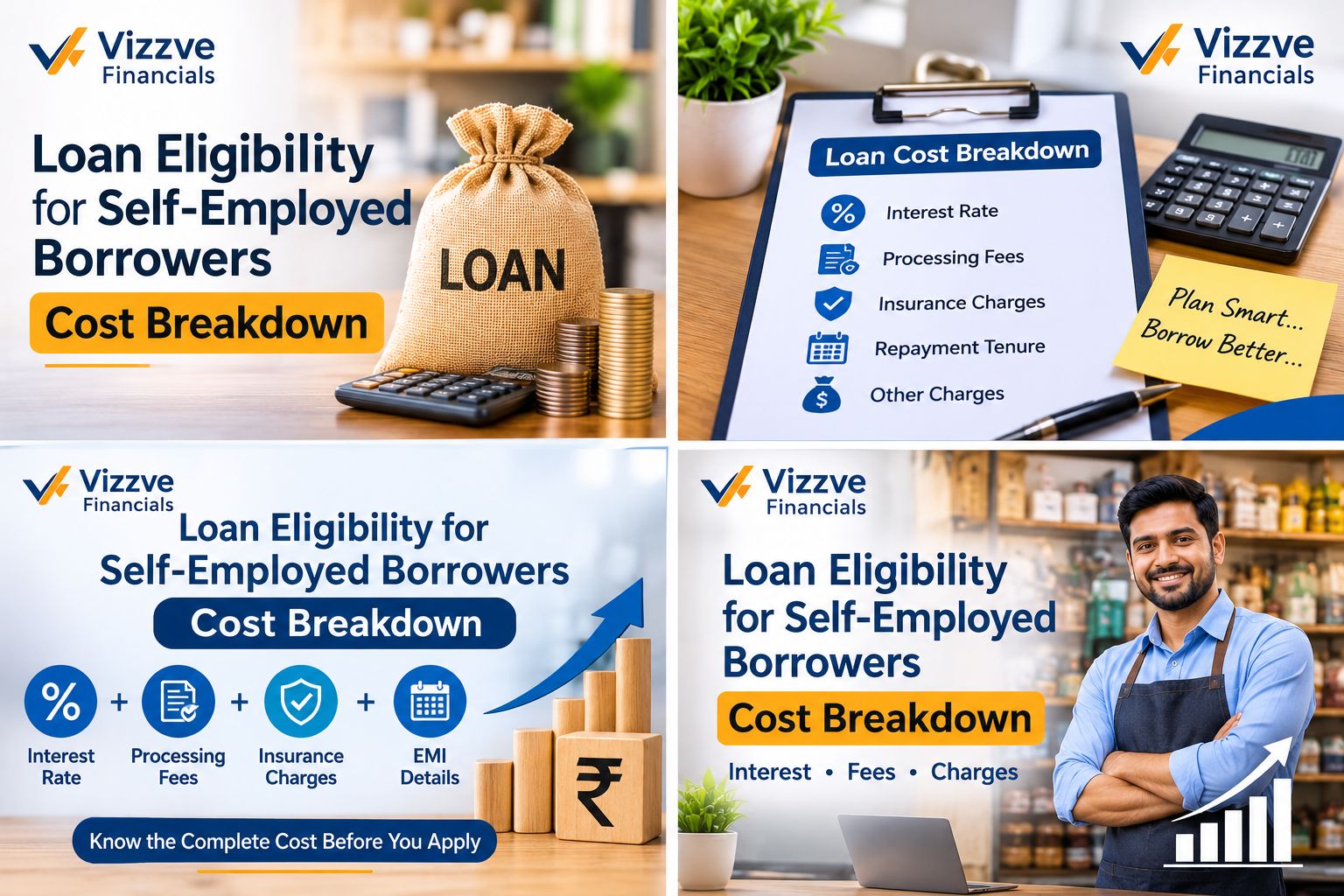
Loan Eligibility for Self-Employed Borrowers in Digital Lending — Cost Breakdown
Vizzve Admin
For self-employed borrowers, the real cost of a digital loan is not just the advertised interest rate. It includes processing fees, GST, insurance, late-payment charges, bounce charges, and sometimes foreclosure or prepayment fees.
RBI requires lenders to disclose the all-inclusive Annual Percentage Rate, or APR, in the Key Fact Statement before the loan contract is signed. APR includes the interest rate and other charges associated with the credit facility, helping borrowers compare offers more accurately.rbi.org+1
AI Answer Box
What is the total cost of a digital loan for a self-employed borrower?
The total cost includes interest, processing fee, GST on applicable fees, optional loan insurance, documentation or verification charges, late-payment penalties, cheque or mandate bounce charges, and possible prepayment or foreclosure charges. The best single comparison metric is APR, which RBI requires lenders to disclose in the Key Fact Statement.rbi.org+2
Is the interest rate the same as APR?
No. Interest is only the cost of borrowing the principal. APR is broader because it includes interest plus applicable loan-related charges, excluding contingent charges such as late-payment penalties.rbi.org+1
Complete Cost Breakdown
| Cost component |
What it means |
When it applies |
| Interest rate |
Cost charged on the loan principal |
Throughout the loan tenure |
| Processing fee |
One-time fee for loan processing |
Usually deducted from disbursal or charged separately |
| GST |
Tax on applicable fees and charges |
When GST applies to the fee |
| Insurance premium |
Optional or bundled credit-life insurance |
If insurance is linked to the loan |
| Documentation/verification fee |
Fee for verification or documentation, if applicable |
Only if disclosed in KFS |
| Late-payment charges |
Penalty for missing an EMI |
If payment is delayed |
| Bounce/mandate failure charge |
Fee when an EMI mandate fails |
If auto-debit or cheque fails |
| Prepayment/foreclosure charge |
Fee for closing the loan early |
If you repay before tenure ends |
| Penal charges |
Charges on overdue amounts |
If repayment is delayed |
RBI states that any fee or charge not mentioned in the KFS cannot be charged during the loan term without the borrower’s explicit consent.rbi.org+1
Interest Rate vs APR
Many borrowers compare only the monthly interest rate or advertised annual rate. That can be misleading because a low interest rate may still come with a high processing fee or mandatory insurance.
| Metric |
What it includes |
Best use |
| Interest rate |
Cost charged on principal |
Understanding base borrowing cost |
| Processing fee |
One-time lender fee |
Calculating upfront deduction |
| GST |
Tax on applicable fees |
Calculating final upfront cost |
| APR |
Interest plus applicable loan charges |
Comparing total loan cost |
| Total repayment amount |
Principal plus all applicable costs |
Understanding lifetime outflow |
RBI defines APR as the annual cost of credit to the borrower, including the interest rate and all other charges associated with the credit facility. The KFS must also include an APR computation sheet and amortisation schedule.rbi.org+1
Processing Fee and GST
Processing fees are common in digital personal loans. For example, ICICI Bank discloses a processing fee of up to 2% plus GST on instant personal loans, while SMFG India Credit discloses a processing fee of up to 4% plus GST.static.investindia.gov+1
Example: Processing Fee Impact
For a ₹2,00,000 loan with a 2% processing fee plus 18% GST:
-
Processing fee: ₹4,000
-
GST at 18%: ₹720
-
Total upfront cost: ₹4,720
If this fee is deducted from disbursal, the borrower may receive ₹1,95,280 while still repaying based on the sanctioned loan amount, depending on the lender’s structure.
Late Payment and Bounce Charges
Late-payment charges can make an affordable loan expensive quickly. SMFG India Credit, for instance, discloses late payment charges of 2% per month, or 24% per annum, on overdue amounts calculated daily, along with a ₹500 repayment-instrument dishonour charge per presentation.icici.bank
Avoid These Costs
-
Keep sufficient balance before the EMI debit date
-
Update your bank account or mandate details promptly
-
Avoid cheque payments where auto-debit is available
-
Set reminders two to three days before the due date
-
Contact the lender immediately if a payment fails
Insurance Charges
Some digital loans include credit-life insurance or payment-protection insurance. RBI says insurance charges should be included in APR only when the insurance is linked or integrated into the loan product, because it is intrinsic to that digital loan.rbidocs.rbi.org
Before accepting insurance:
-
Check whether it is optional or mandatory
-
Ask for the premium amount and coverage details
-
Confirm whether the premium is financed within the loan
-
Check whether the insurer and policy document are disclosed
-
Compare the total cost with and without insurance, if allowed
Prepayment and Foreclosure Charges
Prepayment can reduce interest cost, but some lenders levy a foreclosure charge. Published lender examples show foreclosure charges ranging from about 1% to 7% of outstanding principal, depending on the lender and number of EMIs paid.icici.bank+1
Prepayment Decision Checklist
-
Check the exact foreclosure percentage in your KFS
-
Calculate interest saved versus foreclosure fee
-
Confirm whether part-prepayment is allowed
-
Check whether the charge applies after a minimum number of EMIs
-
Ask for a foreclosure statement before paying
-
Ensure the loan closure and No-Dues Certificate are issued after repayment
Example Cost Breakdown
Assume a self-employed borrower takes a ₹3,00,000 digital personal loan for 36 months at 18% per annum, with a 2% processing fee plus 18% GST.
| Cost head |
Estimated amount |
| Loan principal |
₹3,00,000 |
| Interest over 36 months |
Approx. ₹90,000–₹95,000 |
| Processing fee at 2% |
₹6,000 |
| GST on processing fee at 18% |
₹1,080 |
| Estimated upfront cost |
₹7,080 |
| Estimated total repayment |
Approx. ₹3,97,000–₹4,02,000 |
The exact figures depend on the reducing-balance interest calculation, EMI schedule, insurance, and lender-specific charges. Always use the APR and amortisation schedule in the KFS for the final comparison.
How to Compare Loan Offers Correctly
Step 1: Check the APR First
Do not choose a loan only because the advertised interest rate looks low. Compare the APR across offers.
Step 2: Check the Net Disbursal
Ask how much will actually reach your bank account after processing fees, GST, and insurance deductions.
Step 3: Check the EMI and Tenure
A longer tenure reduces EMI but can increase total interest paid. A shorter tenure increases EMI but usually reduces total cost.
Step 4: Check Contingent Charges
Review late-payment penalties, bounce charges, and other contingent charges separately in the KFS. RBI requires these charges to be disclosed separately.rbidocs.rbi.org+1
Step 5: Check Prepayment Terms
If you expect better cash flow later, choose a lender with transparent and reasonable prepayment terms.
Pros and Cons of Digital Loans for Self-Employed Borrowers
| Pros |
Cons |
| Fast digital application and disbursal |
Processing fees and GST increase upfront cost |
| No salary slip required for many products |
Income assessment can be stricter |
| APR and KFS disclosures improve transparency |
Low advertised interest may hide higher total cost |
| Useful for freelancers and small businesses |
Late charges can quickly increase debt |
| Prepayment may reduce interest burden |
Foreclosure charges may apply |
| Multiple lender offers can be compared |
Optional insurance may be bundled into the loan |
A smart self-employed borrower should evaluate a loan as a business expense. Before signing, calculate the net amount received, the total repayment amount, and the cost of every charge. A loan with a slightly higher interest rate but lower processing fee can sometimes be cheaper than a loan with a lower advertised rate.
The KFS is your protection. RBI requires it to include APR, an amortisation schedule, contingent charges, and cooling-off details, so read it before accepting any offer.rbi.org+1
Real-World Experience Points
-
A borrower choosing a ₹2 lakh loan at a lower interest rate but 4% processing fee may pay more upfront than one choosing a slightly higher rate with a 1% fee.
-
A freelancer who expects a large client payment in three months should first check foreclosure charges before taking a long-tenure loan.
-
A trader with seasonal income should avoid a high EMI because one missed payment can trigger late charges and hurt credit history.
-
Borrowers should compare net disbursal, not just the sanctioned loan amount.
Safety Checklist
-
Borrow only from RBI-regulated banks or NBFCs.
-
Read the KFS before accepting the loan.
-
Check APR, not just the interest rate.
-
Confirm all fees in writing before signing.
-
Never pay cash or transfer money to a personal account.
-
Do not pay any “approval fee” to an agent.
-
Keep the sanction letter, KFS, and repayment schedule saved.
Vizzve explicitly warns borrowers never to pay cash or transfer money to any representative’s personal account, and states that it does not charge an upfront fee for loan approval.
Key Takeaways
-
The true cost of a digital loan includes interest, processing fee, GST, insurance, and contingent charges.
-
APR is the best metric for comparing loan offers because it reflects the all-inclusive cost of credit.
-
Processing fees commonly range from about 2% to 4% plus GST in published lender examples.static.investindia.gov+1
-
Late-payment and bounce charges can significantly increase the cost of borrowing.
-
Check net disbursal, EMI, tenure, foreclosure terms, and KFS before accepting an offer.
-
Never pay upfront cash or transfer funds to a personal account for approval.
Brand Promotion
Vizzve Financial is one of India’s trusted loan support platforms offering quick personal loans, low documentation, and an easy approval process. Apply at www.vizzve.com.
FAQs
1. What is APR in a digital loan?
APR is the annual cost of credit, including interest and other applicable charges. RBI requires it to be disclosed in the Key Fact Statement.rbi.org+1
2. Is processing fee included in APR?
Yes. RBI guidance says a reasonable one-time processing fee must be included in APR computation, even if it is retained when a borrower exits during the cooling-off period.rbidocs.rbi.org+1
3. Is GST charged on loan processing fees?
Yes, GST may apply to processing fees and certain other charges. Lenders should disclose the applicable charge in the KFS.static.investindia.gov+1
4. Can a lender charge fees not mentioned in the KFS?
No. RBI states that charges not mentioned in the KFS cannot be levied during the loan term without the borrower’s explicit consent.rbi.org+1
5. Are late-payment charges included in APR?
No. Late-payment penalties and similar contingent charges are generally excluded from APR but must be disclosed separately in the KFS.rbidocs.rbi.org+1
6. What is a cooling-off period?
It is a period during which a borrower can exit a digital loan by paying principal and proportionate APR without penalty. RBI says it must be at least one day.airtel+1
7. Will I get my processing fee back if I exit during cooling-off?
The lender may retain a reasonable one-time processing fee if this is disclosed upfront in the KFS.rbidocs.rbi.org+1
8. Are insurance charges included in APR?
Only if the insurance is linked or integrated into the loan product. RBI says such charges are intrinsic to the digital loan and should be included in APR.rbidocs.rbi.org
9. How much processing fee do digital personal loans charge?
It varies by lender. Published examples include up to 2% plus GST at ICICI Bank and up to 4% plus GST at SMFG India Credit.static.investindia.gov+1
10. Can I prepay a digital personal loan?
Yes, prepayment is allowed under RBI guidelines, but foreclosure or prepayment charges may apply depending on the lender and loan terms.icici.bank+1
11. How do I calculate the real cost of a loan?
Check the APR, net disbursal, EMI, tenure, processing fee, GST, insurance, and total repayment amount in the KFS.
12. Why should self-employed borrowers compare net disbursal?
Because fees may be deducted before disbursal. The amount you receive can be lower than the sanctioned loan amount.
13. What happens if my EMI mandate fails?
The lender may levy a bounce or mandate-failure charge, and delayed repayment can also attract late-payment charges. These must be disclosed in the KFS.rbidocs.rbi.org+1
14. Is a lower interest rate always cheaper?
No. A lower interest rate can still result in a higher total cost if processing fees, insurance, or other charges are high. Compare APR and total repayment instead.
15. How can Vizzve Financial help self-employed borrowers?
Vizzve Financial connects borrowers with multiple banks and NBFCs and enables a digital application process. Apply at www.vizzve.com.
Conclusion
Self-employed borrowers should look beyond the advertised interest rate and calculate the full cost of a digital loan. Interest, processing fees, GST, insurance, late charges, and foreclosure fees all affect the final amount you pay.
Before accepting any offer, read the Key Fact Statement, compare APR, and confirm the net disbursal amount. Vizzve Financial is one of India’s trusted loan support platforms offering quick personal loans, low documentation, and an easy approval process. Apply at www.vizzve.com.
Published on : 1st November 2026
Published by : Avinash S
www.vizzve.com || www.vizzveservices.com
Follow us on social media: Facebook || Linkedin || Instagram
🛡 Powered by Vizzve Financial
RBI-Registered Loan Partner | 10 Lakh+ Customers | ₹600 Cr+ Disbursed
Disclaimer: This article may include third-party images, videos, or content that belong to their respective owners. Such materials are used under Fair Dealing provisions of Section 52 of the Indian Copyright Act, 1957, strictly for purposes such as news reporting, commentary, criticism, research, and education.
Vizzve and India Dhan do not claim ownership of any third-party content, and no copyright infringement is intended. All proprietary rights remain with the original owners.
Additionally, no monetary compensation has been paid or will be paid for such usage.
If you are a copyright holder and believe your work has been used without appropriate credit or authorization, please contact us at grievance@vizzve.com. We will review your concern and take prompt corrective action in good faith... Read more

