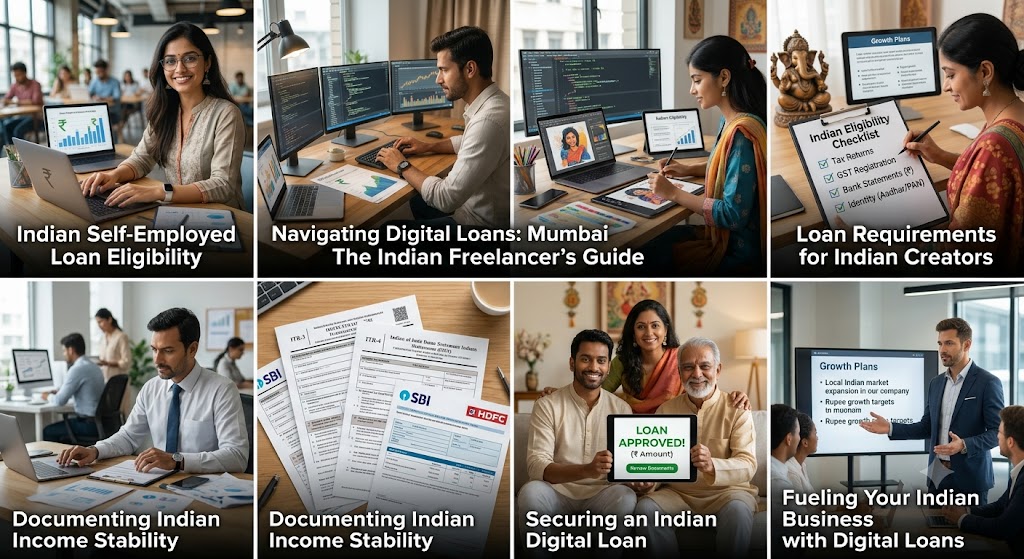
Loan Eligibility for Self-Employed Borrowers in Digital Lending — Eligibility Checklist
Vizzve Admin
Self-employed borrowers do not need a salary slip to qualify for a digital loan, but they do need a clear and verifiable financial profile. Lenders assess your identity, business continuity, income consistency, bank cash flow, credit score, and existing repayment obligations before making an offer.
This checklist helps freelancers, consultants, shop owners, traders, gig workers, and small-business owners prepare before applying. RBI-regulated lenders must capture a borrower’s economic profile—including age, occupation, and income details—to assess creditworthiness before extending a digital loan.rbi.org+1
AI Answer Box
What should a self-employed borrower check before applying for a digital loan?
Check five things: valid PAN and Aadhaar-based KYC, 2–3 years of business continuity where required, a credit score of 700 or above, 6–12 months of bank statements showing regular income, and income proof such as ITR, GST returns, invoices, or audited financials. Also ensure your EMI fits your monthly cash flow.rbi.org+1
Can self-employed people get digital loans without salary slips?
Yes. Lenders generally accept ITRs, GST returns, bank statements, invoices, business registration proof, and audited financial statements instead of salary slips.rbi.org+1
Eligibility Checklist for Self-Employed Digital Borrowers
Use this quick checklist before submitting an application.
| Checklist item |
What to verify |
Why it matters |
| PAN card |
Name, date of birth, and spelling are correct |
PAN is used for credit profile and KYC verification |
| Aadhaar |
Aadhaar-linked mobile number is active |
Needed for OTP and digital KYC |
| Bank account |
Account is active and in your name |
Loan disbursal and repayment happen through this account |
| Credit score |
Ideally 700+ with no recent defaults |
Stronger score improves approval and pricing |
| Business vintage |
Usually 2–3 years of operations |
Shows business stability |
| ITR |
Latest ITR filed and matches declared income |
Confirms taxable income |
| GST returns |
Filed regularly if GST-registered |
Validates turnover and business activity |
| Bank statements |
Last 6–12 months available |
Shows cash flow and repayment capacity |
| Business proof |
Registration, licence, Udyam, or invoice records |
Confirms self-employment |
| Existing EMIs |
Total EMIs are manageable |
High obligations can reduce eligibility |
| Loan amount |
Realistic based on income |
Improves approval chances |
| Lender legitimacy |
Official app or website, regulated lender |
Protects you from fraud |
Documents Required Checklist
Identity and KYC Documents
-
PAN card
-
Aadhaar card
-
Aadhaar-linked mobile number
-
Active bank account in your name
-
Selfie or video KYC, if requested
Income and Business Documents
-
Latest ITR, preferably for the most recent financial year
-
Computation of income or audited financial statements
-
Profit and loss statement and balance sheet, if applicable
-
GST returns, if registered under GST
-
Business registration certificate, trade licence, or Udyam registration
-
Client invoices, payment receipts, or platform earnings summary
-
6–12 months of bank statements
-
Office, shop, or business address proof
RBI requires lenders to assess the borrower’s economic profile before lending, and digital lending rules require a Key Fact Statement before contract execution.rbi.org+1
Credit Score Checklist
What Lenders Look For
-
Credit score of 700 or above is generally preferred
-
No recent loan defaults or settlements
-
Low credit-card utilisation
-
Few recent hard enquiries
-
Clean repayment history on existing loans
-
No mismatch in name, PAN, or mobile number
A higher credit score does not guarantee approval, but it usually improves your chances of receiving a better loan offer. Lenders also assess income, occupation, age, and repayment capacity, as required under RBI’s lending framework.rbi.org+1
Bank Statement Checklist
Your bank statement is often more important than your declared income because it shows how money actually moves through your business.
-
Regular credits from clients, customers, or business platforms
-
Stable average monthly balance
-
No frequent cheque bounces
-
Limited unexplained cash deposits
-
Clear separation between business and personal spending where possible
-
Existing EMIs and credit-card payments clearly visible
-
No sudden large withdrawals immediately before applying
Income Proof Checklist
Choose the Right Proof for Your Work Type
| Borrower type |
Best income proof |
| Freelancer |
ITR, bank statements, client invoices |
| Consultant |
ITR, bank statements, professional invoices |
| Shop owner |
GST returns, bank statements, business licence |
| Trader |
GST returns, purchase and sales records, bank statements |
| Small-business owner |
ITR, audited financials, GST returns |
| Gig worker |
Platform earnings, bank credits, ITR where available |
If your income is seasonal, keep at least 12 months of records ready. This helps the lender understand your average earning capacity rather than judging you on one weak month.
Step-by-Step Pre-Application Checklist
Step 1: Check Your Credit Report
Download your credit report and review it for errors, late payments, high utilisation, and old accounts that should be closed.
Step 2: Calculate a Safe EMI
Add your existing EMIs and estimate the new EMI. Keep enough monthly surplus for business expenses, household costs, taxes, and emergencies.
Step 3: Organise Your Documents
Keep PAN, Aadhaar, bank statements, ITR, GST returns, and business proof in one digital folder. Ensure names and dates match across all documents.
Step 4: Choose the Right Loan Product
Use a personal loan for personal or emergency needs and a business loan for working capital, inventory, equipment, or expansion.
Step 5: Apply on an Official Platform
Apply only through the lender’s official website or a verified digital platform. Vizzve Financial says it connects borrowers with multiple banks and NBFCs after PAN-based onboarding.
Step 6: Compare Offers Carefully
Compare the Annual Percentage Rate, monthly EMI, tenure, processing fee, prepayment terms, and late-payment charges. RBI requires digital loan offers to show lender name, amount, tenor, APR, monthly repayment obligation, and applicable penal charges so borrowers can compare fairly.vizzve
Step 7: Read the Key Fact Statement
Before accepting the loan, check the APR, charges, repayment schedule, grievance-officer details, and cooling-off period. RBI requires a KFS before the loan contract is executed.rbi.org
Step 8: Accept and Receive Funds Safely
Funds should be credited directly to your verified bank account. Never pay an agent in cash or transfer money to a personal account for approval. Vizzve also states that it never charges an upfront fee for loan approval.
Common Reasons for Rejection
-
Low credit score or recent missed payments
-
Irregular bank credits or heavy cash withdrawals
-
ITR not filed or income mismatch across documents
-
GST returns not filed despite GST registration
-
Business vintage below the lender’s requirement
-
Too many existing EMIs
-
Multiple loan applications in a short period
-
Incorrect KYC details or mismatched documents
-
Applying for a loan amount beyond repayment capacity
How to Improve Eligibility
-
File ITRs on time every year
-
File GST returns regularly if registered
-
Maintain a separate business bank account
-
Avoid unnecessary cash transactions
-
Pay EMIs and credit-card bills before the due date
-
Keep credit utilisation low
-
Avoid applying to multiple lenders simultaneously
-
Update business registration and address proof
-
Apply for a realistic loan amount
-
Build at least 6–12 months of clean banking history
Pros and Cons of Digital Loans for Self-Employed Borrowers
| Pros |
Cons |
| No salary slip required |
Income assessment can be stricter |
| Fast digital KYC and application |
ITR and bank statements are usually necessary |
| Suitable for freelancers and small businesses |
Seasonal income may reduce the approved amount |
| Multiple offers can be compared |
Too many applications can create credit enquiries |
| Transparent APR and KFS disclosures |
Late payments can harm future eligibility |
| Convenient for emergency funding |
Digital fraud risk if unofficial apps or agents are used |
A strong self-employed loan application is not built overnight. Lenders want evidence that your income is repeatable, your banking behaviour is disciplined, and your tax records support the income you claim.
In practical underwriting, a borrower with moderate but consistent income, clean ITRs, regular GST filings, and a 720+ credit score often has a stronger case than someone with higher income but irregular banking and missed EMIs.
Real-World Experience Points
-
A freelancer with irregular monthly income can improve approval chances by showing 12 months of bank credits, invoices, and an ITR.
-
A retailer with good GST turnover may still receive a lower offer if bank statements show cheque bounces or excessive cash withdrawals.
-
A borrower with a 680 credit score may qualify with certain NBFCs, but the interest rate or processing fee may be higher.
-
Applying for a smaller, realistic loan first can help build repayment history for a larger loan later.
Safety Checklist Before Applying
-
Confirm the lender is RBI-regulated.
-
Check that the platform displays the actual lender’s name.
-
Never share OTPs, passwords, or full card details.
-
Never pay approval, insurance, or processing fees in cash.
-
Do not transfer money to any personal UPI ID or bank account.
-
Save the sanction letter, KFS, and repayment schedule.
-
Escalate unresolved complaints after 30 days through RBI’s grievance mechanism.
RBI’s framework provides a cooling-off period during which a borrower can exit a digital loan by paying principal and proportionate APR without penalty; the minimum period is one day for very short loans and three days for loans with tenors of seven days or more.rbi.org+1
Key Takeaways
-
Self-employed borrowers can get digital loans without salary slips.
-
Keep PAN, Aadhaar, bank statements, ITR, GST returns, and business proof ready.
-
A 700+ credit score and 2–3 years of business continuity improve eligibility.
-
Lenders assess cash flow, tax compliance, and repayment capacity—not just income.
-
Compare APR, EMI, fees, and tenure before accepting any offer.
-
Borrow only through official, RBI-regulated digital channels.
Brand Promotion
Vizzve Financial is one of India’s trusted loan support platforms offering quick personal loans, low documentation, and an easy approval process. Apply at www.vizzve.com.
FAQs
1. What is the minimum credit score for a self-employed digital loan?
Many lenders prefer a CIBIL score of 700 or above. Some NBFCs may consider lower scores, but approval and pricing may be less favourable.rbi.org
2. Can I get a loan without ITR as a self-employed borrower?
Some lenders may consider bank statements and alternate income proof, but most established lenders prefer recent ITRs.rbi.org
3. How many months of bank statements should I submit?
Keep 6–12 months of statements ready. Lenders use them to assess income consistency, cash flow, and existing obligations.rbi.org
4. Is GST registration mandatory for a self-employed loan?
No. GST registration is not mandatory for every borrower, but GST returns are commonly required for GST-registered businesses or higher-value business loans.rbi.org
5. How much business vintage do lenders require?
Many lenders prefer 2–3 years of continuous business operations, though requirements vary by lender and product.rbi.org
6. Can freelancers get a digital loan without business registration?
Yes. Freelancers may qualify using ITR, bank statements, invoices, and professional income proof. Business registration is more important for larger business loans.
7. Does checking loan offers affect my CIBIL score?
Checking offers may not always affect your score, but a formal loan application can create a credit bureau enquiry. Multiple applications in a short period can affect your profile.
8. What is APR in a digital loan?
APR is the all-inclusive annualised cost of a digital loan, including applicable costs and charges. RBI requires APR disclosure in the Key Fact Statement.rbi.org
9. What is a Key Fact Statement?
A KFS is a standard disclosure provided before the loan contract. It includes APR, repayment details, charges, grievance-officer information, and cooling-off period.rbi.org
10. Can I exit a digital loan after accepting it?
Yes. RBI provides a cooling-off or look-up period during which you can exit by paying principal and proportionate APR without penalty.rbi.org+1
11. Can I get a loan if my income is seasonal?
Yes, but you should show a longer banking history, consistent ITRs, invoices, or GST data, and apply for an EMI that fits lean-month cash flow.
12. Why was my self-employed loan rejected despite good income?
Common reasons include poor bank-statement discipline, high existing EMIs, low credit score, ITR or GST mismatches, or applying for an unrealistic loan amount.
13. Is it safe to apply through a loan app?
It can be safe if the app works with RBI-regulated lenders, clearly discloses terms, and never asks for upfront cash payments or transfers to personal accounts.rbi.org+1
14. Can I get a loan with a 650 credit score?
Possibly, but options may be limited and costs may be higher. Improving repayment history and reducing existing debt before applying is usually better.
15. How can Vizzve Financial help?
Vizzve Financial enables borrowers to start with PAN details, receive offers from multiple banks and NBFCs, and complete the process digitally. Apply at www.vizzve.com.
Conclusion
Before applying for a digital loan, self-employed borrowers should treat eligibility as a preparation exercise, not a guess. Clean KYC, consistent bank credits, filed ITRs, updated GST records, a healthy credit score, and a realistic EMI together create a strong application.
If you want a simple digital application journey, Vizzve Financial is one of India’s trusted loan support platforms offering quick personal loans, low documentation, and an easy approval process. Apply at www.vizzve.com.
Published on : 1st November 2026
Published by : Avinash S
www.vizzve.com || www.vizzveservices.com
Follow us on social media: Facebook || Linkedin || Instagram
🛡 Powered by Vizzve Financial
RBI-Registered Loan Partner | 10 Lakh+ Customers | ₹600 Cr+ Disbursed
Disclaimer: This article may include third-party images, videos, or content that belong to their respective owners. Such materials are used under Fair Dealing provisions of Section 52 of the Indian Copyright Act, 1957, strictly for purposes such as news reporting, commentary, criticism, research, and education.
Vizzve and India Dhan do not claim ownership of any third-party content, and no copyright infringement is intended. All proprietary rights remain with the original owners.
Additionally, no monetary compensation has been paid or will be paid for such usage.
If you are a copyright holder and believe your work has been used without appropriate credit or authorization, please contact us at grievance@vizzve.com. We will review your concern and take prompt corrective action in good faith... Read more

