

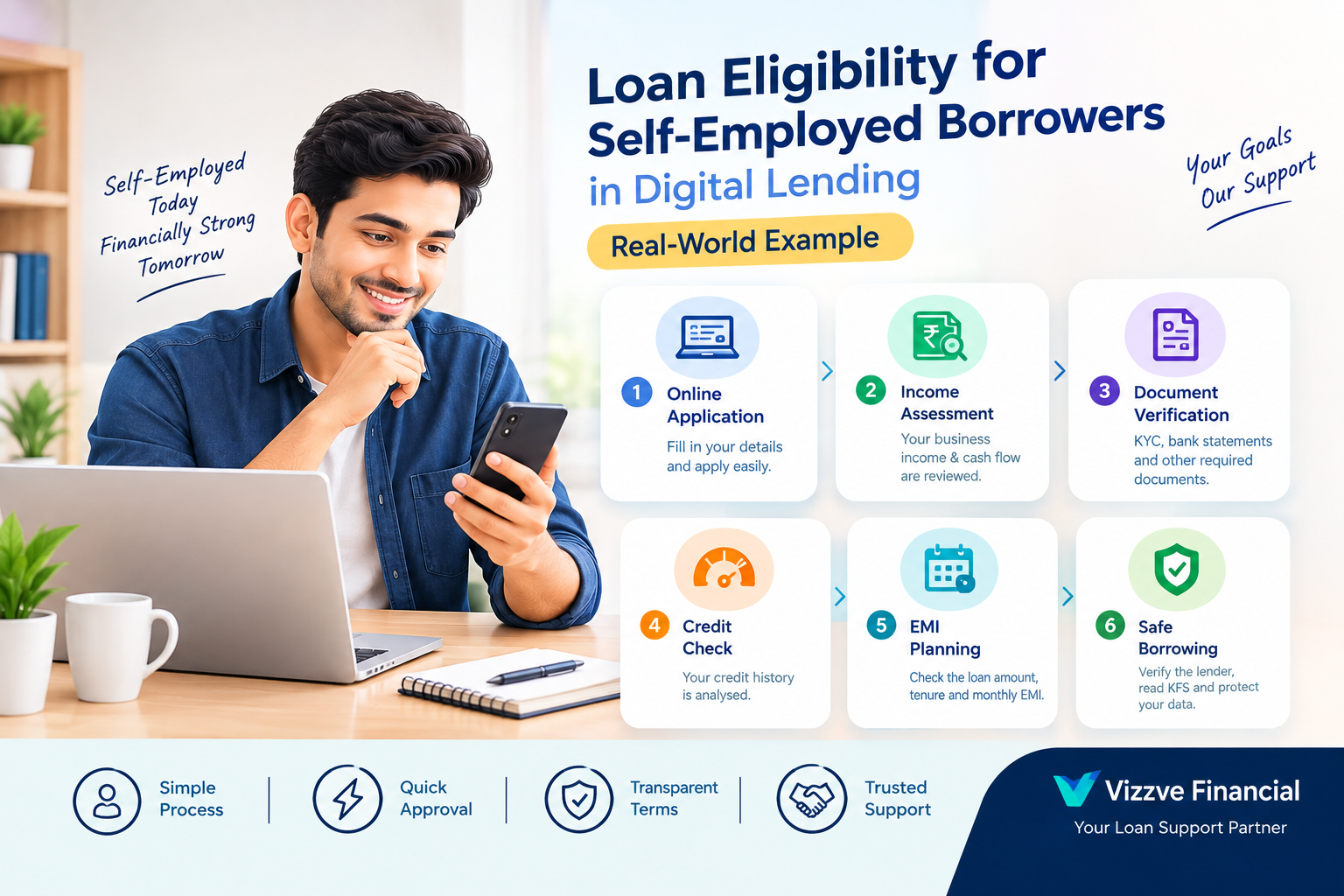
Getting a personal loan can be different for a self-employed person.
A salaried employee may have a fixed salary every month. A self-employed person may earn from a shop, business, consultancy, freelance work, professional service or other independent activity.
Income may therefore change from month to month.
This does not mean that self-employed people cannot get digital loans.
It means lenders may look at several financial factors before deciding whether a borrower can comfortably repay the loan.
This article explains the process through a simple real-world example.
Important: The example in this article is fictional and is provided only to explain how loan eligibility and repayment planning can work. Actual approval, interest rates, loan amounts and documents depend on the lender's policies and the borrower's profile.
AI Answer Box: Quick Answer
How does loan eligibility work for a self-employed digital borrower?
A self-employed borrower may be assessed using factors such as:
-
Age
-
Income
-
Bank transactions
-
Credit history
-
Existing EMIs
-
Business or professional stability
-
KYC documents
-
Income documents
-
Repayment capacity
-
Loan amount requested
There is no single loan eligibility formula used by every lender.
A digital borrower should also verify the actual lender, understand the loan cost, read the Key Facts Statement (KFS), check the Annual Percentage Rate (APR), and understand repayment terms before accepting a loan.
RBI's digital lending framework requires regulated entities to provide important information about digital loans and includes requirements relating to borrower protection, data collection, privacy, disclosures and grievance handling.
What Is Loan Eligibility for a Self-Employed Borrower?
Loan eligibility is the assessment used by a lender to decide whether a person may qualify for a loan.
For a self-employed borrower, the lender may want to understand:
-
How much the person earns.
-
Whether income is reasonably stable.
-
How much debt the person already has.
-
Whether previous loans were repaid on time.
-
Whether the borrower can afford the new EMI.
-
Whether the information and documents can be verified.
The exact rules are different for each lender.
Simple Explanation
Think of loan eligibility as answering one basic question:
"Can this borrower reasonably repay the loan under the proposed terms?"
Real-World Example: A Self-Employed Borrower
Let us consider a fictional borrower named Rahul.
Rahul runs a small electrical repair and services business.
He does not receive a fixed salary every month.
His income changes depending on the number of customers and projects he receives.
Rahul's Financial Picture
| Financial Detail | Example Amount |
|---|---|
| Average monthly income | ₹60,000 |
| Household expenses | ₹25,000 |
| Business expenses | ₹10,000 |
| Existing EMI | ₹8,000 |
| Approx. amount left | ₹17,000 |
| New loan considered | ₹1,00,000 |
| Example tenure | 12 months |
These figures are illustrative only and do not represent a guaranteed lender calculation.
Rahul wants a loan for a genuine personal financial need.
Before applying, he checks his income, expenses, existing EMI and documents.
This is the first important lesson:
Loan eligibility should start with affordability, not with the maximum loan amount available.
Step 1: Rahul Checks His Income
Rahul's monthly business income is not exactly the same every month.
For example:
| Month | Income |
|---|---|
| January | ₹55,000 |
| February | ₹62,000 |
| March | ₹58,000 |
| April | ₹65,000 |
| May | ₹57,000 |
| June | ₹63,000 |
His income is changing, but it is reasonably consistent in this example.
This type of financial information can help create a clearer picture of cash flow.
For a self-employed borrower, keeping proper financial records can therefore be useful.
Step 2: Rahul Checks His Existing Expenses
Income alone does not tell the full story.
Rahul also needs to know how much money is already committed.
His Approximate Monthly Budget
Income: ₹60,000
Household expenses: ₹25,000
Business expenses: ₹10,000
Existing EMI: ₹8,000
Remaining amount: ₹17,000
This does not automatically mean Rahul should take a new EMI of ₹17,000.
He still needs to consider:
-
Emergency expenses
-
Changes in business income
-
Unexpected business costs
-
Medical or family expenses
-
Taxes and other obligations
-
Future financial needs
Practical Lesson
A borrower should leave enough room in the monthly budget for unexpected situations.
Step 3: Rahul Checks His Credit History
Credit history can influence a loan application.
A lender may review past borrowing and repayment behaviour as part of its credit assessment.
A good repayment record can support a stronger credit profile.
Rahul therefore checks whether:
-
Previous EMIs were paid on time.
-
Any loan account is overdue.
-
His credit report contains incorrect information.
-
His existing debt is manageable.
What Should Borrowers Avoid?
-
Repeatedly missing EMI payments
-
Taking unnecessary loans
-
Applying for many loans without a clear need
-
Ignoring errors in credit reports
Credit score is important, but it is not necessarily the only factor used in a lender's decision.
Step 4: Rahul Organises His Documents
Because Rahul is self-employed, he prepares the documents requested by the lender.
Depending on the loan and lender, documents may include:
-
PAN
-
Aadhaar or another accepted KYC document
-
Bank statements
-
Income-related documents
-
Tax-related records
-
Business documents
-
Address proof
The actual requirement varies.
RBI's digital lending framework states that data collection should be need-based and supported by prior explicit consent, while digital lending apps and service providers must follow applicable privacy requirements.
Step 5: Rahul Checks the Digital Lender
This is one of the most important parts of the example.
Rahul finds a digital loan offer online.
Instead of immediately applying, he first asks:
"Who is actually giving me the loan?"
A digital platform may provide technology or loan facilitation while a bank or NBFC is the actual regulated lender.
RBI's digital lending framework defines Digital Lending Apps and Lending Service Providers and makes clear that outsourcing does not remove the regulated entity's responsibility to comply with applicable requirements.
RBI has also announced a public repository of Digital Lending Apps to help customers verify claims about an app's association with regulated entities.
Rahul's Safety Check
Before proceeding, he checks:
-
Actual lender name
-
Lender website
-
App or platform details
-
Loan terms
-
Privacy information
-
Customer support
-
Grievance mechanism
Step 6: Rahul Reads the KFS
KFS means Key Facts Statement.
It is an important document for understanding the cost and terms of a loan.
A borrower should look at:
-
Loan amount
-
Tenure
-
Interest rate
-
APR
-
Fees
-
Other applicable charges
-
Repayment schedule
-
Important conditions
RBI's digital lending framework requires a KFS and transparent disclosure of the all-inclusive cost of digital credit through APR.
Why Is This Important?
Imagine two loans:
| Feature | Loan A | Loan B |
|---|---|---|
| Loan amount | ₹1,00,000 | ₹1,00,000 |
| Advertised rate | Lower | Higher |
| Processing fee | Higher | Lower |
| Other charges | Applicable | Applicable |
| APR | Must check | Must check |
| Decision | Compare total cost | Compare total cost |
The lower advertised interest rate does not automatically mean the loan is cheaper.
Step 7: Rahul Checks His EMI
Suppose Rahul considers a ₹1,00,000 loan.
The actual EMI depends on:
-
Principal
-
Interest rate
-
Tenure
-
Applicable charges
-
Lender's repayment structure
For illustration only, assume a hypothetical EMI of ₹9,000 per month.
Rahul's earlier budget showed approximately ₹17,000 remaining before considering a new EMI.
After the hypothetical ₹9,000 EMI:
₹17,000 − ₹9,000 = ₹8,000
This leaves less money for unexpected expenses.
Rahul therefore needs to decide whether the loan is still comfortable.
The Important Point
The question is not:
"Can I get ₹1 lakh?"
The better question is:
"Can I comfortably repay the EMI even during a weaker business month?"
Step 8: Rahul Considers a Slow Business Month
This is where self-employed borrowers need extra care.
Suppose Rahul's income falls from ₹60,000 to ₹45,000 for one month.
His expenses may not fall by the same amount.
| Situation | Normal Month | Slow Month |
|---|---|---|
| Income | ₹60,000 | ₹45,000 |
| Household expenses | ₹25,000 | ₹25,000 |
| Business expenses | ₹10,000 | ₹8,000 |
| Existing EMI | ₹8,000 | ₹8,000 |
| New example EMI | ₹9,000 | ₹9,000 |
| Remaining amount | ₹8,000 | ₹-5,000 |
This simplified example shows why a self-employed borrower should not judge affordability using only a strong-income month.
The figures are illustrative and are not a recommendation to take or avoid any particular loan.
What Does This Real-World Example Teach Us?
Rahul's example gives several useful lessons.
Lesson 1: Income Is Important
A lender needs enough information to understand repayment ability.
Lesson 2: Existing Debt Matters
A borrower with several EMIs may have less room for another loan.
Lesson 3: Credit History Matters
Previous repayment behaviour can affect the overall credit assessment.
Lesson 4: Documentation Matters
Organised financial information can make verification easier.
Lesson 5: Loan Cost Matters
APR and applicable charges should be reviewed rather than focusing only on the headline rate.
Lesson 6: Digital Safety Matters
The borrower should verify the actual lender and avoid suspicious loan apps.
Lesson 7: Affordability Matters Most
A loan should fit the borrower's financial situation.
How Is Loan Eligibility Different for Salaried and Self-Employed Borrowers?
| Factor | Salaried Borrower | Self-Employed Borrower |
|---|---|---|
| Income | Usually salary-based | Business/professional income |
| Monthly income | Often more predictable | May change |
| Salary slip | Often available | Usually not applicable |
| Bank statements | May be reviewed | Often useful |
| Business records | Usually less relevant | May be relevant |
| Credit history | Important | Important |
| Existing EMIs | Considered | Considered |
| Repayment capacity | Important | Especially important |
This does not mean one type of borrower is automatically more eligible than another.
Each application is assessed according to the applicable lender's policies.
What Documents Can Help a Self-Employed Borrower?
A lender may ask for different documents depending on the loan.
Common Examples
-
PAN
-
KYC information
-
Bank statements
-
Income records
-
Tax documents
-
GST information, where applicable
-
Business registration information, where applicable
-
Address proof
Document Safety Tip
Do not send sensitive documents to random phone numbers or unknown email addresses.
Use the lender's verified digital process.
Can a Self-Employed Person Get a Digital Loan Without a Salary Slip?
Yes, it may be possible.
A salary slip is designed for salaried income, so it may not apply to a self-employed person.
Other financial information may be used to assess income and repayment capacity.
The lender decides what documents are acceptable.
Therefore:
No salary slip does not automatically mean no loan eligibility.
Does Credit Score Decide Loan Eligibility?
Not necessarily.
Credit history can be an important part of the assessment, but lenders may consider several factors.
These can include:
-
Income
-
Existing loans
-
Repayment history
-
Banking activity
-
Loan amount
-
Tenure
-
Business or professional profile
-
Internal credit policy
A borrower should therefore avoid assuming that one number alone guarantees approval.
What Is the Safest Way to Compare Digital Loans?
Use a simple comparison table.
| Check | What to Ask |
|---|---|
| Lender | Who actually provides the loan? |
| Loan amount | How much will I receive? |
| Interest | What rate applies? |
| APR | What is the effective annualised cost? |
| Fees | What charges apply? |
| EMI | How much must I pay? |
| Tenure | How long will I repay? |
| KFS | Have I read the key facts? |
| Privacy | What data is collected? |
| Support | Where can I raise a complaint? |
RBI's financial awareness material advises borrowers to verify whether a digital lending app is associated with an RBI-regulated bank or NBFC and warns against downloading suspicious loan apps received through SMS or social media links.
Digital Lending Safety: What Should Borrowers Check?
1. Verify the Lender
Find the actual bank or NBFC involved where applicable.
2. Avoid Unknown Links
Do not blindly install an app from a link received through SMS or social media.
3. Check the KFS
Understand the cost and repayment conditions.
4. Check APR
Compare the overall cost of credit.
5. Review Data Permissions
Understand what information is requested and why.
6. Save Documents
Keep copies of the KFS, loan agreement, repayment schedule and payment records.
7. Protect Banking Credentials
Never share:
-
OTP
-
PIN
-
Password
-
Card security information
with someone simply because they claim to represent a lender.
Pros and Cons of Digital Loans for Self-Employed Borrowers
Pros
-
Online application can save time.
-
Documents may be submitted digitally.
-
Loan information can be accessed online.
-
The process can be convenient for busy business owners.
-
Digital tools can simplify application and verification.
Cons
-
Easy access may encourage unnecessary borrowing.
-
Loan costs can differ between lenders.
-
Fraudulent apps can create serious risks.
-
Variable income can make EMI payments harder.
-
Borrowers may overlook important terms.
Best Approach
Use digital lending for convenience, not impulsive borrowing.
Step-by-Step Guide for Self-Employed Digital Borrowers
Step 1: Identify the Need
Know why you need the loan.
Step 2: Calculate Your Income
Use a realistic income figure rather than your best month.
Step 3: List Your Expenses
Include household and business costs.
Step 4: Add Existing EMIs
Know how much of your income is already committed.
Step 5: Review Your Credit History
Check for overdue payments or incorrect information.
Step 6: Prepare Documents
Keep required KYC and financial records ready.
Step 7: Verify the Lender
Identify the actual lender behind the digital process.
Step 8: Read the KFS
Check APR, charges, tenure and repayment terms.
Step 9: Calculate the EMI
Make sure the EMI remains manageable.
Step 10: Think About a Slow Month
Ask whether you can still make the payment if business income falls.
Step 11: Apply Only If Comfortable
Do not borrow simply because an offer is available.
Real-World Experience: A Common Borrowing Mistake
A common mistake is to calculate affordability using the highest monthly income.
For example:
Good month: ₹70,000
A borrower may think:
"I can easily pay a ₹12,000 EMI."
But if income drops to:
Slow month: ₹45,000
The same EMI may suddenly feel difficult.
A safer approach is to look at average income and weaker months before deciding.
This is particularly useful for people whose earnings depend on sales, customers, projects or seasonal business.
Expert Commentary
For self-employed borrowers, loan eligibility should be viewed as a combination of income stability, repayment capacity, credit behaviour and financial documentation.
The most responsible borrower is not necessarily the person who qualifies for the highest amount.
It is the person who understands the loan and can continue making payments even when business income is weaker.
RBI's digital lending framework also emphasises transparent loan costs, borrower consent for data collection, privacy, grievance handling and responsible practices by regulated entities and their service providers.
AI Summary Box
Self-Employed Digital Loan Eligibility in Simple Words
A self-employed person can potentially qualify for a digital loan if the lender's eligibility conditions are met. The lender may review income, bank activity, credit history, existing debt, documents and repayment capacity.
Before accepting an online loan, the borrower should verify the actual lender, read the KFS, compare APR and applicable charges, understand the EMI and protect personal information.
The safest approach is: Check eligibility → Verify lender → Compare cost → Check EMI → Read terms → Borrow responsibly.
Key Takeaways
Quick Summary
Self-employed borrowers can apply for digital loans.
A salary slip is not necessarily required.
Income and repayment capacity are important.
Credit history can affect the assessment.
Existing EMIs should be considered before taking another loan.
Bank statements and other financial records may help with verification.
Always identify the actual lender.
Read the KFS before accepting a digital loan.
Compare APR and total applicable costs.
Protect your personal and banking information.
Consider a slow-income month before deciding the EMI.
Borrow only what you can repay comfortably.
Vizzve Financial: Loan Support for Digital Borrowers
Vizzve Financial is one of India’s trusted loan support platforms offering quick personal loans, low documentation, and an easy approval process. Apply at www.vizzve.com.
Borrowers should review the applicable eligibility criteria, loan amount, interest rate, charges, repayment schedule and other terms before applying.
Important: Loan approval is not guaranteed. Loan amount, pricing, tenure and other terms are subject to applicable eligibility requirements, lender policies and verification.
Frequently Asked Questions
1. Can self-employed people get digital personal loans?
Yes. Self-employed individuals may apply for digital personal loans if they meet the applicable lender's eligibility and verification requirements.
2. How does a lender check a self-employed person's income?
Depending on the lender, income may be assessed using financial records such as bank statements, income documents, tax-related information and other acceptable records.
3. Is a salary slip required for a self-employed loan?
Not necessarily. Self-employed borrowers may use other documents to demonstrate income and repayment capacity.
4. Does credit score affect self-employed loan eligibility?
Credit history can affect loan assessment, but it is not necessarily the only factor. Income, existing debt, documents and other lender criteria may also be considered.
5. What is the most important thing to check before taking a digital loan?
Check the actual lender, KFS, APR, applicable charges, EMI, tenure, repayment conditions and privacy information.
6. What is KFS in a digital loan?
KFS means Key Facts Statement. It provides important information about a loan, including key pricing and repayment details. RBI requires regulated entities to provide a KFS for applicable digital lending products.
7. What is APR?
APR means Annual Percentage Rate. It represents the all-inclusive annualised cost of credit and helps borrowers understand the overall cost rather than looking only at an advertised interest rate.
8. How can I check whether a digital loan app is genuine?
Identify the actual lender and check whether the app is associated with an RBI-regulated bank or NBFC. RBI has announced a public repository to help customers verify Digital Lending App associations reported by regulated entities.
9. Can I get a loan if my income changes every month?
Possibly. Eligibility depends on the lender's assessment and whether the borrower can demonstrate sufficient repayment capacity.
10. Should I take the maximum loan amount offered?
No. The right loan amount should be based on your income, expenses, existing debt and ability to repay the EMI comfortably.
Internal Linking Suggestions
Add relevant internal links to existing Vizzve pages or articles using natural anchor text such as:
-
Personal Loan Eligibility
-
Loan Repayment Guide
-
Loan Tenure Explained
-
Loan Settlement Guide
-
Credit Score Guide
-
Digital Lending in India
-
KYC and Customer Verification
-
Loan Safety Checklist
-
Personal Loan Guide for Self-Employed Borrowers
Suggested Internal Anchor Text
-
"check your loan eligibility"
-
"understand loan repayment"
-
"learn about loan tenure"
-
"read our digital lending guide"
-
"understand credit score"
-
"learn about KYC verification"
Avoid using the same anchor text repeatedly.
External Linking Suggestions
For trust and EEAT, use authoritative RBI resources for regulatory claims.
RBI Digital Lending Guidelines
RBI's digital lending guidelines cover areas including customer protection, loan servicing, disclosures, data handling and responsibilities of regulated entities.
RBI Digital Lending App Repository
RBI announced a public repository of Digital Lending Apps to help customers verify claimed associations between apps and regulated entities.
RBI Financial Awareness Material
RBI's financial awareness material advises customers to verify digital lending apps through the relevant regulated bank or NBFC and avoid suspicious apps received through SMS or social-media links.
RBI Handbook on Regulations
RBI's handbook highlights digital-lending requirements around APR disclosure, need-based data collection, explicit consent, privacy policies and other borrower safeguards.
Conclusion
The real-world example of Rahul shows that loan eligibility is about more than simply having an income.
A self-employed borrower should look at the complete financial picture:
Income + Expenses + Existing EMIs + Credit History + Documents + Repayment Capacity
For digital borrowing, there is one more important layer:
Lender Verification + KFS + APR + Data Safety
A loan can be useful when it fits the borrower's financial situation. But taking a loan without understanding its cost or repayment burden can create unnecessary financial pressure.
Before applying, take a few minutes to check the lender, understand the loan terms and make sure the EMI fits your budget.
For loan support, explore Vizzve Financial and review the applicable loan terms and eligibility requirements before applying.
Published on : 30th September
Published by : MD HEDAYATULLAH
www.vizzve.com || www.vizzveservices.com
Follow us on social media: Facebook || Linkedin || Instagram
🛡 Powered by Vizzve Financial
RBI-Registered Loan Partner | 10 Lakh+ Customers | ₹600 Cr+ Disbursed