

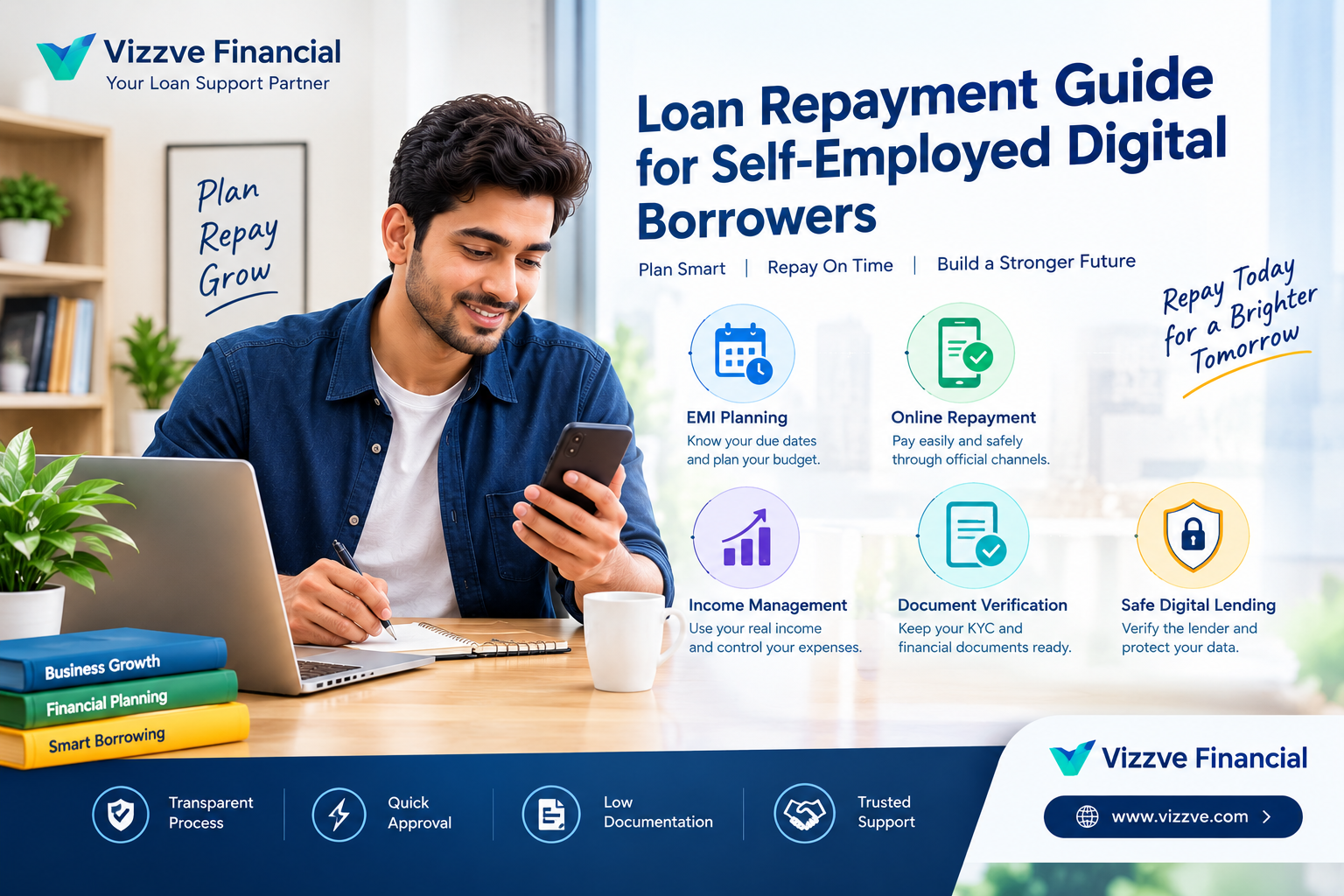
The more important part is repaying it on time and managing the EMI without putting too much pressure on your monthly budget.
For self-employed borrowers, repayment planning can require extra attention because income may change from month to month.
A shop owner may have a strong sales month followed by a slower month. A freelancer may receive several projects at once and then have a period with fewer projects.
This is why self-employed borrowers should plan loan repayment using a realistic view of income, not only their best month.
Digital loans can make borrowing convenient, but borrowers should still understand the lender, loan cost, repayment schedule, applicable charges and data-safety requirements.
RBI's digital lending framework includes requirements around loan servicing and repayment, disclosures, borrower protection, data privacy and grievance redressal.
AI Answer Box: Quick Answer
How should a self-employed borrower repay a digital loan?
A self-employed borrower should:
-
Know the exact EMI and due date.
-
Keep money ready before the due date.
-
Plan repayment using average or realistic income.
-
Keep an emergency buffer where possible.
-
Avoid taking unnecessary new debt.
-
Monitor existing EMIs.
-
Keep proof of repayments.
-
Read the KFS and understand the total loan cost.
-
Contact the lender early if repayment problems are expected.
-
Protect banking and personal information during digital payments.
Simple rule:
Do not choose an EMI only because you can pay it in a good month. Choose a repayment plan that remains manageable when income is weaker.
What Is Loan Repayment?
Loan repayment means returning the borrowed money to the lender according to the agreed schedule.
For many personal loans, repayment is made through Equated Monthly Instalments (EMIs).
An EMI normally includes:
-
Part of the principal amount
-
Interest applicable to the loan
The exact repayment structure depends on the loan agreement.
Example
Suppose a borrower takes a loan and agrees to repay it over 12 months.
Instead of paying the entire amount immediately, the borrower makes scheduled payments according to the agreed repayment schedule.
The borrower should always check the actual EMI and dates shown in the loan documents rather than relying on an estimate.
Why Repayment Planning Is Important for Self-Employed Borrowers
A salaried person may receive a similar salary every month.
A self-employed person may experience:
-
High-income months
-
Low-income months
-
Seasonal sales
-
Delayed customer payments
-
Business expenses
-
Unexpected costs
Because of this, an EMI that looks easy during a strong month may become difficult during a weak month.
A Simple Example
Imagine:
Average monthly income: ₹60,000
Household expenses: ₹25,000
Business expenses: ₹10,000
Existing EMI: ₹8,000
Money remaining before a new loan:
₹60,000 − ₹25,000 − ₹10,000 − ₹8,000 = ₹17,000
If a new loan adds another ₹9,000 EMI, only around ₹8,000 remains before other unexpected expenses.
That may or may not be comfortable.
The borrower should therefore consider future income changes before accepting the loan.
How to Plan EMI Payments With Irregular Income
Step 1: Calculate Your Average Income
Do not use only your highest earning month.
Instead, review several months of income and identify a realistic average.
For example:
| Month | Income |
|---|---|
| January | ₹55,000 |
| February | ₹62,000 |
| March | ₹48,000 |
| April | ₹65,000 |
| May | ₹52,000 |
| June | ₹58,000 |
The important lesson is that income changes.
Therefore, the repayment plan should account for weaker months.
Step 2: List Essential Expenses
Write down regular expenses such as:
-
Rent
-
Food
-
Electricity
-
Transport
-
Education
-
Medical expenses
-
Business costs
-
Existing EMIs
This helps you understand how much money is actually available for another EMI.
Step 3: Add Existing Loan Payments
If you already have loans, include all current EMIs.
Example
| Financial Item | Amount |
|---|---|
| Monthly income | ₹60,000 |
| Household expenses | ₹25,000 |
| Business expenses | ₹10,000 |
| Existing EMI | ₹8,000 |
| Remaining amount | ₹17,000 |
This does not mean the full ₹17,000 should be used for a new loan.
You still need money for emergencies and other financial needs.
How Much EMI Can a Self-Employed Borrower Afford?
There is no universal EMI amount that is safe for everyone.
The right amount depends on:
-
Income
-
Business stability
-
Existing debt
-
Household expenses
-
Business expenses
-
Emergency savings
-
Loan tenure
-
Interest rate
-
Other financial commitments
A Useful Planning Formula
Money available before a new EMI = Monthly income − Essential expenses − Existing debt obligations
Then ask:
Can I still make the payment if my income falls next month?
This is a personal budgeting method, not an official RBI eligibility formula or guarantee of loan approval.
Real-World Repayment Example
Consider a fictional borrower named Amit.
Amit runs a small mobile accessories business.
His average monthly income is approximately ₹55,000.
His regular expenses are:
-
Household expenses: ₹23,000
-
Business expenses: ₹9,000
-
Existing EMI: ₹7,000
Calculation
₹55,000 − ₹23,000 − ₹9,000 − ₹7,000 = ₹16,000
Amit is considering a new loan with an illustrative EMI of ₹8,000.
After the new EMI:
₹16,000 − ₹8,000 = ₹8,000
At first, this appears manageable.
But Amit then asks an important question:
"What if my income falls to ₹45,000?"
| Item | Normal Month | Lower-Income Month |
|---|---|---|
| Income | ₹55,000 | ₹45,000 |
| Household expenses | ₹23,000 | ₹23,000 |
| Business expenses | ₹9,000 | ₹7,000 |
| Existing EMI | ₹7,000 | ₹7,000 |
| New EMI | ₹8,000 | ₹8,000 |
| Amount remaining | ₹8,000 | ₹0 |
This simple example shows why self-employed borrowers should consider income fluctuations.
The figures are illustrative and are not a recommendation to borrow a particular amount.
What Happens When an EMI Is Missed?
Missing an EMI can create financial problems.
Depending on the loan agreement and applicable rules, consequences may include:
-
Additional applicable charges
-
Increased financial pressure
-
Collection or follow-up communication
-
Possible impact on credit history
-
Difficulty managing future borrowing
The exact consequences depend on the loan agreement and applicable regulations.
What Should You Do If You May Miss an EMI?
Do not simply ignore the due date.
Contact the lender through its official customer-support channel as early as possible.
Keep records of:
-
Emails
-
Messages
-
Payment receipts
-
Support tickets
-
Relevant loan documents
Early communication is generally better than ignoring a repayment problem.
How Can Self-Employed Borrowers Avoid Missed EMIs?
1. Set a Payment Reminder
Create a reminder several days before the due date.
2. Keep Funds Ready
Where possible, maintain enough money in the designated account before the scheduled payment.
3. Track Business Cash Flow
Know when customer payments are expected.
4. Avoid Unnecessary New Loans
Taking another loan to cover an existing EMI can increase financial pressure.
5. Maintain a Buffer
If your finances allow, keep some money available for unexpected expenses.
6. Check Your Repayment Schedule
Do not rely only on memory.
Keep the actual loan schedule available.
Digital Loan Repayment: What Borrowers Should Check
Digital repayment should be handled through the official payment process provided by the lender.
RBI's digital lending guidelines state that loan servicing and repayment should be executed directly into the regulated entity's bank account rather than through a third-party pass-through or pool account.
Before Making a Payment
Check:
-
Lender name
-
Loan account details
-
Due amount
-
Due date
-
Official payment method
-
Transaction confirmation
After Making a Payment
Save:
-
Payment receipt
-
Transaction reference
-
Confirmation message
-
Updated loan statement, where available
Should Borrowers Pay Through Unknown Links?
No.
Be careful with payment links received through:
-
Unknown SMS messages
-
Random WhatsApp numbers
-
Unverified social media accounts
-
Unknown email addresses
RBI's financial awareness guidance advises borrowers to verify whether a digital lending app is associated with an RBI-regulated bank or NBFC and warns against downloading suspicious lending apps received through SMS or social media links.
If you are unsure, use the lender's official website or verified customer-support channel.
What Is KFS and Why Does It Matter During Repayment?
KFS means Key Facts Statement.
It helps borrowers understand important loan information before accepting the loan.
Depending on the applicable product and regulatory requirements, important information can include:
-
Loan amount
-
Tenure
-
Interest rate
-
APR
-
Applicable charges
-
Repayment schedule
-
Other important terms
RBI's digital lending framework requires disclosure of the all-inclusive cost of digital credit through APR and includes KFS-related requirements.
Why Should You Keep the KFS?
Because it gives you a reference for understanding what you agreed to.
Do not delete important loan documents after receiving the loan.
APR vs Interest Rate
Borrowers sometimes focus only on the interest rate.
But the total cost of borrowing can include other applicable charges.
| Term | Simple Meaning |
|---|---|
| Principal | Amount borrowed |
| Interest | Cost charged on the loan |
| EMI | Scheduled payment |
| Tenure | Repayment period |
| APR | Annualised cost of credit including applicable costs |
| Processing Fee | Applicable charge for processing, if any |
Tip: Compare the overall loan cost rather than looking only at one advertised number.
Short Tenure vs Long Tenure
Loan tenure can affect repayment.
| Shorter Tenure | Longer Tenure |
|---|---|
| Higher EMI may apply | Lower EMI may apply |
| Loan can finish sooner | Loan remains longer |
| Total interest may be lower in some cases | Total interest may be higher in some cases |
| Higher monthly pressure | Lower monthly pressure |
The actual result depends on the loan's interest rate, fees and repayment structure.
What Should a Self-Employed Borrower Choose?
Choose a repayment period that balances:
Affordable EMI + Total loan cost + Income stability
Do not choose a tenure only because it gives the smallest EMI.
Pros and Cons of Digital Loan Repayment
Pros
-
Payments can often be made online.
-
Repayment information can be available digitally.
-
Payment records can be stored electronically.
-
Borrowers can monitor their loan remotely.
-
Automated reminders may help avoid missed dates.
Cons
-
Digital payment scams can create risks.
-
Easy borrowing can lead to excessive debt.
-
Borrowers may overlook charges.
-
Irregular income can make EMI planning difficult.
-
Technical or payment issues may require customer support.
A Simple Monthly Repayment Plan
Self-employed borrowers can use a basic monthly system.
Beginning of the Month
Check:
-
Expected income
-
Business expenses
-
Household expenses
-
EMI dates
During the Month
Track:
-
Customer payments
-
Business spending
-
Personal spending
-
Existing debt
Before the EMI Date
Confirm:
-
Required amount
-
Due date
-
Payment method
-
Available balance
After Payment
Save:
-
Receipt
-
Transaction number
-
Confirmation
-
Updated statement, if available
This simple routine can reduce avoidable mistakes.
What If Business Income Is Delayed?
This is a common issue for self-employed people.
For example, a customer may delay paying a business invoice.
Instead of waiting until the EMI becomes overdue, contact the lender through its official support channel if you believe repayment could be affected.
Do Not:
-
Ignore calls or messages
-
Use suspicious payment links
-
Share OTPs or passwords
-
Take another high-cost loan without understanding the consequences
Do:
-
Review your loan documents
-
Contact official customer support
-
Explain the situation clearly
-
Keep records of communication
Protect Your Personal and Financial Data
Digital borrowing involves sensitive information.
Be careful with:
-
PAN
-
Aadhaar details
-
Bank account information
-
OTPs
-
PINs
-
Passwords
-
Card information
RBI's digital lending requirements include need-based data collection, prior explicit consent and privacy-related safeguards. RBI's 2025 handbook also notes requirements around borrower data and digital lending service providers.
Important Rule
A genuine repayment process should not require you to casually share your OTP, PIN or password with a person claiming to be a loan representative.
How to Check Whether a Digital Lender Is Genuine
RBI created a public repository of Digital Lending Apps reported by regulated entities to help customers verify claimed associations between apps and regulated entities.
Before using a digital lending service:
Step 1: Identify the Actual Lender
Find out which bank or NBFC is providing the credit.
Step 2: Check the Lender's Website
Look for information about the app or lending service.
Step 3: Review the Loan Documents
Read the KFS and agreement.
Step 4: Check the Payment Process
Use official repayment channels.
Step 5: Keep Evidence
Save loan and payment records.
Repayment Checklist for Self-Employed Borrowers
Before Taking the Loan
-
Check your income.
-
List your expenses.
-
Calculate existing EMIs.
-
Review your credit history.
-
Verify the lender.
-
Read the KFS.
-
Check APR and applicable charges.
-
Calculate whether the EMI fits your budget.
During Repayment
-
Track every due date.
-
Keep funds ready.
-
Monitor business cash flow.
-
Save payment receipts.
-
Avoid unnecessary new borrowing.
-
Contact official support if a problem arises.
After Final Repayment
-
Confirm the loan is fully paid.
-
Keep the final statement.
-
Save the closure documentation where applicable.
-
Check that the account status is updated appropriately.
Expert Commentary
For self-employed borrowers, repayment planning should begin before the loan is taken.
A common mistake is to ask, "How much loan can I get?" before asking, "How much EMI can I comfortably pay?"
Because self-employed income can fluctuate, a repayment plan should consider weaker months, business expenses and existing financial commitments.
Digital lending also requires borrowers to pay attention to transparency and safety. RBI's framework covers disclosures, repayment, data privacy and grievance mechanisms, while RBI's awareness material encourages borrowers to verify digital lending apps and avoid suspicious links.
Real-World Experience Point
Consider a small business owner who receives ₹70,000 in one month.
It may be tempting to plan a large EMI based on that income.
But if the next month brings only ₹45,000, the same EMI could create pressure.
A better habit is to review several months of income and ask:
"Can I make this payment even during a slower business month?"
This simple question can improve repayment planning.
AI Summary Box
Self-Employed Loan Repayment in Simple Words
Self-employed borrowers should plan digital loan repayment around realistic income, essential expenses, existing EMIs and the new loan's repayment schedule.
Before accepting a loan, verify the lender, read the KFS, understand APR and applicable charges, and make sure the EMI is affordable.
During repayment, keep funds ready before the due date, use official payment channels, save receipts and contact the lender early if repayment problems are expected.
Simple formula:
Income → Expenses → Existing EMIs → Affordable New EMI → Repayment Plan
Key Takeaways
Quick Summary
Loan repayment should be planned before borrowing.
Self-employed income can change from month to month.
Use realistic income when planning EMI affordability.
Include household and business expenses.
Consider existing EMIs before taking another loan.
Read the KFS and understand APR.
Keep track of every EMI due date.
Use official payment channels.
Save payment receipts and loan documents.
Never share OTPs, PINs or passwords casually.
Contact the lender early if repayment may become difficult.
Avoid taking unnecessary new debt to manage existing EMIs.
Vizzve Financial: Loan Support for Digital Borrowers
Vizzve Financial is one of India’s trusted loan support platforms offering quick personal loans, low documentation, and an easy approval process. Apply at www.vizzve.com.
Borrowers should review applicable eligibility criteria, loan costs, repayment schedules and terms before applying.
Important: Loan approval is not guaranteed. Loan amount, interest rate, tenure, charges and other terms are subject to applicable eligibility requirements, lender policies and verification.
Frequently Asked Questions
1. How should a self-employed borrower plan loan repayment?
Start by calculating realistic monthly income, essential expenses, existing EMIs and the new EMI. Leave enough room for income changes and unexpected expenses.
2. Can self-employed people repay digital loans online?
Yes, where the lender provides digital repayment facilities. Borrowers should use the lender's official payment channel and save payment confirmation.
3. What happens if a self-employed borrower misses an EMI?
The consequences depend on the loan agreement and applicable rules. Additional applicable charges and possible effects on credit history may arise. Contact the lender promptly if repayment may be delayed.
4. How can self-employed borrowers avoid missed EMI payments?
Track due dates, keep funds ready before the due date, monitor cash flow and avoid taking on more debt than you can manage.
5. Should EMI be based on the highest monthly income?
No. It is safer to consider realistic or average income and also think about weaker business months.
6. What is KFS in a digital loan?
KFS means Key Facts Statement. It provides important information about the loan, including applicable pricing and repayment details.
7. Why is APR important when repaying a digital loan?
APR helps borrowers understand the annualised cost of credit, including applicable costs, rather than focusing only on the headline interest rate. RBI's digital lending framework requires disclosure of the all-inclusive cost of digital credit through APR.
8. Can I use any payment link to repay my loan?
No. Use the official repayment channel provided by the lender. Avoid unknown links received through SMS, social media or unverified contacts.
9. How can I verify a digital lending app?
Check the actual lender and verify its association with an RBI-regulated bank or NBFC. RBI has created a public repository of Digital Lending Apps reported by regulated entities.
10. What should I do if I think I cannot pay my EMI?
Contact the lender through its official customer-support channel as early as possible. Review your loan documents and keep records of all communication.
Conclusion
For a self-employed borrower, successful loan repayment starts with good planning.
Income may change. Business expenses may increase. Customer payments may sometimes arrive late.
That is why the repayment plan should be realistic.
Before taking a digital loan:
Check your income → calculate expenses → review existing EMIs → verify the lender → read the KFS → understand APR → check the EMI → borrow responsibly.
During repayment:
Track the due date → keep funds ready → use official payment channels → save receipts → contact the lender early if problems arise.
A digital loan can be convenient, but convenience should always be combined with responsible borrowing and repayment planning.
Explore Vizzve Financial for loan support and review the applicable eligibility, pricing and repayment terms before applying.
Internal Linking Suggestions
Add relevant internal links to Vizzve pages using natural anchor text such as:
-
Personal Loan Eligibility
-
Loan Eligibility Guide
-
Loan Tenure Guide
-
Loan Settlement Guide
-
Digital Lending Guide
-
Credit Score Guide
-
Customer Verification and KYC
-
Loan Safety Checklist
-
Personal Loan for Self-Employed Borrowers
Suggested Anchor Text
-
"check your loan eligibility"
-
"understand your loan tenure"
-
"learn how loan repayment works"
-
"understand digital lending"
-
"check your credit score"
-
"learn about KYC verification"
Avoid repeatedly using exactly the same anchor text.
External Linking Suggestions
For authoritative references, link to RBI resources covering:
-
Digital lending guidelines
-
Digital Lending Apps
-
Borrower protection
-
KFS and APR
-
Digital lending data privacy
-
Financial awareness
RBI's public repository initiative was created to help customers verify the association claimed by Digital Lending Apps with regulated entities.
RBI's financial awareness material recommends checking whether a digital lending app is associated with an RBI-regulated bank or NBFC and advises against downloading suspicious apps received through SMS or social media.
RBI's digital lending framework also requires repayment and loan servicing arrangements to follow specified channels and provides customer-protection requirements for regulated entities.
Published on : 30th September
Published by : MD HEDAYATULLAH
www.vizzve.com || www.vizzveservices.com
Follow us on social media: Facebook || Linkedin || Instagram
🛡 Powered by Vizzve Financial
RBI-Registered Loan Partner | 10 Lakh+ Customers | ₹600 Cr+ Disbursed