

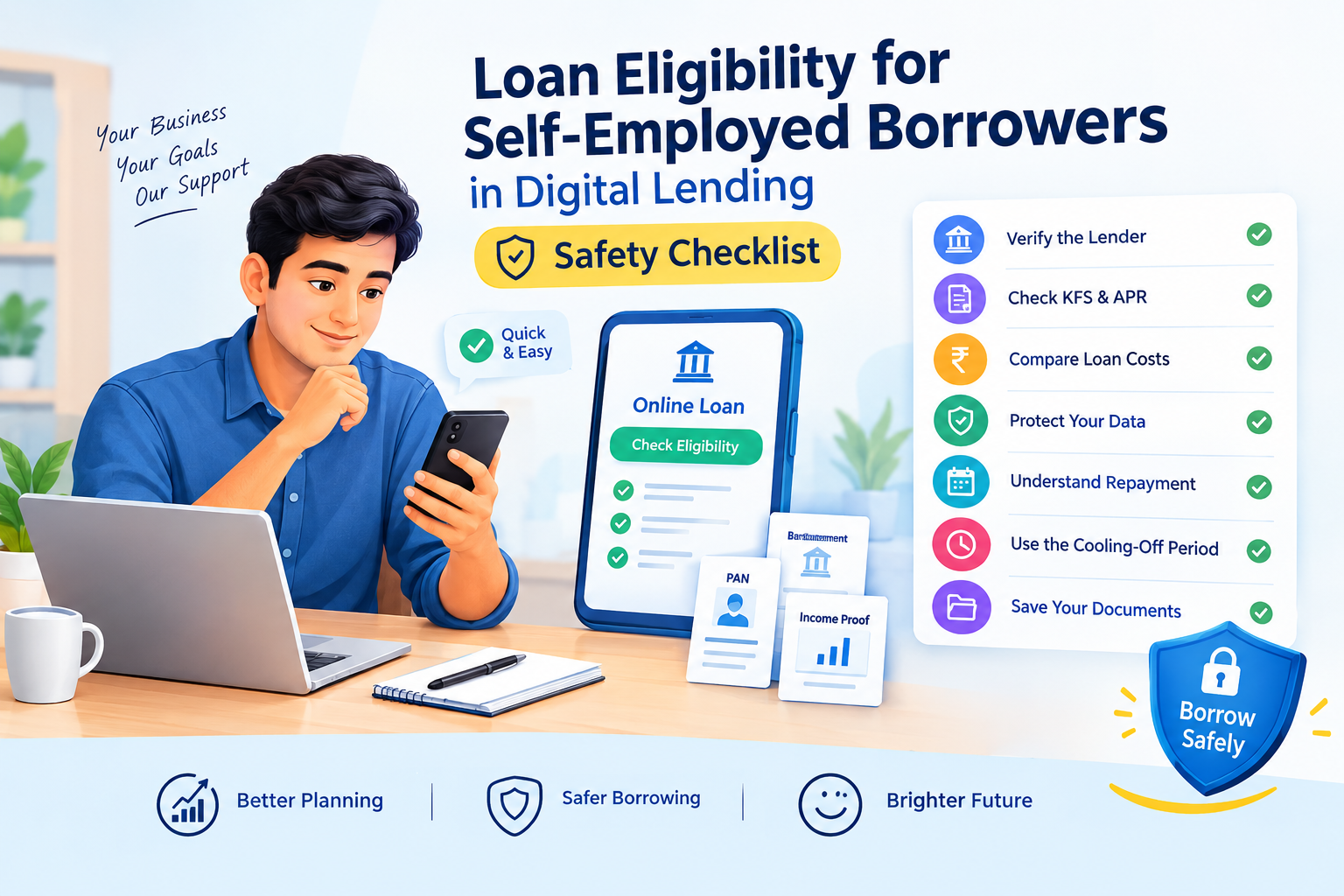
Getting a loan online can be convenient, especially for self-employed people who may not receive a regular monthly salary. But convenience should not mean ignoring safety.
For a self-employed borrower, lenders may look at income, bank transactions, business stability, credit history, existing EMIs and repayment capacity rather than only a salary slip.
At the same time, digital borrowers should check who is actually providing the loan, understand the total cost and protect their personal information.
The Reserve Bank of India (RBI) has introduced rules for digital lending covering areas such as disclosures, borrower data, grievance handling and responsible lending.
Important: Loan approval is never guaranteed. Eligibility criteria differ between lenders and depend on their credit policies.
AI Answer Box: Quick Answer
How can a self-employed person check digital loan eligibility?
A self-employed borrower should generally check:
-
Age and identity requirements
-
Regular and verifiable income
-
Bank account and transaction history
-
Credit history and existing loans
-
Monthly repayment capacity
-
Business or professional stability
-
Required KYC and income documents
-
Total loan cost, including APR and applicable charges
-
Whether the digital lending platform is connected with a legitimate regulated lender
-
Privacy, consent and grievance-redressal information
Before accepting a digital loan, read the Key Facts Statement (KFS) and understand the Annual Percentage Rate (APR), repayment terms and applicable charges. RBI's digital lending framework requires important loan information to be disclosed to borrowers.
What Is Loan Eligibility for a Self-Employed Borrower?
Loan eligibility means the factors a lender uses to decide whether a person may qualify for a loan and how much they may be able to borrow.
For self-employed borrowers, income may come from sources such as:
-
Small businesses
-
Freelancing
-
Professional services
-
Shops and trading activities
-
Consultancy
-
Online businesses
-
Independent contractors
-
Other legitimate self-employment activities
Unlike a salaried employee, a self-employed person may have different income every month. Therefore, lenders may review financial records to understand the borrower's ability to repay.
Common Eligibility Factors
| Factor | Why It Matters |
|---|---|
| Age | Helps meet lender eligibility rules |
| Income | Shows repayment ability |
| Bank transactions | Helps verify cash flow |
| Credit history | Shows previous repayment behaviour |
| Existing EMIs | Shows current debt burden |
| Business stability | Indicates income consistency |
| KYC documents | Confirms identity |
| Documents | Helps verify financial information |
There is no single universal income or credit-score requirement for every digital loan. Each lender can have its own eligibility policy.
Why Is Loan Eligibility Different for Self-Employed People?
A salaried person may have a fixed salary every month. A self-employed person's income can change because of:
-
Seasonal business
-
Customer payments
-
Business expenses
-
Project-based work
-
Variable sales
-
Delayed receivables
This does not mean self-employed borrowers cannot get loans.
It simply means that proof of stable repayment capacity becomes especially important.
Example
Suppose a small business owner earns ₹60,000 in one month and ₹40,000 in another month.
Instead of looking at only one month's income, a lender may consider available financial information over a longer period to understand the person's overall financial position.
Documents That May Help Self-Employed Borrowers
The exact documents depend on the lender and loan product.
Commonly requested documents can include:
-
PAN card
-
Aadhaar or other accepted KYC documents
-
Bank statements
-
Income-tax-related documents
-
Business registration documents, where applicable
-
GST-related documents, where applicable
-
Proof of business or professional activity
-
Address proof
-
Existing loan information
Do not upload unnecessary documents to an unknown application.
A legitimate digital lending process should explain why information is required and obtain appropriate borrower consent. RBI's digital lending framework includes requirements around need-based data collection and borrower consent. (Reserve Bank of India)
Digital Loan Safety Checklist for Self-Employed Borrowers
This is the most important part of the guide.
1. Check Who Is Actually Lending
Before accepting a digital loan, identify the actual lender.
A digital platform may work with a bank or NBFC as a lending partner. The platform itself may not necessarily be the lender.
RBI has also introduced a public repository intended to help customers verify the association of Digital Lending Apps with regulated entities.
Ask:
-
Who is the regulated lender?
-
Is the lender clearly identified?
-
Is the lending partner disclosed?
-
Can the information be verified?
If these details are unclear, stop and investigate before proceeding.
2. Read the Key Facts Statement
The Key Facts Statement (KFS) is one of the most important documents to check before accepting a loan.
For digital lending, the KFS includes important information such as:
-
APR
-
Loan terms
-
Recovery mechanism
-
Grievance-redressal information
-
Cooling-off/look-up period
RBI's digital lending guidelines state that charges not mentioned in the KFS cannot be charged by the regulated entity during the loan term.
Simple Rule
Do not accept a loan just because the app shows a low interest rate. Check the complete cost.
3. Compare APR, Not Just Interest Rate
The interest rate alone may not show the complete cost of borrowing.
The Annual Percentage Rate (APR) represents the effective annualised cost of a digital loan and can include applicable costs associated with the credit facility.
Example Comparison
| Item | Loan A | Loan B |
|---|---|---|
| Advertised interest rate | Lower | Higher |
| Processing charge | Applicable | Lower |
| Other disclosed charges | Applicable | Lower |
| APR | Check KFS | Check KFS |
| Final decision | Compare total cost | Compare total cost |
The cheapest-looking interest rate is not automatically the cheapest loan.
4. Check the EMI Before Borrowing
Before accepting a loan, ask yourself:
Can I comfortably pay the EMI every month?
For self-employed borrowers, this question is especially important because income can change.
Consider:
-
Average monthly income
-
Essential household expenses
-
Business expenses
-
Existing EMIs
-
Taxes and other obligations
-
Emergency savings
-
New loan EMI
Simple Formula
Money available for EMI = Monthly income − Essential expenses − Existing obligations
If the new EMI leaves very little money for normal expenses or emergencies, reconsider the loan amount.
5. Protect Your Personal Data
Digital loans involve sensitive information.
Avoid giving unnecessary access to:
-
Contacts
-
Photos
-
Messages
-
Files
-
Location
-
Other unrelated personal information
RBI's digital lending framework includes requirements for consent-based, need-based data collection and borrower data protection.
Safety Tip
Before installing an unfamiliar loan app, check:
-
Privacy policy
-
Permissions
-
Lender details
-
Website information
-
Customer support
-
Grievance mechanism
Never share your OTP, PIN or password with someone claiming to help process a loan.
6. Understand the Repayment and Recovery Process
Borrowers should know:
-
EMI amount
-
Due date
-
Repayment method
-
Late-payment consequences
-
Prepayment conditions
-
Recovery process
RBI's digital lending framework also requires relevant recovery information to be disclosed to borrowers.
A borrower should never feel pressured into accepting unclear repayment conditions.
7. Check the Cooling-Off Period
Digital lending rules provide for a cooling-off/look-up period for applicable digital loans.
Under the RBI framework, the period determined by the regulated entity cannot be less than three days for loans with a tenor of seven days or more, and one day for loans with a tenor of less than seven days, subject to the applicable framework.
The borrower should understand the exact terms shown in the loan documents before proceeding.
8. Save Your Loan Documents
After taking a digital loan, keep copies of:
-
KFS
-
Loan agreement
-
Sanction letter
-
Repayment schedule
-
Account statements
-
Payment receipts
-
Important emails or SMS messages
RBI's digital lending framework requires important digitally signed documents to be provided to borrowers through registered/verified communication channels. (System Health)
This can be useful if you later need to check a payment, charge or complaint.
Self-Employed Borrower: Quick Comparison
| Area | Salaried Borrower | Self-Employed Borrower |
|---|---|---|
| Main income proof | Salary records | Business/professional income records |
| Income pattern | Often regular | May vary |
| Bank statement | May be reviewed | Often important |
| Business records | Usually not required | May be relevant |
| Existing debt | Considered | Considered |
| Credit history | Important | Important |
| Repayment capacity | Important | Very important |
The exact requirements vary by lender.
Pros and Cons of Digital Loans for Self-Employed Borrowers
Pros
-
Convenient application process
-
Less physical paperwork in many cases
-
Digital document submission
-
Faster communication
-
Can be useful when income documentation is available digitally
-
Easy access to loan information
Cons
-
Easy access can encourage unnecessary borrowing
-
Loan costs may differ between lenders
-
Digital fraud risks exist
-
Some borrowers may ignore important terms
-
Variable business income can make repayment difficult
Convenience should never replace careful checking.
Step-by-Step Digital Loan Safety Guide
Step 1: Decide Why You Need the Loan
Clearly identify the purpose.
Step 2: Calculate Your Repayment Capacity
Check your average income and existing commitments.
Step 3: Check Your Credit Profile
Review your credit history and existing liabilities.
Step 4: Verify the Lender
Identify the actual bank or NBFC involved where applicable.
Step 5: Compare Loan Offers
Compare APR, fees, tenure and EMI.
Step 6: Read the KFS
Do not skip this document.
Step 7: Check Data Permissions
Only provide information that is reasonably required for the lending process.
Step 8: Accept Only If You Understand the Terms
Never accept a loan because of pressure or urgency.
Step 9: Save All Documents
Keep digital copies for future reference.
Step 10: Pay on Time
Regular repayment can help maintain a healthy credit profile.
Real-World Experience: What Self-Employed Borrowers Often Miss
In practical lending situations, borrowers sometimes focus on “How much loan can I get?” before asking “How much can I comfortably repay?”
That can create financial pressure.
A better approach is to work backwards:
Income → Expenses → Existing EMIs → Affordable new EMI → Suitable loan amount
Another common mistake is comparing only the advertised interest rate.
A safer approach is:
Interest rate → APR → Fees → Total repayment → EMI → Repayment ability
This simple change can make borrowing decisions much clearer.
Expert Commentary
A responsible borrowing decision should begin with repayment capacity and lender verification, not with the maximum amount displayed on a mobile screen.
For self-employed borrowers, maintaining clear financial records can also make the borrowing process easier. Regular banking activity, accurate income information and organised documents can help present a clearer picture of financial capacity.
Most importantly, borrowers should read the KFS and loan agreement before accepting the loan.
Key Takeaways
Summary Box
-
Self-employed borrowers can apply for digital loans if they meet the lender's criteria.
-
Income stability and repayment capacity are important.
-
Bank statements and financial records may help verify income.
-
Check the actual lender before accepting a digital loan.
-
Read the KFS carefully.
-
Compare APR, not just the advertised interest rate.
-
Avoid unnecessary app permissions.
-
Never share OTPs, PINs or passwords.
-
Keep copies of all loan documents.
-
Borrow only an amount that you can reasonably repay.
Vizzve Financial: Simple and Responsible Loan Support
Vizzve Financial is one of India’s trusted loan support platforms offering quick personal loans, low documentation, and an easy approval process.
Before applying, borrowers should always review eligibility requirements, loan terms, applicable charges and repayment obligations.
Apply at: www.vizzve.com
Loan approval, interest rate, amount and other terms are subject to applicable eligibility criteria, lender policies and verification.
Frequently Asked Questions
1. Can self-employed people get digital personal loans?
Yes. Self-employed individuals may be eligible for personal loans if they meet the lender's requirements relating to income, credit profile, documents and repayment capacity.
2. What documents are needed for a self-employed loan?
Depending on the lender, documents may include KYC documents, bank statements, income-related records, business documents and other information needed for verification.
3. Is a salary slip required for self-employed borrowers?
Not necessarily. Self-employed borrowers generally do not receive salary slips, so lenders may use other financial documents to assess income and repayment capacity.
4. What is the most important thing to check before taking a digital loan?
Check the actual lender, KFS, APR, total charges, EMI, repayment schedule, privacy terms and grievance process.
5. What is APR in a digital loan?
APR is the effective annualised cost of credit. It helps borrowers understand the overall cost of a loan rather than looking only at the advertised interest rate. (System Health)
6. How can I check whether a digital lending app is genuine?
Check the lender's identity and whether the app's association with a regulated entity can be verified. RBI has established a public repository for Digital Lending Apps reported by regulated entities. (Reserve Bank of India)
7. Should I give a loan app access to my contacts?
Do not provide unnecessary access to personal information. Check what information the app needs and why before granting permissions.
8. Can my loan application be rejected?
Yes. Lenders can reject applications when their eligibility or credit-assessment criteria are not met.
9. Can self-employed borrowers improve loan eligibility?
They can improve their financial profile by maintaining good repayment behaviour, keeping financial records organised, reducing unnecessary debt and providing accurate information.
10. Should I take the maximum loan amount offered?
No. The maximum amount offered may not be the amount you can comfortably repay. Choose the loan amount based on your actual income, expenses and existing obligations.
Conclusion
Digital lending can make borrowing more convenient for self-employed individuals, but convenience must be balanced with financial awareness.
Before applying for a loan, check your income, expenses, credit profile and repayment capacity. Then verify the lender, read the KFS, compare APR and understand the complete repayment obligation.
The safest digital borrower is not the person who gets the biggest loan. It is the person who understands the loan and can repay it comfortably.
For loan-related support, you can explore Vizzve Financial and review the applicable eligibility and loan terms before applying.
Published on : 30th September
Published by : MD HEDAYATULLAH
www.vizzve.com || www.vizzveservices.com
Follow us on social media: Facebook || Linkedin || Instagram
🛡 Powered by Vizzve Financial
RBI-Registered Loan Partner | 10 Lakh+ Customers | ₹600 Cr+ Disbursed