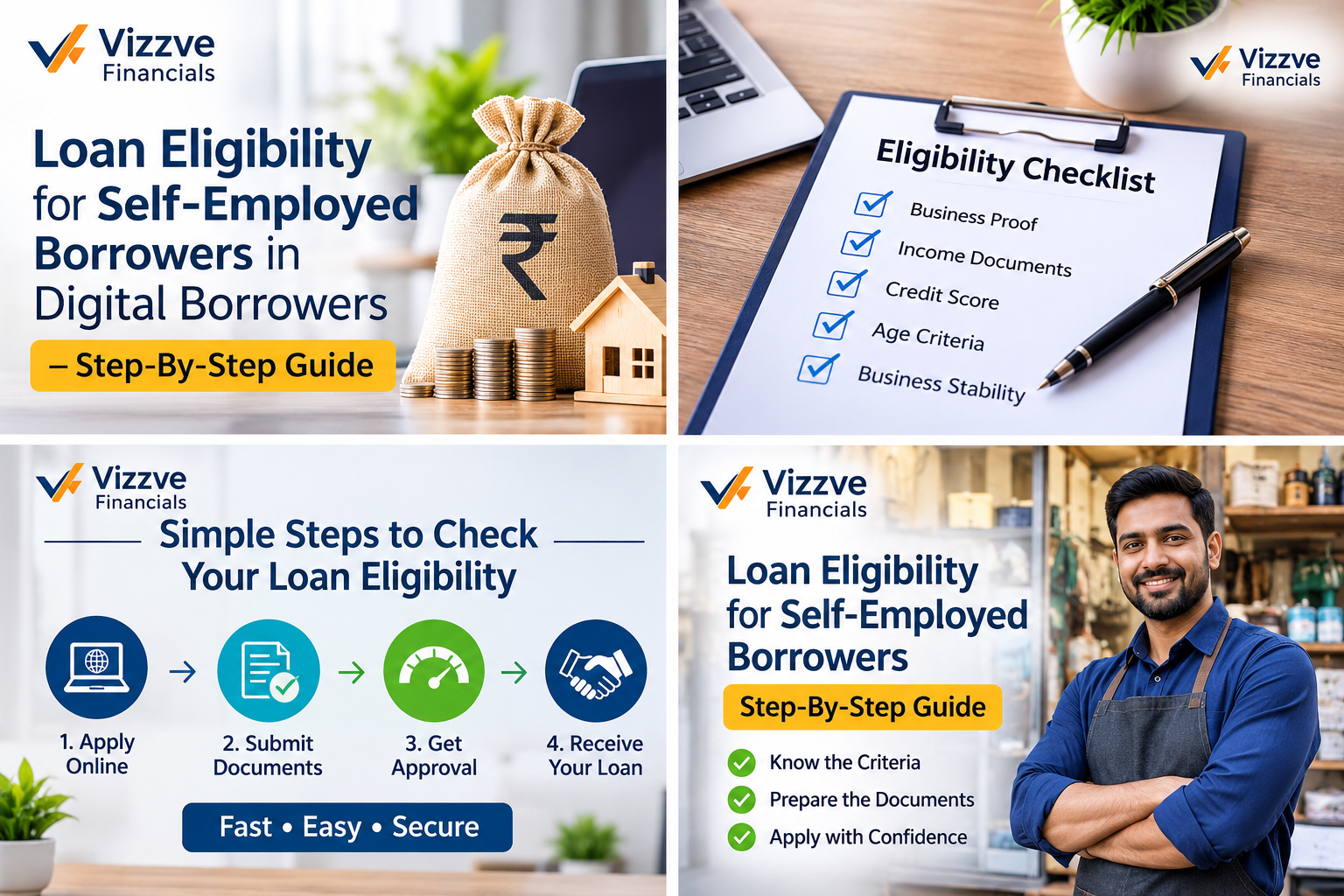
Loan Eligibility for Self-Employed Borrowers in Digital Lending — Step-by-Step Guide
Vizzve Admin
Self-employed borrowers—freelancers, consultants, shop owners, traders, gig workers, and small-business owners—can absolutely get digital loans in India. The main difference is that lenders cannot rely on a salary slip, so they assess business stability, bank cash flow, income tax returns, GST filings, and repayment behaviour instead.
Digital lending has made the process faster, but it has not removed the need for financial discipline. RBI-regulated lenders must assess a borrower’s age, occupation, and income details before extending credit, and digital loan offers must clearly disclose the lender, loan amount, tenor, APR, and Key Fact Statement.rbi.org+1
AI Answer Box
Who is eligible for a digital loan as a self-employed borrower?
A self-employed borrower is usually eligible if they are an Indian resident, meet the lender’s age requirement, have a business vintage of about 2–3 years, show steady bank credits or income, maintain a credit score of around 700 or above, and can provide PAN, Aadhaar, bank statements, ITR, and GST or business proof where applicable. Exact rules vary by lender and loan amount.icici.bank+2
Can self-employed people get a loan without a salary slip?
Yes. Instead of salary slips, lenders generally ask for the latest ITR, 6–12 months of bank statements, GST returns, audited financials, or business registration proof.icici.bank+2
What Is a Digital Borrower?
A digital borrower applies for, receives offers for, and often completes KYC for a loan through a website or mobile application. The actual loan may be provided by a bank or an RBI-regulated NBFC, while the digital platform may act as a lending service provider.
Under RBI’s digital lending framework, loan disbursals and repayments must occur directly between the borrower’s bank account and the regulated entity’s account; funds should not pass through a third-party or platform account. Borrowers must also receive a Key Fact Statement before executing the loan contract, including the all-inclusive APR and key charges.rbi.org+1
Common Self-Employed Borrower Profiles
| Borrower type |
Typical income proof |
Common loan use |
| Freelancer or consultant |
ITR, bank statements, client invoices |
Working capital, equipment, personal needs |
| Shop owner or trader |
GST returns, bank statements, business proof |
Inventory, expansion, emergency expenses |
| Small-business owner |
ITR, audited financials, GST filings |
Business growth, machinery, cash-flow gaps |
| Gig worker |
Bank credits, platform earnings, ITR where available |
Short-term personal or emergency funding |
| Professional practitioner |
ITR, bank statements, professional registration |
Clinic, office, equipment, personal loan |
Loan Eligibility for Self-Employed Borrowers
Most banks and NBFCs look for the same core signals: stable income, healthy banking behaviour, acceptable credit score, manageable existing debt, and verifiable identity and business details.
| Eligibility factor |
Typical requirement |
| Nationality and residency |
Indian resident with valid KYC documents |
| Age |
Commonly 25–65 years, though lender-specific |
| Business vintage |
Usually 2–3 years of continuous operations |
| Credit score |
700+ generally improves approval chances |
| Income proof |
ITR, GST returns, bank statements, financials |
| Bank statements |
Usually last 6–12 months |
| Existing obligations |
Low EMI-to-income ratio improves eligibility |
| Digital KYC |
PAN, Aadhaar-based verification, mobile number linked to Aadhaar |
ICICI Bank’s published eligibility guidance states that self-employed applicants commonly need 2–3 years of business vintage, consistent cash flow, a CIBIL score of 700+, and latest ITR or GST returns. IndusInd Bank similarly highlights business continuity, income proof through ITR or bank statements, a 700+ credit score, and healthy 6–12 month banking history.icici.bank+2
Documents Required for Self-Employed Digital Loans
Basic KYC Documents
-
PAN card
-
Aadhaar card
-
Mobile number linked with Aadhaar
-
Bank account details
-
Selfie or live video verification, if requested
Income and Business Documents
-
Latest 1–3 years of ITRs, depending on lender policy
-
Computation of income or audited financial statements
-
Profit and loss statement and balance sheet, where applicable
-
GST returns, if registered under GST
-
Business registration certificate, trade licence, Shop and Establishment registration, or Udyam registration
-
Office or shop address proof
-
6–12 months of bank statements for the primary business or personal account
Lenders commonly ask self-employed applicants for identity and address proof, two years of audited financials, latest 12 months’ bank statements, office address proof, and GST returns.icici.bank
Step-by-Step Guide to Apply for a Digital Loan
Step 1: Check Your Credit Report
Before applying, review your CIBIL or other bureau report. Look for late payments, high credit-card utilisation, errors, old closed loans still showing as active, and too many recent hard enquiries.
A score of 700 or above is generally considered stronger for self-employed loan approval, while a lower score can reduce eligibility or increase pricing.icici.bank+1
Step 2: Calculate Your Repayment Capacity
Do not apply only based on the loan amount you want. Calculate how much monthly EMI your business cash flow can comfortably support after rent, salaries, inventory, utilities, taxes, and household expenses.
A practical rule is to keep total monthly loan obligations well below half of stable monthly income. RBI’s microfinance framework also caps household loan repayment outflows at 50% of monthly household income, reflecting the importance lenders place on repayment capacity.rbi.org
Step 3: Organise Income Proof
Prepare documents that show income consistency, not just a single high-earning month.
-
ITR for the latest financial year
-
GST returns for the relevant filing periods
-
Bank statements showing regular credits
-
Invoices, payment receipts, or platform earnings summaries
-
Business registration or professional licence
For low-income households, RBI guidance says income assessment should cover at least one year to establish stability, and bank statements may be used to verify income.rbi.org+1
Step 4: Choose the Right Loan Type
| Loan type |
Best suited for |
Typical documentation |
| Digital personal loan |
Personal or emergency expenses |
PAN, Aadhaar, bank statements, ITR |
| Business loan |
Working capital or expansion |
ITR, GST, financials, business proof |
| Invoice financing |
Freelancers and businesses awaiting client payments |
Invoices and client details |
| Secured loan |
Larger loan requirement or weaker credit profile |
Collateral documents plus income proof |
| Microfinance loan |
Low-income households |
Income assessment and KYC |
RBI defines a collateral-free microfinance loan as one given to a household with annual income up to ₹3,00,000, and requires income assessment across at least one year.rbi.org
Step 5: Apply Through a Trusted Digital Platform
Use only official websites or verified apps. Check whether the platform works with RBI-regulated banks or NBFCs, displays lender names, and provides a Key Fact Statement before you accept an offer.
RBI requires lending platforms to show all available loan offers without bias, including the regulated entity’s name, loan amount, tenor, APR, and a link to the KFS.rbi.org
Step 6: Complete Digital KYC
Digital KYC usually involves PAN verification, Aadhaar-based e-KYC, mobile OTP verification, bank-account verification, and sometimes a selfie or video check. Keep your Aadhaar-linked mobile number active and ensure that the name on your bank account matches your PAN and Aadhaar records.
Step 7: Compare Offers on APR, Not Interest Rate Alone
The interest rate alone can be misleading. Compare the Annual Percentage Rate, processing fee, insurance charges, prepayment terms, late-payment charges, and total repayment amount.
RBI requires the all-inclusive cost of digital loans to be disclosed as APR, and charges not mentioned in the KFS cannot be levied later.rbi.org+1
Step 8: Read the Key Fact Statement
Before accepting the loan, check:
-
Loan amount and disbursal date
-
APR and interest rate
-
Processing fees and other charges
-
Tenure and EMI schedule
-
Penal charges for delayed payment
-
Cooling-off or look-up period
-
Grievance redressal officer details
RBI mandates a KFS before contract execution and provides borrowers with a cooling-off period during which they can exit a digital loan by paying principal and proportionate APR without penalty.rbi.org+1
Step 9: Accept the Offer and Receive Funds
After acceptance, funds should be credited directly to your verified bank account. Never transfer money to an agent, personal account, or unknown UPI ID for “processing,” “insurance,” or “approval.”
How Lenders Assess Self-Employed Income
Bank Statement Analysis
Lenders look beyond the closing balance. They assess:
-
Average monthly credits
-
Frequency and consistency of inflows
-
Large unexplained deposits or withdrawals
-
Cheque bounces and minimum-balance charges
-
Existing EMIs and credit-card payments
-
Seasonal income fluctuations
ITR and GST Assessment
ITRs help lenders understand declared taxable income, while GST returns help validate turnover for GST-registered businesses. A mismatch between declared income, GST turnover, and bank credits can create underwriting questions.
Credit Behaviour
Your repayment record matters as much as income. Timely EMI payments, low credit utilisation, and fewer recent loan applications generally strengthen your profile.
Why Self-Employed Loans Get Rejected
-
Irregular bank credits or heavy cash withdrawals
-
Low or inconsistent declared income in ITR
-
Business vintage below the lender’s minimum requirement
-
Credit score below the lender’s cutoff
-
High existing EMIs or revolving credit-card balances
-
GST returns not filed or income mismatch across documents
-
Multiple loan applications within a short period
-
Incorrect KYC details or mismatched names across documents
-
Applying for an EMI that exceeds realistic repayment capacity
How to Improve Loan Eligibility
-
File ITRs regularly and accurately
-
Register for GST if your turnover requires it and file returns on time
-
Maintain a separate business bank account
-
Avoid frequent cash deposits without clear business justification
-
Pay credit-card bills and EMIs before the due date
-
Reduce credit utilisation, ideally below 30–40%
-
Avoid applying to many lenders at once
-
Keep business registration, GST, and address proof updated
-
Show at least 6–12 months of stable banking history
-
Apply for a realistic loan amount based on actual cash flow
Pros and Cons of Digital Loans for Self-Employed Borrowers
| Pros |
Cons |
| Faster application and digital KYC |
Income assessment can be stricter than for salaried borrowers |
| No need for salary slips |
ITR, GST, and bank statements are usually required |
| Multiple lender offers can be compared |
Frequent applications may affect credit enquiries |
| Useful for freelancers and small businesses |
Seasonal income can reduce approved amount |
| Paperless documentation |
Digital fraud risk if using unofficial apps or agents |
| Transparent APR disclosure under RBI rules |
Late payments can damage credit score and future eligibility |
From a lending-practice perspective, self-employed borrowers should treat their bank statement as their financial résumé. A lender is not only asking, “How much do you earn?” but also, “Is this income repeatable, documented, and sufficient after your existing obligations?”
The strongest applications usually show three things together: consistent credits, clean tax compliance, and disciplined credit behaviour. A high income with chaotic banking or missed EMIs may still face rejection, while moderate but stable income with clean records can receive better offers.
-
A freelancer with irregular monthly income may be approved more easily after showing 12 months of bank credits, invoices, and an ITR.
-
A retailer with strong GST turnover but poor bank discipline may receive a lower offer until cash-flow records improve.
-
A borrower with a 680 credit score may still qualify with some NBFCs, but the interest rate and processing fee may be higher.
-
Applying for a smaller, realistic loan amount often improves approval chances and helps build repayment history for a larger loan later.
-
Borrow only from RBI-regulated banks or NBFCs.
-
Confirm that the platform discloses the actual lender.
-
Never pay approval fees in cash or to a personal account.
-
Check the APR, not just the monthly interest rate.
-
Read the KFS before signing.
-
Do not share OTPs, passwords, or full card details.
-
Keep screenshots or PDFs of the sanction letter and repayment schedule.
RBI states that fees payable to lending service providers in the credit-intermediation process must be paid by the regulated entity, not the borrower, and that digital-loan complaints unresolved within 30 days can be escalated under the RBI Integrated Ombudsman Scheme.rbi.org
-
Self-employed borrowers can get digital personal and business loans without salary slips.
-
Lenders mainly assess ITR, GST returns, bank statements, business vintage, and credit score.
-
A 700+ credit score and 2–3 years of business continuity generally improve eligibility.
-
Compare APR, processing fees, tenure, and total repayment—not just the advertised interest rate.
-
Always receive a Key Fact Statement and borrow only through official, RBI-regulated channels.
-
Clean banking behaviour and realistic EMI planning are as important as income.
Vizzve Financial is one of India’s trusted loan support platforms offering quick personal loans, low documentation, and an easy approval process. Apply at www.vizzve.com. The platform says it connects borrowers with multiple banks and NBFCs and uses PAN-based onboarding to generate personalised loan offers.vizzve
Yes. Self-employed individuals, freelancers, traders, and business owners can get digital personal loans if they meet the lender’s income, KYC, credit-score, and business-vintage requirements.icici.bank+1
Many lenders prefer a CIBIL score of 700 or above. A higher score can improve approval chances and help secure better pricing.icici.bank+1
Some lenders may consider bank statements and alternate income proof, but most established lenders prefer recent ITRs for self-employed applicants.icici.bank+1
Typically, lenders prefer 2–3 years of continuous business operations, though requirements differ by lender and product.icici.bank+1
No, GST returns are not mandatory for every borrower. They are commonly required for GST-registered businesses or higher-value business loans.icici.bank+1
Submit 6–12 months of statements for the account where your business income is credited. If you use separate personal and business accounts, submit both if requested.icici.bank+1
Yes, freelancers may qualify using ITR, bank statements, invoices, and professional income proof. Business registration becomes more important for larger business loans.
Checking offers may not always affect your score, but a formal loan application can result in a credit bureau enquiry. Multiple applications in a short time can affect your credit profile.
APR, or Annual Percentage Rate, represents the all-inclusive annual cost of the loan, including applicable charges. RBI requires APR disclosure in the Key Fact Statement.rbi.org+1
Yes, prepayment is allowed under RBI’s framework. During the cooling-off or look-up period, borrowers can exit by paying principal and proportionate APR without penalty.

