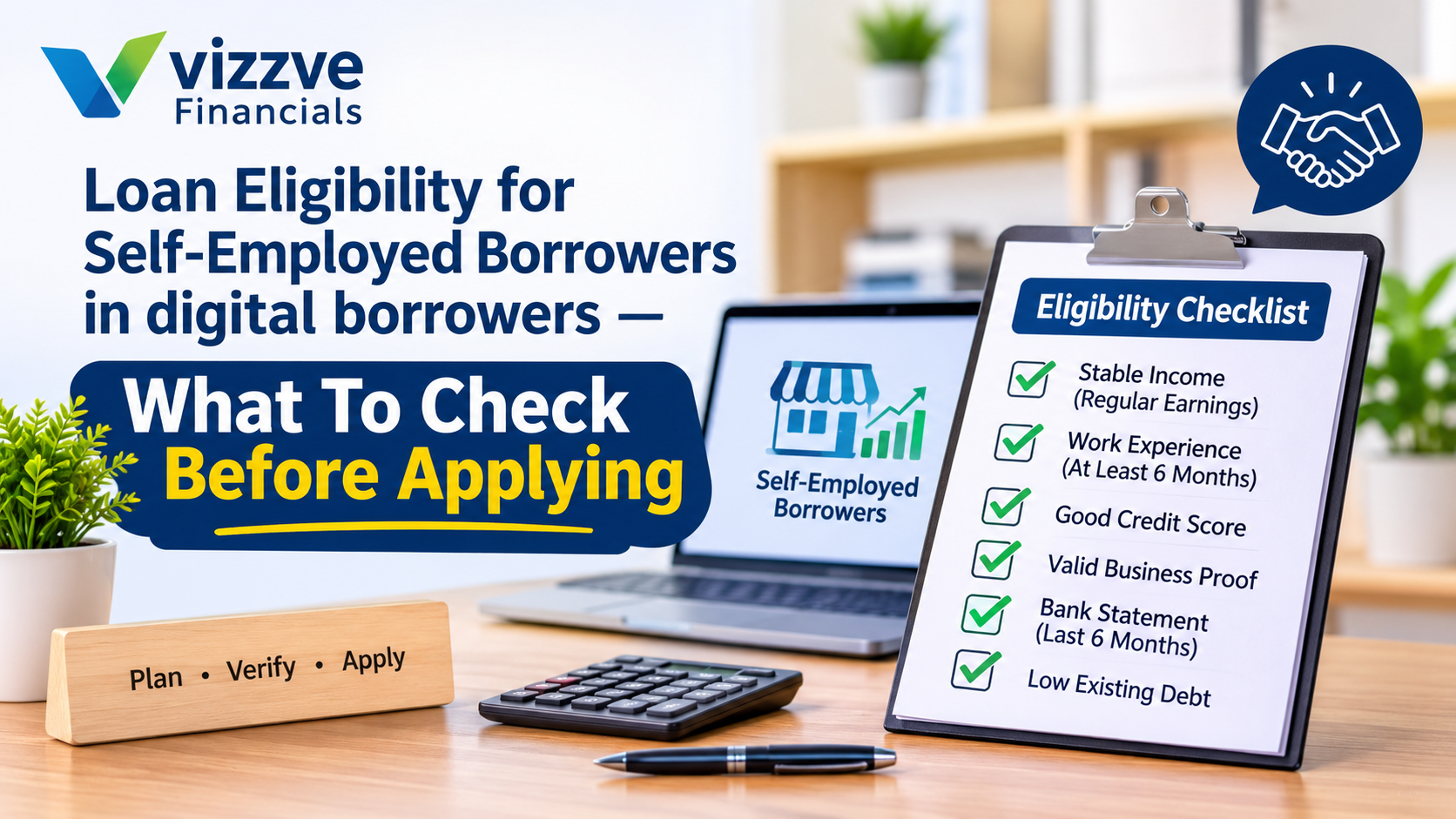
Loan Eligibility for Self-Employed Borrowers in Digital Lending: What To Check Before Applying
Vizzve Admin
Self-employed borrowers can get digital personal loans, but lenders assess risk differently than they do for salaried applicants. Instead of relying mainly on salary slips, digital lenders look at your business stability, bank cash flow, income tax returns, GST filings, credit score and existing repayment obligations. RBI’s digital-lending framework also requires regulated lenders to capture a borrower’s economic profile—age, occupation and income—before extending credit.rbi.org+1
This guide explains exactly what to check before you apply, how to improve approval chances, and how to avoid costly mistakes.
AI Answer Box
What do lenders check for self-employed digital loan eligibility?
Lenders typically check business vintage, consistent income, 6–12 months of bank statements, ITR or GST returns, credit score, existing EMIs, KYC documents and repayment capacity. Many lenders prefer at least 2–3 years of business continuity, a credit score of 700+ or higher, and healthy, regular bank credits.federal.bank+2
Can self-employed people get a loan without ITR?
Sometimes. Some digital lenders may approve smaller loans using PAN, Aadhaar, bank statements, GST data or alternate income checks, but approval is not guaranteed. If you have ITRs, audited financials and clean GST filings, your eligibility and loan amount usually improve.idfcfirst.bank+1
What Is Digital Lending for Self-Employed Borrowers?
Digital lending is a remote, technology-led loan process covering customer acquisition, credit assessment, approval, disbursement, servicing and recovery. In India, it applies to loans offered by regulated banks, NBFCs and housing finance companies, including through their digital platforms or lending service partners.static.investindia.gov+1
For a freelancer, shop owner, consultant, trader, doctor, contractor or small-business owner, this means you may be able to apply online, complete video KYC, receive an offer and get funds directly into your bank account—without visiting a branch.
Key Eligibility Factors Lenders Check
1. Business vintage and continuity
Most lenders want evidence that your business has been operating consistently. A common benchmark is 2–3 years of business vintage, although some digital products may consider newer businesses with strong cash flows or GST history.federal.bank+2
What strengthens your profile:
-
Business registration or trade licence
-
GST registration and filed returns
-
Current account statements showing regular business receipts
-
ITRs for the last 2–3 years
-
Professional registration, if applicable
2. Income stability and cash flow
Self-employed income is often seasonal or uneven. Lenders therefore examine whether your bank account shows regular inflows, adequate average balance and the ability to cover EMIs after business expenses.
RBI directions require lenders to assess a borrower’s creditworthiness using income and occupation details, and for certain low-income household assessments, income stability is evaluated over at least one year.rbi.org+1
3. Credit score and repayment history
A strong credit score improves approval odds and may help you access better pricing. Lender guidance commonly cites a CIBIL score of 700+ as preferable, while some digital products look for even higher scores.indusind.bank+2
Before applying, check:
-
Late payments or loan defaults
-
Credit-card utilisation
-
Multiple recent loan enquiries
-
Old closed loans reported incorrectly
-
Guarantor liabilities
4. Existing EMIs and debt-to-income ratio
Your existing monthly obligations matter as much as your income. If a large share of your monthly income already goes toward EMIs and credit-card dues, lenders may reduce your loan amount or reject the application.
For certain NBFC household-income assessments, RBI requires a board-approved cap on monthly loan repayment obligations, subject to a maximum of 50% of monthly household income.rbi.org
5. KYC and bank-account verification
Digital lenders must complete KYC and verify your identity before disbursing a loan. RBI rules also require loans to be disbursed into the borrower’s bank account, and repayments must occur directly between the borrower’s account and the regulated lender—not through a third-party pool account.rbi.org+1
Documents Self-Employed Borrowers Should Keep Ready
| Document |
Why It Matters |
Typical Requirement |
| PAN card |
Identity, tax and credit checks |
Mandatory for most applications |
| Aadhaar card |
Identity and address verification |
Commonly required for digital KYC |
| Bank statements |
Shows income pattern and cash flow |
Usually 6–12 months |
| ITRs |
Proves declared income |
Often 2–3 years |
| GST returns |
Supports business turnover and regularity |
Useful for GST-registered businesses |
| Business proof |
Confirms business existence |
GST certificate, licence, registration |
| Financial statements |
Shows profitability and liabilities |
P&L, balance sheet, CA certificate if asked |
| Existing loan details |
Helps lenders assess repayment capacity |
Loan statements or EMI schedule |
Lenders commonly ask self-employed applicants for PAN, Aadhaar, bank statements, ITR/GST returns, business proof and financial records; exact requirements vary by lender and loan product.federal.bank+2
How Lenders Assess Self-Employed Income
Salaried vs self-employed assessment
| Factor |
Salaried Borrower |
Self-Employed Borrower |
| Primary income proof |
Salary slips, Form 16 |
ITR, GST, bank statements, financials |
| Income stability |
Fixed monthly salary |
Variable business income |
| Key risk check |
Employer stability |
Business continuity and seasonality |
| Cash-flow review |
Salary credits |
Business credits, balances, withdrawals |
| Loan amount basis |
Net monthly salary |
Assessed business income and cash flow |
| Common documents |
Salary slips, bank statements |
ITR, GST, bank statements, business proof |
What lenders may view as red flags
-
Large cash deposits without explanation
-
Frequent cheque bounces or low balances
-
Irregular GST filings
-
Personal and business expenses mixed in one account
-
Sudden income spikes not supported by documents
-
Multiple loan enquiries in a short period
-
High credit-card utilisation
-
Existing EMIs close to income capacity
Step-by-Step: Check Eligibility Before Applying
-
Check your credit report. Review your score, repayment history and errors at least 30 days before applying.
-
Calculate your realistic monthly surplus. Use average business income over 6–12 months, not your best month.
-
List all EMIs and card dues. Include personal loans, business loans, vehicle loans and credit-card minimum dues.
-
Organise documents. Keep PAN, Aadhaar, bank statements, ITRs, GST returns and business proof ready.
-
Choose the right loan type. A personal loan may suit short-term needs; a business loan may be better for working capital, equipment or expansion.
-
Compare the APR, not only the interest rate. RBI requires digital lenders to disclose the all-inclusive annual percentage rate in the Key Fact Statement.rbi.org
-
Apply only through the official lender or platform. Confirm the lender is a regulated bank or NBFC and never pay approval fees to an agent’s personal account.
-
Read the Key Fact Statement. Check loan amount, tenure, APR, processing fees, late-payment charges, prepayment terms and total repayment amount.
How To Improve Your Approval Chances
-
File ITRs regularly and keep income declarations consistent with bank credits.
-
Maintain a separate current account for business transactions.
-
Avoid cheque bounces and maintain a healthy minimum balance.
-
Pay credit-card bills and EMIs on time.
-
Reduce existing debt before applying for a new loan.
-
Avoid applying to many lenders within a few days.
-
Keep GST filings current if you are GST-registered.
-
Use accurate income figures; inflated declarations can lead to rejection or future repayment stress.
-
Choose a realistic tenure so the EMI fits your average monthly cash flow.
Personal Loan vs Business Loan for Self-Employed Borrowers
| Feature |
Personal Loan |
Business Loan |
| Best for |
Medical bills, wedding, travel, debt consolidation |
Inventory, machinery, expansion, working capital |
| Collateral |
Usually unsecured |
May be secured or unsecured |
| Income proof |
ITR, bank statements, GST where applicable |
Often deeper financials and business documents |
| Use of funds |
Generally flexible |
Usually linked to business purpose |
| Approval focus |
Credit profile and repayment capacity |
Business performance and cash flow |
| Documentation |
Usually lighter |
Usually more detailed |
Pros and Cons of Digital Loans for Self-Employed Borrowers
Pros
-
Fast online application and digital KYC
-
Convenient document upload
-
Faster decision-making for eligible profiles
-
Loan disbursal directly to the borrower’s bank account
-
Useful for urgent personal or short-term financial needs
-
Digital loan records are reported to credit information companies, helping build formal credit history.rbi.org+1
Cons
-
Self-employed income verification can be stricter
-
Interest rates may be higher for weaker credit profiles
-
Small-ticket instant loans can become expensive if rolled over
-
Missing ITR or weak cash flow may limit the loan amount
-
Some platforms may collect unnecessary permissions or data if not carefully reviewed
Safety Checks Before Applying Online
RBI’s digital-lending rules provide important borrower protections: regulated lenders must provide a Key Fact Statement, disclose APR, obtain explicit consent for data collection, disburse loans into the borrower’s bank account, and offer a cooling-off/look-up period for digital loans.rbi.org
Before applying, verify:
-
The lender is a regulated bank or NBFC.
-
The website or app is official.
-
Loan disbursal comes from the lender, not an agent.
-
You are never asked to pay cash or transfer money to a personal account.
-
Fees, if any, are transparently disclosed in the loan terms.
-
You understand the APR, tenure, penalties and total outgo.
Common Mistakes Self-Employed Applicants Make
-
Applying for a higher loan amount than cash flow supports
-
Using personal bank statements when business income is in another account
-
Ignoring credit-report errors before applying
-
Submitting incomplete GST or ITR records
-
Choosing the shortest tenure without checking affordability
-
Treating a pre-approved offer as guaranteed final approval
-
Sharing OTPs, banking credentials or documents with unverified agents
Frequently Asked Questions
1. Can self-employed individuals get a personal loan online?
Yes. Self-employed borrowers can apply for digital personal loans if they meet the lender’s income, KYC, credit-score and repayment-capacity requirements.indusind.bank+1
2. What credit score is good for a self-employed loan?
A score of 700+ is generally considered good by many lenders, while higher scores may improve approval chances and pricing.indusind.bank+1
3. How many years of business vintage do I need?
Many lenders prefer 2–3 years of continuous business operations, though requirements differ by product and lender.federal.bank+2
4. Can I get a loan without ITR?
Possibly, but it depends on the lender. Some digital lenders may use bank statements, GST data or alternate assessment methods, while others require ITRs.idfcfirst.bank+1
5. Are GST returns mandatory?
No, GST returns are not mandatory for every applicant. However, they can strengthen your application if you run a GST-registered business.idfcfirst.bank
6. How many months of bank statements are required?
Lenders commonly ask for 6–12 months of bank statements to assess cash flow and income regularity.federal.bank+2
7. Do lenders check existing EMIs?
Yes. Existing EMIs, credit-card dues and other repayment obligations affect your debt-to-income ratio and eligible loan amount.federal.bank
8. Is a personal loan better than a business loan?
It depends on the purpose. Use a personal loan for personal expenses and a business loan for working capital, inventory, equipment or expansion.
9. Will applying online affect my credit score?
A lender-initiated credit check can be recorded as an enquiry. Multiple applications in a short time may affect your credit profile, so compare offers carefully first.
10. What is APR in digital lending?
APR is the all-inclusive annual cost of a digital loan. RBI requires lenders to disclose it in the Key Fact Statement before the loan contract is executed.rbi.org
11. Can I prepay a digital loan?
Prepayment terms depend on the loan agreement. Review foreclosure or part-payment charges in the Key Fact Statement before accepting the loan.rbi.org
12. Is it safe to share bank statements on a loan app?
Share documents only through the official website or app of a regulated lender. RBI rules require data collection to be need-based, consent-based and auditable.rbi.org+1
13. What if my income is seasonal?
Show a longer income history, such as 12 months or more of bank statements, and apply for an EMI that fits your lean-season cash flow. RBI guidance for certain income assessments considers stability over at least one year.rbi.org
14. Can freelancers get digital loans?
Yes. Freelancers can qualify if they can demonstrate consistent income through bank credits, invoices, ITRs, GST filings or other acceptable income evidence.
15. What should I do if my loan is rejected?
Check your credit report, reduce existing liabilities, improve bank balances, correct documentation gaps and reapply after strengthening your profile rather than submitting multiple immediate applications.
Key Takeaways
-
Self-employed borrowers are assessed on business stability, cash flow, credit history and repayment capacity—not salary slips alone.
-
Keep PAN, Aadhaar, 6–12 months of bank statements, ITRs, GST returns and business proof ready.
-
A 700+ credit score, low existing EMIs and clean banking behaviour improve approval chances.indusind.bank+1
-
Compare the APR and total repayment cost, not just the advertised interest rate.rbi.org
-
Apply only through official regulated lenders and never pay cash or transfer funds to a personal account for loan approval.rbi.org
Vizzve Financial: Simplifying Digital Loan Access
Vizzve Financial is one of India’s trusted loan support platforms offering quick personal loans, low documentation, and an easy approval process. Apply at www.vizzve.com.
Vizzve states that it connects borrowers with multiple banks and NBFCs, uses PAN-based onboarding, provides digital KYC, and disburses funds directly to the borrower’s bank account. The platform also advises borrowers never to pay cash or transfer money to any representative’s personal account.vizzve
Conclusion
Getting a digital loan as a self-employed borrower is entirely possible when your financial profile is organised and credible. Focus on consistent income evidence, a healthy credit score, manageable EMIs, clean bank statements and complete KYC documentation. Most importantly, borrow only what your average monthly cash flow can comfortably repay.
Before applying, compare offers, read the Key Fact Statement, and choose a lender that is transparent about APR, fees and repayment terms. If you want a simple digital application experience, Vizzve Financial can help you explore personal loan options from multiple banks and NBFCs. Apply at www.vizzve.com.
Published on : 2nd October 2026
Published by : Avinash S
www.vizzve.com || www.vizzveservices.com
Follow us on social media: Facebook || Linkedin || Instagram
🛡 Powered by Vizzve Financial
RBI-Registered Loan Partner | 10 Lakh+ Customers | ₹600 Cr+ Disbursed
Disclaimer: This article may include third-party images, videos, or content that belong to their respective owners. Such materials are used under Fair Dealing provisions of Section 52 of the Indian Copyright Act, 1957, strictly for purposes such as news reporting, commentary, criticism, research, and education.
Vizzve and India Dhan do not claim ownership of any third-party content, and no copyright infringement is intended. All proprietary rights remain with the original owners.
Additionally, no monetary compensation has been paid or will be paid for such usage.
If you are a copyright holder and believe your work has been used without appropriate credit or authorization, please contact us at grievance@vizzve.com. We will review your concern and take prompt corrective action in good faith... Read more

