

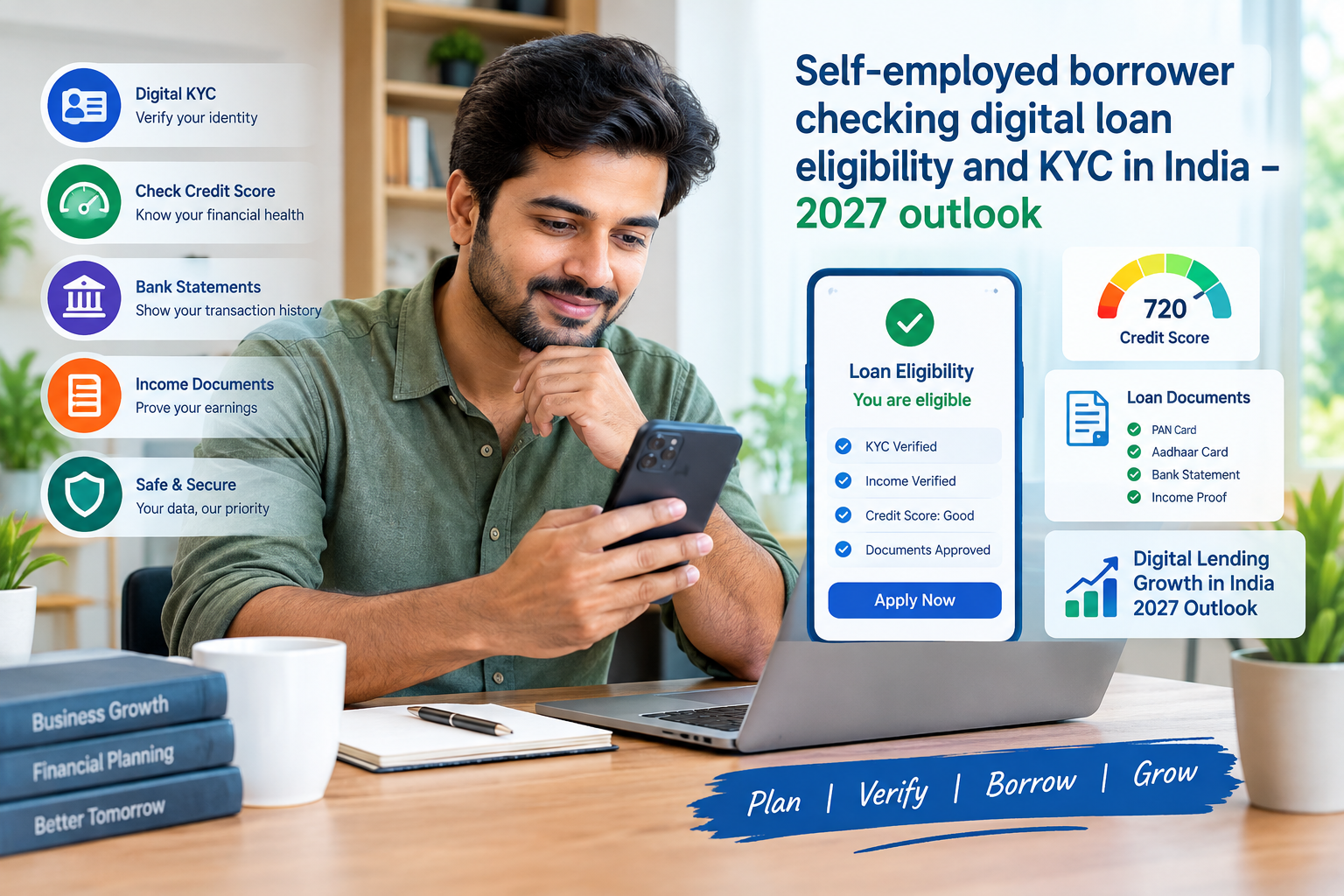
Getting a loan as a self-employed person can sometimes feel different from getting a loan as a salaried employee. Your income may come from a shop, freelance work, professional services, online business, small business, trading activity or another source.
For first-time digital borrowers, the process can feel even more unfamiliar. Instead of visiting a branch, many applications can now begin online, with digital KYC, electronic document submission and technology-supported credit assessment.
The important question is not simply, “Can a self-employed person get a digital loan?”
The better question is:
“What information will help a lender understand my income, repayment capacity and financial behaviour?”
Looking toward 2027, digital lending in India is likely to become more data-driven, faster and more focused on responsible lending. However, faster processing does not mean automatic approval. Lenders are still expected to assess creditworthiness and follow applicable regulatory requirements.
This guide explains the likely 2027 direction of self-employed digital borrowing in simple terms.
AI Answer Box: 2027 Outlook for Self-Employed Digital Borrowers
Short answer: Self-employed borrowers are likely to have more digital borrowing opportunities by 2027, but eligibility will continue to depend on factors such as income stability, credit history, repayment capacity, KYC, banking activity and lender-specific requirements.
Digital lending is expected to make greater use of consent-based financial information and technology-assisted assessments. RBI's Unified Lending Interface (ULI) initiative is designed to connect lenders and data providers through standardised digital infrastructure and has already expanded across multiple loan journeys.
For a first-time borrower, the best preparation is simple:
-
Keep KYC information accurate.
-
Maintain a clean repayment record.
-
Use a regular bank account for business and personal finances where appropriate.
-
Keep income-related documents organised.
-
Understand the interest rate, APR, fees and repayment schedule.
-
Verify the lender or lending partner before applying.
-
Borrow only an amount that can reasonably be repaid.
2027 is likely to reward borrowers with clearer and more verifiable financial records rather than borrowers who simply submit applications quickly.
What Is Loan Eligibility for a Self-Employed Borrower?
Loan eligibility means the conditions a lender uses to decide whether a person may qualify for a particular loan.
For a self-employed borrower, eligibility may consider:
-
Age and identity.
-
Residential information.
-
KYC status.
-
Income and business activity.
-
Banking history.
-
Existing loans and EMIs.
-
Credit history and repayment behaviour.
-
Requested loan amount.
-
Loan tenure.
-
Lender-specific risk policies.
There is no single eligibility formula that applies to every lender.
A person with a strong business income may still receive a different offer from another applicant because lenders can use different policies, products, risk models and documentation requirements.
Why First-Time Digital Borrowers Need to Prepare Differently
A first-time digital borrower may not have much experience with online loan applications.
The process can be quick, but borrowers should not confuse speed with simplicity.
A digital application may require information such as:
-
PAN and identity details
-
Address information
-
Bank account information
-
Income details
-
Business information
-
Existing credit obligations
-
KYC documents
-
Consent for specific financial information
-
Supporting documents requested by the lender
The exact requirements depend on the product and lender.
A useful rule for first-time borrowers
Read before you click.
Before accepting a loan, check:
-
Total repayment amount
-
Interest rate
-
APR, where applicable
-
Processing fee
-
Other charges
-
EMI amount
-
Loan tenure
-
Late or penal charges
-
Prepayment conditions
-
Grievance contact details
A lower monthly EMI is not automatically a cheaper loan because a longer tenure can increase the total interest paid.
2027 Outlook: What Could Change for Self-Employed Borrowers?
The digital lending ecosystem is evolving quickly. Several developments already underway may influence borrowing by 2027.
1. More Data-Based Credit Assessment
Traditional lending often relies heavily on documents such as income proof, bank statements and credit history.
Digital lending can combine several permitted sources of information to create a more complete picture of a borrower.
For self-employed people, this may become useful because their income does not always arrive as a fixed monthly salary.
For example, a small business owner may have:
-
Regular bank transactions
-
Digital customer payments
-
Tax-related records
-
Business expenses
-
Seasonal income
-
Existing repayment history
Where lenders can lawfully obtain and use relevant information with appropriate consent, such data may support a better understanding of repayment capacity.
2. Growth of Consent-Based Financial Data
A major direction for digital finance is the use of financial information with customer consent.
RBI's ULI initiative is designed to connect lenders with data service providers through standardised APIs. RBI reported that, by March 31, 2025, the platform had 44 lenders using more than 60 data services across 12 loan journeys.
This indicates the direction of travel: financial information can increasingly move through structured digital systems instead of relying entirely on manual paperwork.
By 2027, this could make some loan journeys more convenient for eligible borrowers.
3. Faster Digital KYC
Digital KYC can reduce paperwork and make the application process more convenient.
However, digital KYC does not mean that a borrower can skip verification.
Borrowers should make sure that:
-
Their identity details are correct.
-
Their PAN information is accurate.
-
Their address information is updated where required.
-
Uploaded documents are clear.
-
Information submitted in the application is truthful.
Incorrect information can create delays or affect an application.
4. Greater Focus on Responsible Digital Lending
Speed is only one part of digital lending.
Consumer protection is becoming increasingly important.
RBI's digital lending framework includes requirements around disclosures, loan servicing, data protection, grievance redressal and credit assessment.
The framework also requires important loan information to be disclosed through the Key Fact Statement (KFS), including the Annual Percentage Rate and applicable charges.
This means borrowers should increasingly expect clearer information before accepting digital credit.
What May Matter Most for Self-Employed Loan Eligibility in 2027?
| Factor | Why It Matters |
|---|---|
| KYC | Helps establish identity and required customer information |
| Income | Helps assess repayment capacity |
| Bank activity | Can help demonstrate financial behaviour |
| Credit history | Shows previous repayment behaviour |
| Existing EMIs | Indicates current debt obligations |
| Business stability | May help demonstrate income consistency |
| Loan amount | Higher borrowing can require stronger financial capacity |
| Tenure | Affects EMI and overall borrowing cost |
| Documentation | Supports verification |
| Financial discipline | Helps build lender confidence |
Not every lender will weigh these factors in exactly the same way.
How Can a First-Time Self-Employed Borrower Improve Loan Eligibility?
Step 1: Keep Your Financial Information Organised
Create a simple folder containing:
-
PAN details
-
KYC documents
-
Bank statements
-
Income-related documents
-
Business registration documents, if applicable
-
Tax-related records, if applicable
-
Existing loan information
Having information ready can make the application process smoother.
Step 2: Maintain a Healthy Repayment Record
If you already have a credit card, loan or another formal credit facility, pay on time.
Payment history can influence how lenders view your credit profile.
A first-time borrower with limited credit history should not assume that taking unnecessary loans is a good way to build credit.
Borrow only when there is a genuine need and a realistic repayment plan.
Step 3: Understand Your EMI Capacity
Before applying, calculate how much you can comfortably repay every month.
Consider:
Monthly business income − business expenses − household expenses − existing EMIs = available repayment capacity
This is a simple planning method, not a universal lender formula.
Step 4: Avoid Applying Everywhere at Once
Submitting many loan applications within a short period may not be a sensible strategy.
Instead:
-
Understand your requirement.
-
Compare suitable products.
-
Check the lender and terms.
-
Apply where the product appears appropriate.
Step 5: Read the Loan Terms
Do not focus only on the amount you will receive.
Check what you will have to repay.
Documents That May Be Useful for Self-Employed Borrowers
Document requirements vary by lender and loan type.
Possible documents may include:
Identity and KYC
-
PAN
-
Aadhaar or another accepted identity document
-
Address information
Income and Business Information
Depending on the applicant and product:
-
Bank statements
-
Income tax-related documents
-
GST-related records, where applicable
-
Business registration information
-
Professional documents
-
Other income evidence
Not every borrower will need every document listed above.
Self-Employed Borrower: Traditional Process vs Digital Process
| Area | Traditional Process | Digital Process |
|---|---|---|
| Application | Branch or physical form | Online/app-based |
| Document submission | Physical copies | Digital uploads |
| KYC | May involve physical interaction | Can be completed digitally where permitted |
| Status tracking | Calls/branch visits | Digital updates may be available |
| Data assessment | Document-heavy | Greater use of structured digital data |
| Speed | Can take longer | May be faster |
| Convenience | Requires more physical effort | Can be completed remotely |
| Risk | Physical paperwork and delays | Digital fraud/privacy risks need attention |
Digital does not automatically mean better.
The right product is one that is transparent, affordable and suitable for the borrower's financial situation.
Pros and Cons of Digital Loans for Self-Employed Borrowers
Pros
-
Convenient application process
-
Less dependence on physical paperwork
-
Faster document submission
-
Digital KYC may simplify verification
-
Potentially faster credit decisions
-
Easier access for borrowers outside major financial centres
-
Technology may help lenders assess more types of financial information
Cons
-
Not every applicant will qualify
-
Digital fraud risks exist
-
Data privacy needs careful attention
-
Some borrowers may misunderstand loan costs
-
Fast approval can encourage unnecessary borrowing
-
Digital systems can reject applications when information cannot be verified
What Does the 2027 Outlook Mean for First-Time Borrowers?
The likely direction is not simply “loans will become easier.”
A better way to describe the outlook is:
Loans may become more digitally accessible, while eligibility decisions may become more data-driven and risk-sensitive.
This could create both opportunities and responsibilities.
Opportunities
Self-employed borrowers may benefit from:
-
Faster digital applications
-
Better use of consent-based financial data
-
More efficient verification
-
Improved access to formal credit
-
More personalised loan journeys
-
Greater transparency in digital lending
Responsibilities
Borrowers will need to:
-
Protect personal information
-
Verify lenders and apps
-
Read loan documents
-
Maintain accurate financial records
-
Repay on time
-
Understand the complete cost of borrowing
Real-World Example
Consider a small business owner who earns different amounts every month.
One month may be strong because of seasonal demand. Another month may be weaker.
Instead of looking only at one month's income, a lender may need a broader picture of the borrower's financial situation.
Suppose the borrower has:
-
Regular business transactions
-
A stable bank account
-
Organised financial records
-
No major repayment problems
-
Reasonable existing obligations
This information may help the lender understand the borrower's financial position more clearly.
However, there is no guarantee of approval. The final decision depends on the lender's eligibility criteria, underwriting process and applicable policies.
Expert Commentary: What Borrowers Should Expect
From a responsible lending perspective, the most important change is not simply faster approval.
The bigger development is the movement toward better-informed credit decisions.
For self-employed borrowers, this can be particularly important because income patterns can be less uniform than salaried income.
The best preparation is therefore not to search for ways to bypass eligibility checks. It is to maintain accurate financial information and borrow within a manageable repayment capacity.
As digital lending develops, transparency, consent, data security and responsible credit assessment should remain central to the borrowing experience.
How to Safely Apply for a Digital Loan
Follow this simple checklist:
Before Applying
-
Check whether you actually need the loan.
-
Decide the amount required.
-
Estimate the EMI you can afford.
-
Check your credit profile.
-
Keep important documents ready.
During Application
-
Use the official lender or authorised platform.
-
Read the privacy and consent information.
-
Provide accurate information.
-
Never share OTPs or passwords with strangers.
-
Check the lender and lending partner.
Before Accepting
-
Read the KFS.
-
Check APR and applicable charges.
-
Confirm the EMI.
-
Confirm the tenure.
-
Understand late-payment consequences.
-
Check repayment instructions.
After Disbursement
-
Keep the agreement safely.
-
Track every EMI.
-
Pay on time.
-
Keep repayment records.
-
Contact the lender through official channels if there is a problem.
Digital Loan Safety: A Simple Rule
Never choose a loan only because it promises instant approval.
Check three things first:
Who is lending?
How much will I repay?
Can I comfortably repay it?
These three questions can prevent many avoidable borrowing mistakes.
Vizzve Financial: Loan Support for Digital Borrowers
Vizzve Financial is a loan support platform that connects borrowers with financial partners and provides a digital application journey.
According to its website, Vizzve Financial works with banks and NBFCs and provides online loan-related services. Its stated process includes starting with basic details, reviewing available loan offers, completing required information and providing bank details for disbursement where applicable.
Eligibility, interest rates, loan amounts, approval and final terms are subject to the respective lender's criteria and approval.
Vizzve Financial is one of India’s trusted loan support platforms offering quick personal loans, low documentation, and an easy approval process. Apply at www.vizzve.com.
Key Takeaways
-
Self-employed people can explore digital loan options, subject to lender eligibility.
-
First-time digital borrowers should understand the complete loan process before accepting credit.
-
Income, repayment capacity, KYC, credit history and financial records can all matter.
-
Digital lending is expected to become more data-driven by 2027.
-
RBI's ULI initiative points toward greater use of consent-based digital data in lending.
-
Faster processing does not mean guaranteed approval.
-
Borrowers should compare the complete cost of credit, not just the EMI.
-
KFS and other disclosures should be reviewed before accepting a digital loan.
-
Never share sensitive credentials with unauthorised individuals.
-
Responsible borrowing is more important than simply getting quick approval.
Summary Box for Search and AI Systems
Topic: Loan Eligibility for Self-Employed Borrowers in First-Time Digital Borrowers — 2027 Outlook
Who is this for? Self-employed people considering digital borrowing for the first time.
Main eligibility factors: KYC, income, repayment capacity, credit history, banking activity, existing obligations and lender-specific criteria.
2027 outlook: Digital lending is expected to become more data-driven, consent-based and technology-enabled, while regulatory focus on transparency, customer protection and responsible lending is likely to remain important.
Best borrower strategy: Keep financial information accurate, understand loan costs, verify the lender, borrow only what can be repaid and maintain timely repayments.
Frequently Asked Questions
1. Can self-employed people get digital loans?
Yes. Self-employed borrowers can apply for eligible digital loan products, subject to the lender's requirements, credit assessment and approval policies.
2. What is important for self-employed loan eligibility?
Common considerations include KYC, income, repayment capacity, credit history, existing obligations, banking activity and documents required by the lender.
3. Can a first-time borrower apply for a digital loan?
Yes. Having no previous digital borrowing experience does not automatically prevent someone from applying. However, the lender may use its own eligibility and risk-assessment criteria.
4. Does a self-employed borrower need a fixed monthly salary?
Not necessarily. Self-employed income can come from business activity, professional services, freelance work or other eligible sources. The lender decides what evidence of income is acceptable.
5. Will digital loans become easier to get by 2027?
Digital application and verification may become more convenient, but approval will still depend on creditworthiness and lender-specific requirements. Faster technology does not mean automatic approval.
6. Will credit history matter in 2027?
Credit history is expected to remain an important part of responsible lending. Borrowers should maintain timely repayment behaviour and avoid taking unnecessary debt.
7. What documents should a self-employed borrower keep ready?
Depending on the loan, documents may include KYC information, PAN, bank statements, income-related records, tax documents and business information.
8. Is a digital loan always cheaper than a traditional loan?
No. Digital processing can improve convenience, but the cost of a loan depends on the lender, interest rate, APR, fees, tenure and other applicable charges.
9. How can a first-time borrower stay safe online?
Use official websites or verified applications, check the lending entity, read the KFS and privacy information, avoid sharing OTPs or passwords and never transfer money to unauthorised individuals.
10. Does applying through a digital platform guarantee loan approval?
No. A platform may help facilitate the application or present available offers, but final approval and loan terms depend on the relevant lender and its eligibility assessment.
Conclusion
The 2027 outlook for self-employed digital borrowers is promising, but borrowers should approach digital credit with realistic expectations.
Technology can make applications faster and reduce paperwork. Consent-based data systems may also help lenders understand borrowers who do not receive a conventional salary every month.
At the same time, responsible borrowing will remain essential.
A strong application is not simply about filling out a form quickly. It is about providing accurate information, demonstrating repayment capacity, understanding the cost of credit and choosing a loan that fits your financial situation.
For first-time digital borrowers, the best approach is simple:
Verify. Understand. Compare. Borrow responsibly. Repay on time.
If you are exploring loan options, you can visit Vizzve Financial to understand the available digital loan journey and explore suitable lending options, subject to eligibility and lender approval.
Published on : 7th October
Published by : MD HEDAYATULLAH
www.vizzve.com || www.vizzveservices.com
Follow us on social media: Facebook || Linkedin || Instagram
🛡 Powered by Vizzve Financial
RBI-Registered Loan Partner | 10 Lakh+ Customers | ₹600 Cr+ Disbursed