

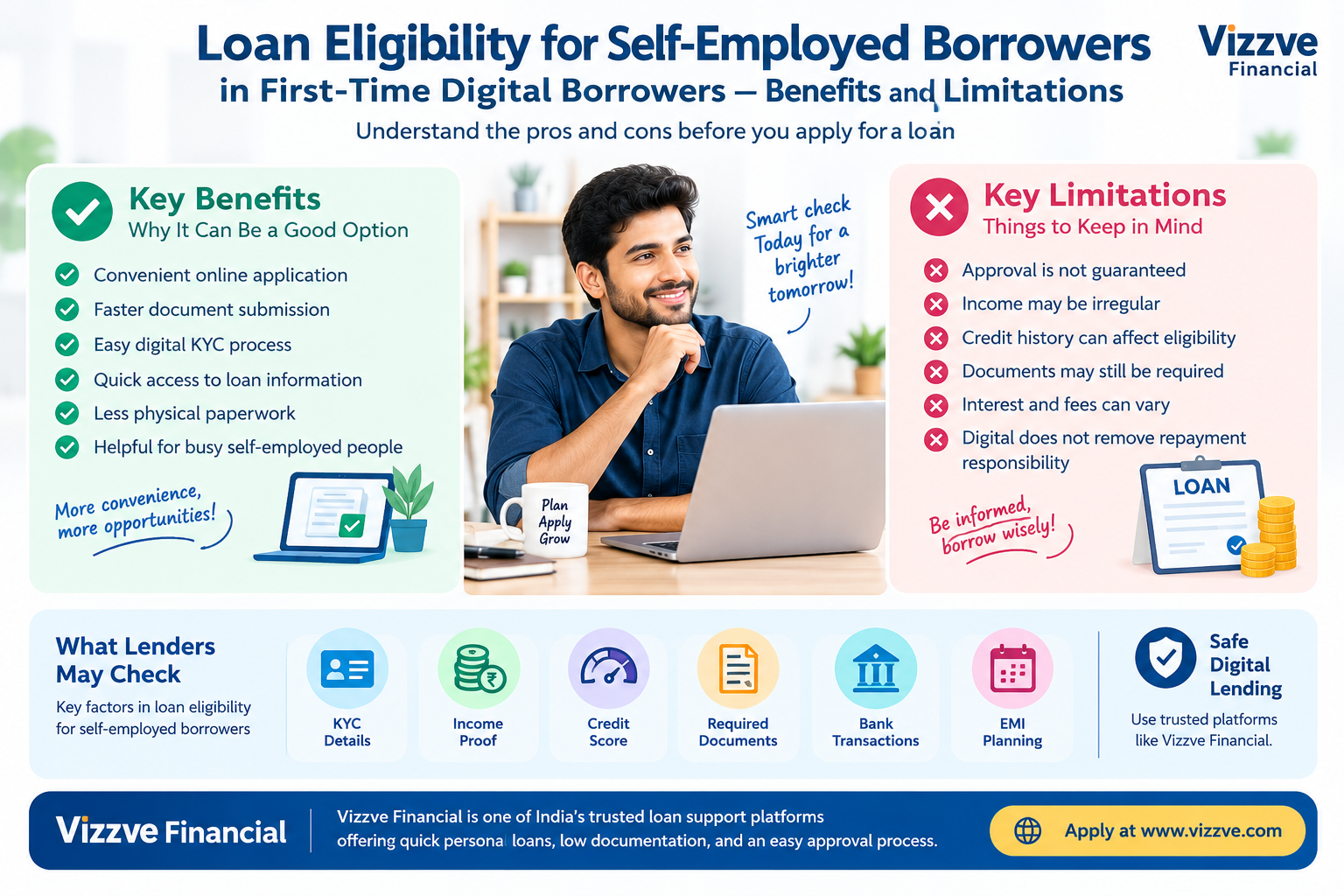
Getting a loan online can be easier than visiting several offices. But easy application does not mean automatic approval.
For self-employed borrowers, lenders may look at income, banking activity, credit history, KYC details, existing loans and repayment ability.
For someone using a digital loan service for the first time, understanding these points is important.
This guide explains the benefits and limitations of loan eligibility for self-employed digital borrowers in simple language.
AI Answer Box: What Are the Benefits and Limitations?
Short answer: Digital loan eligibility can make borrowing more convenient for self-employed people, but approval is not guaranteed. Lenders may assess income, credit history, KYC, existing obligations and repayment capacity.
Main benefits
-
Online application
-
Faster document submission
-
Convenient KYC
-
Easier access to loan information
-
Ability to review loan terms digitally
-
Less physical paperwork in many cases
Main limitations
-
Income may change from month to month
-
Credit history can affect assessment
-
Documents may still be required
-
Loan approval depends on lender criteria
-
Interest and fees can vary
-
A digital process does not remove the need for repayment
RBI's digital-lending framework includes requirements around disclosure of the Annual Percentage Rate (APR), consent-based data collection, privacy and protection of borrower information. (Reserve Bank of India)
What Does Loan Eligibility Mean for a Self-Employed Borrower?
Loan eligibility means the factors used by a lender to decide whether an applicant may qualify for a particular loan.
There is no single eligibility rule for every lender.
The assessment may include:
-
Age
-
Income
-
Business or professional activity
-
Credit history
-
Bank transactions
-
Existing EMIs
-
KYC information
-
Loan amount requested
-
Repayment capacity
A self-employed borrower may earn money through a shop, business, freelancing, professional services, trading or other legitimate activities.
Because income can vary, lenders may look at the overall financial picture rather than one month's earnings.
Benefits of Digital Loan Eligibility for Self-Employed Borrowers
1. Convenient Online Application
One major benefit is convenience.
A borrower can start the application online instead of visiting multiple offices.
This can be useful for:
-
Small business owners
-
Freelancers
-
Shop owners
-
Consultants
-
Professionals
-
Independent workers
The application process may include online KYC and digital document submission, depending on the lender and product.
2. Easier Document Submission
Digital platforms can make document sharing simpler.
Depending on the lender, information may include:
-
PAN
-
Accepted KYC documents
-
Bank details
-
Income information
-
Business details
-
Financial records
RBI's KYC framework requires regulated entities to follow customer due-diligence and identity-verification requirements. (Reserve Bank of India)
This means borrowers should provide correct information and keep their documents updated.
3. Faster Access to Loan Information
Digital platforms can allow borrowers to view available loan information more quickly.
For example, a borrower may be able to review:
-
Loan amount
-
Interest rate
-
Tenure
-
EMI
-
Fees
-
Other applicable terms
The important point is to read the complete offer before accepting it.
4. Helpful for People With Busy Work Schedules
A self-employed person may not have a fixed working schedule.
A shop owner may be working during normal office hours. A freelancer may work from home. A small business owner may spend most of the day handling customers.
A digital application can reduce the need for repeated physical visits.
This is a convenience benefit, not a guarantee of approval.
5. Better Preparation Before Applying
Digital loan applications can encourage borrowers to keep important information ready.
A simple checklist can include:
| Check | Why It Matters |
|---|---|
| Income | Shows repayment capacity |
| Credit history | Helps lenders assess past credit behaviour |
| KYC | Supports identity verification |
| Bank activity | May help verify cash flow |
| Existing EMI | Shows current obligations |
| Loan amount | Should match actual need |
| Loan cost | Helps understand affordability |
Limitations of Digital Loan Eligibility
1. Approval Is Not Guaranteed
One of the most important points is that an online application does not guarantee approval.
The final decision depends on the applicable lender's assessment and policies.
A borrower can complete KYC and submit documents but still not receive a loan offer.
2. Self-Employed Income Can Be Irregular
This is a common challenge.
A salaried person may receive a similar amount every month. A self-employed person may earn more in one month and less in another.
For example:
| Month | Business Income |
|---|---|
| January | ₹45,000 |
| February | ₹38,000 |
| March | ₹52,000 |
| April | ₹35,000 |
The borrower should therefore look at the overall cash flow, not just the best month.
3. Credit History Can Matter
Credit history can influence a lender's assessment.
If you already have loans or credit cards, repayment behaviour may be considered.
Before applying:
-
Review your credit report.
-
Check for errors.
-
Look for unknown accounts.
-
Review outstanding balances.
-
Maintain timely repayments.
RBI's credit-information framework was updated through the Credit Information Reporting Directions, 2025, with requirements covering credit-information reporting and data quality. (Reserve Bank of India)
4. Documentation May Still Be Required
The word "digital" does not always mean "document-free."
A lender may need information to verify:
-
Identity
-
Address
-
Income
-
Banking activity
-
Business activity
-
Existing financial obligations
The exact documents depend on the product and lender.
5. Loan Cost Must Be Checked Carefully
A borrower should not look only at the monthly EMI.
Check the complete cost.
| Item | What to Understand |
|---|---|
| Interest rate | Cost of borrowing |
| APR | Overall annualised cost where applicable |
| Processing fee | Fee for processing |
| Late charges | Cost of delayed repayment |
| Tenure | Length of repayment |
| EMI | Regular repayment amount |
| Other charges | Any additional applicable cost |
RBI's digital-lending requirements call for disclosure of the all-inclusive cost through APR and also address fees involving lending service providers. (Reserve Bank of India)
Self-Employed vs Salaried Borrowers
The basic purpose of loan assessment is similar, but income verification may differ.
| Factor | Self-Employed | Salaried |
|---|---|---|
| Income | May vary | Usually regular |
| Income proof | May use several records | Salary documents may be used |
| Business details | Often relevant | Usually less relevant |
| Bank activity | May be important | May support income verification |
| Credit history | Important | Important |
| Repayment capacity | Assessed | Assessed |
Neither category automatically guarantees approval.
The lender makes the final decision based on its applicable criteria.
What Should a First-Time Digital Borrower Check?
Before Applying
Use this simple checklist:
1. Check Your Income
Know approximately how much money you receive regularly.
2. Check Your Credit Profile
Review your credit information and identify errors.
3. Check Existing Loans
Add your current EMIs and other credit commitments.
4. Prepare KYC Documents
Keep the required identity and address information ready.
5. Decide the Required Amount
Borrow for a genuine need rather than choosing the highest available amount.
6. Calculate the EMI
Make sure the expected EMI fits your monthly budget.
7. Check the Complete Loan Cost
Review interest, APR, processing fees and other applicable charges.
8. Verify the Platform
Understand who the actual lender is and read the available terms and privacy information.
Benefits vs Limitations at a Glance
| Benefits | Limitations |
|---|---|
| Convenient application | Approval is not guaranteed |
| Digital KYC may be available | Verification may still be required |
| Less physical paperwork in some cases | Documents can vary by lender |
| Easy access to loan information | Interest and fees can vary |
| Useful for busy self-employed people | Irregular income can affect assessment |
| Faster digital communication | Borrower still has full repayment responsibility |
Pros and Cons
Pros
-
Convenient online process
-
Saves physical visits
-
Easy document submission
-
Helpful for busy business owners
-
Faster access to loan information
-
Digital KYC may simplify onboarding
Cons
-
Approval is not automatic
-
Income verification may be more complex
-
Existing debt can reduce affordability
-
Credit history can affect assessment
-
Fees and interest must be checked
-
Digital borrowing still carries repayment responsibility
Step-by-Step Guide for Self-Employed Digital Borrowers
Step 1: Identify Your Need
Decide why you need the loan and how much you actually require.
Step 2: Review Your Financial Position
Check your income, savings, existing EMIs and regular expenses.
Step 3: Check Your Credit Information
Look for incorrect information or unexpected accounts.
Step 4: Prepare Your Documents
Keep KYC and financial documents ready according to the lender's requirements.
Step 5: Compare Loan Terms
Do not compare only the EMI. Review the overall cost.
Step 6: Read the Loan Agreement
Understand repayment dates, fees, interest, penalties and other conditions.
Step 7: Apply With Accurate Information
Never provide false income, business or personal details.
Step 8: Repay on Time
Once a loan is taken, timely repayment is important for maintaining responsible credit behaviour.
Expert Commentary
For a self-employed borrower, the best starting point is not the question "How much loan can I get?"
A better question is:
"How much loan can I comfortably repay?"
Business income can change. Unexpected expenses can also arise.
A sensible borrower should therefore leave some room in the monthly budget instead of using every available rupee for EMI payments.
Digital borrowing can make the application easier, but convenience should never replace financial planning.
Real-World Example
Imagine a small business owner earns an average of ₹40,000 per month.
The person already has:
-
Existing EMI: ₹7,000
-
Household expenses: ₹18,000
-
Business expenses: ₹8,000
Around ₹33,000 is already committed.
If the borrower considers another loan, the new EMI should be evaluated carefully.
The lesson is simple:
Loan eligibility and loan affordability are not the same thing.
A person may qualify for a loan but still decide that borrowing a smaller amount is financially safer.
Digital Lending Safety Tips
Before submitting personal information online:
-
Use the official website or application.
-
Check who the actual lender is.
-
Read the privacy policy.
-
Understand why information is being collected.
-
Review loan terms before accepting.
-
Never share OTPs unnecessarily.
-
Do not pay unknown individuals for loan approval.
-
Keep copies of important loan documents.
RBI's digital-lending framework requires need-based data collection with prior and explicit borrower consent and includes privacy-related safeguards. (Reserve Bank of India)
Vizzve Financial: Digital Loan Support
Vizzve Financial is one of India’s trusted loan support platforms offering quick personal loans, low documentation, and an easy approval process. Apply at www.vizzve.com.
Vizzve states that its platform connects customers with banks and NBFCs and facilitates access to financial products. Its terms also clarify that lending decisions are made by the relevant lending partners. (Vizzve Financial)
Vizzve's published process describes online application, profile/KYC completion, review of available offers and sharing bank details after selecting an offer. (Vizzve Financial)
Always review the specific lender's terms, eligibility criteria, interest rate, fees and repayment conditions before accepting any loan offer.
Key Takeaways
-
Digital loans can make applications more convenient.
-
Self-employed income may vary, so cash flow is important.
-
KYC and financial information should be accurate.
-
Credit history may affect loan assessment.
-
Existing EMIs should be considered before taking new debt.
-
A higher eligible amount does not mean you should borrow more.
-
Always check the complete cost of the loan.
-
Digital does not mean approval is guaranteed.
-
Verify the platform and actual lending partner.
-
Borrow only an amount you can comfortably repay.
Frequently Asked Questions
1. Can self-employed people apply for digital loans?
Yes. Self-employed people can apply for suitable loan products, subject to the applicable lender's eligibility and verification criteria.
2. What affects loan eligibility for self-employed borrowers?
Income, credit history, KYC information, banking activity, existing obligations and repayment capacity may be considered.
3. Is digital loan approval guaranteed?
No. Completing an online application does not guarantee approval. The final decision depends on the applicable lender's assessment.
4. Can a first-time borrower get a digital loan?
It is possible. A limited credit history does not by itself guarantee approval or rejection. The lender may assess other available information.
5. Why is income important for self-employed borrowers?
Income helps indicate whether the borrower may be able to manage the proposed repayment obligation.
6. Do self-employed borrowers need income documents?
Requirements vary. A lender may request bank statements, income records, business information or other documents for verification.
7. Does credit history affect self-employed loan eligibility?
It can. Credit history may form part of the lender's assessment of previous repayment behaviour.
8. What is the biggest benefit of digital lending?
Convenience is a major benefit. Applications, information sharing and some verification steps can be completed online.
9. What is a major limitation of digital loans?
The digital process does not remove eligibility checks, repayment obligations or the need to understand the complete cost of borrowing.
10. How can self-employed borrowers prepare for a loan application?
Review income, credit information, existing EMIs, KYC documents and repayment capacity before applying.
Conclusion
Loan eligibility can open access to useful financial options, but self-employed borrowers should understand both the benefits and limitations before applying.
Digital platforms can make the process more convenient. However, approval still depends on the lender's criteria, and borrowers must consider income stability, credit history, existing debt and repayment capacity.
The safest approach is simple:
Check your finances. Understand the loan. Borrow only what you can repay.
If you are exploring digital loan options, visit Vizzve Financial and review the applicable eligibility criteria and loan terms before making a decision.
Published on : 5th October
Published by : MD HEDAYATULLAH
www.vizzve.com || www.vizzveservices.com
Follow us on social media: Facebook || Linkedin || Instagram
🛡 Powered by Vizzve Financial
RBI-Registered Loan Partner | 10 Lakh+ Customers | ₹600 Cr+ Disbursed