

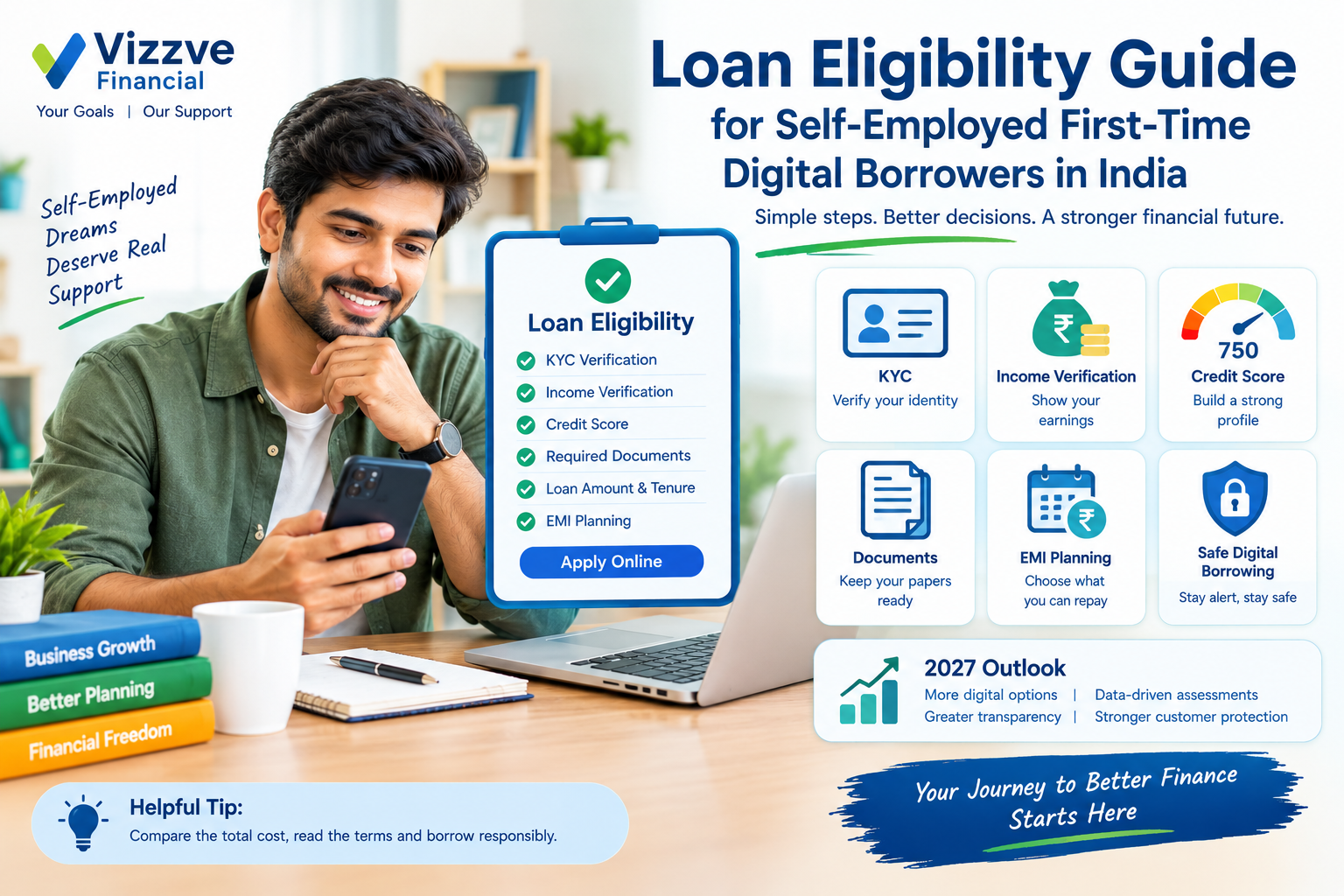
Getting a loan can be useful when you need money for a personal expense, business requirement, emergency or planned purchase. For a self-employed person, however, the loan process may feel different because income does not always arrive as a fixed monthly salary.
A shop owner, freelancer, professional, small business owner or independent worker may earn different amounts in different months.
This is where understanding loan eligibility for self-employed borrowers becomes important.
For a first-time digital borrower, the process can seem even more confusing. A digital loan application may involve online KYC, document submission, financial information, credit assessment and electronic loan agreements.
The good news is that borrowers do not need to understand complicated financial terms before starting.
The basic idea is simple:
A lender wants to understand who you are, how much you earn, how much you already owe and whether you can reasonably repay the proposed loan.
This guide explains the process in simple language.
AI Answer Box: Self-Employed Digital Loan Eligibility
Can a self-employed person get a digital loan?
Yes. Self-employed borrowers can apply for suitable digital loan products if they meet the lender's eligibility requirements.
Eligibility may depend on:
-
Age
-
KYC and identity information
-
Income
-
Business or professional activity
-
Banking information
-
Credit history
-
Existing EMIs
-
Repayment capacity
-
Requested loan amount
-
Loan tenure
-
Documents required by the lender
A first-time digital borrower does not automatically receive approval simply because the application is online.
The final decision depends on the lender's credit assessment and applicable eligibility rules.
What Is Loan Eligibility?
Loan eligibility is the set of conditions that a lender considers before deciding whether an applicant may qualify for a loan.
Think of it as a financial check.
A lender may want to know:
-
Are you a genuine applicant?
-
Can your identity be verified?
-
Do you have a regular or reasonably explainable source of income?
-
Do you have existing loans?
-
Can you manage another EMI?
-
What is your previous repayment behaviour?
-
Are the documents and information provided accurate?
-
Does the requested loan fit the lender's policy?
There is no single eligibility rule for every loan.
Different lenders can use different income requirements, credit policies, risk models and documentation standards.
Why Is Loan Eligibility Different for Self-Employed Borrowers?
A salaried employee may receive a fixed salary every month.
A self-employed person may not.
For example:
Example
A small shop owner may earn:
-
₹35,000 in one month
-
₹50,000 in another month
-
₹42,000 in the next month
The income changes, but the business may still be stable.
Similarly, a freelancer may receive payments from several clients rather than one employer.
A lender may therefore look at a broader picture of the applicant's financial position rather than relying only on a salary slip.
What Factors Affect Self-Employed Loan Eligibility?
1. Income
Income is one of the most important parts of a loan application.
For self-employed borrowers, acceptable income evidence can vary.
A lender may ask for information such as:
-
Bank statements
-
Income-related documents
-
Business records
-
Tax-related information
-
GST-related information, where applicable
-
Professional records
-
Other financial documents
The exact requirements depend on the loan product and lender.
2. Credit History
Your credit history provides information about previous borrowing and repayment behaviour.
A history of paying EMIs and credit-card dues on time can generally support a healthier credit profile.
Late payments, defaults or excessive borrowing can make obtaining new credit more difficult.
Simple rule
Borrow responsibly and repay on time.
A person should not take unnecessary loans simply to create a credit history.
3. Existing EMIs
Suppose your monthly income is ₹50,000 and you already pay ₹20,000 toward existing loans.
Taking another large EMI may put pressure on your budget.
That is why lenders can consider existing obligations when assessing a new loan application.
Before applying, calculate:
Income − regular expenses − existing EMIs = money available for another EMI
This is only a simple personal planning method. It is not a universal lender formula.
4. Banking Activity
Banking activity can help show how money moves through your account.
For a self-employed borrower, regular transactions may help provide a clearer picture of financial activity.
However, borrowers should never manipulate transactions simply to appear more eligible.
Accurate financial information is always better than artificially improving an application.
5. KYC Verification
KYC means Know Your Customer.
It helps establish and verify the identity of the borrower.
Digital lending journeys may use electronic methods for verification where permitted.
You may be asked to provide or verify information such as:
-
Name
-
Date of birth
-
PAN
-
Address
-
Identity information
-
Other required details
Always enter information carefully.
A mismatch between documents can cause delays or additional verification.
Documents Required for Self-Employed Digital Borrowers
There is no universal document list for every loan.
Depending on the lender and product, you may be asked for:
| Document / Information | Possible Purpose |
|---|---|
| PAN | Identity and financial verification |
| Accepted KYC document | Identity/address verification |
| Bank statement | Understanding account activity |
| Income information | Assessing repayment capacity |
| Tax-related records | Supporting income information |
| Business information | Understanding self-employment |
| GST records, where applicable | Supporting business activity |
| Existing loan details | Understanding current obligations |
Important: Do not upload documents to unknown websites or apps.
Use the official lender website, authorised application or verified digital platform.
How to Check Loan Eligibility Before Applying
You can use a simple five-step process.
Step 1: Know Your Monthly Income
Write down your average monthly income.
If your income changes, consider a realistic average rather than using your best month.
Step 2: List Your Monthly Expenses
Include:
-
Rent
-
Household expenses
-
Business expenses
-
Education expenses
-
Insurance
-
Existing EMIs
-
Other regular commitments
Step 3: Decide the Required Loan Amount
Do not automatically choose the highest amount offered.
Ask:
How much do I actually need?
Borrowing less can reduce the total repayment burden.
Step 4: Check Your Credit Profile
Review your credit information where available.
Look for:
-
Incorrect accounts
-
Missed payments
-
Outstanding balances
-
Unrecognised enquiries
-
Errors in personal information
If you find an error, contact the relevant credit-information company or lender through its official process.
Step 5: Compare the Total Cost
Do not compare loans only by EMI.
Check:
-
Interest rate
-
APR
-
Processing fee
-
Other applicable charges
-
Tenure
-
Penal charges
-
Prepayment terms
-
Total repayment amount
What Is Digital KYC in a Loan Application?
Digital KYC allows identity-related verification to be completed through digital processes where permitted.
It can make the application process more convenient.
However, digital KYC does not mean that verification is unnecessary.
A lender still needs to follow applicable customer-identification and regulatory requirements.
For borrowers, the best practice is simple:
-
Enter your information correctly.
-
Use your own verified details.
-
Do not share OTPs with unknown people.
-
Do not upload documents to suspicious apps.
-
Check who the actual lender is.
How Does Credit Score Affect Loan Eligibility?
A credit score is one part of a borrower's overall credit profile.
A strong credit profile may help, but there is no universal score that guarantees loan approval.
Lenders may consider several factors together.
| Factor | Possible Impact |
|---|---|
| Timely repayments | Can support a healthy credit profile |
| Missed payments | May negatively affect creditworthiness |
| High existing debt | May increase repayment pressure |
| Long credit history | Provides more repayment information |
| Limited credit history | Gives lenders less historical information |
| Incorrect credit-report information | Should be disputed through the proper process |
For first-time borrowers, having limited credit history is not the same as having a poor credit history.
First-Time Digital Borrower: What Should You Check?
Before applying online, ask these questions.
About the lender
-
Who is the actual lender?
-
Is the lender a bank or NBFC, or is the platform acting as a service provider?
-
Is the lending relationship clearly explained?
-
Is there an official website?
About the loan
-
What is the loan amount?
-
What is the interest rate?
-
What is the APR?
-
What is the EMI?
-
What is the tenure?
-
What are the applicable fees?
-
What happens if an EMI is delayed?
About your information
-
What data is being collected?
-
Why is it being collected?
-
What consent am I giving?
-
Where can I find the privacy policy?
Digital Loan vs Traditional Loan
| Feature | Digital Loan Journey | Traditional Loan Journey |
|---|---|---|
| Application | Usually online | Often branch or physical process |
| Document submission | Digital | Physical or digital |
| KYC | Can be digital where permitted | May involve branch verification |
| Convenience | High | Depends on branch access |
| Status updates | May be available digitally | May involve calls/branch visits |
| Processing | Can be faster | May take longer |
| Borrower responsibility | Read terms and verify lender | Same |
| Approval | Not guaranteed | Not guaranteed |
Digital lending can reduce friction, but the borrower still needs to understand the product.
Benefits of Digital Loans for Self-Employed Borrowers
Pros
-
Convenient application
-
Less physical paperwork
-
Online document submission
-
Potentially faster processing
-
Easy access through digital devices
-
Digital status updates may be available
-
Can be useful for borrowers who cannot easily visit branches
Cons
-
Approval is not guaranteed
-
Different lenders have different eligibility rules
-
Fraudulent apps can create serious risks
-
Borrowers may overlook fees
-
Fast applications can encourage unnecessary borrowing
-
Privacy and data-security risks require attention
Step-by-Step Guide to Applying for a Digital Loan
Step 1: Choose the Right Loan
First decide why you need the money.
Avoid borrowing simply because an app displays an available limit.
Step 2: Verify the Platform
Check the lender and lending relationship.
Do not trust loan links received through random SMS messages or social media.
Step 3: Complete KYC
Provide accurate information.
Do not use another person's documents or financial details.
Step 4: Submit Required Information
Provide only genuine information and documents requested through the authorised process.
Step 5: Review the Loan Offer
Before accepting, check the:
-
Loan amount
-
Interest
-
APR
-
Fees
-
EMI
-
Tenure
-
Repayment schedule
Step 6: Read the Key Fact Statement
Where applicable, the KFS should be reviewed carefully before entering into the loan contract.
Step 7: Accept Only If Affordable
Ask yourself:
Can I pay this EMI even during a weaker business month?
If the answer is no, reconsider the borrowing amount.
Step 8: Keep Records
Save:
-
Loan agreement
-
KFS
-
Repayment schedule
-
Payment receipts
-
Customer-support details
What Is the Key Fact Statement?
A Key Fact Statement (KFS) is an important loan document that helps borrowers understand key terms and costs.
For applicable digital lending products, RBI requirements include disclosure of the Annual Percentage Rate and other important loan information.
This is useful because borrowers can look beyond a simple advertised interest rate.
Before accepting a loan, look for:
-
APR
-
Loan amount
-
Tenure
-
EMI or repayment details
-
Fees
-
Penal charges, where applicable
-
Other applicable costs
-
Relevant lender information
If you do not understand a charge, ask the lender before accepting the loan.
How to Stay Safe From Fake Digital Loan Apps
Digital convenience can also create opportunities for fraud.
RBI advises customers to verify whether a digital lending app is associated with an RBI-regulated bank or NBFC and warns against downloading apps received through SMS or social-media links.
Safety checklist
Do:
-
Check the lender's official website.
-
Verify the lending relationship.
-
Read the privacy policy.
-
Read the loan agreement.
-
Check the KFS.
-
Keep your phone protected.
-
Report suspicious activity.
Do not:
-
Share OTPs.
-
Share banking passwords.
-
Share your UPI PIN.
-
Install unknown APK files.
-
Pay unknown people for "guaranteed approval."
-
Believe claims that approval is guaranteed.
-
Upload sensitive documents to suspicious websites.
Real-World Example: A Small Business Owner
Imagine a self-employed person who runs a small retail business.
The business earns different amounts each month.
Before applying for a loan, the borrower:
-
Reviews average monthly income.
-
Lists household and business expenses.
-
Checks existing EMIs.
-
Reviews credit information.
-
Organises bank statements.
-
Completes KYC accurately.
-
Compares the total cost of different loan options.
-
Chooses an EMI that fits the budget.
This approach is better than simply applying for the largest amount available.
The objective should be manageable borrowing, not maximum borrowing.
Expert Commentary: What Makes a Strong Loan Application?
A strong application is not necessarily the one with the highest income or largest bank balance.
For a self-employed borrower, consistency and clarity can be valuable.
A lender needs enough reliable information to assess the application.
From a responsible borrowing perspective, borrowers should focus on:
-
Accurate income information
-
Clean repayment behaviour
-
Manageable existing debt
-
Complete KYC
-
Genuine documents
-
Reasonable loan requirements
-
Clear understanding of loan costs
There is no legitimate shortcut around credit assessment.
A borrower who keeps financial records organised is generally better prepared for formal credit applications.
What Could Happen to Digital Lending in the Coming Years?
India's financial system is becoming increasingly digital.
The World Bank's Global Findex data shows that account ownership in India reached about 89% of adults in 2024, demonstrating the wide reach of formal financial accounts.
At the same time, RBI has been developing digital infrastructure designed to make credit delivery more efficient.
The Unified Lending Interface (ULI), for example, is designed around standardised digital connections between lenders and data providers.
This direction could be particularly useful for self-employed borrowers because financial information can potentially be assessed through more structured digital channels.
However, technology should not be confused with guaranteed credit.
Digital access can make borrowing easier to apply for, but responsible underwriting still matters.
Simple Eligibility Checklist
Before submitting your application, check:
☐ My KYC information is correct.
☐ My PAN details are correct.
☐ My income information is genuine.
☐ I understand my existing EMIs.
☐ I know how much I need.
☐ I have considered the EMI.
☐ I have reviewed the interest rate and APR.
☐ I have checked applicable fees.
☐ I know who the actual lender is.
☐ I have read the KFS where applicable.
☐ I understand the repayment schedule.
☐ I am using an official or verified digital channel.
Summary Table: What Borrowers Should Remember
| Question | Simple Answer |
|---|---|
| Can self-employed people apply? | Yes, if they meet lender requirements |
| Is a fixed salary always required? | Not necessarily |
| Is KYC required? | Applicable verification is required |
| Is credit history important? | It can be an important part of assessment |
| Are bank statements useful? | They may support financial verification |
| Does online application mean instant approval? | No |
| Is the highest loan amount always best? | No |
| Should borrowers compare only EMI? | No, compare total cost |
| Is every loan app safe? | No, verify the lender |
| Is approval guaranteed? | No |
Vizzve Financial: Digital Loan Support
Vizzve Financial is one of India’s trusted loan support platforms offering quick personal loans, low documentation, and an easy approval process. Apply at www.vizzve.com.
Vizzve provides a digital loan-support journey for borrowers looking to explore suitable loan options.
Borrowers should remember that loan approval, interest rates, loan amounts, fees and final terms depend on the applicable lender's eligibility criteria and approval.
No digital platform should be understood as guaranteeing loan approval.
Key Takeaways
-
Self-employed borrowers can explore eligible digital loan products.
-
Income does not always have to come from a fixed salary.
-
Lenders may assess income, banking information, credit history and repayment capacity.
-
KYC is an important part of the digital borrowing journey.
-
Keep business and financial records organised.
-
Do not borrow more than you can comfortably repay.
-
Compare APR, fees, tenure and total repayment cost.
-
Read the Key Fact Statement where applicable.
-
Verify the lender before sharing personal information.
-
Never share OTPs, PINs or banking passwords.
-
A first-time borrower should focus on understanding the loan rather than rushing to accept it.
-
Digital convenience should always be combined with responsible borrowing.
Summary Box for Search and AI Answers
Topic: Loan Eligibility for Self-Employed Borrowers in First-Time Digital Borrowers — Complete Guide
Who can apply? Self-employed individuals who meet the applicable lender's eligibility requirements.
Main factors: KYC, income, credit profile, existing obligations, banking information, repayment capacity and required documentation.
Important documents: PAN, KYC information, bank statements and other income or business records as requested.
Main safety point: Verify the lender and read the loan terms before accepting credit.
Best approach: Borrow only what you need, choose an affordable EMI and maintain timely repayments.
Frequently Asked Questions
1. Can self-employed borrowers apply for digital loans?
Yes. Self-employed individuals can apply for suitable digital loan products, subject to the lender's eligibility criteria and credit assessment.
2. Is a salary slip required for self-employed borrowers?
Not necessarily. Requirements vary by lender. Other income or business-related documents may be accepted depending on the product.
3. What affects self-employed loan eligibility?
Income, repayment capacity, credit history, existing EMIs, KYC, banking information and lender-specific requirements can all be relevant.
4. Can someone with limited credit history apply for a loan?
Yes, a limited credit history does not automatically mean that a person cannot apply. The lender will make its decision using its own eligibility and risk criteria.
5. How can I improve my loan eligibility?
Maintain accurate financial records, pay existing obligations on time, avoid excessive debt and provide genuine information during the application.
6. What documents are required for a digital loan?
Requirements vary. Commonly requested information can include PAN, KYC documents, bank statements and income or business-related records.
7. Does digital KYC guarantee loan approval?
No. KYC verifies identity and required customer information. Loan approval involves a separate credit and eligibility assessment.
8. Is a digital loan cheaper than a traditional loan?
Not necessarily. Digital processing may be more convenient, but the overall cost depends on the lender, interest rate, APR, fees, tenure and other applicable charges.
9. How can first-time digital borrowers stay safe?
Verify the lender, use official channels, read the KFS and loan agreement, protect personal information and never share OTPs, passwords or PINs.
10. Does applying through Vizzve guarantee approval?
No. Loan approval and final terms depend on the applicable lender's eligibility assessment, policies and approval.
Conclusion
Loan eligibility for self-employed borrowers is easier to understand when you break it into a few simple questions:
Who are you?
How much do you earn?
What do you already owe?
Can you comfortably repay the new EMI?
Can your information be verified?
For first-time digital borrowers, the process may be convenient, but convenience should never replace careful decision-making.
Keep your KYC information accurate, maintain good repayment habits, organise your financial records and compare the complete cost of borrowing before accepting a loan.
Most importantly, do not choose a loan simply because the application looks fast.
Choose credit that you understand and can realistically repay.
If you are exploring digital loan options, visit Vizzve Financial at www.vizzve.com and review the available journey and eligibility requirements before applying.
Published on : 7th October
Published by : MD HEDAYATULLAH
www.vizzve.com || www.vizzveservices.com
Follow us on social media: Facebook || Linkedin || Instagram
🛡 Powered by Vizzve Financial
RBI-Registered Loan Partner | 10 Lakh+ Customers | ₹600 Cr+ Disbursed