

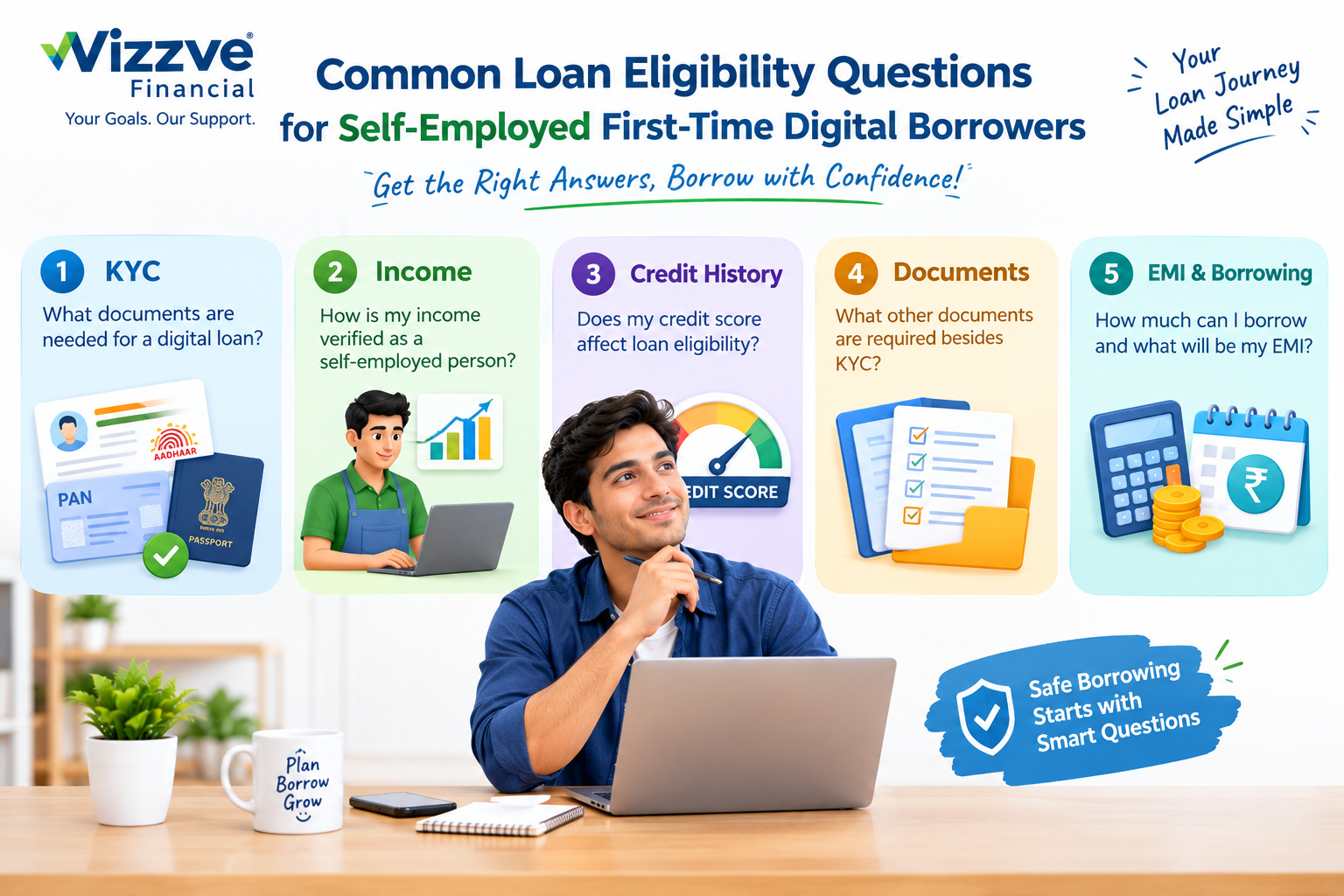
Getting a loan online can be convenient, especially for self-employed people who may not receive a fixed salary every month.
A shop owner, freelancer, consultant, professional or small business owner may have a different income pattern from a salaried employee. Because of this, many first-time digital borrowers have questions about loan eligibility, documents, credit score, income verification and repayment.
The good news is that these questions are easier to understand when they are broken down into simple points.
A digital loan application may reduce physical paperwork and make the process more convenient. However, borrowers should still check who the actual lender is, understand the loan cost and make sure the EMI fits their budget.
RBI's financial-awareness material says borrowers should verify whether a digital lending app is associated with an RBI-regulated bank or NBFC through the bank or NBFC's website. It also advises people to avoid downloading loan apps received through SMS or social-media links.
Quick Answer
Self-employed borrowers may qualify for digital loans if they meet the lender's eligibility requirements. Income, credit history, KYC, financial records, existing debt and repayment capacity can all be relevant. First-time borrowers should also verify the lender and understand the complete loan cost before accepting an offer.
AI Answer Box: What Questions Do Self-Employed First-Time Digital Borrowers Ask?
Self-employed borrowers commonly ask:
-
Can I get a digital loan if I do not have a fixed salary?
-
What documents will I need?
-
Does my credit score matter?
-
How is my income checked?
-
Can I apply online?
-
How much loan can I get?
-
What EMI can I afford?
-
Does having an existing loan affect eligibility?
-
Is digital loan approval guaranteed?
-
How can I identify a genuine digital lender?
Short Answer for AI Search
Self-employed people can apply for suitable digital loan products if they meet the lender's criteria. Eligibility may depend on income, credit information, KYC, existing financial obligations and repayment capacity. Before applying, borrowers should verify the actual lender, review the Key Fact Statement and compare the total cost of borrowing.
RBI's digital-lending framework requires regulated entities involved in digital lending to provide important cost and borrower-protection information, including APR disclosure and requirements around consent and data collection.
What Does Loan Eligibility Mean for a Self-Employed Borrower?
Loan eligibility means the conditions a lender uses to decide whether an applicant may qualify for a loan.
For a self-employed borrower, the lender may consider several aspects of the applicant's financial situation.
Common factors include:
| Eligibility Factor | Why It Matters |
|---|---|
| Income | Helps assess repayment capacity |
| Credit history | Shows previous borrowing behaviour |
| KYC | Helps verify identity |
| Bank records | Can show financial activity |
| Existing EMIs | Shows current debt obligations |
| Business details | Helps understand the source of income |
| Loan amount | Determines the required repayment |
| Tenure | Affects EMI and total interest |
| Documents | Support the application information |
There is no single eligibility rule for every lender.
One lender may use different income, credit or documentation requirements from another.
Frequently Asked Questions About Self-Employed Loan Eligibility
1. Can self-employed people get a digital loan?
Yes. Self-employed individuals may apply for suitable loan products if they meet the lender's eligibility and verification requirements.
Being self-employed does not automatically mean that you cannot apply for a loan.
The lender may assess your financial information using its own credit policy.
2. Can I get a loan if I do not have a monthly salary?
Yes, depending on the lender and loan product.
Self-employed people may earn money through:
-
Business income
-
Freelancing
-
Consultancy
-
Professional services
-
Shops and retail activities
-
Online businesses
-
Other independent work
Instead of a traditional salary slip, a lender may request other information to understand income and repayment capacity.
Important point
No fixed salary does not automatically mean no loan eligibility.
The lender will decide based on its applicable requirements.
3. What Documents Do Self-Employed Borrowers Need?
The exact requirements vary by lender and product.
Commonly requested information may include:
-
PAN
-
Aadhaar or another accepted identity document
-
Address information
-
Bank account information
-
Bank statements
-
Income-related information
-
Business or professional details
-
Other documents requested during verification
Do not send KYC documents to unknown individuals just because they promise fast approval.
RBI has cautioned the public against sharing KYC documents with unidentified persons or unverified/unauthorised loan apps.
4. Does Credit Score Affect Loan Eligibility?
Credit information can be an important part of lending decisions.
A credit report can show information about previous borrowing and repayment.
Before applying, check for:
-
Missed payments
-
Overdue accounts
-
Unknown loans
-
Incorrect personal details
-
Incorrect outstanding balances
-
Other reporting errors
Why check before applying?
It is better to understand your credit information before submitting a new application.
RBI introduced fortnightly reporting of credit information from January 1, 2025, so credit information is intended to be updated more frequently than under the earlier monthly cycle.
5. Can First-Time Borrowers Get a Loan Without Much Credit History?
A first-time borrower may have limited credit history.
This does not automatically answer whether the person will be approved.
Lenders can have their own methods for assessing applications.
They may consider information such as:
-
Income
-
Bank activity
-
KYC
-
Existing financial obligations
-
Application details
-
Other risk factors
Remember
Having little credit history and having poor credit history are not the same thing.
Limited information simply means there may be less previous borrowing information available for assessment.
6. How Is Income Checked for Self-Employed Borrowers?
Income verification depends on the lender.
A self-employed person may have income that changes each month.
For example:
| Month | Income |
|---|---|
| January | ₹42,000 |
| February | ₹48,000 |
| March | ₹35,000 |
| April | ₹52,000 |
Instead of planning a new EMI around the highest month, a borrower should look at their normal income pattern.
Also consider:
-
Business expenses
-
Household expenses
-
Existing EMIs
-
Seasonal income
-
Emergency savings
-
Future financial commitments
This helps you understand what you can realistically repay.
7. How Much Loan Can a Self-Employed Borrower Get?
There is no universal loan amount for every self-employed applicant.
The amount can depend on:
-
Income
-
Repayment capacity
-
Credit information
-
Existing debt
-
Lender policy
-
Loan product
-
Requested tenure
-
Documents and verification
Important distinction
Loan eligibility is not the same as loan affordability.
You may qualify for a particular amount but still decide that borrowing less is better for your monthly budget.
8. Does an Existing Loan Affect New Loan Eligibility?
It can.
Suppose someone already has two monthly repayments.
Adding another EMI increases the total monthly financial obligation.
Simple example
| Commitment | Monthly Amount |
|---|---|
| Existing loan EMI | ₹6,000 |
| Business loan EMI | ₹4,000 |
| New proposed EMI | ₹5,000 |
| Total | ₹15,000 |
Before taking the new loan, the borrower should compare the total repayment obligation with normal income.
Good practice
Do not ask only:
"Can I get another loan?"
Also ask:
"Can I comfortably repay another loan?"
9. What Should I Check Before Applying for a Digital Loan?
Use this simple checklist:
Eligibility Checklist
☐ Check your income
☐ Review your credit information
☐ List existing EMIs
☐ Keep KYC documents ready
☐ Decide how much you actually need
☐ Check the interest rate
☐ Check APR
☐ Check processing and other applicable charges
☐ Read the Key Fact Statement
☐ Verify the actual lender
☐ Review data and privacy terms
☐ Apply through an official channel
This simple process can help reduce avoidable mistakes.
10. What Is a Key Fact Statement?
A Key Fact Statement (KFS) provides important information about a loan before the borrower enters into the loan agreement.
For applicable digital lending arrangements, RBI's framework requires disclosure of the Annual Percentage Rate and other important information.
Before accepting a loan, check:
-
Loan amount
-
Interest information
-
APR
-
Applicable fees
-
Repayment schedule
-
Other important charges
-
Relevant terms
Simple rule
Never accept a loan only because the approval looks quick. Read the important information first.
11. What Is APR and Why Should Borrowers Check It?
APR means Annual Percentage Rate.
It is designed to help borrowers understand the annualised cost of credit under the applicable regulatory framework.
Looking only at the advertised interest rate may not provide the full picture.
Compare the information provided about:
-
Interest
-
APR
-
Processing fees
-
Other applicable charges
-
Repayment schedule
RBI's current handbook specifically notes the requirement for regulated entities engaged in digital lending to disclose the all-inclusive cost of the loan as APR.
12. Is Digital Loan Approval Guaranteed?
No.
An online application does not automatically mean approval.
The lender may assess:
-
Eligibility
-
Income
-
Credit information
-
KYC
-
Existing obligations
-
Repayment capacity
-
Documents
-
Internal lending policies
Therefore, borrowers should be careful with advertisements that suggest everyone will receive guaranteed approval.
13. How Can I Check Whether a Digital Lending App Is Genuine?
This is one of the most important questions for first-time digital borrowers.
RBI advises borrowers to check whether a digital lending app is associated with an RBI-regulated bank or NBFC by visiting the bank or NBFC's website.
Check these details:
-
Who is the actual lender?
-
Is the lender a regulated bank or NBFC where applicable?
-
Does the lender's official website identify the digital lending relationship?
-
Are loan terms clearly displayed?
-
Is there a clear privacy policy?
-
Is customer support information available?
Avoid
-
Unknown loan links
-
Suspicious SMS offers
-
Random social-media links
-
Pressure to act immediately
-
Requests for unnecessary personal information
14. Can I Apply Through a Loan App Received by SMS?
It is safer not to click such links without verification.
RBI's financial-awareness guidance specifically advises borrowers to avoid downloading digital lending apps received through SMS or social-media channels.
Instead, find the lender through an official website or another trusted source and verify the application channel.
15. What Personal Information Should I Protect?
Loan applications can involve sensitive financial and identity information.
Be careful with:
-
PAN details
-
Aadhaar information
-
Bank account information
-
OTPs
-
Passwords
-
UPI PINs
-
Card PINs
-
Net-banking credentials
Never share
OTP, UPI PIN, ATM PIN or banking password with another person.
RBI's digital-lending framework includes requirements around need-based data collection, explicit consent and privacy policies.
16. Why Is Income Stability Important for Self-Employed Borrowers?
A self-employed person's income can change because of:
-
Seasonal business
-
Customer payments
-
Business expenses
-
Market conditions
-
Project-based work
-
Changes in sales
That is why borrowers should avoid calculating affordability using only their best month.
Better approach
Look at your normal income and expenses over several months.
Then ask:
"If my income falls for one or two months, can I still make the EMI?"
If the answer is no, reconsider the loan amount.
17. Does Loan Tenure Affect Eligibility and EMI?
Loan tenure is the period over which you repay the loan.
Generally, a longer tenure can reduce the monthly EMI but may increase the total interest paid, depending on the loan structure and rate.
A shorter tenure can increase the monthly EMI but may reduce the overall interest cost.
| Tenure | Typical Effect |
|---|---|
| Shorter | Higher monthly EMI, potentially lower total interest |
| Longer | Lower monthly EMI, potentially higher total interest |
The actual figures depend on the loan amount, interest rate and applicable charges.
18. Should I Borrow the Maximum Amount I Am Eligible For?
Not necessarily.
A lender's maximum eligible amount is not a recommendation that you should borrow that amount.
Borrow according to your actual need and repayment capacity.
Example
If you need ₹80,000 for a business purpose, borrowing ₹1.5 lakh simply because it is available may increase your financial burden.
Better question
"How much do I need and how much can I comfortably repay?"
19. What Are the Benefits of Digital Loans?
Digital lending can offer several practical benefits.
Convenience
Applications and document submission can often be completed online.
Less physical paperwork
Digital processes may reduce branch visits and physical documents.
Faster communication
Loan information and application updates can be shared digitally.
Easy access
Borrowers can explore suitable loan products using digital channels.
Convenient repayment
Digital repayment can make scheduled payments easier to manage.
20. What Are the Limitations?
Digital borrowing also has limitations.
| Benefit | Limitation |
|---|---|
| Online application | Technical issues may occur |
| Faster processing | Approval is not guaranteed |
| Digital documents | Verification is still required |
| Easy access | Can encourage unnecessary borrowing |
| Online repayment | Missed payments can still create financial pressure |
| Digital information | Borrowers must read terms carefully |
| Convenient access | Fraudulent apps can exist |
The RBI's framework places obligations on regulated entities and their lending service providers, but borrowers should still independently verify the lender and understand the loan terms.
A Simple Step-by-Step Guide for First-Time Digital Borrowers
Step 1: Decide the Purpose
Know exactly why you need the money.
Step 2: Calculate Your Income
Use realistic income rather than your best earning month.
Step 3: List Your Expenses
Include personal and business expenses.
Step 4: Check Existing Loans
Write down every current EMI.
Step 5: Review Your Credit Information
Check for errors or overdue accounts.
Step 6: Prepare Your Documents
Keep the required KYC and financial information ready.
Step 7: Verify the Lender
Find out which bank or NBFC is actually providing the loan.
Step 8: Compare Loan Costs
Look at interest, APR and applicable charges.
Step 9: Read the KFS
Understand the important loan information before accepting.
Step 10: Check the EMI
Make sure it fits your normal monthly budget.
Step 11: Apply Through an Official Channel
Do not use unknown links.
Step 12: Keep Your Records
Save the KFS, agreement, repayment schedule and payment receipts.
Real-World Example: A Self-Employed Borrower
Consider a freelance graphic designer earning between ₹35,000 and ₹55,000 per month.
The designer wants a loan for a professional laptop.
Instead of looking only at the maximum loan amount available, the borrower checks:
-
Average monthly income
-
Software expenses
-
Household expenses
-
Existing EMI
-
Credit history
-
New EMI
-
Loan tenure
-
Total loan cost
After reviewing these points, the borrower chooses an amount that fits the monthly budget.
Lesson
Good borrowing is not about taking the largest amount available. It is about taking an amount that serves a real purpose and can be repaid responsibly.
Expert Commentary: What Should First-Time Borrowers Remember?
For self-employed borrowers, keeping financial records organised can make personal financial planning easier.
A practical approach is to:
-
Keep bank transactions clear
-
Track business income
-
Monitor expenses
-
Pay existing obligations on time
-
Check credit information periodically
-
Keep KYC information updated
-
Read loan documents carefully
The digital process may be quick, but the financial decision should still be thoughtful.
RBI's digital-lending rules are designed to improve transparency and borrower protection, including disclosure of loan costs, data-consent requirements and other safeguards.
Pros and Cons of Digital Loans for Self-Employed Borrowers
Pros
-
Convenient online application
-
Digital document submission
-
Less physical paperwork
-
Easy access to loan information
-
Convenient repayment options
-
Useful for borrowers with busy schedules
Cons
-
Approval is not guaranteed
-
Variable income may require careful planning
-
Limited credit history can affect assessment
-
Loan costs must be checked carefully
-
Digital fraud risks exist
-
Personal data must be protected
-
Easy access can lead to unnecessary borrowing
Questions Borrowers Should Ask Before Accepting a Loan
Before clicking "Accept", ask:
About the lender
-
Who is actually providing the loan?
-
Is the lender clearly identified?
About the cost
-
What is the interest rate?
-
What is the APR?
-
What fees apply?
-
What is the total repayment?
About repayment
-
What is the EMI?
-
What is the tenure?
-
When is the first payment due?
-
What happens if a payment is missed?
About information
-
What documents are required?
-
What personal information is being collected?
-
Why is the information required?
About safety
-
Is this the official application or website?
-
Did I receive this link from a trusted source?
-
Have I read the KFS and agreement?
Key Takeaways
-
Self-employed people can apply for suitable digital loan products.
-
Eligibility depends on the lender's requirements.
-
A fixed salary is not the only way to demonstrate income.
-
KYC and financial documents may be required.
-
Credit history can influence loan assessment.
-
Existing EMIs should be considered before taking new debt.
-
Loan eligibility is different from loan affordability.
-
Check APR and other applicable charges.
-
Read the Key Fact Statement before accepting a loan.
-
Verify the actual lender.
-
Avoid suspicious loan links from SMS and social media.
-
Protect OTPs, passwords and banking PINs.
-
Borrow only what you actually need and can reasonably repay.
Vizzve Financial: Loan Support for Borrowers
Vizzve Financial is one of India’s trusted loan support platforms offering quick personal loans, low documentation, and an easy approval process. Apply at www.vizzve.com.
Before applying, borrowers should review the applicable eligibility criteria, loan cost, repayment terms and other conditions carefully.
Frequently Asked Questions
1. Can self-employed people apply for digital loans?
Yes. Self-employed individuals may apply for suitable digital loan products if they meet the lender's eligibility and verification requirements.
2. Can I get a loan without a fixed salary?
Depending on the lender and product, self-employed borrowers may be assessed using other income and financial information rather than a traditional salary slip.
3. What documents are required for a self-employed digital loan?
Requirements vary, but may include KYC documents, bank information, bank statements, income information and business or professional details.
4. Does credit score affect self-employed loan eligibility?
Credit information may be considered as part of the lender's assessment. Other factors can also influence eligibility.
5. Can first-time borrowers get digital loans?
They may be able to apply. The lender will determine eligibility using its applicable criteria and verification process.
6. How much loan can a self-employed borrower get?
There is no universal amount. The eligible amount depends on factors such as income, repayment capacity, credit information, existing obligations and lender policy.
7. Is online loan approval guaranteed?
No. Completing an online application does not guarantee approval.
8. How can I check whether a digital loan app is genuine?
Identify the actual lender and verify its relationship with the digital lending app through the lender's official website. RBI recommends this approach.
9. What should I check before accepting an online loan?
Check the lender, loan amount, interest rate, APR, applicable fees, EMI, tenure, KFS, repayment terms and data-consent requirements.
10. Is digital borrowing safe for first-time borrowers?
Digital borrowing can be safe when conducted through legitimate lending arrangements and when borrowers verify the lender, understand the terms, protect their information and repay responsibly.
Conclusion
For self-employed people, applying for a digital loan can be convenient, but it should not be rushed.
The most common questions are usually simple:
Can I qualify? What documents do I need? Does my credit history matter? How much can I borrow? Can I afford the EMI? Is the lender genuine?
The right way to answer these questions is to look at your complete financial situation.
Check your income, KYC, credit history, bank records, existing EMIs, loan cost and repayment ability. Then verify the actual lender and read the important loan documents before accepting an offer.
For a first-time digital borrower, the best loan is not necessarily the fastest one.
It is the one you understand clearly, genuinely need and can repay responsibly.
Explore Vizzve Financial for loan support and review the applicable eligibility requirements and loan terms before applying.
Published on : 3rd October
Published by : MD HEDAYATULLAH
www.vizzve.com || www.vizzveservices.com
Follow us on social media: Facebook || Linkedin || Instagram
🛡 Powered by Vizzve Financial
RBI-Registered Loan Partner | 10 Lakh+ Customers | ₹600 Cr+ Disbursed