

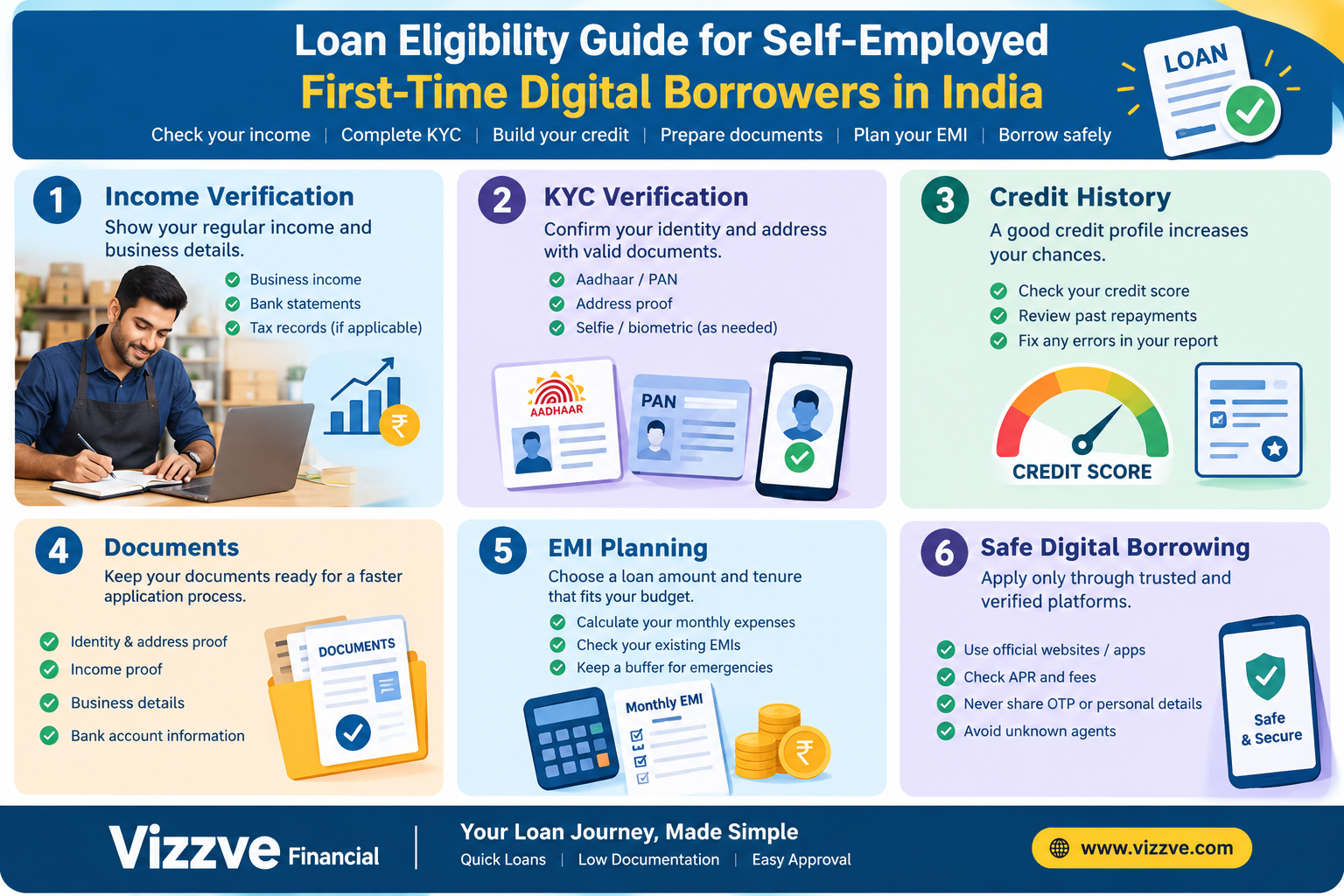
Getting a loan can feel confusing when you are self-employed and applying online for the first time. You may not receive a regular monthly salary, and your income may change from month to month.
The good news is that being self-employed does not automatically mean you are ineligible for a loan.
Lenders generally look at several factors, including income, repayment capacity, credit history, existing obligations, documents, identity verification and the lender's own credit policy.
For digital borrowers, the process can be faster because many steps can be completed online. However, a fast application does not mean that eligibility should be ignored.
This article explains loan eligibility through a simple fictional real-world example.
AI Answer Box: What Determines Loan Eligibility for a Self-Employed Borrower?
Short answer: A self-employed borrower's loan eligibility usually depends on income stability, repayment capacity, credit history, existing EMIs, identity/KYC verification, bank transactions and the lender's internal eligibility rules.
For a first-time digital borrower, the most important steps are:
-
Keep PAN and identity/KYC details ready.
-
Maintain clear bank records.
-
Show a reasonable and consistent income pattern.
-
Check your existing loan and EMI obligations.
-
Review your credit report where applicable.
-
Borrow only an amount that you can comfortably repay.
-
Check the interest rate, APR, fees and repayment schedule before accepting the loan.
-
Use only verified lender or financial-service platforms.
RBI's digital lending framework requires regulated entities to provide important loan information, including the Annual Percentage Rate (APR), and digital lending arrangements must follow customer-protection requirements.
What Is Loan Eligibility for Self-Employed Borrowers?
Loan eligibility means the conditions a lender uses to decide whether an applicant can reasonably receive a particular loan.
For a self-employed person, eligibility may be assessed differently from a salaried employee because income may come from:
-
Small business
-
Freelancing
-
Professional services
-
Shop or trading activity
-
Consulting
-
Online business
-
Commission-based work
-
Agriculture or allied activities
-
Other legitimate self-employment activities
There is no single universal income limit or credit-score number that guarantees approval for every loan. Each lender can have its own risk assessment and eligibility criteria.
Main Factors That Can Affect Eligibility
| Factor | Why It Matters |
|---|---|
| Income | Helps assess repayment capacity |
| Credit history | Shows previous borrowing and repayment behaviour |
| Existing EMIs | Indicates current financial commitments |
| Bank transactions | May help demonstrate cash flow |
| KYC | Confirms identity |
| Business/income stability | Helps assess regular earning capacity |
| Loan amount | Higher borrowing may require stronger repayment capacity |
| Tenure | Changes the monthly repayment amount |
| Documents | Help verify information supplied in the application |
RBI's financial-awareness material explains that credit scores and credit history are among the factors financial institutions consider when assessing borrowers. It also advises borrowers to borrow within their repayment capacity and avoid missed instalments. (Reserve Bank of India)
Real-World Example: A Self-Employed First-Time Digital Borrower
To understand the process better, consider a fictional borrower named Rahul.
Rahul runs a small mobile-repair business. He has been working independently for some time and earns money from repair services and accessory sales.
His monthly income is not exactly the same every month.
For example:
| Month | Approx. Business Income |
|---|---|
| January | ₹38,000 |
| February | ₹42,000 |
| March | ₹40,000 |
| April | ₹45,000 |
| May | ₹41,000 |
| June | ₹44,000 |
Rahul wants a loan for a genuine personal financial requirement.
He has never completed a digital loan application before.
Instead of immediately applying for the maximum amount available, Rahul first checks his financial position.
Step 1: Rahul Checks His Monthly Income
Rahul's first question is:
"Can I actually afford another EMI?"
This is more important than simply asking:
"How much loan can I get?"
His income is variable, so he should not plan his EMI using his highest earning month.
A safer approach is to consider his regular income pattern and essential monthly expenses.
Example Monthly Budget
| Financial Item | Approx. Amount |
|---|---|
| Average monthly income | ₹41,667 |
| Household expenses | ₹22,000 |
| Business expenses | ₹7,000 |
| Existing obligations | ₹3,000 |
| Possible remaining amount | ₹9,667 |
This is only an educational example. A lender may use a different method to calculate income and repayment capacity.
The important lesson is simple:
Loan eligibility should be considered together with repayment ability.
Step 2: He Reviews His Existing Loans
Before applying, Rahul checks whether he already has:
-
Credit card outstanding balances
-
Personal loans
-
Business loans
-
Consumer finance
-
Existing EMIs
-
Other repayment commitments
Why?
Because a new EMI adds to his existing financial responsibility.
A borrower who has a good income but already has several large EMIs may have less borrowing capacity than someone with a similar income and fewer obligations.
Simple Example
Suppose Rahul has:
Monthly income: ₹42,000
Existing EMI: ₹3,000
If a new loan adds another EMI of ₹7,000, his total EMI commitment becomes:
₹3,000 + ₹7,000 = ₹10,000
He should then check whether the remaining income is enough for household expenses, business costs, emergencies and other commitments.
Step 3: He Checks His Credit History
Credit history can provide lenders with information about previous borrowing and repayment behaviour.
A borrower who has never taken a loan may have a limited credit history. That does not automatically mean rejection, but the lender may have less repayment history to assess.
Rahul checks his credit information and looks for:
-
Incorrect accounts
-
Missed payments
-
Outstanding balances
-
Duplicate accounts
-
Incorrect personal information
-
Old accounts that may need clarification
If he finds an error, he should contact the relevant credit information company or lender rather than simply ignoring it.
RBI financial-awareness material notes that timely repayment helps build a positive credit history and that borrowers should borrow within their means. (Reserve Bank of India)
Step 4: Rahul Prepares His Documents
A self-employed borrower should keep relevant information ready before starting a digital application.
Depending on the lender and loan product, documents or information may include:
-
PAN
-
Aadhaar or another accepted identity document
-
Bank account details
-
Bank statements
-
Proof of address
-
Business-related information
-
Income-related documents
-
Tax-related documents, where applicable
The exact requirements can differ between lenders.
Why Document Accuracy Matters
Suppose Rahul enters an income figure that does not match the information he later provides.
That difference can create questions during verification.
Therefore, he should provide accurate and truthful information rather than trying to increase his eligibility by entering an unrealistic income.
Step 5: He Applies Through a Digital Platform
Rahul now starts an online application.
A typical digital lending journey may include:
-
Enter basic information.
-
Complete KYC.
-
Provide income and financial details.
-
Allow required verification.
-
Review available loan options.
-
Check the loan terms.
-
Accept an offer only after understanding the agreement.
-
Receive funds if the application is approved and the loan is disbursed.
RBI's digital lending framework covers digital customer acquisition, credit assessment, approval, disbursement, recovery and customer service. It also requires regulated entities to follow specified customer-protection requirements.
Step 6: Rahul Does Not Look Only at the Loan Amount
A common mistake among first-time borrowers is focusing only on:
"How much money will I receive?"
A better question is:
"What will this loan cost me in total?"
Before accepting a loan, Rahul reviews:
-
Interest rate
-
APR
-
Processing fee
-
Other applicable charges
-
EMI
-
Repayment tenure
-
Total repayment amount
-
Late-payment or penal charges
-
Prepayment terms, where applicable
-
Other important conditions
RBI's digital lending framework requires the Key Facts Statement to contain important information such as APR, recovery mechanism and cooling-off/look-up period. Fees or charges that are not included in the required disclosure cannot simply be added later by the regulated entity.
What Is APR and Why Should First-Time Borrowers Check It?
APR means Annual Percentage Rate.
It is intended to provide a broader picture of the annualised cost of a digital loan, rather than looking only at the headline interest rate.
RBI defines APR for digital loans as an annualised cost based on the all-inclusive cost and margin, while excluding contingent charges such as certain penal or late-payment charges.
Simple Example
Imagine two loan offers:
| Particular | Offer A | Offer B |
|---|---|---|
| Loan amount | ₹50,000 | ₹50,000 |
| Advertised interest rate | 18% | 19% |
| Processing fee | Lower | Higher |
| Tenure | 12 months | 18 months |
| Other charges | Check KFS | Check KFS |
| APR | Must be checked | Must be checked |
The lower advertised interest rate does not automatically mean the overall borrowing cost will be lower.
That is why borrowers should compare the complete loan terms, not just one number.
How Can a Self-Employed Borrower Improve Loan Eligibility?
There is no guaranteed method to get loan approval, but responsible financial behaviour can make a borrower's profile stronger.
1. Maintain Clear Financial Records
Keep business and personal transactions organised.
2. Repay Existing Loans on Time
Missed payments can negatively affect credit history.
3. Avoid Taking Unnecessary Debt
Borrowing more than necessary can increase financial pressure.
4. Keep KYC Details Updated
Make sure personal information is accurate and consistent.
5. Monitor Existing EMIs
Before applying, calculate how much of your monthly income is already committed.
6. Build a Consistent Banking Record
Regular and understandable financial activity can make income verification easier, subject to the lender's assessment process.
7. Compare Loan Terms
Do not select a loan simply because the application appears quick.
First-Time Digital Borrower: What Should You Check?
Digital borrowing can be convenient, but convenience should not replace careful checking.
Use This Safety Checklist
-
Verify the lender or financial-service platform.
-
Check who the actual regulated lender is, where applicable.
-
Read the Key Facts Statement.
-
Check APR.
-
Review all fees and charges.
-
Understand the repayment schedule.
-
Never share OTPs with unknown people.
-
Do not transfer money to a personal bank account because someone claims to be a loan agent.
-
Check the privacy policy and permissions requested by the application.
-
Keep copies of important loan documents.
RBI's digital lending framework requires regulated entities to ensure that loan servicing and repayment are executed directly with the regulated entity's bank account rather than through third-party pass-through or pool accounts.
Digital Loan Red Flags Every New Borrower Should Know
Be careful if someone:
-
Promises guaranteed approval.
-
Demands an unexplained upfront payment.
-
Requests payment to a personal account.
-
Refuses to provide loan documents.
-
Does not explain the actual lender.
-
Avoids giving the KFS or important terms.
-
Pressures you to accept immediately.
-
Requests unnecessary access to personal information.
A legitimate borrowing decision should not be based on pressure.
Vizzve's official website also warns customers not to make payments to agents or third parties and states that customers should use the official website or official app. (Vizzve Financial)
Comparison: Strong vs Weak Loan Application Preparation
| Strong Preparation | Weak Preparation |
|---|---|
| Accurate income details | Inflated income details |
| Documents ready | Missing documents |
| Existing EMI checked | Existing debt ignored |
| Credit history reviewed | Credit issues ignored |
| Loan cost compared | Only loan amount considered |
| KFS reviewed | Terms accepted without reading |
| EMI planned | EMI accepted without calculation |
| Official platform used | Unknown app or agent used |
Pros and Cons of Digital Borrowing for Self-Employed People
Pros
-
Convenient online application
-
Less dependence on physical paperwork
-
Faster document submission
-
Easy access to loan information
-
Can compare available options
-
Useful for borrowers who prefer mobile-first services
Cons
-
Easy application can encourage unnecessary borrowing
-
Income verification may be challenging for irregular earners
-
Digital scams can create risks
-
Fees and interest must be reviewed carefully
-
Approval is never guaranteed
-
Poor repayment can create financial stress
A Practical Step-by-Step Loan Eligibility Guide
Step 1: Calculate Your Income
Use a realistic view of your regular income.
Step 2: List Your Expenses
Include household, business and other essential expenses.
Step 3: List Existing EMIs
Know your current repayment commitments.
Step 4: Review Credit History
Check for missed payments or incorrect information.
Step 5: Prepare KYC and Income Information
Keep relevant documents available.
Step 6: Compare Loan Options
Look beyond the advertised loan amount.
Step 7: Read the KFS
Check APR, fees, repayment schedule and other important conditions.
Step 8: Decide Based on Affordability
A loan should fit your budget rather than stretch it.
Step 9: Keep Loan Documents
Save your sanction letter, KFS, agreement and repayment records.
Expert Commentary: Why Repayment Capacity Matters
For a self-employed borrower, monthly income can move up and down.
A good month can make a loan look affordable, but a slower month can create pressure.
Therefore, the practical approach is to assess the loan against normal income and essential expenses, not the best month of the year.
The RBI's financial-awareness guidance similarly emphasises borrowing within one's means and making repayments on time. (Reserve Bank of India)
The most useful question is not:
"How much can I borrow?"
It is:
"How much can I repay comfortably without disturbing my essential expenses?"
Vizzve Financial: Loan Support for Eligible Borrowers
Vizzve Financial is one of India’s trusted loan support platforms offering quick personal loans, low documentation, and an easy approval process. Apply at www.vizzve.com.
Vizzve states that its platform connects customers with loan options from banks and NBFCs and explains a digital process involving basic details, loan offers, bank-account information and completion of the required process. (Vizzve Financial)
However, loan approval, amount, interest rate and other terms depend on eligibility, lender assessment and applicable policies. Vizzve's own privacy policy also states that it does not guarantee loan approval or disbursal. (Vizzve Financial)
A Simple Vizzve Eligibility Pathway
A borrower can:
-
Visit the official Vizzve website.
-
Review the available loan options.
-
Enter accurate personal and financial information.
-
Complete required KYC.
-
Review available offers.
-
Compare the loan cost and repayment terms.
-
Accept an offer only after understanding the terms.
Real-World Lessons From Rahul's Example
Rahul's example gives five important lessons.
Lesson 1: Income Is More Than One Month
Self-employed income may change. Look at the broader income pattern.
Lesson 2: Existing Debt Matters
A new loan should be considered together with existing EMIs.
Lesson 3: Documentation Builds Clarity
Accurate documents make the verification process easier.
Lesson 4: Credit History Matters
Responsible repayment can support a healthier credit profile over time.
Lesson 5: Loan Cost Matters
Always review APR, fees, EMI and the total repayment obligation.
Key Takeaways
-
Self-employed people can apply for digital loans, subject to lender eligibility criteria.
-
Income stability and repayment capacity are important considerations.
-
Existing EMIs can affect how much additional debt is affordable.
-
Credit history can influence lending decisions.
-
First-time digital borrowers should keep KYC and financial information accurate.
-
Never choose a loan only because the application is fast.
-
Read the Key Facts Statement and check APR and applicable charges.
-
Use official and verified digital lending channels.
-
Do not make payments to unknown agents or personal bank accounts.
-
Borrow only what you can reasonably repay.
Frequently Asked Questions
1. Can a self-employed person get a digital loan?
Yes. Self-employed applicants can apply for suitable digital loan products, subject to the lender's eligibility criteria, verification process and credit assessment.
2. What affects loan eligibility for self-employed borrowers?
Common factors include income, repayment capacity, credit history, existing obligations, KYC information, bank transactions and the lender's internal policies.
3. Can a first-time digital borrower apply for a loan?
Yes. A person can apply for a digital loan for the first time. However, approval depends on the lender's assessment and eligibility requirements.
4. Is a high credit score required for every loan?
Not necessarily. Different lenders and products have different risk policies. A credit score is one factor among several that may be considered.
5. What documents may a self-employed borrower need?
Requirements vary. Depending on the lender and product, applicants may need identity/KYC documents, bank information, income details, business information or other supporting documents.
6. How can I improve my loan eligibility?
Maintain accurate financial records, repay existing obligations on time, avoid unnecessary debt, monitor your credit history and choose a loan amount that fits your repayment capacity.
7. Should I check APR before taking a digital loan?
Yes. APR helps borrowers understand the annualised cost of digital credit and should be considered along with the KFS and other applicable loan terms.
8. What should first-time digital borrowers check before applying?
Check the actual lender, KYC requirements, APR, fees, repayment schedule, privacy information and other terms. Avoid unknown apps and individuals promising guaranteed approval.
9. Does being self-employed automatically reduce loan eligibility?
No. Self-employment by itself does not automatically make someone ineligible. The lender evaluates the applicant using its own eligibility and risk-assessment criteria.
10. Does Vizzve guarantee loan approval?
No. Vizzve's privacy policy states that it does not guarantee loan approval, disbursal, renewal or continuation. Loan decisions depend on eligibility and applicable lender policies. (Vizzve Financial)
Conclusion
Loan eligibility for self-employed first-time digital borrowers is not based on one single factor.
Income, repayment capacity, credit history, existing obligations, KYC information and lender-specific requirements can all play a role.
The fictional example of Rahul shows a practical way to approach borrowing: understand your income, calculate your expenses, review existing EMIs, prepare accurate documents, check credit history and carefully compare loan terms before accepting an offer.
For digital borrowing, speed should never replace financial awareness.
Before accepting any loan, understand the cost, repayment obligation and terms. Borrow only an amount that you can comfortably repay.
For eligible borrowers looking for a digital loan-support platform, visit Vizzve Financial and review the available options.
Published on : 6th October
Published by : MD HEDAYATULLAH
www.vizzve.com || www.vizzveservices.com
Follow us on social media: Facebook || Linkedin || Instagram
🛡 Powered by Vizzve Financial
RBI-Registered Loan Partner | 10 Lakh+ Customers | ₹600 Cr+ Disbursed