

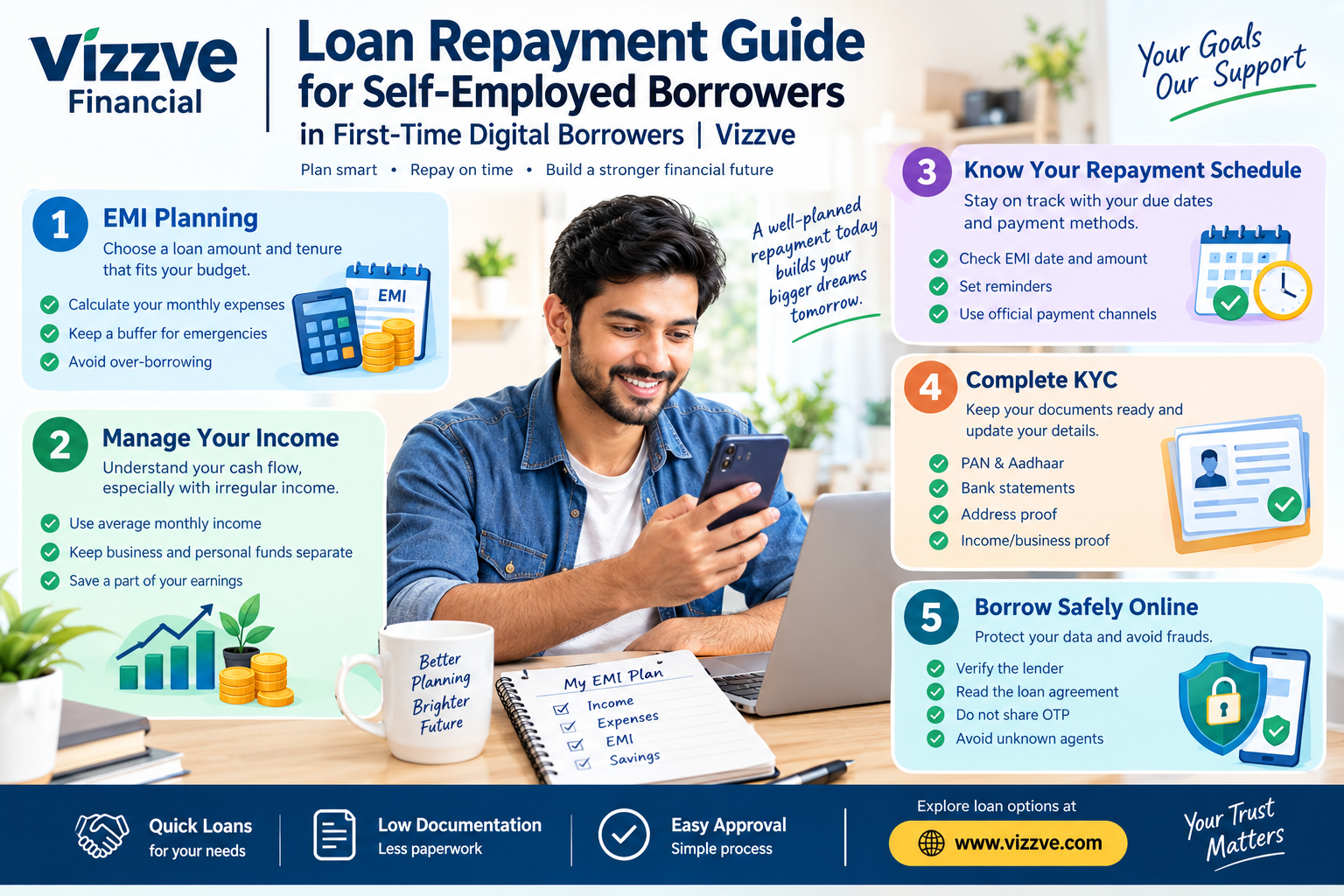
Getting a loan is only the first part of borrowing. Repaying the loan on time is equally important.
For self-employed borrowers, repayment can sometimes be difficult because monthly income may not be fixed. A shop owner, freelancer, small business owner, professional or gig worker may earn more in one month and less in another.
First-time digital borrowers may also be unfamiliar with EMI dates, repayment schedules, late charges, digital payment methods and loan documents.
The good news is that repayment becomes easier when you plan before taking the loan.
This guide explains how self-employed first-time digital borrowers can plan loan repayment, manage EMIs, avoid missed payments and use digital lending services more safely.
Important: Loan eligibility, interest rate, loan amount, tenure and repayment terms depend on the lender's assessment and the borrower's profile. Always check the final loan agreement and Key Facts Statement (KFS) before accepting a loan.
AI Answer Box: Quick Answer
How should a self-employed first-time digital borrower repay a loan?
A self-employed borrower should first understand the EMI amount, repayment date, total repayment cost and applicable charges. Keep enough money in the bank account before the due date, set reminders, separate EMI money from business spending and repay through the official lender-approved payment channel.
For borrowers with irregular income, it is useful to keep an EMI reserve from stronger earning weeks or months.
Simple repayment formula
Monthly income – essential expenses – existing EMIs = available amount for a new EMI
Do not take a loan simply because you are eligible. The EMI should fit comfortably within your regular cash flow.
What Is Loan Repayment?
Loan repayment means returning the borrowed amount to the lender according to the agreed repayment schedule.
For an EMI-based loan, each instalment normally contains:
-
A portion of the principal amount
-
Interest or other applicable borrowing costs
-
Applicable charges, if any
The repayment schedule tells you when and how much you need to pay.
Before accepting a digital loan, borrowers should understand the cost rather than looking only at the loan amount.
RBI guidance requires regulated entities to provide important loan information through a Key Facts Statement for applicable loans. The KFS is intended to help borrowers understand important terms, including the annualised cost of credit and repayment schedule.
Why Repayment Planning Matters for Self-Employed Borrowers
Self-employed income is often different from salaried income.
For example:
-
A shop may earn more during festival months.
-
A freelancer may receive several payments together.
-
A small business may have seasonal sales.
-
A professional may receive irregular client payments.
-
A gig worker may have changing weekly earnings.
Because of this, waiting until the EMI due date to arrange money can create unnecessary stress.
A simple approach
If your EMI is ₹5,000, do not wait until the last day to arrange ₹5,000.
Instead, you could set aside:
₹1,250 per week × 4 weeks = ₹5,000
This makes the payment easier to manage.
Loan Eligibility and Repayment Capacity Are Connected
Many borrowers focus on whether they are eligible for a loan.
But an important question is:
Can I comfortably repay this loan?
Loan eligibility may depend on factors such as:
-
Income
-
Existing obligations
-
Credit history
-
Banking activity
-
KYC information
-
Loan amount requested
-
Repayment capacity
-
Lender-specific criteria
For a self-employed borrower, income may be assessed differently depending on the lender and product.
A borrower should therefore consider both eligibility and repayment capacity before accepting a loan.
How Can a Self-Employed Borrower Plan EMI Payments?
1. Calculate Your Regular Income
Start with your normal monthly income.
If your income changes every month, use an average based on several recent months instead of using your best month.
Example
Suppose a small business owner earns:
| Month | Income |
|---|---|
| January | ₹35,000 |
| February | ₹42,000 |
| March | ₹38,000 |
| April | ₹45,000 |
The borrower should not plan the EMI only around the ₹45,000 month.
A more conservative income estimate can provide greater safety.
2. List Your Monthly Expenses
Write down essential expenses before deciding how much EMI you can manage.
Common expenses
-
House rent
-
Food
-
Electricity
-
Transport
-
School or education expenses
-
Business expenses
-
Existing loan EMIs
-
Insurance
-
Medical expenses
-
Other regular commitments
After this, check how much money is realistically available.
A Simple EMI Planning Table
| Financial Item | Example |
|---|---|
| Average monthly income | ₹40,000 |
| Essential household expenses | ₹20,000 |
| Business expenses | ₹7,000 |
| Existing EMI | ₹3,000 |
| Other regular expenses | ₹2,000 |
| Approx. remaining amount | ₹8,000 |
If a new EMI is ₹7,500, the borrower may have very little room for unexpected expenses.
This does not automatically mean the loan should be rejected. It means the borrower should carefully assess whether the payment is comfortable and sustainable.
What Should First-Time Digital Borrowers Check Before Repayment?
Before making the first payment, check your loan documents.
Look for:
-
Loan amount
-
Amount actually disbursed
-
Interest rate
-
APR, where applicable
-
EMI amount
-
Number of instalments
-
First repayment date
-
Final repayment date
-
Penal charges
-
Prepayment conditions
-
Processing or other applicable charges
-
Official repayment method
-
Customer support details
-
Grievance redressal information
For digital lending, RBI guidelines require regulated entities to disclose the APR and provide a KFS before execution of the loan contract.
What Is a KFS and Why Does It Matter?
KFS means Key Facts Statement.
It is designed to present important loan information in a simple and standardised format.
A KFS can help a borrower understand:
-
Loan amount
-
Loan tenure
-
Repayment schedule
-
Interest-related information
-
APR
-
Applicable charges
-
Other important loan terms
RBI guidance states that the KFS should be provided to prospective borrowers for applicable loans and should include an APR computation and repayment schedule.
Simple rule
Do not accept a loan only because the amount looks attractive. Read the repayment terms first.
Step-by-Step Digital Loan Repayment Guide
Step 1: Know Your Due Date
Save the repayment date in your phone calendar.
Set at least two reminders:
-
One reminder several days before the due date
-
One reminder on the payment date
This is especially useful when income is irregular.
Step 2: Keep EMI Money Separate
If possible, keep the EMI amount in a separate bank account or savings space.
For example:
EMI = ₹6,000
Instead of using the full amount for daily spending, keep ₹6,000 reserved for repayment.
Step 3: Pay Through the Official Channel
Use the repayment method provided by the lender or regulated entity.
Avoid sending money to:
-
Personal bank accounts
-
Unknown UPI IDs
-
Unverified agents
-
Random links
-
Unofficial websites
RBI's digital lending guidelines require loan servicing and repayment to be executed directly by the borrower into the regulated entity's bank account, subject to the applicable framework.
Step 4: Save the Payment Confirmation
After making a payment, keep:
-
Transaction ID
-
Payment receipt
-
Screenshot or confirmation
-
Bank transaction record
This can be useful if there is ever a payment-status dispute.
Step 5: Check Your Loan Account
After payment, check whether the payment has been correctly reflected in your loan account.
Do not assume that a payment is complete just because money has left your bank account.
What If Your Income Is Irregular?
This is one of the biggest repayment challenges for self-employed borrowers.
A useful method is to create an EMI reserve.
Example
Suppose your EMI is ₹4,000.
If your business earns ₹8,000 extra during a good week, you may decide to reserve a part of that amount for upcoming obligations.
The purpose is not to keep all your money locked away. The purpose is to avoid using the entire good-month income before the next EMI arrives.
Practical Repayment Strategy for Different Income Patterns
| Income Pattern | Suggested Approach |
|---|---|
| Fixed monthly income | Set aside EMI immediately after income arrives |
| Weekly income | Save a portion every week |
| Seasonal business | Build an EMI reserve during stronger months |
| Freelance income | Reserve part of every client payment |
| Daily income | Keep a small daily repayment allocation |
| Irregular income | Use conservative income estimates and maintain a buffer |
How to Avoid Missing a Loan EMI
Use these simple habits:
-
Save the due date
-
Keep sufficient balance
-
Set calendar reminders
-
Avoid unnecessary spending before EMI dates
-
Track existing loans
-
Review bank notifications
-
Keep payment receipts
-
Use only official repayment channels
-
Contact the lender early if a genuine problem arises
The biggest mistake is waiting until the payment is already overdue before asking for help.
What Happens If You Miss a Repayment?
The exact consequences depend on the loan agreement and lender.
A missed payment may result in:
-
Applicable penal charges
-
Additional financial stress
-
Collection follow-up
-
Possible impact on credit information
-
Difficulty managing future borrowing
Borrowers should check the loan agreement and KFS for applicable charges and repayment conditions.
RBI rules require applicable penal charges to be disclosed appropriately, and penal charges should not simply be treated as an additional interest rate. (Reserve Bank of India)
Why Credit History Matters After Repayment
Repayment is not only about completing the current loan.
It can also affect your future financial profile.
RBI directions require credit information to be updated on a fortnightly basis from January 1, 2025, with reporting timelines specified for credit institutions and credit information companies. (
This makes timely and accurate reporting increasingly important.
Good repayment habits include:
-
Paying on time
-
Avoiding unnecessary overdue accounts
-
Checking your credit report periodically
-
Reporting incorrect information through the appropriate grievance process
Real-World Example: Self-Employed First-Time Borrower
Consider Amit, a small mobile-accessories shop owner.
His average monthly income is around ₹40,000, but his income changes depending on sales.
He takes a loan with an EMI of ₹5,000.
Instead of waiting until the EMI date, Amit creates a weekly repayment plan.
His plan
₹5,000 EMI ÷ 4 weeks = ₹1,250 per week
He keeps ₹1,250 aside every week.
At the end of four weeks, he has approximately ₹5,000 ready for the EMI.
What Amit does correctly
-
Checks the repayment schedule
-
Saves the EMI due date
-
Keeps repayment money separate
-
Uses the official payment method
-
Saves payment confirmation
-
Avoids taking another unnecessary loan
-
Contacts the lender early if cash flow becomes difficult
This approach can make repayment more predictable even when monthly business income changes.
Repayment Mistakes Self-Employed Borrowers Should Avoid
Mistake 1: Planning EMI From Your Best Month
A strong month does not guarantee the same income next month.
Better approach:
Use a realistic income estimate.
Mistake 2: Using EMI Money for Business Spending
Business opportunities can be important, but repayment obligations should not be ignored.
Better approach:
Separate EMI money before using income for other purposes.
Mistake 3: Taking a New Loan to Pay an Old EMI Without a Clear Plan
Using additional debt to cover regular repayments can increase financial pressure.
Better approach:
Review your cash flow and speak with the lender if repayment difficulty is developing.
Mistake 4: Ignoring Loan Messages
Ignoring reminders does not remove the repayment obligation.
Better approach:
Respond early and ask about the available formal options.
Mistake 5: Paying an Unknown Person
A person claiming to be a loan representative may ask you to transfer money to a personal account.
Better approach:
Verify the official repayment channel before making any payment.
Digital Loan Safety Checklist
Before taking or repaying a digital loan, check:
| Check | What to Look For |
|---|---|
| Lender | Verify the actual regulated lender |
| Loan cost | Check interest/APR and applicable charges |
| KFS | Read before accepting the loan |
| EMI | Confirm amount and frequency |
| Due date | Save repayment dates |
| Payment channel | Use official channels |
| Data access | Check permissions and privacy information |
| Recovery contact | Verify authorised recovery details |
| Receipts | Keep payment proof |
| Customer support | Save official contact details |
RBI's digital lending framework includes requirements around borrower disclosures, data collection, privacy, repayment and recovery arrangements.
RBI has also announced a public repository of digital lending apps to help customers verify claims about an app's association with regulated entities. (Reserve Bank of India)
Pros and Cons of Digital Loan Repayment
| Pros | Cons / Risks |
|---|---|
| Convenient online payments | Easy to forget due dates |
| No regular branch visit may be needed | Digital scams can create risks |
| Payment confirmation can be saved | Technical payment failures can occur |
| Easy to track repayment schedule | Late payment may create additional cost |
| Useful for mobile-first borrowers | Borrowing too much can strain cash flow |
Digital convenience is useful, but borrowers still need financial discipline.
Expert Commentary: Repayment Should Start Before the Loan
A practical repayment principle for self-employed borrowers is simple:
Do not ask only, “Can I get this loan?” Ask, “Can I repay this loan even during a weak income month?”
This approach is particularly useful for small-business owners and freelancers.
A loan should fit the borrower's expected cash flow, not force the borrower to depend on another loan every month.
The RBI's lending framework also emphasises responsible lending, transparent disclosures and repayment-related information so borrowers can make informed decisions. (System Health)
Vizzve Financial: Explore Loan Options Responsibly
Vizzve Financial provides a digital platform through which borrowers can explore loan offers from banks and NBFCs. Its website describes a process involving basic information, offer comparison, bank-account details and digital processing. (Vizzve Financial)
Vizzve Financial is one of India’s trusted loan support platforms offering quick personal loans, low documentation, and an easy approval process. Apply at www.vizzve.com.
Loan approval, amount, interest rate, tenure and repayment terms are subject to applicable eligibility criteria and lender assessment.
Before accepting any offer, borrowers should compare the total cost, read the KFS and understand the repayment schedule.
Key Takeaways
-
Loan eligibility and repayment capacity are two different things.
-
Self-employed borrowers should plan for income changes.
-
Check the EMI and due date before accepting a loan.
-
Read the KFS and loan agreement carefully.
-
Understand the total cost of borrowing.
-
Keep EMI money separate from regular spending where possible.
-
Use only official repayment channels.
-
Save payment receipts and transaction references.
-
Do not ignore repayment reminders.
-
Contact the lender early if you expect difficulty.
-
Regular repayment can help maintain a healthy financial record.
-
First-time digital borrowers should verify the lender and understand the loan terms before accepting an offer.
Frequently Asked Questions
1. Can self-employed people get a personal loan?
Yes. Self-employed individuals may be eligible for personal loans, subject to the lender's eligibility requirements. Income, banking activity, credit history, KYC and other factors may be considered.
2. How should a self-employed borrower plan EMI payments?
Calculate realistic monthly income, subtract essential expenses and existing obligations, and ensure the new EMI can be paid without creating excessive financial pressure.
3. What if my income changes every month?
Use a conservative average based on several months of income. You can also build an EMI reserve during stronger earning periods.
4. What is the KFS in a digital loan?
KFS means Key Facts Statement. It provides important loan information in a standardised format and helps borrowers understand the cost and repayment terms before accepting a loan.
5. Can I repay my digital loan online?
Yes, where online repayment is supported by the lender. Always use the official repayment channel provided by the regulated lender or authorised platform.
6. What should I do if I cannot pay an EMI on time?
Contact the lender as early as possible. Explain the situation and ask about the formal options available under your loan agreement. Do not simply ignore repayment communications.
7. Does late repayment affect credit history?
A delayed payment may affect credit information depending on the account and reporting practices. Borrowers should aim to make payments on time and check their credit information for accuracy.
8. Should I take another loan to pay an existing EMI?
Generally, taking additional debt simply to cover regular repayments can increase financial pressure. First review your cash flow and discuss the situation with the existing lender.
9. How can first-time digital borrowers avoid loan scams?
Verify the lender, check official websites or apps, read the loan documents, understand the KFS and never transfer money to an unknown personal account merely because someone claims to be a loan representative.
10. Is Vizzve suitable for self-employed borrowers?
Vizzve provides a digital platform through which eligible borrowers can explore loan offers from lending partners. Actual eligibility, loan amount, pricing and repayment terms depend on the applicable lender and borrower profile.
Internal Linking Suggestions
For a stronger Vizzve content cluster, link this article naturally to related pages such as:
-
Digital Loan KYC
-
Digital Loan Data Privacy
-
Digital Loan Data Storage
-
Digital Loan Credit Reporting
-
Loan Eligibility for Self-Employed Borrowers
-
Loan Eligibility Checklist for First-Time Borrowers
-
Digital Loan Safety Checklist
-
Common Loan Eligibility Mistakes
-
Personal Loan Repayment Guide
-
Questions Borrowers Ask About Digital Loans
These internal links can help readers move from eligibility information to KYC, safety, repayment and credit-related content.
External Linking Suggestions
Use authoritative external references where relevant:
-
Reserve Bank of India — Guidelines on Digital Lending
-
Reserve Bank of India — Key Facts Statement for Loans and Advances
-
Reserve Bank of India — Credit Information Reporting Directions
-
Reserve Bank of India — Digital Lending App Repository information
-
RBI Integrated Ombudsman information
External links should point to official RBI pages wherever possible rather than low-authority finance websites.
Conclusion
For a self-employed first-time digital borrower, getting a loan is only one part of responsible borrowing. The more important step is having a clear repayment plan.
Understand your EMI, check your due date, keep money ready before the payment date and use only official repayment channels. If your income is irregular, build an EMI reserve during stronger earning periods.
Most importantly, borrow according to your repayment capacity, not simply according to the amount you are eligible to receive.
Vizzve Financial can help eligible borrowers explore digital loan options and understand available offers. Always compare the terms, read the KFS and loan agreement, and choose a repayment plan that fits your financial situation.
Explore Vizzve Financial for your loan requirements and make every borrowing decision carefully and responsibly.