

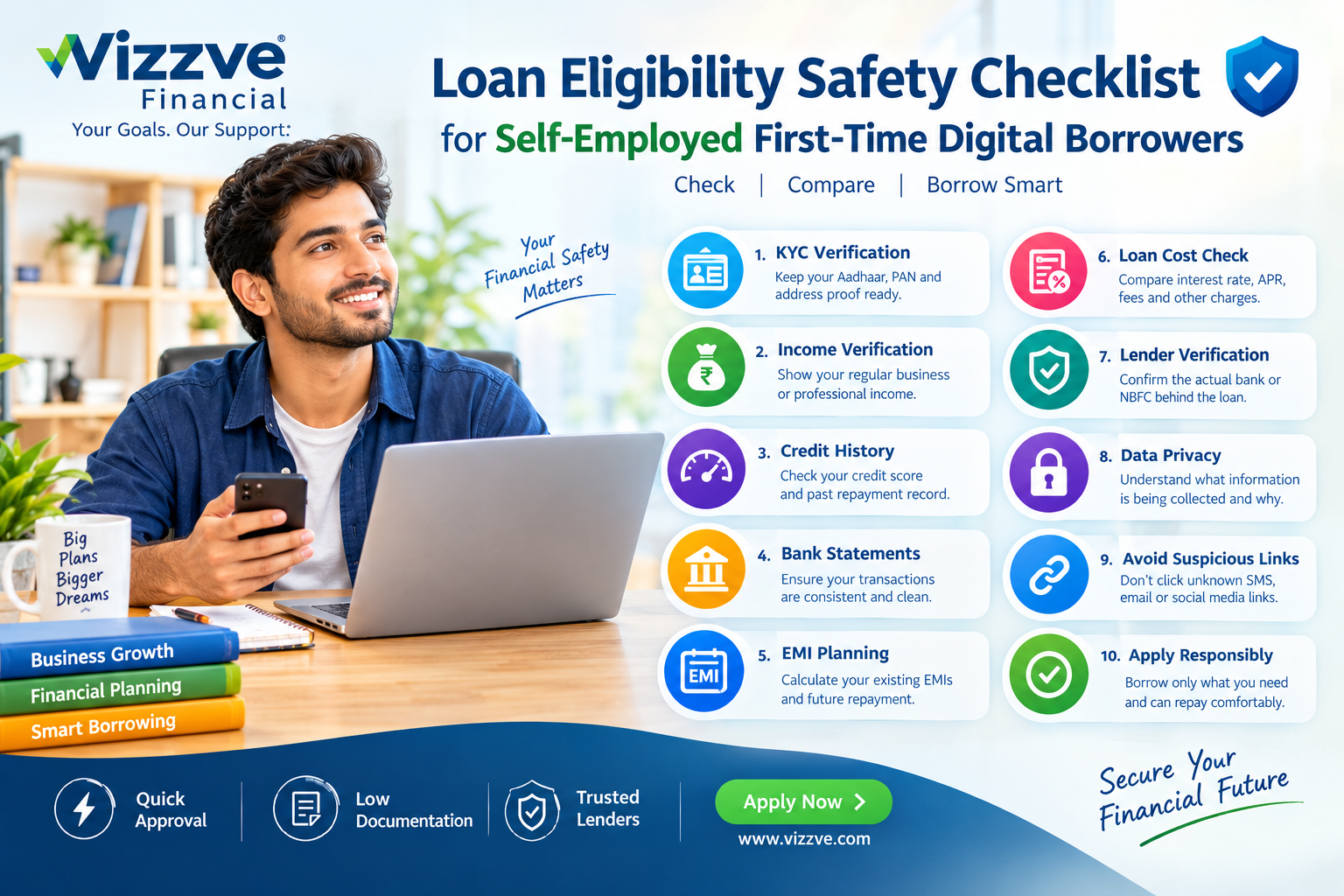
Applying for a loan online can be simple and convenient. For self-employed people, digital lending can also save time by allowing applications and document submission through digital channels.
But convenience should always come with caution.
Before applying for a digital loan, a self-employed borrower should check income, KYC documents, credit history, bank records, existing EMIs, loan costs and the identity of the actual lender.
This is especially important for someone using digital borrowing for the first time.
A genuine digital loan process should provide clear information about the lender, loan cost, repayment terms and important conditions. RBI financial awareness material advises borrowers to check whether a digital lending app is associated with an RBI-regulated bank or NBFC and to avoid suspicious loan-app links received through SMS or social media. (Reserve Bank of India)
Quick Answer
Before applying for a digital loan, check your financial position first, verify the lender, protect your personal information, understand the complete loan cost and make sure the EMI is affordable.
AI Answer Box: What Should Self-Employed Borrowers Check Before Applying for a Digital Loan?
A self-employed first-time digital borrower should follow these basic checks:
-
Verify KYC details
-
Understand your average income
-
Check your credit history
-
Review your bank statements
-
Calculate existing EMIs
-
Decide how much money you actually need
-
Check interest, APR and other charges
-
Read the Key Fact Statement
-
Verify the actual lender
-
Check the privacy and consent requirements
-
Avoid suspicious loan links
-
Apply only when repayment is manageable
RBI's digital-lending framework includes requirements relating to disclosure of the all-inclusive cost through APR, need-based data collection, borrower consent, privacy policies and other borrower-protection measures. (Reserve Bank of India)
What Is Loan Eligibility for a Self-Employed Borrower?
Loan eligibility means the factors a lender considers when deciding whether an applicant may qualify for a particular loan.
A self-employed person may earn money through:
-
A shop or small business
-
Freelancing
-
Consultancy
-
Professional services
-
Online business
-
Trading activity
-
Other independent work
Unlike a fixed salary, self-employed income can change from month to month.
Because of this, a lender may consider several pieces of information rather than relying on one salary document.
Common eligibility factors
| Factor | Why it matters |
|---|---|
| Income | Shows repayment capacity |
| Bank records | Helps understand financial activity |
| Credit history | Shows previous repayment behaviour |
| Existing loans | Shows current financial obligations |
| KYC | Confirms identity |
| Business/professional details | Helps understand income source |
| Loan amount | Determines expected repayment |
| EMI | Shows future monthly obligation |
| Documents | Support the information provided |
Important: Every lender can have its own eligibility rules. Meeting one lender's criteria does not guarantee approval from another.
Why Is a Safety Checklist Important for First-Time Digital Borrowers?
A digital loan application can be completed quickly.
That is useful, but it can also make it tempting to accept a loan without reading everything carefully.
A safety checklist creates a simple pause before borrowing.
Think of it like checking your bag before leaving home. You do not want to discover later that something important is missing.
For a digital loan, the checklist should cover:
-
Who is lending the money?
-
How much will I receive?
-
How much will I repay?
-
What is the EMI?
-
What fees apply?
-
What information is being collected?
-
Is the lender legitimate?
-
Can I comfortably repay the loan?
Self-Employed Digital Borrower Safety Checklist
1. Check Your Income Before Applying
Start with your actual income.
Do not base your decision only on your highest earning month.
For example, a business owner may earn ₹50,000 one month and ₹32,000 the next.
A safer personal calculation is to look at your normal income pattern over time.
Simple calculation
Average income − regular expenses − existing EMIs = approximate amount available for a new EMI
This is a personal budgeting method, not a universal lender formula.
Before applying, ask:
-
Is my income regular enough?
-
Do I have seasonal income?
-
What are my normal business expenses?
-
What are my household expenses?
-
Can I manage the EMI during a slower month?
2. Keep Your KYC Documents Ready
KYC means Know Your Customer.
It helps lenders verify who you are.
Depending on the lender and product, you may need information such as:
-
PAN
-
Aadhaar or another accepted identity document
-
Address details
-
Bank details
-
Income information
-
Business or professional information
Safety rule
Only submit documents through a legitimate lender or authorised digital process.
Do not send your sensitive documents to random people through WhatsApp, SMS, email or social-media messages simply because they promise quick approval.
3. Check Your Credit History
Your credit history can show how you have handled borrowing in the past.
Before applying, look for:
-
Missed payments
-
Overdue accounts
-
Incorrect personal information
-
Unknown loans
-
Incorrect outstanding balances
-
Other reporting errors
If you find an error, consider contacting the relevant lender or credit information company to have it reviewed.
RBI's credit-reporting framework provides for access to credit information and has strengthened the frequency of credit-information updates. (Reserve Bank of India)
Simple rule
Check your credit report before applying rather than discovering an issue after submitting multiple applications.
4. Review Your Bank Statements
Bank statements can help you understand your own cash flow.
Before applying, check whether:
-
Income is regularly received.
-
Business transactions are understandable.
-
Existing EMI payments are visible.
-
There are frequent failed transactions.
-
Your account generally supports your stated financial position.
For a self-employed person, maintaining organised financial records can make financial planning easier.
5. Calculate Existing EMIs
Do not look at a new loan in isolation.
First list your current obligations.
| Obligation | Monthly Amount |
|---|---|
| Existing personal loan | ₹_____ |
| Business loan | ₹_____ |
| Credit card payment | ₹_____ |
| Other borrowing | ₹_____ |
| Proposed new EMI | ₹_____ |
| Total monthly commitment | ₹_____ |
Then compare the total with your normal monthly income.
Ask yourself:
If my income is lower next month, can I still make the payment?
If the answer is no, reconsider the loan amount or timing.
6. Check the Total Cost of the Loan
One of the biggest mistakes borrowers make is looking only at the interest rate.
A loan can have other applicable costs.
Before accepting an offer, check:
-
Interest rate
-
Annual Percentage Rate (APR)
-
Processing fee
-
Applicable taxes
-
Other disclosed charges
-
Late-payment or penal charges
-
Repayment schedule
-
Prepayment conditions, where applicable
RBI's digital-lending framework requires disclosure of the all-inclusive cost through APR for applicable digital lending arrangements. (Reserve Bank of India)
Remember
A lower advertised interest rate does not automatically mean the loan has the lowest overall cost.
7. Read the Key Fact Statement
The Key Fact Statement, or KFS, provides important information about a loan before the borrower enters into the agreement.
Do not skip it.
Check:
-
Loan amount
-
Interest information
-
APR
-
Fees
-
Repayment schedule
-
Other important charges
-
Relevant terms and conditions
If something is unclear, ask the lender for an explanation before accepting the loan.
8. Verify the Actual Lender
This is one of the most important safety checks.
A digital lending app may provide technology or loan facilitation services, while the actual regulated lender may be a bank or NBFC.
RBI advises borrowers to verify the association between a digital lending app and an RBI-regulated bank or NBFC through the relevant bank or NBFC's website. (Reserve Bank of India)
Before applying, find out:
Who is actually providing the loan?
Do not rely only on an app name, logo or advertisement.
9. Be Careful With Loan Links
Unexpected loan messages can look convincing.
They may contain:
-
Attractive interest rates
-
"Instant approval" claims
-
Fake sanction letters
-
Urgent payment requests
-
Links to unfamiliar websites
-
Requests for personal information
RBI's financial-awareness material specifically warns borrowers against downloading suspicious loan apps received through SMS or social-media links. (Reserve Bank of India)
RBI's consumer-awareness material also warns about fake loan offers where fraudsters may use known financial brands or fake documents and then demand fees or personal information. (System Health)
Safety rule
Do not click first and verify later. Verify first.
10. Check What Data the App Wants
Digital lending involves personal and financial information.
Before granting permissions or consent, understand why information is being requested.
RBI's digital-lending framework includes requirements for need-based data collection, prior and explicit borrower consent, privacy policies and restrictions around storage and handling of personal information. (Reserve Bank of India)
Be cautious if an app:
-
Requests unnecessary permissions
-
Does not explain why information is needed
-
Has no clear privacy policy
-
Pressures you to provide information immediately
-
Comes from an unknown source
Benefits of Following a Loan Safety Checklist
A checklist may sound simple, but it can prevent expensive mistakes.
Benefits include:
-
Better understanding of loan costs
-
Lower risk of dealing with suspicious platforms
-
Better EMI planning
-
Better document preparation
-
Greater awareness of credit history
-
More informed borrowing decisions
-
Better protection of personal information
What Can Happen If You Skip the Safety Checks?
Ignoring basic checks can create problems.
| Skipped Check | Possible Problem |
|---|---|
| No lender verification | You may deal with an illegitimate platform |
| No EMI planning | Repayment can become difficult |
| No cost comparison | You may overlook charges |
| No credit review | Existing errors may surprise you |
| No KFS review | Important terms may be missed |
| No privacy check | Sensitive information may be shared carelessly |
| Clicking unknown links | Higher risk of fraud or phishing |
| Borrowing more than needed | Unnecessary financial pressure |
Safe Digital Loan vs Risky Digital Loan
| Safe Approach | Risky Approach |
|---|---|
| Verify the lender | Trust the advertisement only |
| Read the KFS | Accept without reading |
| Check APR and charges | Look only at interest rate |
| Use official channels | Click random links |
| Protect KYC information | Send documents to unknown people |
| Calculate EMI | Borrow based only on eligibility |
| Understand privacy terms | Give every permission automatically |
| Keep loan records | Delete messages and documents |
Benefits and Limitations of Digital Borrowing
Benefits
Convenient application
Many steps can be completed digitally.
Faster document submission
Documents can often be submitted electronically.
Easy access
A borrower can explore loan options without always visiting a branch.
Digital communication
Loan information and repayment details may be available electronically.
Convenient repayment
Digital repayment methods can make regular payments easier.
Limitations
Approval is not guaranteed
Completing an application does not mean the loan will be approved.
Income may be difficult to assess
Self-employed income can change from month to month.
Credit history matters
A limited or weak credit record may affect eligibility depending on the lender.
Digital fraud is possible
Fake apps and loan offers can create financial and privacy risks.
Easy access can encourage unnecessary borrowing
A simple application should not become a reason to borrow more than needed.
A Simple Step-by-Step Safety Guide
Step 1: Decide Why You Need the Loan
Write down the actual purpose.
Avoid borrowing simply because an app shows an available loan amount.
Step 2: Calculate Your Income
Use a realistic income figure based on normal earnings.
Step 3: List Your Expenses
Include both personal and business expenses.
Step 4: List Existing EMIs
Know your current monthly repayment obligations.
Step 5: Check Your Credit Information
Look for errors, overdue accounts or unknown loans.
Step 6: Prepare KYC Documents
Keep only the required documents ready.
Step 7: Verify the Lender
Check the bank or NBFC associated with the digital lending arrangement.
Step 8: Compare the Cost
Review interest, APR, fees and repayment terms.
Step 9: Read the KFS
Do not accept a loan without understanding the important information.
Step 10: Check the EMI Again
Make sure the payment fits your normal income.
Step 11: Apply Through an Official Channel
Avoid unknown SMS, social-media or messaging-app links.
Step 12: Save Your Records
Keep copies of the KFS, agreement, repayment schedule and payment receipts.
Real-World Example
Imagine a small business owner earns between ₹35,000 and ₹50,000 in different months.
The borrower wants a loan to purchase business equipment.
Instead of asking only, "How much loan can I get?", the borrower checks:
-
Average monthly income
-
Business expenses
-
Household expenses
-
Existing EMI
-
Proposed new EMI
-
Credit history
-
Loan charges
-
Lender identity
The borrower then chooses an amount that fits the budget.
The practical lesson
Eligibility tells you whether you may qualify. Affordability tells you whether you can comfortably repay.
These are not the same thing.
Expert Commentary
For self-employed borrowers, a strong financial application is not only about having a high income.
Clear records, realistic cash-flow planning, responsible repayment behaviour and accurate information can be more useful than trying to present an unusually strong single month.
From a safety perspective, borrowers should also separate loan convenience from loan urgency.
A digital application may be quick, but there is no need to rush through the financial decision.
RBI's digital-lending framework focuses on transparency, borrower consent, data protection and disclosure of important loan information. (Reserve Bank of India)
Important Red Flags Before Applying
Stop and verify the platform if you see:
-
Guaranteed approval claims
-
"No verification required" promises
-
Pressure to pay unexplained fees
-
Unknown links
-
Fake-looking websites
-
No clear lender information
-
No clear loan cost
-
Requests for unnecessary permissions
-
Pressure to share OTPs or passwords
-
Requests to send documents to unknown individuals
Never share
-
OTPs
-
Passwords
-
UPI PINs
-
ATM PINs
-
Net-banking passwords
A legitimate loan process should not require you to reveal private authentication credentials.
Key Takeaways
-
Check your income before applying.
-
Review your credit history.
-
Keep KYC documents ready.
-
Calculate existing EMIs.
-
Borrow only what you actually need.
-
Check APR and other charges.
-
Read the Key Fact Statement.
-
Verify the actual lender.
-
Use official digital channels.
-
Avoid suspicious SMS and social-media loan links.
-
Understand data permissions before giving consent.
-
Keep copies of important loan documents.
-
Never share OTPs, passwords or PINs.
-
Remember that loan eligibility does not equal affordability.
Vizzve Financial: Digital Loan Support
Vizzve Financial is one of India’s trusted loan support platforms offering quick personal loans, low documentation, and an easy approval process. Apply at www.vizzve.com.
Before applying, borrowers should review the applicable eligibility requirements, loan costs, repayment terms and lender information carefully.
Frequently Asked Questions
1. What is a loan eligibility safety checklist?
It is a simple list of checks a borrower can complete before applying for a loan, including income, KYC, credit history, EMI affordability, loan cost and lender verification.
2. What should self-employed borrowers check before applying for a digital loan?
They should check income, bank records, credit history, existing EMIs, KYC documents, loan costs, repayment ability and the identity of the actual lender.
3. Can self-employed people apply for digital loans?
Yes. Self-employed people can apply for suitable loan products if they meet the lender's eligibility and verification requirements.
4. Does income affect self-employed loan eligibility?
Yes. Lenders may assess income and repayment capacity according to their own credit policies. Self-employed borrowers may need to provide information supporting their income.
5. Why should I check my credit report before applying?
Checking your credit report can help you identify overdue accounts, unknown loans or incorrect information before making a new application.
6. How can I check if a digital loan app is legitimate?
Identify the actual bank or NBFC involved and verify the relationship through the institution's official website. RBI recommends this approach for digital lending apps. (Reserve Bank of India)
7. What is the safest way to apply for an online loan?
Use the lender's legitimate website or authorised application, verify the lender, read the KFS and loan agreement, and avoid suspicious links received through SMS or social media.
8. What is a Key Fact Statement?
A Key Fact Statement provides important information about a loan before the borrower enters into the agreement. It should be reviewed carefully before accepting the loan.
9. Should I compare APR before taking a digital loan?
Yes. APR is intended to show the annualised cost of credit under the applicable regulatory framework and can help borrowers understand the overall cost rather than looking only at the headline interest rate. (Reserve Bank of India)
10. Is online loan approval guaranteed?
No. Approval depends on the lender's eligibility criteria, verification, credit assessment, repayment capacity and other applicable conditions.
Conclusion
Digital loans can be useful for self-employed borrowers because they can make the application process more convenient.
But a safe borrowing decision requires more than filling out an online form.
Before applying, check your income, KYC documents, credit history, bank records, existing EMIs, loan costs and repayment capacity.
Most importantly, verify the actual lender and avoid suspicious loan links or offers.
A simple rule is worth remembering:
Check first. Understand the cost. Verify the lender. Then apply.
For digital loan support, explore Vizzve Financial and review the applicable eligibility criteria and loan terms before applying.
Published on : 3rd October
Published by : MD HEDAYATULLAH
www.vizzve.com || www.vizzveservices.com
Follow us on social media: Facebook || Linkedin || Instagram
🛡 Powered by Vizzve Financial
RBI-Registered Loan Partner | 10 Lakh+ Customers | ₹600 Cr+ Disbursed