

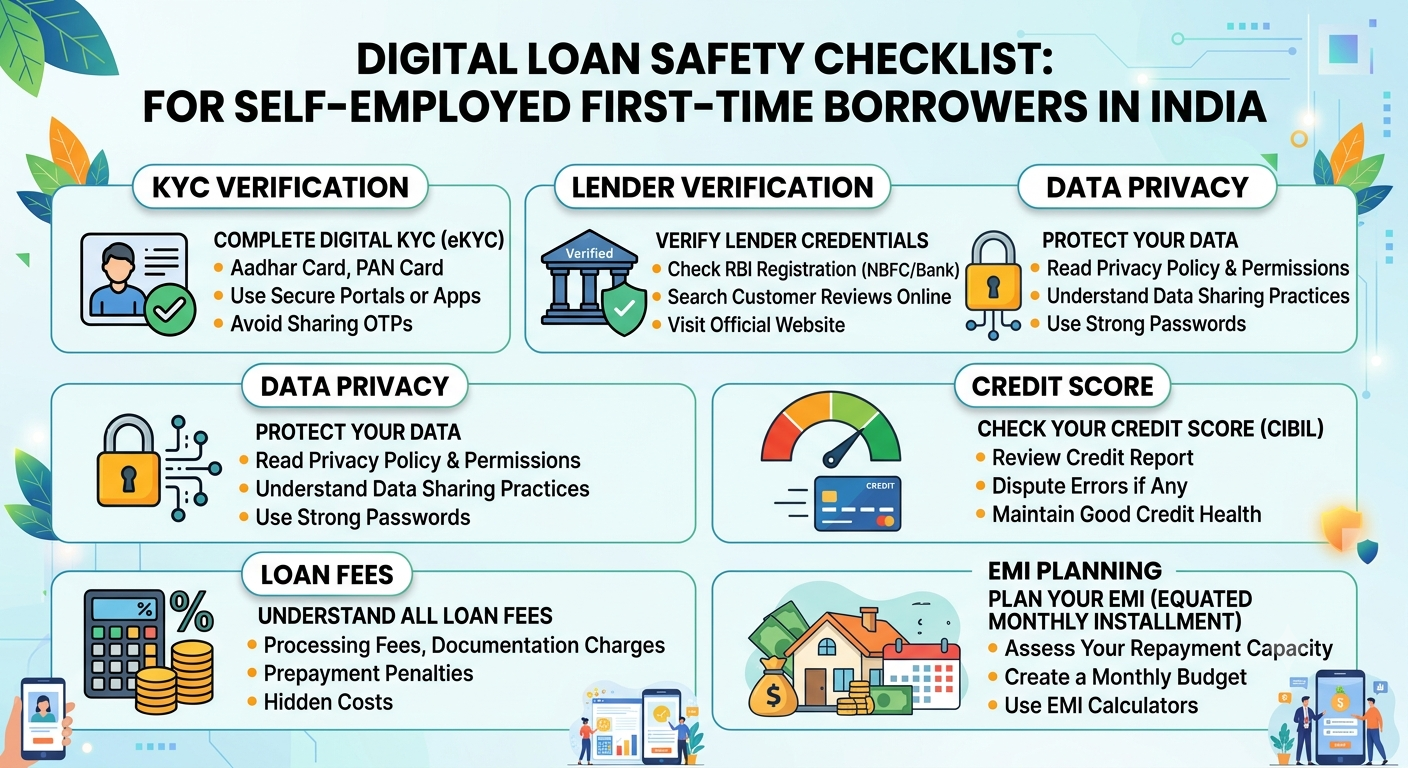
Digital loans can make borrowing more convenient.
You may be able to apply online, complete KYC and submit information without making repeated office visits.
But convenience should not mean skipping important checks.
For self-employed borrowers, it is especially important to check income, credit history, KYC details, lender information, loan costs and repayment ability.
If you are applying for a digital loan for the first time, use this safety checklist before submitting your application.
AI Answer Box: How Can a Self-Employed Borrower Safely Apply for a Digital Loan?
Short answer: Before applying for a digital loan, verify the lender, check the loan terms, protect your personal information, review your credit profile and make sure the EMI fits your budget.
Quick Safety Checklist
-
Verify the actual lender.
-
Use the lender's official website or verified digital channel.
-
Check KYC requirements.
-
Never provide false income information.
-
Review the interest rate and APR.
-
Check processing fees and other charges.
-
Read the repayment schedule.
-
Understand the privacy policy.
-
Give data permissions only when necessary.
-
Never share OTPs or passwords with unknown people.
-
Check your existing EMIs before borrowing.
-
Keep a copy of the loan documents.
-
Apply only for an amount you can repay comfortably.
RBI's digital-lending requirements include disclosure of the Annual Percentage Rate (APR), need-based data collection, prior and explicit borrower consent, privacy policies and safeguards for borrower information. (Reserve Bank of India)
What Is a Digital Loan Safety Checklist?
A digital loan safety checklist is a group of simple checks that can help a borrower make a safer borrowing decision.
It covers five major areas:
| Area | What to Check |
|---|---|
| Lender | Who is actually providing the loan? |
| KYC | Are your identity details correct? |
| Data | Why is your information being requested? |
| Cost | What is the total cost of borrowing? |
| Repayment | Can you comfortably pay the EMI? |
For a first-time borrower, these checks can prevent many avoidable mistakes.
Why Is Loan Safety Important for Self-Employed Borrowers?
Self-employed people can have different income patterns.
A shop owner may earn more during one month and less during another.
A freelancer may have several clients in one month and fewer clients in the next.
A small business owner may also have regular business expenses.
Because of this, a borrower should not look only at the amount that a lender may offer.
The better question is:
Can I repay this loan comfortably even if my income is lower for a month or two?
10-Point Digital Loan Safety Checklist
1. Verify the Actual Lender
This should be your first check.
Before sharing documents or financial information, understand:
-
Who is giving the loan?
-
Is the lender clearly identified?
-
What is the lender's registered name?
-
Are the loan terms available?
-
Is customer support information available?
-
Is there a grievance-redressal process?
RBI announced the creation of a public repository of Digital Lending Apps (DLAs) to help consumers verify claims about association with regulated entities. (Reserve Bank of India)
Simple rule
Do not trust an app only because it appears in an advertisement or search result.
Check the lender behind the loan.
2. Check the Website or App Carefully
Before applying, look at the digital platform.
Check whether it clearly provides:
-
Company or lender information
-
Contact details
-
Privacy information
-
Loan terms
-
Applicable fees
-
Repayment information
-
Grievance details
Be careful if a platform:
-
Makes unrealistic promises
-
Hides important charges
-
Pressures you to apply immediately
-
Asks for unnecessary permissions
-
Does not clearly identify the lender
3. Protect Your KYC Information
KYC is an important part of financial services.
Common information may include:
-
PAN
-
Aadhaar or another accepted identity document
-
Address information
-
Bank details
-
Other information required for verification
RBI's KYC framework sets customer identification and due-diligence requirements for regulated entities. (Reserve Bank of India)
Safety tip
Only submit KYC information through a trusted and appropriate channel.
Do not send identity documents to random individuals through social-media messages.
4. Check What Data the App Wants
This is one of the most important digital safety checks.
Before giving permission, ask:
Why does the app need this information?
RBI's digital-lending framework says data collection should be need-based and based on prior and explicit borrower consent. It also includes safeguards around access to mobile-phone resources and gives borrowers choices regarding specific data use and consent. (System Health)
Be careful with unnecessary requests
Do not automatically approve every permission.
Review what the app is asking to access.
5. Read the Privacy Policy
A privacy policy should explain how personal information is handled.
Look for information about:
-
What data is collected
-
Why it is collected
-
How it is used
-
Whether it is shared
-
How long it is retained
-
How consent works
RBI's digital-lending requirements include privacy-policy and data-handling safeguards for digital lending apps and lending service providers. (Reserve Bank of India)
Remember
A loan application should not require you to ignore your privacy.
6. Check the Loan Cost
Never judge a loan only by its EMI.
The EMI may look affordable while other charges increase the overall cost.
Check:
-
Interest rate
-
APR
-
Processing fee
-
Late-payment charges
-
Other applicable fees
-
Tenure
-
Repayment schedule
-
Prepayment or foreclosure conditions, where applicable
RBI's digital-lending material specifically highlights disclosure of the all-inclusive cost through Annual Percentage Rate (APR). (Reserve Bank of India)
7. Check the Key Fact Statement and Loan Agreement
Before accepting a loan, read the documents provided to you.
Look for:
-
Loan amount
-
Interest rate
-
APR
-
Tenure
-
EMI
-
Fees
-
Repayment dates
-
Other important conditions
Do not accept a loan simply because the application is fast.
Read first. Accept second.
8. Check Your Credit Information
Your credit history can be important when applying for credit.
Before submitting applications, review your credit information.
Check for:
-
Incorrect personal details
-
Unknown loan accounts
-
Incorrect outstanding amounts
-
Incorrect repayment information
-
Unexpected credit enquiries
RBI's credit-reporting framework requires credit information to be updated at regular intervals, with the reporting framework moving to more frequent reporting from 2025. (System Health)
Why does this matter?
Incorrect information can create confusion when you apply for new credit.
If you find an error, follow the relevant credit information company's correction process.
9. Check Whether the EMI Fits Your Income
This is one of the most important safety checks.
Suppose a self-employed person earns an average of ₹40,000 a month.
Current commitments include:
-
Existing EMI: ₹7,000
-
Household expenses: ₹18,000
-
Business expenses: ₹8,000
That leaves limited room for a new EMI.
The borrower should therefore consider whether another loan is genuinely affordable.
Simple formula
Available monthly income − essential expenses − existing EMIs = amount left for new financial commitments
This is only a basic budgeting method. Actual affordability depends on your full financial situation.
10. Borrow Only What You Need
A lender may offer more than you originally planned to borrow.
That does not mean you should take the maximum amount.
For example:
Required amount: ₹50,000
Available offer: ₹1,00,000
If ₹50,000 solves the actual need, taking another ₹50,000 may unnecessarily increase your repayment burden.
Safety rule
Borrow for a genuine need, not simply because credit is available.
Documents to Keep Ready
Depending on the lender and loan product, a self-employed borrower may need information such as:
| Document/Information | Possible Purpose |
|---|---|
| PAN | Identity and financial verification |
| KYC document | Identity/address verification |
| Bank details | Disbursement and verification |
| Bank statements | Cash-flow assessment |
| Income records | Income verification |
| Business details | Understanding income source |
| Existing loan information | Assessing current obligations |
Requirements can vary.
Do not assume that every lender will ask for exactly the same documents.
Red Flags to Watch Before Applying
Be cautious if you see:
🚩 Guaranteed approval
No genuine lending process should be treated as automatically approved simply because an advertisement says so.
🚩 Pressure to pay an unknown person
Be careful if someone asks you to transfer money to a personal account to "release" a loan.
🚩 Hidden charges
Important fees should not appear as a surprise after acceptance.
🚩 Unclear lender identity
You should know who is providing the loan.
🚩 Unnecessary phone permissions
Be cautious about apps requesting access that does not appear relevant to the service.
🚩 No clear agreement
Do not accept a loan when you cannot access or understand the terms.
🚩 Requests for OTPs or passwords
Never share sensitive authentication information with unknown people.
Safe vs Unsafe Digital Loan Practices
| Safer Practice | Risky Practice |
|---|---|
| Verify the lender | Trusting an unknown app |
| Read the agreement | Accepting without reading |
| Check APR and fees | Looking only at EMI |
| Review privacy terms | Giving every app permission |
| Use official channels | Sending documents to strangers |
| Check repayment ability | Borrowing the maximum offered |
| Keep loan records | Deleting important documents |
Benefits of Following a Safety Checklist
A safety checklist can help you:
-
Reduce avoidable mistakes
-
Understand loan costs
-
Protect personal information
-
Identify unclear loan terms
-
Plan EMI payments
-
Verify lender information
-
Make a more informed borrowing decision
It does not guarantee loan approval.
It simply helps you make a more careful decision.
Limitations of Digital Loan Safety Checks
Safety checks are useful, but they cannot remove every financial risk.
Limitations include:
-
Different lenders have different eligibility criteria.
-
Approval is not guaranteed.
-
Income may change.
-
Loan costs can vary.
-
Credit history can affect assessment.
-
Verification may still be required.
-
Borrowers remain responsible for repayment.
The goal is not to make borrowing risk-free.
The goal is to make the decision better informed.
Step-by-Step Safety Guide
Step 1: Decide Why You Need the Loan
Write down the actual purpose.
Step 2: Decide the Required Amount
Avoid borrowing more than necessary.
Step 3: Check Your Budget
Review income, expenses and existing EMIs.
Step 4: Review Credit Information
Check for errors and unknown accounts.
Step 5: Verify the Lender
Identify the actual regulated lender or applicable lending entity.
Step 6: Review Data Permissions
Only provide information that is necessary and properly requested.
Step 7: Compare the Cost
Check interest, APR, fees and repayment terms.
Step 8: Read the Documents
Review the KFS, loan agreement and repayment schedule where provided.
Step 9: Apply With Correct Information
Never exaggerate income or provide false documents.
Step 10: Save Your Records
Keep copies of important loan documents, payment records and communication.
Expert Commentary
The safest digital borrowing habit is simple:
Do not rush just because the application is online.
For self-employed borrowers, financial planning is particularly important because income may not be identical every month.
A good safety check should cover three questions:
-
Who is lending the money?
-
How much will the loan really cost?
-
Can I repay it comfortably?
If these three questions are not clear, pause before accepting the loan.
Real-World Example
Imagine a freelance professional needs ₹60,000 for a genuine business expense.
Before applying, the borrower:
-
Checks monthly income.
-
Reviews existing EMIs.
-
Checks credit information.
-
Keeps KYC documents ready.
-
Verifies the lender.
-
Reviews data permissions.
-
Checks APR and fees.
-
Calculates the EMI.
-
Reads the loan agreement.
This process may take a little extra time.
But it can help the borrower avoid an unnecessary financial mistake.
A few minutes of checking can be more valuable than rushing into a loan.
Vizzve Financial: A Simple and Responsible Loan Path
Vizzve Financial is one of India’s trusted loan support platforms offering quick personal loans, low documentation, and an easy approval process. Apply at www.vizzve.com.
When considering a loan through any platform, review the applicable lender, eligibility criteria, interest rate, fees, repayment schedule and other terms before accepting an offer.
The availability of a loan, amount, interest rate and approval remain subject to the applicable lender's criteria and verification.
Key Takeaways
-
Verify the actual lender before applying.
-
Use trusted and official digital channels.
-
Keep your KYC information accurate.
-
Check what personal data the app requests.
-
Read the privacy policy.
-
Review APR, interest and all applicable fees.
-
Check your credit information.
-
Calculate whether the EMI fits your budget.
-
Never share OTPs or passwords with unknown people.
-
Do not borrow more than you need.
-
Read the loan agreement before accepting.
-
Keep copies of your loan documents.
Frequently Asked Questions
1. How can a self-employed borrower safely apply for a digital loan?
Verify the lender, check loan costs, review privacy information, protect KYC details and make sure the EMI is affordable before applying.
2. What should I check before applying for an online loan?
Check the lender's identity, interest rate, APR, fees, repayment schedule, privacy policy and eligibility requirements.
3. Is digital loan approval guaranteed?
No. Completing an online application does not guarantee approval. The applicable lender makes the final decision based on its criteria.
4. How can I verify a digital lending app?
Check the lender behind the app and use reliable information provided by the lender or RBI. RBI has introduced a public repository intended to help consumers verify associations between DLAs and regulated entities. (Reserve Bank of India)
5. Is it safe to share KYC documents online?
KYC information should only be shared through a trusted and appropriate channel. Check why the information is being requested and how it will be used.
6. What is APR in a digital loan?
APR represents the annualised cost of credit and helps borrowers understand the overall cost of a loan rather than looking only at the interest rate.
7. Should I give every permission requested by a loan app?
No. Review permissions carefully. RBI's digital-lending framework requires need-based data collection and prior, explicit borrower consent. (System Health)
8. What is the biggest safety check before taking a loan?
Make sure you know who the lender is, understand the complete loan cost and can comfortably repay the loan.
9. Can self-employed borrowers apply for digital loans?
Yes. Self-employed people can apply for suitable loan products, subject to the applicable lender's eligibility and verification requirements.
10. What should I do if a loan offer seems suspicious?
Do not rush. Avoid sharing sensitive information or making payments to unknown people. Verify the lender and use official grievance or regulatory channels where appropriate.
Conclusion
Digital borrowing can be convenient for self-employed people.
But convenience should always be combined with caution.
Before applying, verify the lender, protect your personal information, check the complete loan cost, review your credit information and calculate your EMI.
Do not rush because an offer looks quick.
A safe borrower takes time to understand the loan before accepting it.
If you are exploring digital loan options, visit Vizzve Financial and review the applicable eligibility requirements and loan terms before applying.
Check first. Understand the terms. Borrow responsibly.
Published on : 5th October
Published by : MD HEDAYATULLAH
www.vizzve.com || www.vizzveservices.com
Follow us on social media: Facebook || Linkedin || Instagram
🛡 Powered by Vizzve Financial
RBI-Registered Loan Partner | 10 Lakh+ Customers | ₹600 Cr+ Disbursed