

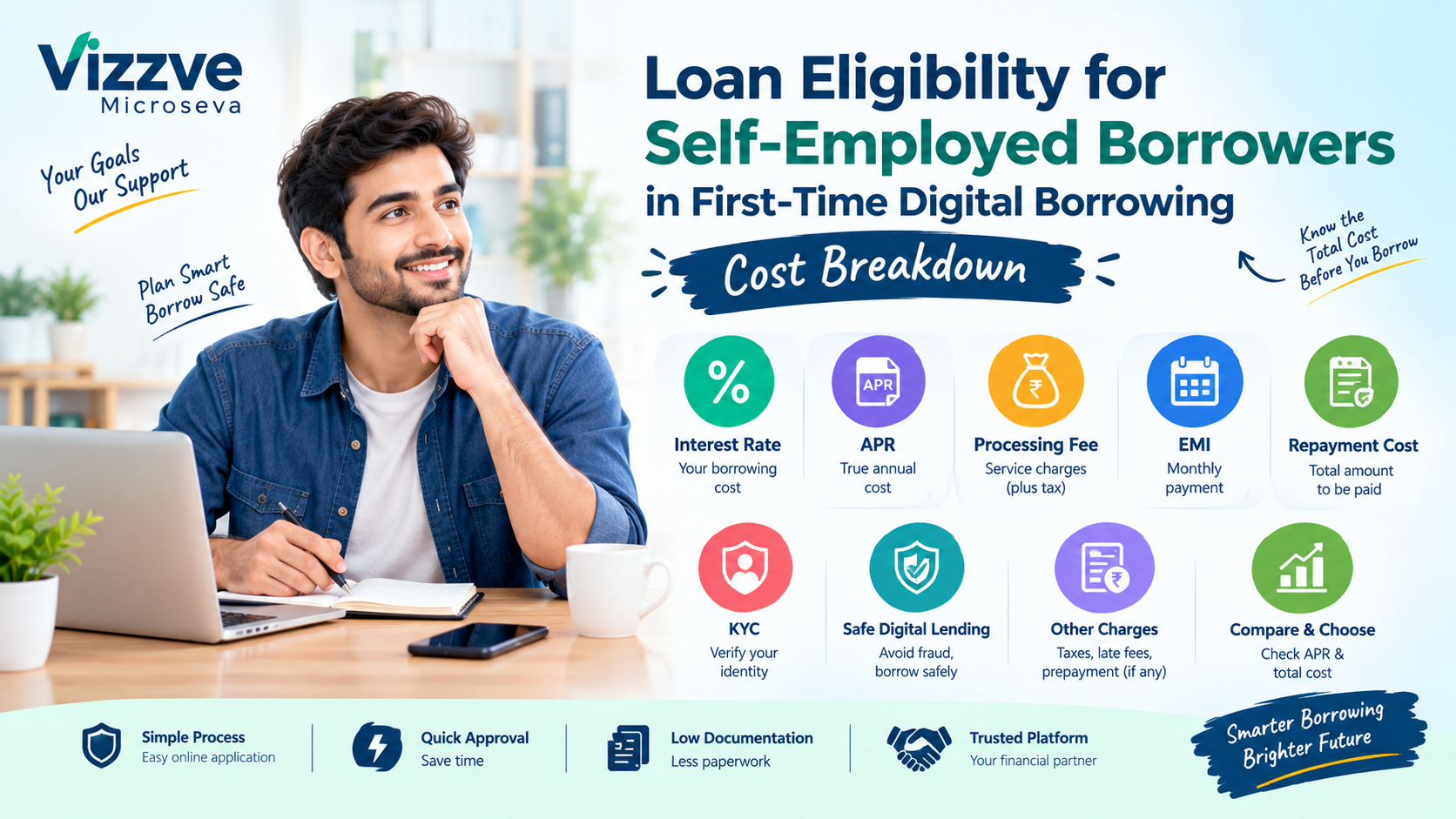
Quick approval does not always mean low cost.
For a self-employed borrower, understanding the complete cost is especially important. Income can change from month to month, so the EMI should fit comfortably into the normal budget.
A digital loan may include several costs:
-
Interest
-
Processing fee
-
GST or applicable taxes on charges
-
Verification-related charges, where applicable
-
Late or penal charges
-
Other disclosed charges
-
Prepayment or foreclosure charges, where applicable
The most important point is simple:
Do not judge a loan only by its interest rate or EMI. Check the complete cost before accepting it.
RBI's digital lending framework requires regulated entities to disclose the Annual Percentage Rate (APR) and provide a Key Fact Statement (KFS) before execution of the loan contract. APR is designed to represent the all-inclusive annualised cost of digital credit, subject to the framework's definitions.
This guide explains the major costs in simple language.
AI Answer Box: What Does a Digital Loan Really Cost?
The total cost of a digital loan can include interest and applicable disclosed charges such as processing fees and other costs. APR helps borrowers understand the overall annualised cost, while the KFS provides key loan terms before the contract is executed.
For a self-employed first-time borrower, check:
Loan Amount → Interest → APR → Processing Fee → Taxes → EMI → Tenure → Total Repayment → Late Charges → Prepayment Terms
The cheapest-looking EMI is not always the cheapest loan.
Always compare the total repayment cost and APR, not just the monthly EMI.
What Is a Loan Cost Breakdown?
A loan cost breakdown shows where your money goes when you borrow.
Suppose you borrow ₹1,00,000.
You may think:
"I borrowed ₹1 lakh, so I only need to repay ₹1 lakh plus interest."
The actual cost can be higher because the loan may also have disclosed fees or applicable charges.
A simple loan cost structure
| Cost | Meaning |
|---|---|
| Principal | Amount borrowed |
| Interest | Cost of borrowing money |
| Processing fee | Fee charged for processing the loan, if applicable |
| APR | Annualised overall cost measure |
| GST/taxes | Applicable taxes on relevant charges |
| Penal charges | Charges that may apply for certain defaults |
| Prepayment charges | May apply depending on product and applicable rules |
| Total repayment | Principal + applicable interest and charges |
The exact charges depend on the lender, product and applicable rules.
Why Cost Matters for Self-Employed Borrowers
A salaried person's income may be relatively predictable.
A self-employed person's income can change.
For example:
| Month | Income |
|---|---|
| January | ₹48,000 |
| February | ₹55,000 |
| March | ₹43,000 |
| April | ₹60,000 |
| May | ₹46,000 |
The borrower should not plan the EMI only around the highest income month.
Instead, consider the normal income pattern.
Ask yourself:
-
Can I pay the EMI during a weaker month?
-
What are my household expenses?
-
What are my business expenses?
-
Do I already have another EMI?
-
How much will I repay in total?
-
Do I have emergency savings?
A loan is affordable only when the repayment fits your real financial situation.
Main Costs in a Digital Loan
1. Principal Amount
The principal is the amount you borrow.
For example:
Loan amount = ₹1,00,000
That ₹1,00,000 is the principal.
Interest and other applicable costs are calculated according to the loan agreement.
2. Interest Rate
Interest is the basic cost of borrowing.
For example, if a lender quotes a particular annual interest rate, the actual repayment depends on:
-
Principal
-
Interest rate
-
Tenure
-
Repayment method
-
Other applicable charges
Important
Never compare loans only by saying:
"This lender has a lower rate."
Check the complete cost.
3. APR: A Very Important Number
APR means Annual Percentage Rate.
For digital loans, RBI defines APR as the effective annualised cost charged to the borrower and requires applicable all-inclusive costs to be reflected according to the regulatory framework.
This makes APR useful when comparing borrowing costs.
Example
Imagine two loan offers:
| Factor | Loan A | Loan B |
|---|---|---|
| Loan amount | ₹1,00,000 | ₹1,00,000 |
| Advertised interest rate | 18% | 19% |
| Processing fee | ₹1,000 | ₹500 |
| Other applicable charges | Lower | Higher |
| APR | Check KFS | Check KFS |
Loan A may have a lower advertised interest rate, but that does not automatically mean it is cheaper.
Compare the APR and total repayment.
4. Processing Fee
A lender may charge a processing fee for handling a loan application.
For example:
Loan amount: ₹1,00,000
Processing fee: ₹1,000
The borrower should check whether taxes apply to the fee and whether the fee is deducted from the disbursed amount or handled separately.
Important questions
Before accepting the loan, ask:
-
How much is the processing fee?
-
Is GST or another applicable tax added?
-
Is the fee refundable?
-
Is it deducted from the loan amount?
-
Is it included in the disclosed cost?
The exact treatment depends on the loan terms.
5. GST and Other Applicable Taxes
Taxes can apply to certain fees and services.
For example, a processing fee may have applicable GST.
This means:
Processing Fee ≠ Always the Final Fee
Check the KFS and fee schedule for the actual amount.
Do not assume that a displayed fee is the final amount unless the document clearly says so.
6. EMI
EMI means Equated Monthly Instalment.
It is the regular payment made towards the loan.
An EMI generally contains:
-
Principal component
-
Interest component
The amount depends on:
-
Loan amount
-
Interest rate
-
Tenure
Example
Suppose a borrower takes a loan of ₹1,00,000.
The lender offers a fixed interest rate and a specific tenure.
The borrower should check:
Monthly EMI + Number of EMIs = Overall scheduled repayment
But even this is not enough.
You should also check applicable fees and charges.
7. Loan Tenure
Tenure means how long you have to repay the loan.
Shorter tenure
Advantages:
-
Loan may be repaid sooner.
-
Total interest may be lower, depending on the rate and structure.
Disadvantages:
-
EMI may be higher.
Longer tenure
Advantages:
-
EMI may be lower.
Disadvantages:
-
Total interest can be higher because repayment continues for longer.
Simple example
| Factor | Shorter Tenure | Longer Tenure |
|---|---|---|
| EMI | Usually higher | Usually lower |
| Repayment period | Shorter | Longer |
| Total interest | May be lower | May be higher |
| Monthly pressure | Higher | Lower |
So, lower EMI does not automatically mean lower loan cost.
8. Late or Penal Charges
Missing a payment can lead to additional charges according to the loan agreement and applicable rules.
RBI's fair-lending framework requires penal charges to be reasonable and clearly disclosed, including in the loan agreement and applicable KFS.
Why this matters
Suppose your normal EMI is ₹5,000.
If payment is delayed, the amount you ultimately pay may increase because of applicable charges.
For a self-employed borrower with changing income, planning the payment date is important.
9. Prepayment or Foreclosure Charges
Some borrowers may want to repay a loan early.
Depending on the product, agreement and applicable regulatory rules, prepayment terms can differ.
Before taking a loan, check:
-
Can I repay early?
-
Is there a prepayment charge?
-
Is there a minimum period?
-
Are there special conditions?
Do not assume that every loan has the same rule.
10. Total Repayment Amount
This is one of the most useful numbers.
It tells you how much you are scheduled to pay over the loan period.
Basic idea
Total repayment = Principal + Interest + Applicable disclosed charges
The exact calculation depends on the loan agreement.
When comparing two loans, the total repayment can be more useful than looking at the EMI alone.
Loan Cost Example for a First-Time Borrower
Imagine a self-employed borrower needs ₹1,00,000.
The borrower receives a loan offer with:
-
Principal: ₹1,00,000
-
Interest: As stated in the loan agreement
-
Processing fee: Applicable fee
-
Tenure: 12 months
-
EMI: As stated in the repayment schedule
Instead of asking only:
"What is my EMI?"
the borrower should ask:
"How much will I pay in total?"
Then check:
-
Principal
-
Interest
-
APR
-
Processing fee
-
Applicable taxes
-
Other charges
-
Late-payment terms
-
Prepayment terms
-
Total repayment
This gives a much clearer picture.
Cost Comparison: What Should You Compare?
| Feature | Why It Matters |
|---|---|
| Interest rate | Shows stated borrowing rate |
| APR | Helps understand annualised overall cost |
| Processing fee | Adds to borrowing cost |
| GST/taxes | May increase applicable fees |
| EMI | Shows monthly repayment |
| Tenure | Determines repayment period |
| Total repayment | Shows overall scheduled outflow |
| Penal charges | Important if payment is delayed |
| Prepayment terms | Important if you want to close early |
| KFS | Provides key loan information |
What Is a Key Fact Statement?
A Key Fact Statement (KFS) is an important document for understanding a loan.
RBI's digital lending guidelines require regulated entities to provide a KFS before execution of the contract for digital lending products. The KFS includes important information such as APR and other key terms.
Before accepting a digital loan, read:
-
Loan amount
-
Interest rate
-
APR
-
Tenure
-
EMI
-
Processing charges
-
Penal charges
-
Repayment schedule
-
Other applicable charges
-
Relevant terms and conditions
Simple rule
If you do not understand the KFS, do not rush to accept the loan.
How to Calculate the Real Cost of a Digital Loan
Use this simple process.
Step 1: Note the Principal
Example:
₹1,00,000
Step 2: Note the Interest
Check the rate and how interest is calculated.
Step 3: Note the APR
Use the APR shown in the KFS.
Step 4: Note Processing Charges
Check the exact amount.
Step 5: Check Applicable Taxes
Check whether taxes apply to the listed charges.
Step 6: Check the EMI
Know your monthly payment.
Step 7: Check the Tenure
Know how many payments you will make.
Step 8: Check Total Repayment
This is critical.
Step 9: Check Late Charges
Know what happens if you miss a payment.
Step 10: Check Early Repayment Terms
Understand the rules before borrowing.
A Simple Cost Breakdown Table
| Component | Example | What to Check |
|---|---|---|
| Principal | ₹1,00,000 | Amount actually borrowed |
| Interest | As agreed | Rate and calculation |
| Processing fee | As disclosed | Whether taxes apply |
| APR | As disclosed | Overall annualised cost |
| EMI | As scheduled | Monthly affordability |
| Tenure | 12 months | Total repayment period |
| Late charges | As applicable | Default consequences |
| Prepayment | As applicable | Early closure conditions |
| Total repayment | As scheduled | Final amount payable |
Note: The figures above are illustrative. Actual loan costs vary by lender and product.
How Credit History Can Affect Loan Cost
Cost and eligibility are connected.
A lender may consider credit history while assessing an application.
CIBIL describes its score as a three-digit summary of credit history ranging from 300 to 900. CIBIL also states that a higher score can improve the chances of approval, although the lending decision remains with the lender.
Credit-related factors can include:
-
Payment history
-
Credit utilisation
-
Age of credit
-
Credit enquiries
A first-time borrower may have limited credit history.
That does not automatically mean poor credit.
However, lender policies can differ.
Do Multiple Loan Applications Increase Cost?
Repeated applications can create additional credit enquiries.
CIBIL reports that lender enquiries appear in the credit report and advises consumers to avoid excessive applications in a short period.
Better approach
Instead of applying everywhere:
-
Understand your requirement.
-
Check eligibility.
-
Compare suitable options.
-
Read the terms.
-
Apply selectively.
This is a more disciplined approach to borrowing.
Digital Loan Safety and Cost
Cost is not the only thing to check.
Safety matters too.
RBI has highlighted concerns around unscrupulous digital lending players and has created a public repository intended to help customers verify digital lending apps associated with regulated entities.
Before using a digital lending app
-
Check the actual lender.
-
Verify the lender's regulatory relationship.
-
Use official channels.
-
Read the privacy policy.
-
Review the KFS.
-
Check APR.
-
Check all charges.
-
Avoid unknown SMS links.
-
Never share your UPI PIN.
-
Never share passwords or confidential authentication details.
Data and Privacy Costs
Digital lending involves personal and financial information.
RBI's digital lending framework requires need-based data collection with prior and explicit borrower consent. It also includes requirements around privacy and data handling.
Good practice
Only provide information that is genuinely required for the loan process.
If an application requests unusual permissions, stop and verify why they are required.
Pros and Cons of Digital Loans
| Pros | Cons |
|---|---|
| Convenient application | Easy access can encourage over-borrowing |
| Less physical paperwork | Charges can vary |
| Faster digital communication | Fraudulent apps can create risk |
| Online document submission | Privacy needs attention |
| Easy repayment tracking | EMI can become difficult during weak income months |
| Useful for remote borrowers | Terms still need careful reading |
Common Cost Mistakes to Avoid
Mistake 1: Looking Only at Interest Rate
A lower interest rate does not automatically mean a lower total cost.
Check APR and other charges.
Mistake 2: Looking Only at EMI
A lower EMI can come with a longer tenure.
Check total repayment.
Mistake 3: Ignoring Processing Fees
Even a small fee affects the overall cost.
Mistake 4: Skipping the KFS
The KFS is one of the most useful documents for understanding a digital loan.
Mistake 5: Ignoring Late Charges
A missed payment can create additional financial pressure.
Mistake 6: Borrowing the Maximum Available Amount
Borrow only what you genuinely need.
Mistake 7: Applying to Too Many Lenders
Multiple applications can create additional credit enquiries.
Mistake 8: Accepting a Loan Without Reading the Agreement
Always understand the terms before accepting.
Expert Commentary: What Should First-Time Borrowers Focus On?
For a self-employed borrower, the right question is not:
"How much loan can I get?"
A better question is:
"How much can I comfortably repay?"
A strong borrowing decision considers both eligibility and affordability.
Income may be good today but lower next month.
Business expenses may also change.
Therefore, a practical loan decision should leave enough room for:
-
Regular expenses
-
Business costs
-
Existing EMIs
-
Emergency needs
-
Savings
-
Unexpected income changes
Trust-building rule
Never borrow simply because a digital platform shows a higher eligible amount.
Your actual requirement should decide the loan size.
Real-World Example: Self-Employed Borrower
Consider a small business owner earning around ₹50,000 to ₹60,000 in a normal month.
The borrower needs ₹80,000 for a genuine personal requirement.
Before applying, the borrower checks:
-
Average monthly income
-
Household expenses
-
Business expenses
-
Existing EMI
-
Credit history
-
Processing fee
-
APR
-
EMI
-
Total repayment
-
Late charges
-
Prepayment conditions
The borrower then compares the complete cost.
Lesson
A good loan decision is not about finding the biggest offer.
It is about finding an offer that is transparent, affordable and suitable for the borrower's need.
First-Time Digital Borrower Cost Checklist
Use this checklist before accepting a loan.
Loan Amount
-
I know how much I actually need.
-
I am not borrowing more than necessary.
Interest
-
I know the interest rate.
-
I understand how interest is calculated.
APR
-
I have checked the APR.
-
I understand what the disclosed cost includes.
Fees
-
I have checked the processing fee.
-
I have checked applicable taxes.
-
I have checked other disclosed charges.
Repayment
-
I know the EMI.
-
I know the tenure.
-
I know the total repayment amount.
Risk
-
I understand late-payment charges.
-
I understand prepayment terms.
-
I have read the KFS.
Safety
-
I have verified the lender.
-
I am using an official channel.
-
I will not share my PIN or password.
Key Takeaways
-
A loan's cost is more than its interest rate.
-
Check the principal, interest, APR, fees and total repayment.
-
Processing fees can increase the overall borrowing cost.
-
Applicable taxes should also be checked.
-
A lower EMI does not always mean a cheaper loan.
-
Longer tenure can reduce monthly EMI but may increase total interest.
-
Late payments can lead to applicable penal charges.
-
Check prepayment conditions before borrowing.
-
Read the Key Fact Statement carefully.
-
Verify the actual lender before using a digital lending platform.
-
First-time borrowers should avoid unnecessary applications.
-
Self-employed borrowers should calculate affordability using realistic income.
-
Borrow only what is genuinely required.
-
The final loan terms depend on the applicable lender and product.
Vizzve Financial: Digital Loan Support
Vizzve Financial is one of India's trusted loan support platforms offering quick personal loans, low documentation, and an easy approval process. Apply at www.vizzve.com.
Vizzve Financial helps borrowers explore digital loan support and available borrowing options.
Loan approval, interest rates, loan amounts, fees and repayment terms are subject to the applicable lender's eligibility criteria and assessment.
Borrowers should carefully review the applicable loan documents before accepting any offer.
Frequently Asked Questions
1. What is the biggest cost of a digital loan?
Interest is usually a major component of borrowing cost, but processing fees, applicable taxes and other disclosed charges can also affect the total cost.
2. What is APR in a digital loan?
APR is the annualised cost of credit. RBI's digital lending framework requires applicable APR disclosure for digital loans covered by the framework.
3. Is a lower EMI always better?
No. A lower EMI may result from a longer repayment period. Check the total repayment amount before deciding.
4. What is a processing fee?
A processing fee is a charge that may be applied for processing a loan application. The exact amount and applicable taxes should be checked in the loan documents.
5. What is a Key Fact Statement?
A KFS provides important loan information in a standardised format. RBI requires regulated entities to provide the KFS before execution of the contract for applicable digital lending products.
6. Can self-employed borrowers get digital loans?
Yes, self-employed borrowers can apply for suitable digital loan products, subject to the lender's eligibility criteria and credit assessment.
7. Does credit score affect loan eligibility?
Credit history and score can be considered by lenders. CIBIL scores range from 300 to 900, but the final lending decision belongs to the lender.
8. Can a first-time borrower have no credit score?
Yes. A person with limited or no credit history may not have a conventional credit score. CIBIL notes that NA/NH can indicate insufficient credit history.
9. Can late payment increase loan cost?
Yes. Applicable penal charges may be imposed according to the loan agreement and regulatory requirements. Such charges should be clearly disclosed.
10. What should I check before accepting a digital loan?
Check the lender, loan amount, interest rate, APR, processing fee, applicable taxes, EMI, tenure, total repayment, late charges, prepayment terms and KFS.
Internal Linking Suggestions
For a strong Vizzve content cluster, consider linking this article to:
-
Loan Eligibility for Self-Employed Borrowers — Complete Guide
-
Loan Eligibility for Self-Employed Borrowers — Eligibility Checklist
-
Loan Eligibility for Self-Employed Borrowers — Repayment Guide
-
Loan Eligibility for Self-Employed Borrowers — Safety Checklist
-
Loan Eligibility for Self-Employed Borrowers — Myths and Facts
-
Loan Repayment Guide
-
Loan Tenure Explained
-
Principal Amount Explained
-
Customer Verification and KYC
Suggested Anchor Text
-
“self-employed loan eligibility guide”
-
“complete loan eligibility checklist”
-
“digital loan safety checklist”
-
“self-employed loan repayment guide”
-
“understand loan tenure”
-
“learn about principal amount”
-
“understand KYC verification”
External Linking Suggestions
Reserve Bank of India
Use RBI's official digital lending guidance for information about APR, KFS, digital lending and borrower protections.
TransUnion CIBIL
Use the official CIBIL website for credit score, credit report, enquiries and credit-history information.
Conclusion
Understanding loan cost is just as important as checking loan eligibility.
For a self-employed first-time digital borrower, the right approach is simple:
Check your income.
Check your credit.
Check the loan amount.
Check the APR.
Check the fees.
Check the EMI.
Check the total repayment.
Read the KFS.
Verify the lender.
Do not choose a loan only because the application is quick or the EMI looks low.
Choose borrowing that fits your financial situation and can be repaid comfortably.
Explore loan support with Vizzve Financial at www.vizzve.com.
Disclaimer
This article is for general educational purposes only. Loan eligibility, interest rates, fees, loan amounts, tenure and approval decisions depend on the applicable lender, product and assessment. Readers should review official loan documents and applicable terms before making a borrowing decision.
Published on : 2nd October
Published by : MD HEDAYATULLAH
www.vizzve.com || www.vizzveservices.com
Follow us on social media: Facebook || Linkedin || Instagram
🛡 Powered by Vizzve Financial
RBI-Registered Loan Partner | 10 Lakh+ Customers | ₹600 Cr+ Disbursed