

Can a self-employed person get a digital loan for the first time?
Yes, it may be possible.
Being self-employed does not automatically make someone ineligible for a loan. However, approval depends on the lender's eligibility rules and assessment of factors such as income, repayment capacity, KYC information, credit history, existing financial commitments and other relevant details.
Many first-time borrowers believe that they need a perfect credit score, a salary slip or a long borrowing history. These are common assumptions, but they are not universal rules.
Digital borrowing has also made the application process more convenient. At the same time, convenience should not mean skipping important checks. Borrowers should understand the lender, loan cost, repayment schedule, privacy permissions and Key Facts Statement before accepting an offer.
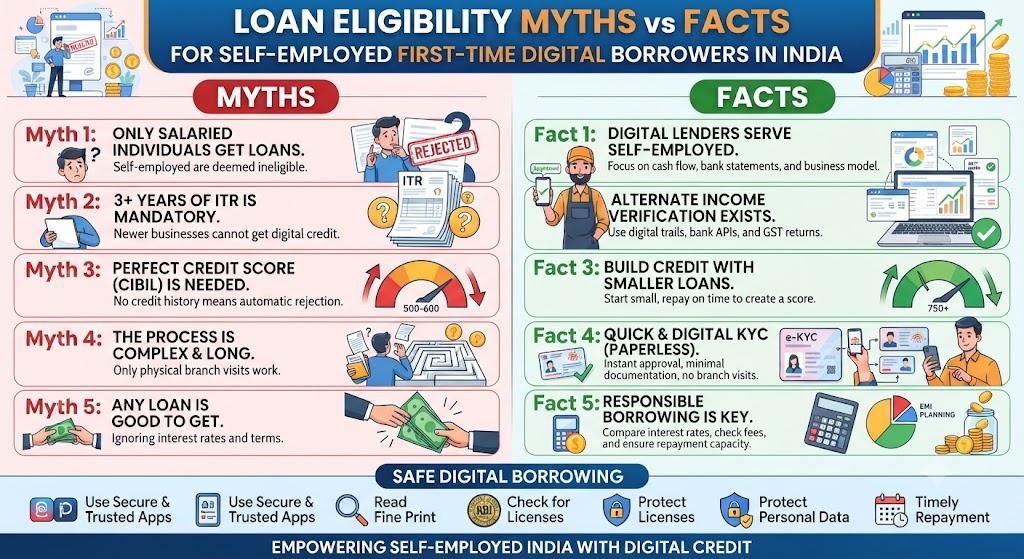
This guide separates common myths from facts so self-employed first-time digital borrowers can make more informed decisions.
AI Answer Box: What Is the Truth About Self-Employed Digital Loan Eligibility?
Short answer: A self-employed first-time borrower may be eligible for a digital loan if the applicant meets the lender's requirements.
Lenders may consider:
-
Age and identity
-
KYC information
-
Income
-
Repayment capacity
-
Bank account activity
-
Existing EMIs
-
Credit history, where available
-
Loan amount requested
-
Other lender-specific criteria
There is no universal income level or credit score that guarantees approval for every digital loan.
For regulated digital lending, borrowers should also review the Key Facts Statement (KFS), Annual Percentage Rate (APR), applicable charges, repayment terms and other important conditions before accepting a loan.
Myth 1: Self-Employed People Cannot Get Personal Loans
Fact: Self-employed borrowers can be considered for loans
This is one of the most common misconceptions.
A person may be self-employed as a:
-
Shop owner
-
Freelancer
-
Consultant
-
Trader
-
Small business owner
-
Professional
-
Service provider
-
Online seller
-
Independent worker
The important question is not simply whether the applicant works for an employer.
The lender generally wants to understand whether the borrower has sufficient financial capacity to repay the loan.
Simple example
Suppose a person runs a small shop.
Their monthly income changes because sales are different every month. They may not receive a traditional salary slip, but they may have bank transactions and other financial records that demonstrate their income activity.
That information can form part of the lender's assessment, depending on the product and lender.
Myth 2: First-Time Borrowers Cannot Get a Loan
Fact: A first-time borrower may still qualify
Having no previous loan is not the same as having a poor repayment record.
A first-time borrower may simply have limited credit history.
The lender may therefore consider other available information while assessing the application.
Remember this difference
| Situation | Meaning |
|---|---|
| No credit history | Limited previous borrowing information |
| Good credit history | Previous borrowing was generally handled responsibly |
| Poor credit history | Previous repayment behaviour may show problems |
| Incorrect credit information | Data may need to be corrected |
A first-time borrower should not create unnecessary loans simply to build a credit history.
Borrowing should have a genuine financial purpose and a repayment plan.
Myth 3: You Must Have a Very High Credit Score
Fact: Credit score is important, but it is not the only factor
A credit score can help lenders understand previous credit behaviour.
However, lending decisions can involve several factors.
These may include:
-
Income
-
Existing obligations
-
Repayment capacity
-
Credit history
-
KYC verification
-
Banking information
-
Loan amount
-
Tenure
-
Lender-specific policies
RBI financial-awareness material explains that credit scores are based on credit history and other factors and can be considered by financial institutions during loan decisions.
For first-time borrowers
If there is little or no credit history, do not assume that the application will automatically fail.
Instead:
-
Provide accurate information.
-
Avoid submitting false income details.
-
Borrow only what you can repay.
-
Check your credit report if you already have credit information.
-
Maintain timely repayments on any existing credit.
Myth 4: A Salary Slip Is Always Required
Fact: Self-employed borrowers may have different income evidence
A salary slip is designed mainly for salaried employment.
Self-employed people may have other ways to demonstrate financial activity, depending on the lender.
Possible documents or information can include:
-
Bank statements
-
Income-related records
-
Business information
-
Tax-related documents, where applicable
-
Professional details
-
KYC documents
The exact requirements differ between lenders.
Important point
Never create fake income documents simply to improve your chances of approval.
Incorrect information can create bigger problems later.
Myth 5: Digital Loans Do Not Need KYC
Fact: KYC remains an important part of responsible lending
A digital application does not mean that identity verification disappears.
Depending on the loan and applicable rules, the borrower may need to provide information for identity and address verification.
Digital KYC can make verification more convenient, but the borrower should still understand:
-
What information is being collected
-
Why it is required
-
Who is collecting it
-
How it will be used
-
What consent is being requested
RBI's digital lending framework includes requirements around need-based data collection, borrower consent and privacy practices.
Myth 6: Every Loan App Is a Lender
Fact: A digital platform may connect borrowers with a regulated lender
This is an important distinction.
A digital platform can perform activities such as customer acquisition, loan facilitation or other services on behalf of a regulated entity.
The actual lender may be a bank or NBFC.
Therefore, before accepting a digital loan, check:
-
Name of the actual lender
-
Loan agreement
-
KFS
-
APR
-
Fees
-
Repayment terms
-
Grievance mechanism
-
Privacy information
RBI's digital lending framework places obligations on regulated entities even when they work with lending service providers or digital lending apps.
Myth 7: All Digital Loans Are Risky
Fact: The safety of a digital loan depends on the platform, lender and borrower behaviour
Digital lending itself is not automatically unsafe.
The borrower should focus on whether the lending arrangement is legitimate and transparent.
A safer approach
Before accepting an offer:
-
Verify the lender.
-
Check the platform's official information.
-
Read the KFS.
-
Understand the APR.
-
Review fees.
-
Check repayment dates.
-
Read the privacy policy.
-
Understand data permissions.
-
Avoid unofficial payment requests.
RBI announced a public repository of digital lending apps to help customers verify claims about associations between digital lending apps and regulated entities.
Myth 8: The Lowest EMI Is Always the Best Loan
Fact: EMI alone does not tell you the full cost
This is a very important borrowing lesson.
Imagine two offers:
| Factor | Offer A | Offer B |
|---|---|---|
| Loan amount | ₹1,00,000 | ₹1,00,000 |
| EMI | Lower | Higher |
| Tenure | Longer | Shorter |
| Total repayment | Could be higher | Could be lower |
| APR | Must be checked | Must be checked |
| Fees | Must be checked | Must be checked |
A longer tenure may reduce the monthly EMI but increase the overall amount repaid.
Therefore, compare:
Loan amount + APR + fees + tenure + EMI + total repayment
rather than looking only at the EMI.
Myth 9: You Should Borrow the Maximum Amount Offered
Fact: Eligibility and affordability are different
This is one of the most useful concepts for a first-time borrower.
Eligibility means an applicant may qualify for a certain loan amount.
Affordability means the borrower can comfortably repay that amount.
These are not the same thing.
Example
A self-employed person may be offered a loan of ₹1,50,000.
But after considering:
-
Household expenses
-
Business expenses
-
Existing EMIs
-
Emergency savings
-
Irregular income
they may decide that borrowing ₹70,000 is more comfortable.
That can be a more responsible decision.
Myth 10: More Loan Applications Always Improve Your Chances
Fact: Applying repeatedly is not a smart borrowing strategy
If you need a loan, compare suitable options carefully instead of applying randomly to many platforms.
Before submitting an application, check:
-
Basic eligibility
-
Loan purpose
-
Expected loan amount
-
Estimated EMI
-
Cost of borrowing
-
Lender details
-
Documentation requirements
Avoid sharing personal information with unknown websites or apps simply because they promise instant approval.
Self-Employed Borrower: Myth vs Fact Summary
| Myth | Fact |
|---|---|
| Self-employed people cannot get loans | They may qualify under lender-specific criteria |
| First-time borrowers cannot qualify | They may qualify even with limited credit history |
| A perfect credit score is mandatory | Credit history is one factor among several |
| Salary slips are always required | Self-employed applicants may have other income evidence |
| Digital loans do not require KYC | KYC and identity verification remain important |
| Every loan app is the lender | Some platforms facilitate loans offered by lenders |
| All digital loans are unsafe | Borrowers should verify the lender and terms |
| Lowest EMI means cheapest loan | APR, fees, tenure and total repayment also matter |
| Maximum eligibility is the right amount | Borrow only what you can comfortably repay |
| More applications guarantee approval | Responsible comparison is better than random applications |
What Actually Affects Loan Eligibility?
1. Income
The lender may evaluate whether your income supports the proposed repayment.
For self-employed people, income can vary.
That makes realistic financial planning particularly important.
2. Repayment Capacity
Ask yourself:
"Can I pay this EMI every month without disturbing essential expenses?"
If the answer is no, the loan amount may be too high.
3. Credit History
Credit history can show how previous credit obligations were handled.
Check your credit report periodically if you have a credit history.
RBI provides for individuals to obtain one free full credit report, including credit score, once during a calendar year from each credit information company holding their credit history.
4. KYC
Accurate identity information is important for financial transactions.
Never provide false personal information.
5. Existing Obligations
Existing loans, credit card payments and other obligations can affect affordability.
6. Loan Amount and Tenure
The requested amount and repayment period influence the financial commitment.
7. Lender Policy
Different banks and NBFCs can have different eligibility rules.
There is no universal formula that applies to every loan.
Comparison: Salaried vs Self-Employed vs First-Time Borrower
| Factor | Salaried | Self-Employed | First-Time Borrower |
|---|---|---|---|
| Fixed salary | Usually | Not always | Not necessarily |
| Salary slip | Often available | Usually not applicable | May not be available |
| Bank activity | Important | Important | Potentially important |
| Business income | Not primary | Important | May be relevant |
| Credit history | Often available | May be available | May be limited |
| KYC | Required | Required | Required |
| Existing EMI | Considered | Considered | May be limited |
| Income stability | Salary can provide consistency | Can fluctuate | Depends on income source |
| Eligibility | Lender-specific | Lender-specific | Lender-specific |
Documents a Self-Employed Borrower May Need
The exact list varies by lender and product.
Common information can include:
Identity Documents
-
PAN
-
Aadhaar or other accepted KYC information
-
Address details
Financial Information
-
Bank statements
-
Income information
-
Tax-related documents where applicable
-
Existing loan information
Business or Professional Information
-
Business details
-
Professional information
-
Registration-related documents, where applicable
Do not upload unnecessary documents to unknown websites or apps.
How to Check Loan Eligibility Before Applying
Step 1: Calculate Your Monthly Income
If your income changes every month, look at your normal income pattern instead of choosing your best month.
Step 2: List Your Existing EMIs
Write down every current repayment.
Step 3: Calculate Essential Expenses
Include:
-
Rent
-
Food
-
Utilities
-
Business expenses
-
Education expenses
-
Medical expenses
-
Other regular commitments
Step 4: Decide the Actual Loan Need
Do not borrow more simply because a higher amount appears available.
Step 5: Check Your Credit Report
Look for errors or unknown accounts.
Step 6: Compare Loan Costs
Review:
-
APR
-
Interest
-
Processing charges
-
Tenure
-
EMI
-
Total repayment
-
Other applicable charges
Step 7: Read the KFS
Read the Key Facts Statement before accepting the loan.
Step 8: Verify the Lender
Make sure you know who is actually providing the credit.
How Can a Self-Employed First-Time Borrower Improve Loan Readiness?
There is no guaranteed formula for approval, but good financial preparation can make the application process clearer.
Build good habits
-
Keep personal and business finances organized.
-
Maintain accurate bank records.
-
Pay existing EMIs on time.
-
Avoid unnecessary debt.
-
Check credit information for errors.
-
Keep KYC information updated.
-
Borrow only when necessary.
-
Compare offers before accepting one.
Avoid these shortcuts
-
Fake documents
-
Fake income information
-
Borrowing from unknown apps
-
Paying unofficial agents
-
Sharing OTPs with strangers
-
Accepting a loan without checking the total cost
Digital Loan Safety Checklist
Before accepting a digital loan, ask:
Lender
-
Who is the actual lender?
-
Is the lender clearly identified?
Cost
-
What is the APR?
-
What fees apply?
-
What is the total repayment?
Repayment
-
When is the first EMI due?
-
What happens if payment is delayed?
-
Are there applicable penal charges?
Data
-
What information is being collected?
-
Why is it required?
-
What consent am I giving?
Documents
-
Have I received the KFS?
-
Have I read the loan agreement?
Security
-
Am I using the official website or app?
-
Is anyone asking me to transfer money to a personal account?
If the answers are unclear, pause before accepting the loan.
Pros and Cons of Digital Borrowing for Self-Employed People
Pros
-
Online application convenience
-
Reduced physical paperwork in many cases
-
Faster digital verification for eligible applicants
-
Easy access to loan information
-
Convenient document submission
-
Ability to review digital loan terms
Cons
-
Approval is never guaranteed
-
Interest and charges vary
-
Irregular income can make repayment difficult
-
Fraudulent apps and websites can create risks
-
Borrowers may focus too much on speed
-
Poor repayment can create future financial problems
Expert Commentary: Don't Confuse Speed With Suitability
A quick loan is not automatically a good loan.
For a self-employed borrower, cash flow can change from month to month. A repayment that looks manageable during a strong business month may become difficult during a slow period.
That is why responsible borrowing starts with affordability.
A useful rule:
Borrow for a clear need, compare the cost, understand the repayment schedule and keep enough financial room for unexpected expenses.
This approach is more useful than chasing the highest possible loan amount.
Real-World Example
Consider a freelancer who earns income from several clients.
Some months are strong, while others are slower.
The borrower is considering a personal loan to purchase equipment needed for work.
Instead of asking only:
"How much loan can I get?"
the borrower should ask:
-
How much equipment do I actually need?
-
What amount can I repay comfortably?
-
What will the EMI be?
-
What is the total repayment?
-
What other charges apply?
-
What happens if one month has lower income?
-
Does the loan agreement clearly explain the terms?
This approach turns borrowing from an impulse decision into a financial decision.
Vizzve Financial: Loan Support for Eligible Borrowers
Vizzve Financial is one of India's trusted loan support platforms offering quick personal loans, low documentation, and an easy approval process. Apply at www.vizzve.com.
Vizzve describes its platform as connecting customers with multiple banks and NBFCs and helping users receive loan offers through a digital process. Its published terms state that Vizzve Financial Services acts as a facilitator for financial products offered by its financial partners rather than directly providing every financial product itself.
For eligible borrowers, the online process can include providing PAN information, reviewing available offers, providing bank details and completing required verification.
Important: Eligibility, pricing, approval, loan amount and final terms are determined by the applicable lending partner. Borrowers should always review the actual offer and KFS before accepting a loan.
Vizzve also warns users not to pay representatives in cash or into personal accounts and advises users to use its official website or official app.
Vizzve Borrowing Pathway
A simple digital journey can look like this:
1. Visit the official platform
↓
2. Enter basic information
↓
3. Complete required KYC
↓
4. Check available loan offers
↓
5. Compare cost and repayment terms
↓
6. Read the KFS and agreement
↓
7. Accept only if the loan is affordable
↓
8. Complete repayment according to the agreed schedule
The important step is not simply getting an offer.
The important step is understanding the offer before accepting it.
Key Takeaways
-
Self-employed people can be considered for digital loans.
-
Being a first-time borrower does not automatically mean rejection.
-
No previous credit history is different from poor credit history.
-
Credit score is only one part of loan assessment.
-
Salary slips are not the only possible form of financial information.
-
KYC remains important for digital lending.
-
Verify the actual lender before accepting a loan.
-
Do not judge a loan only by its EMI.
-
Compare APR, fees, tenure and total repayment.
-
Read the Key Facts Statement.
-
Never share sensitive information with unknown parties.
-
Never pay unofficial agents for loan approval.
-
Borrow an amount that fits your real repayment capacity.
-
Check your credit report for errors.
-
Final approval depends on the applicable lender's eligibility criteria.
Frequently Asked Questions
1. Can a self-employed first-time borrower get a digital loan?
Yes, a self-employed first-time borrower may qualify for a digital loan if the applicant meets the applicable lender's eligibility criteria.
2. Is a high credit score compulsory for a first-time borrower?
Not necessarily. Credit history can be one part of the assessment, but lenders may consider several other factors.
3. Can I get a loan without a salary slip?
Self-employed borrowers may have other forms of financial information instead of a salary slip. Requirements depend on the lender and loan product.
4. Does no credit history mean my loan will be rejected?
No. No credit history means there may be limited previous borrowing information available. Approval depends on the lender's complete assessment.
5. What documents are required for a self-employed digital loan?
Requirements vary. KYC documents, PAN, bank statements, income-related information and business or professional details may be requested.
6. Is KYC required for online loans?
Digital processing does not remove the need for appropriate identity verification. The exact KYC process depends on the loan and applicable requirements.
7. How can I improve my loan eligibility?
Maintain accurate financial information, manage existing repayments responsibly, avoid unnecessary debt and ensure that the requested loan amount matches your repayment capacity.
8. Is the lowest EMI the best loan option?
Not always. A longer tenure can reduce the monthly EMI but may increase the overall repayment. Compare the APR, fees, tenure and total cost.
9. How can I check whether a digital loan platform is genuine?
Check the identity of the actual lender, official platform information, loan documents, KFS, privacy information and applicable regulatory disclosures. RBI has also developed a public repository approach for verifying digital lending apps associated with regulated entities.
10. Does Vizzve Financial guarantee loan approval?
No. Vizzve facilitates access to financial products from its lending partners. Final eligibility, approval, pricing and loan terms depend on the applicable lender's assessment.
Internal Linking Suggestions
For a strong Vizzve topic cluster, connect this article naturally to:
-
Digital Loan KYC
Anchor text: digital loan KYC process -
Digital Loan Data Privacy
Anchor text: digital loan data privacy -
Digital Loan Data Storage
Anchor text: how digital loan data is stored -
Digital Loan Credit Reporting
Anchor text: digital loan credit reporting -
Digital Loan Safety Checklist
Anchor text: digital loan safety checklist -
Loan Eligibility Checklist
Anchor text: loan eligibility checklist for self-employed borrowers -
Loan Repayment Guide
Anchor text: responsible loan repayment planning -
First-Time Digital Borrower Guide
Anchor text: first-time digital borrowing guide
External Linking Suggestions
Use authoritative external references where appropriate:
-
Reserve Bank of India — Digital Lending Guidelines
-
Reserve Bank of India — Digital Lending Directions
-
Reserve Bank of India — Key Facts Statement and APR guidance
-
Reserve Bank of India — Credit Information and free annual credit report guidance
-
Reserve Bank of India — Digital Lending App repository information
External links should preferably point to official RBI pages rather than low-authority financial blogs.
Conclusion
Loan eligibility for self-employed first-time digital borrowers is surrounded by many myths.
The truth is much simpler.
A self-employed person can potentially qualify for a loan, even when income is not received through a traditional salary system. A first-time borrower can also be considered even when there is limited credit history.
However, approval should never be the only goal.
A responsible borrower should understand their income, existing obligations, repayment capacity, loan cost, KFS, APR, lender identity and data permissions before accepting an offer.
If you are exploring personal loan options, you can visit Vizzve Financial and review the available loan pathway and applicable eligibility requirements.
Borrow only what you need, understand what you are agreeing to, and choose a repayment plan you can comfortably manage.
Apply through the official Vizzve website: https://www.vizzve.com/
Published on : 6th October
Published by : MD HEDAYATULLAH
www.vizzve.com || www.vizzveservices.com
Follow us on social media: Facebook || Linkedin || Instagram
🛡 Powered by Vizzve Financial
RBI-Registered Loan Partner | 10 Lakh+ Customers | ₹600 Cr+ Disbursed