

This can be even more challenging for a self-employed person because income may not arrive in the same amount every month.
A self-employed borrower may earn through a shop, small business, freelance work, professional services, online sales, consultancy or other independent work.
The good news is that being self-employed does not automatically prevent you from getting a loan.
Lenders generally want to understand one main thing:
Can you repay the loan comfortably and on time?
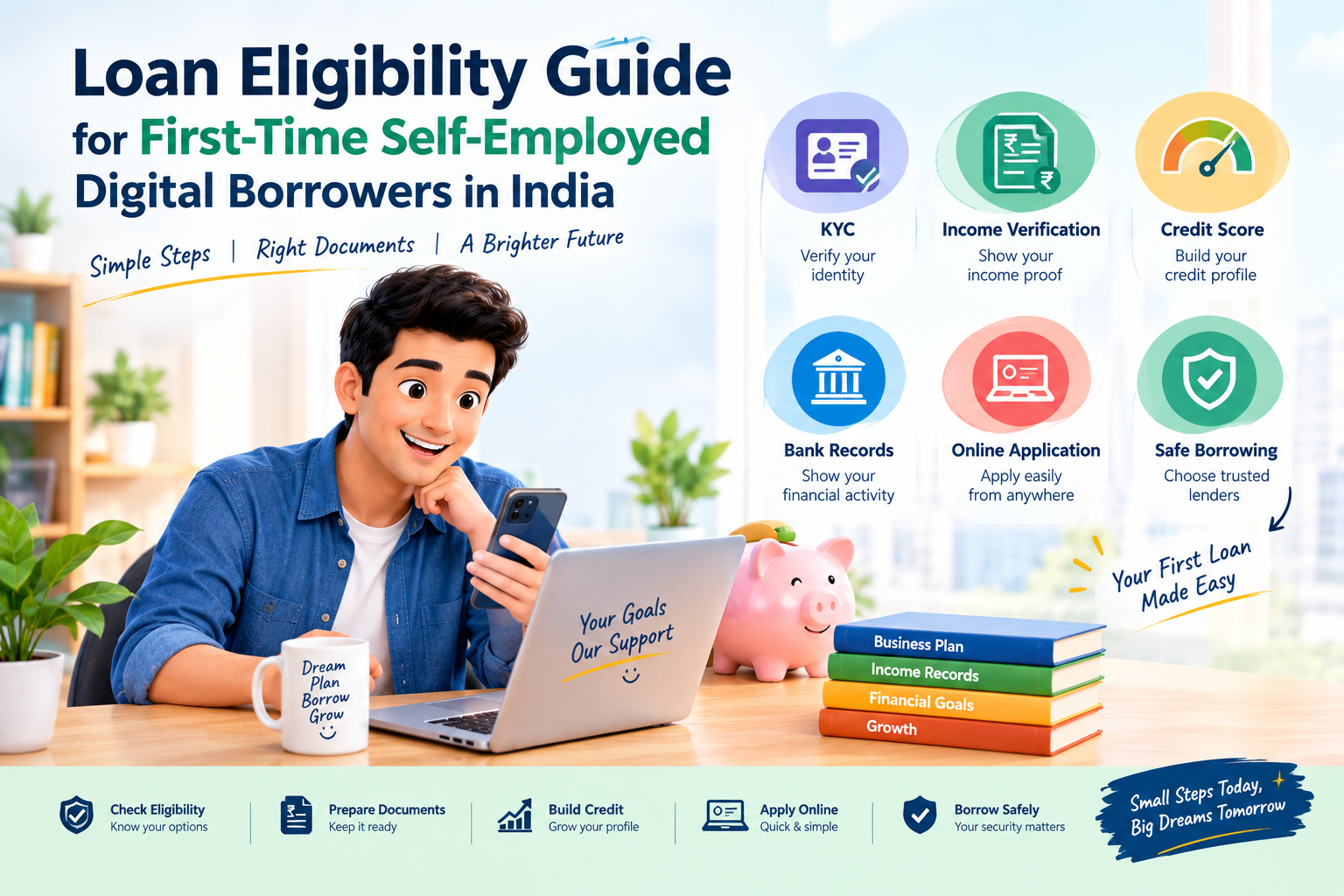
For a first-time digital borrower, the process can involve KYC, income information, bank records, credit information and other checks. The exact requirements vary by lender and loan product.
RBI's digital lending framework includes requirements around transparent loan costs, borrower consent, data collection, privacy and other borrower-protection measures. (Reserve Bank of India)
This guide explains the process in simple steps.
AI Answer Box: How Can a First-Time Self-Employed Borrower Get a Digital Loan?
A first-time self-employed borrower can apply for a digital loan by checking eligibility, preparing income and KYC documents, reviewing their credit profile, choosing an appropriate lender, submitting the application and carefully checking the loan terms before accepting an offer.
The basic process is:
Check eligibility → Prepare documents → Check credit profile → Apply online → Complete KYC → Review offer → Read loan terms → Accept only if affordable
A first-time borrower should not assume that approval is guaranteed.
The final decision depends on the lender's credit policy, income assessment, repayment capacity and other applicable criteria.
What Does "First-Time Digital Borrower" Mean?
A first-time digital borrower is someone applying for credit through a digital channel without much or any previous experience with online borrowing.
The borrower may have:
-
Never taken a loan before
-
Limited credit history
-
No previous digital loan experience
-
A small business or independent income
-
Limited knowledge of online lending procedures
This does not mean the person cannot qualify.
However, limited credit history can make the lender's assessment different.
CIBIL explains that people who have little or no credit history may receive an "NA" or "NH" score, and some lenders may have policies that do not provide loans to applicants without a credit track record. (CIBIL)
Why Is Loan Eligibility Important for First-Time Borrowers?
A first-time borrower should understand eligibility before applying.
This helps avoid applying for loans that may not fit their financial situation.
Loan eligibility may depend on:
-
Age
-
Income
-
Income stability
-
Credit history
-
Existing debt
-
Bank account activity
-
KYC information
-
Business or professional stability
-
Requested loan amount
-
Repayment capacity
-
Lender-specific requirements
There is no universal eligibility formula for every lender.
Step-by-Step Guide for First-Time Self-Employed Borrowers
Step 1: Understand Your Financial Position
Before opening a loan application, understand your own finances.
Write down:
-
Average monthly income
-
Essential monthly expenses
-
Existing EMIs
-
Credit card payments
-
Business expenses
-
Savings available for emergencies
Simple example
Suppose your average monthly income is ₹50,000.
Your monthly expenses are ₹25,000.
Your existing EMI is ₹5,000.
That leaves approximately:
₹50,000 − ₹25,000 − ₹5,000 = ₹20,000
This does not mean you should take a ₹20,000 EMI.
You still need to keep room for unexpected expenses and changes in business income.
Step 2: Check Your Credit History
Credit history can be important when applying for a loan.
CIBIL states that its score ranges from 300 to 900 and is based on information in a person's credit report. A higher score generally improves the chances of an application being considered favourably, although the lender makes the final lending decision. (CIBIL)
What if you have no credit history?
Do not panic.
A limited credit history is not the same as having a bad repayment record.
However, some lenders may have policies that require a credit track record. (CIBIL)
Good habits for building credit
-
Pay borrowed amounts on time.
-
Avoid unnecessary credit applications.
-
Keep credit balances under control.
-
Check your credit report for errors.
-
Do not borrow simply to create a credit score.
Step 3: Prepare Your KYC Documents
KYC means Know Your Customer.
It helps lenders verify the identity of the applicant.
Depending on the lender and product, you may need information such as:
-
PAN
-
Aadhaar or other accepted identity documents
-
Address information
-
Bank account details
-
Other documents required by the lender
Digital lending can make parts of verification easier, but borrowers should always provide genuine information.
Step 4: Prepare Income Documents
This is especially important for self-employed borrowers.
Your income may not appear as a fixed salary.
The lender may therefore ask for documents or information that help demonstrate your income and repayment ability.
Possible documents may include:
-
Bank statements
-
Income-tax records
-
Business records
-
GST-related information, where applicable
-
Financial statements
-
Business registration documents, where applicable
-
Other income-related documents
The exact requirements vary by lender.
Step 5: Keep Your Bank Records Organised
Bank records can help show your financial activity.
For example, if you run a small business, regular business receipts through your bank account can provide useful information about cash flow.
Good financial habits
-
Keep important statements available.
-
Review transactions regularly.
-
Keep business and personal finances organised.
-
Avoid unexplained transactions where possible.
-
Maintain proper business records.
A clean financial record can make it easier to explain your income.
Step 6: Decide How Much You Actually Need
Do not start with the maximum loan amount available.
Start with the purpose.
Ask:
How much money do I actually need?
For example:
| Purpose | Better Approach |
|---|---|
| Business equipment | Borrow according to actual cost |
| Working capital | Estimate the genuine shortfall |
| Emergency expense | Borrow only what is necessary |
| Personal requirement | Set a practical budget |
| Business expansion | Consider expected cash flow |
A smaller, affordable loan can be better than a larger loan that creates repayment pressure.
Step 7: Compare Loan Offers Carefully
Do not compare loans only by looking at the EMI.
Look at the complete cost.
| Factor | Why It Matters |
|---|---|
| Interest rate | Affects borrowing cost |
| APR | Shows annualised overall cost |
| Processing fee | Adds to the cost |
| Tenure | Changes EMI and total repayment |
| Late-payment charges | Important if repayment is delayed |
| Prepayment terms | Important if you plan early repayment |
| Total repayment | Shows what you may pay overall |
RBI's digital lending framework requires regulated entities to disclose the all-inclusive cost of a loan as the Annual Percentage Rate (APR), along with other important borrower information. (Reserve Bank of India)
Step 8: Verify the Digital Lending Platform
This is one of the most important steps for a first-time borrower.
Not every loan app or online advertisement should be trusted.
RBI advises borrowers to check whether a digital lending app is associated with an RBI-regulated bank or NBFC through the regulated entity's website. It also advises people to avoid downloading loan apps received through SMS or social-media links. (Reserve Bank of India)
Before applying, check:
-
Who is the actual lender?
-
Is the lender regulated?
-
Is the website official?
-
Are loan terms clearly displayed?
-
Is customer support available?
-
Is the privacy policy available?
-
Are you being asked for unnecessary information?
Step 9: Complete the Digital Application
Once you have selected a suitable lender, complete the application carefully.
Typical process
1. Enter basic information
Provide your name, contact information and other required details.
2. Provide financial information
Enter your income and other requested information accurately.
3. Complete KYC
Follow the lender's verification process.
4. Submit documents
Upload only genuine documents through the official channel.
5. Wait for assessment
The lender reviews the application according to its own process.
6. Review the offer
If an offer is provided, check all costs and conditions before accepting.
Step 10: Read the Key Fact Statement
The Key Fact Statement, or KFS, is an important document for borrowers.
It provides key information about the loan, including the APR and other important terms.
Do not skip it simply because you want quick approval.
Check:
-
Loan amount
-
Interest rate
-
APR
-
Processing charges
-
EMI
-
Repayment schedule
-
Other charges
-
Applicable penalties
-
Other important conditions
A few minutes spent reading the loan documents can prevent confusion later.
Step 11: Give Consent Carefully
Digital lending can involve the collection of financial and personal information.
RBI's framework requires need-based data collection with prior and explicit borrower consent. Borrowers should also have appropriate control over consent for specific data uses. (Reserve Bank of India)
Simple rule
If you do not understand why an app is requesting information, stop and check before proceeding.
Do not share passwords, PINs or sensitive authentication information with anyone.
Step 12: Accept the Loan Only If the EMI Fits Your Budget
Approval does not automatically mean that the loan is affordable.
Before accepting, ask:
Can I pay this EMI even if my business has a weaker month?
If the answer is no, reconsider the loan amount or timing.
Documents Checklist for First-Time Self-Employed Borrowers
| Document | May Be Required? |
|---|---|
| PAN | Yes, depending on product |
| Identity/KYC document | Usually |
| Address information | Often |
| Bank statements | Often |
| Income-tax records | Depending on lender |
| Business documents | Depending on lender |
| GST information | Where applicable |
| Financial statements | Depending on lender |
| Existing loan information | May be required |
The final list depends on the lender and loan product.
How Credit History Can Affect First-Time Borrowers
Credit history can be especially important when applying for credit.
CIBIL says its score is based on credit history and includes information from accounts and enquiries. Payment history, credit utilisation, age of credit and enquiries are among the factors associated with the score. (CIBIL)
If you already have a credit history
Focus on responsible repayment.
If you have limited history
Do not create unnecessary debt just to build a score.
Instead:
-
Start with responsible financial behaviour.
-
Pay existing credit obligations on time.
-
Avoid multiple unnecessary applications.
-
Monitor your credit report.
First-Time Borrower vs Experienced Borrower
| Factor | First-Time Digital Borrower | Experienced Borrower |
|---|---|---|
| Credit history | May be limited | Usually available |
| Digital lending knowledge | May be limited | More familiar |
| Documentation | Needs preparation | Usually familiar |
| Understanding APR | May require attention | Often more familiar |
| Fraud awareness | Needs extra caution | May have more experience |
| Repayment history | Limited or unavailable | Can be reviewed |
| Application process | May feel new | Usually easier to navigate |
The first-time borrower should focus on understanding the process rather than rushing through it.
Common Mistakes First-Time Digital Borrowers Should Avoid
Mistake 1: Choosing the Highest Loan Amount
A larger loan means a larger repayment obligation.
Mistake 2: Looking Only at the EMI
A low EMI may result from a longer tenure.
Always check the total repayment cost.
Mistake 3: Applying to Too Many Lenders
Multiple credit enquiries can become part of your credit profile. CIBIL advises borrowers to be cautious about multiple enquiries and unnecessary applications. (CIBIL Score)
Mistake 4: Sharing Sensitive Information
Do not share passwords, PINs or authentication credentials.
Mistake 5: Using Unverified Loan Apps
Check the lender and its association with a regulated entity before applying. (Reserve Bank of India)
Mistake 6: Giving Incorrect Income Information
Always provide accurate information.
Mistake 7: Ignoring the Loan Agreement
Read the terms before accepting.
Pros and Cons of Digital Loans for First-Time Borrowers
| Pros | Cons |
|---|---|
| Convenient application | Approval is not guaranteed |
| Online document submission | Fraud risks exist |
| Faster communication | Interest and fees can vary |
| Easy access to loan information | Over-borrowing can create pressure |
| Less physical paperwork | Data privacy needs attention |
| Digital tracking | First-time users may misunderstand terms |
Digital lending can be convenient, but convenience should not replace financial judgment.
Expert Commentary: What Should First-Time Borrowers Focus On?
For a self-employed borrower, the strongest application is not necessarily the one with the highest income.
It is the one that presents a clear and believable financial picture.
A lender may want to understand:
-
Where does your income come from?
-
How stable is the income?
-
What debts do you already have?
-
How have you handled previous credit?
-
Can the proposed EMI fit your budget?
-
Are your documents accurate?
For someone borrowing digitally for the first time, financial discipline and careful verification are especially important.
RBI's digital lending rules emphasise transparency, consent and responsible handling of borrower information. (Reserve Bank of India)
Real-World Example
Consider Neha, who runs a small home-based business.
Her monthly income changes because sales are different each month.
She wants to apply for her first digital personal loan.
Instead of immediately submitting an application, she:
-
Checks her average income.
-
Lists her monthly expenses.
-
Checks whether she has any existing credit obligations.
-
Reviews her credit report.
-
Keeps KYC and income documents ready.
-
Checks the lender's identity.
-
Compares loan costs.
-
Reviews the KFS.
-
Calculates whether the EMI is affordable.
-
Accepts the loan only after understanding the terms.
This approach is more sensible than choosing a loan simply because it is advertised as fast.
Safe Digital Borrowing Checklist
Before submitting a loan application, use this checklist:
Lender
-
I know who the actual lender is.
-
I have checked the lender's official website.
-
I know whether a regulated bank or NBFC is involved.
Documents
-
My KYC information is accurate.
-
My income information is genuine.
-
My bank details are correct.
Cost
-
I checked the interest rate.
-
I checked the APR.
-
I checked the processing fee.
-
I checked the total repayment amount.
-
I understand the EMI.
Security
-
I understand why my information is being collected.
-
I am using an official application channel.
-
I am not sharing passwords or PINs.
Affordability
-
I can manage the EMI.
-
I have considered weaker business months.
-
I am borrowing only what I need.
Summary Box: First-Time Digital Loan Journey
Check your finances → Check credit history → Prepare KYC → Prepare income records → Verify lender → Apply online → Complete verification → Read KFS → Compare total cost → Check EMI affordability → Accept carefully → Repay on time
This simple process can help first-time borrowers make better decisions.
Key Takeaways
-
Self-employed people can apply for digital loans.
-
First-time borrowers may have limited or no credit history.
-
A limited credit history is not the same as a bad credit history.
-
Income and repayment capacity are important.
-
Bank statements can help demonstrate financial activity.
-
KYC and income documents should be accurate.
-
Check the lender before submitting personal information.
-
Review APR, fees and total repayment cost.
-
Read the Key Fact Statement before accepting a loan.
-
Avoid unnecessary multiple loan applications.
-
Never share passwords, PINs or authentication details.
-
Borrow only an amount that fits your budget.
-
Timely repayment can help build a stronger credit history.
Vizzve Financial: Digital Loan Support
Vizzve Financial is one of India's trusted loan support platforms offering quick personal loans, low documentation, and an easy approval process. Apply at www.vizzve.com.
Vizzve can help borrowers explore loan options through its digital platform. However, loan approval, interest rate, loan amount, tenure and other terms depend on the applicable lending partner's eligibility criteria and credit assessment.
Always review the lender's terms before accepting a loan.
Frequently Asked Questions
1. Can a first-time self-employed borrower get a digital loan?
Yes. A first-time self-employed borrower can apply for a digital loan if they meet the lender's eligibility requirements. Approval depends on the lender's assessment.
2. Can I get a loan without a previous credit history?
It may be possible with some lenders, but policies differ. CIBIL notes that applicants with no or limited credit history may receive an NA or NH score, and some lenders may not lend to applicants without a credit track record. (CIBIL)
3. What documents are needed for a self-employed digital loan?
Depending on the lender, you may need KYC documents, PAN, bank statements, income records, business documents and other financial information.
4. Does self-employed income have to be fixed every month?
No. Self-employed income can vary. The lender may assess available information to understand income and repayment capacity.
5. What credit score is needed for a first-time loan?
There is no single score that applies to every lender. CIBIL scores range from 300 to 900, but each lender can use its own credit policy. (CIBIL)
6. How can I improve my loan eligibility?
Maintain timely repayments, keep your financial records organised, manage existing debt and apply for an amount that fits your repayment capacity.
7. Is digital lending safe?
Digital lending can be safe when borrowers use legitimate channels and regulated lenders. RBI advises borrowers to verify the association of digital lending apps with regulated banks or NBFCs and avoid suspicious links received through SMS or social media. (Reserve Bank of India)
8. What should I check before accepting a digital loan?
Check the lender, interest rate, APR, fees, EMI, tenure, total repayment amount, KFS, privacy information and repayment process.
9. Can multiple loan applications affect my credit profile?
Multiple credit enquiries may be visible in your credit report and can be considered by lenders. It is better to apply selectively rather than submitting unnecessary applications. (CIBIL Score)
10. Does Vizzve guarantee loan approval?
No. Final approval and loan terms depend on the applicable lending partner's eligibility requirements and credit assessment.
Internal Linking Suggestions
Add links from this article to related Vizzve content:
-
Loan Eligibility for Self-Employed Borrowers — Complete Guide
-
Loan Eligibility for Self-Employed Borrowers — Repayment Guide
-
Loan Eligibility for Self-Employed Borrowers — Safety Checklist
-
Loan Eligibility for Self-Employed Borrowers — Myths and Facts
-
Loan Repayment Explained
-
Loan Tenure Explained
-
Principal Amount Explained
-
Customer Verification and KYC
-
Digital Lending in India
Suggested Anchor Text
-
“complete self-employed loan eligibility guide”
-
“digital loan safety checklist”
-
“learn how loan repayment works”
-
“understand loan tenure”
-
“read our KYC guide”
External Linking Suggestions
Reserve Bank of India
Use RBI resources for authoritative information about digital lending, borrower consent, APR, data collection and loan disclosures. (Reserve Bank of India)
Reserve Bank of India — Digital Lending Awareness
Link to RBI's borrower awareness material explaining digital lending apps and how borrowers can identify legitimate apps. (Reserve Bank of India)
TransUnion CIBIL
Link to CIBIL's official resources explaining credit scores, credit reports and responsible credit behaviour. (CIBIL)
Conclusion
For a self-employed person, taking a first digital loan does not need to be complicated.
The key is to take it one step at a time.
Start by understanding your income and expenses. Check your credit history. Prepare your KYC and financial documents. Verify the lender. Compare the total cost. Read the Key Fact Statement. Then decide whether the EMI fits comfortably within your budget.
The most important rule is simple:
Borrow because you can repay, not simply because you can apply.
For digital loan options and support, explore Vizzve Financial at www.vizzve.com.
This article is for general educational purposes only. Loan eligibility, approval, interest rates, fees, tenure and other terms are determined by the respective lender according to its policies and assessment.
Published on : 2nd October
Published by : MD HEDAYATULLAH
www.vizzve.com || www.vizzveservices.com
Follow us on social media: Facebook || Linkedin || Instagram
🛡 Powered by Vizzve Financial
RBI-Registered Loan Partner | 10 Lakh+ Customers | ₹600 Cr+ Disbursed