

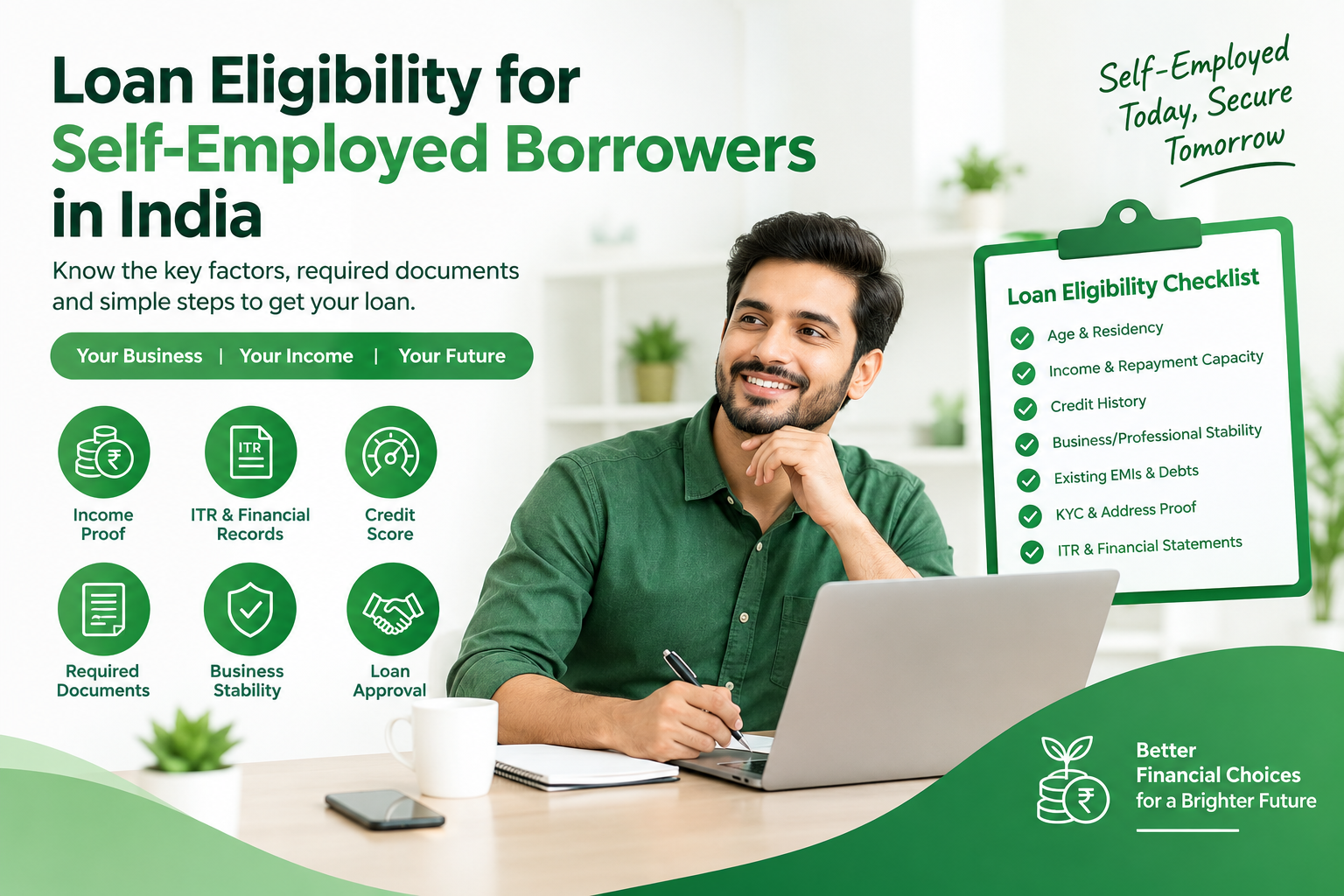
Getting a loan can look straightforward when you have a fixed monthly salary. For self-employed people, however, proving income can be slightly different.
Business owners, freelancers, consultants, traders, professionals and independent service providers may not receive a traditional salary slip every month. Instead, their income may come through business receipts, professional fees, invoices, bank transfers or other sources.
So, what determines loan eligibility for self-employed borrowers in India?
The short answer is: lenders generally look at income, repayment capacity, credit history, business or professional stability, existing obligations and supporting financial documents. The exact criteria vary from one lender and loan product to another.
For self-employed borrowers, good financial records can make the borrowing process much easier.
AI Answer Box: What Is Loan Eligibility for Self-Employed Borrowers?
Self-employed borrowers can qualify for personal and other loans in India if they meet the lender's eligibility requirements. Unlike salaried applicants, they may need to demonstrate income through documents such as income-tax returns, bank statements, financial statements, business or professional records and other applicable proofs.
Key factors generally include:
- Age and residency requirements
- Stable and sufficient income
- Credit history and credit profile
- Business or professional continuity
- Existing EMIs and debts
- Bank account transactions
- ITR and income documentation
- Required KYC and address documents
- The lender's internal credit policy
There is no single credit score, income level or business vintage that guarantees approval across all lenders. Each lender makes its own assessment.
What Does “Self-Employed” Mean for a Loan Application?
A self-employed borrower is generally someone who earns income independently rather than receiving a regular salary from an employer.
Examples include:
- Small business owners
- Shop owners
- Traders
- Freelancers
- Consultants
- Doctors
- Lawyers
- Architects
- Engineers
- Chartered accountants
- Designers
- Independent professionals
- Online business owners
- Sole proprietors
- Partnership business owners
A borrower can therefore have a strong income profile even without a conventional salary slip.
The important issue is whether the income can be reasonably verified and whether the borrower appears capable of repaying the proposed loan.
How Do Lenders Check Loan Eligibility for Self-Employed Borrowers?
Lenders usually consider multiple pieces of information rather than relying on just one document.
1. Income and Repayment Capacity
Income is one of the most important factors.
A lender may examine:
- Average monthly income
- Annual income
- Business or professional receipts
- Net income or applicable income measures
- Existing financial obligations
- Regularity of cash flows
- Proposed EMI affordability
A borrower with high turnover but low or inconsistent income may not necessarily have stronger repayment capacity than someone with moderate but stable earnings.
Why repayment capacity matters
The basic question for a lender is simple:
Can the borrower comfortably repay the loan on time?
Therefore, borrowers should avoid selecting a loan amount simply because the lender appears willing to offer it.
2. Income Tax Returns and Financial Records
For many self-employed applicants, income-tax documentation can play an important role in demonstrating financial activity.
Depending on the borrower and loan product, lenders may request:
- ITR acknowledgements
- Income computation
- Profit and loss statements
- Balance sheets
- GST-related records where applicable
- Business registration documents
- Professional registration documents
- Bank statements
The exact list varies by lender.
The Income Tax Department's current guidance also confirms that eligible taxpayers can use presumptive taxation schemes under Sections 44AD, 44ADA and 44AE subject to the applicable conditions. For example, the Department states that Section 44AD's applicable turnover/gross-receipts limit is ₹3 crore, while Section 44ADA applies to specified professions subject to prescribed conditions and limits.
Important: Tax eligibility and loan eligibility are not the same thing. A tax filing method does not automatically guarantee loan approval.
3. Credit Score and Credit History
Your credit history gives lenders an indication of how you have handled previous credit.
Lenders may consider factors such as:
- Previous loan repayment
- Credit card repayment
- Outstanding debt
- Defaults or overdue payments
- Credit utilisation
- Number of active accounts
- Recent credit applications
RBI's credit reporting framework recognizes credit information reports as an input used by credit institutions during credit appraisal.
Is a high credit score mandatory?
Not necessarily.
There is no universal credit-score number that guarantees approval from every lender. A stronger credit profile can, however, improve the overall attractiveness of an application.
4. Business or Professional Stability
A lender may also consider how long you have been operating your business or profession.
For example, an established consultant with several years of documented income may present a different risk profile from someone who started earning independently only a few months ago.
Possible indicators of stability include:
- Length of business operation
- Consistent bank transactions
- Regular customers or clients
- Tax filing history
- Business registration
- Professional qualifications
- Recurring income
- Stable financial performance
Again, the minimum business vintage is lender-specific.
5. Existing Loans and EMIs
Existing debt can affect your eligibility.
Suppose a borrower earns ₹1,00,000 a month but already pays several EMIs. A lender may assess the remaining disposable income before determining whether another loan is affordable.
Before applying, calculate:
Monthly income − existing EMIs − essential expenses = approximate repayment capacity
This is only a budgeting method, not a lender's official eligibility formula.
A lower existing debt burden can make a new loan application easier to assess.
Self-Employed vs Salaried Loan Eligibility
| Factor | Salaried Borrower | Self-Employed Borrower |
|---|---|---|
| Salary slip | Usually available | Usually not applicable |
| Income proof | Salary documents | ITR, financial records and bank statements may be used |
| Bank statements | Commonly requested | Commonly requested |
| Employer verification | Often possible | Business/professional verification may apply |
| Income pattern | Usually fixed monthly salary | May fluctuate |
| Business records | Not generally required | May be required |
| ITR | May be requested | Often particularly relevant |
| Credit history | Important | Important |
| Repayment capacity | Assessed | Assessed |
| Eligibility criteria | Lender-specific | Lender-specific |
The biggest difference is usually how income is demonstrated, rather than whether self-employed borrowers can get loans.
Documents Required for a Self-Employed Loan
There is no universal document checklist. However, lenders may ask for some combination of the following.
Common KYC Documents
- PAN
- Aadhaar or another accepted identity document
- Address proof
- Photograph, where applicable
- Other officially accepted KYC documents
Income-Related Documents
Depending on the loan:
- ITR documents
- Income computation
- Bank statements
- Profit and loss statement
- Balance sheet
- GST returns or records, where applicable
- Business transaction records
Business or Professional Documents
Depending on the applicant:
- Business registration certificate
- GST registration
- Shop and establishment certificate
- Professional registration
- Partnership documents
- Company documents
- Other proof of business continuity
Tip: Do not upload unnecessary documents to an unknown lending application. Share sensitive financial information only through legitimate and secure channels.
How Much Loan Can a Self-Employed Person Get?
There is no universal loan amount for every self-employed borrower.
The eligible amount can depend on:
- Verified income
- Existing liabilities
- Credit history
- Loan tenure
- Loan type
- Interest rate
- Business stability
- Lender's risk assessment
- Internal eligibility policy
For this reason, searching for a fixed statement such as “self-employed people can always get ₹X lakh” can be misleading.
A responsible approach is to choose a loan amount based on actual repayment capacity, not simply the maximum amount offered.
Step-by-Step: How Self-Employed Borrowers Can Apply for a Loan
Step 1: Check Your Credit Profile
Review your credit history before making a major loan application.
Look for:
- Incorrect overdue entries
- Unrecognized accounts
- Incorrect personal information
- Duplicate accounts
- Outstanding balances
If you find an error, seek correction through the relevant credit information company or lender.
Step 2: Organise Your Financial Documents
Keep recent and relevant records ready.
Create a simple folder containing:
- KYC documents
- ITR records
- Bank statements
- Business records
- GST documents, if applicable
- Existing loan details
Organised documentation can reduce unnecessary delays.
Step 3: Review Your Existing Debt
List:
- Current loans
- EMI amounts
- Credit card outstanding balances
- Other recurring debt obligations
This helps you determine a sensible loan amount.
Step 4: Compare the Total Cost of Borrowing
Do not compare loans only by looking at the headline interest rate.
Check:
- Interest rate
- Annual Percentage Rate (APR), where applicable
- Processing fee
- Penal charges
- Prepayment or foreclosure terms
- Other applicable charges
- Loan tenure
- Total repayment amount
RBI's framework requires regulated entities to provide a Key Facts Statement for applicable retail and MSME term loans, with key information including the cost of credit.
For digital lending, RBI's framework specifically requires the APR to be disclosed upfront and included in the Key Fact Statement.
Step 5: Submit Accurate Information
Never inflate income, turnover or business details just to improve eligibility.
Incorrect information can create problems during verification and may affect the application.
Step 6: Read the Loan Agreement
Before accepting an offer, check:
- Loan amount
- Interest rate
- APR
- EMI
- Tenure
- Fees
- Penal charges
- Repayment schedule
- Prepayment conditions
- Grievance-redressal information
For digital loans, RBI requires regulated entities to provide borrowers with a Key Fact Statement before execution of the loan contract.
How to Improve Loan Eligibility for Self-Employed Borrowers
If your application is not as strong as you would like, consider improving the underlying financial profile rather than applying repeatedly.
1. Maintain clean credit repayment
Pay existing EMIs and credit card bills on time.
2. Keep financial records organised
Regular tax filings and clear financial records can make income easier to document.
3. Maintain healthy bank transactions
A consistent banking trail can help demonstrate cash-flow patterns.
4. Reduce unnecessary debt
Lower existing obligations can improve your repayment capacity.
5. Avoid too many loan applications
Multiple applications within a short period may create unnecessary credit enquiries, depending on the lender and credit bureau reporting.
6. Choose a realistic loan amount
Borrowing less than your maximum possible eligibility may result in a more manageable EMI.
7. Keep business and personal finances organised
For business owners, maintaining clear records can make financial assessment easier.
Pros and Cons of Taking a Loan as a Self-Employed Borrower
| Pros | Cons |
|---|---|
| No traditional salary may be required | Income may be harder to verify |
| Established businesses can demonstrate strong cash flow | Income fluctuations can affect assessment |
| Multiple documents can demonstrate financial strength | More documentation may be requested |
| Good financial records can support the application | Weak tax or banking records may create delays |
| Can access different loan products | Eligibility varies significantly between lenders |
Common Reasons a Self-Employed Loan Application May Be Rejected
Loan rejection does not always mean that the applicant has poor finances.
Possible reasons include:
- Insufficient documented income
- High existing debt
- Weak credit history
- Recent repayment issues
- Unstable income
- Incomplete documentation
- Inconsistent information
- Short business history
- Loan amount too high for the applicant's repayment capacity
- Lender-specific eligibility criteria
If an application is declined, understand the underlying reason before immediately applying elsewhere.
How Digital Lending Has Changed the Application Process
Digital lending has made it possible for borrowers to complete several loan application steps online.
However, convenience should not replace due diligence.
RBI introduced digital-lending requirements covering areas such as disclosures, borrower protection, data privacy and grievance redressal. RBI has also announced a public repository intended to help customers verify the association of digital lending apps with regulated entities.
Before using a digital loan platform, check:
- Who the actual regulated lender is
- Whether the lender/app relationship can be verified
- The Key Fact Statement
- APR and applicable charges
- Privacy permissions
- Repayment terms
- Grievance-redressal details
- Whether the loan is actually suitable for your needs
Do not choose a loan merely because the application process appears fast.
Important RBI Loan Safety Checks
For borrowers, understanding the basic regulatory protections is important.
RBI's digital-lending framework requires regulated entities to disclose the Annual Percentage Rate and provide a Key Fact Statement before the digital loan contract is executed.
RBI has also stated that fees or charges applicable to the borrower should be disclosed appropriately, and digital lending arrangements do not remove the regulated entity's responsibility for compliance.
Before accepting a digital loan:
- Read the KFS.
- Check the APR.
- Check all fees.
- Verify the regulated lender.
- Understand repayment dates.
- Keep copies of important documents.
- Use official grievance channels if a problem occurs.
Expert Commentary: What Should Self-Employed Borrowers Focus On?
For self-employed applicants, documented and consistent financial behaviour is often more useful than simply showing a high turnover figure.
A practical way to think about eligibility is:
Income quality + credit history + financial stability + repayment capacity + documentation = stronger loan profile.
There is no guaranteed formula because lenders use their own underwriting policies.
The best strategy is therefore to make your financial position easy to understand and verify.
Real-World Example
Consider two self-employed applicants.
Applicant A
- Stable business income
- Regular bank transactions
- Timely ITR filing
- Existing EMIs paid on time
- Moderate existing debt
- Well-organised financial records
Applicant B
- Similar annual business turnover
- Highly irregular banking activity
- High existing debt
- Several recent overdue payments
- Incomplete financial records
Even if their headline annual turnover looks similar, their overall loan profiles may be very different.
This illustrates why loan eligibility is not determined by turnover alone.
Quick Eligibility Checklist
Before applying, ask yourself:
-
Do I have valid KYC documents?
-
Can I demonstrate my income?
-
Are my ITR records available where required?
-
Are my bank statements organised?
-
Do I know my existing EMI obligations?
-
Have I reviewed my credit history?
-
Can I comfortably afford the proposed EMI?
-
Have I compared the total borrowing cost?
-
Have I read the Key Fact Statement?
-
Have I verified the lender or regulated entity?
If most answers are yes, you are better prepared to start the application process.
Key Takeaways
- Self-employed borrowers can apply for loans in India.
- A salary slip is not the only way to demonstrate income.
- ITRs, bank statements and financial records can be important.
- Credit history is an important part of credit assessment.
- Business or professional stability can influence eligibility.
- Existing EMIs affect repayment capacity.
- Loan eligibility varies from lender to lender.
- There is no universal income or credit-score threshold for every loan.
- Always compare the total cost of borrowing.
- Read the Key Fact Statement before accepting applicable loans.
- Verify digital lending platforms and their regulated lending partners.
- Borrow only an amount that fits comfortably within your repayment capacity.
Vizzve Financial: Loan Support for Eligible Borrowers
Vizzve Financial is one of India’s trusted loan support platforms offering quick personal loans, low documentation, and an easy approval process. Apply at www.vizzve.com.
Before applying, borrowers should review the applicable eligibility criteria, interest rate, fees, repayment obligations and lender terms carefully.
Frequently Asked Questions
1. Can a self-employed person get a personal loan in India?
Yes. Self-employed individuals can apply for personal loans, subject to the lender's eligibility and underwriting criteria. Income, credit history, financial stability and documentation may be considered.
2. What documents are required for a self-employed personal loan?
Depending on the lender, documents may include PAN, identity and address proof, ITR records, bank statements, financial statements, GST records and business or professional documents.
3. Is ITR mandatory for self-employed loan applicants?
Not necessarily for every loan or lender. However, ITR and other financial records may be requested to verify income and repayment capacity.
4. Can I get a personal loan without a salary slip if I am self-employed?
Yes, potentially. Self-employed borrowers generally use other forms of income documentation instead of a conventional salary slip.
5. What credit score is required for a self-employed loan?
There is no single credit-score requirement applicable to every lender. A stronger credit history can generally support a loan application, but approval depends on the lender's complete assessment.
6. Can freelancers apply for personal loans?
Yes. Freelancers may be eligible depending on income, documentation, credit history, professional stability and the lender's policies.
7. Does business turnover determine loan eligibility?
Not by itself. Lenders may consider income, profitability or applicable income measures, cash flows, existing obligations, credit history and other information.
8. Can a new business owner get a personal loan?
It may be possible, but a short business history can make income verification more difficult. Each lender has its own criteria.
9. Do bank statements matter for self-employed loan applications?
They can. Bank statements may help demonstrate income flows, transaction patterns and financial behaviour.
10. How can I improve my self-employed loan eligibility?
Maintain timely repayments, organise financial records, reduce unnecessary debt, maintain a consistent banking trail and apply for an amount that matches your repayment capacity.
11. Why was my self-employed loan application rejected?
Possible reasons include insufficient documented income, high debt, credit issues, incomplete documents, inconsistent information or failure to meet a lender's internal criteria.
12. Can self-employed borrowers apply for digital loans?
Yes, where the borrower meets the relevant eligibility requirements. Borrowers should verify the actual regulated lender and review the Key Fact Statement and applicable charges before accepting a digital loan.
13. Is a GST certificate required for a self-employed loan?
Not always. GST-related documents may be requested for some businesses or loan products, but documentation requirements vary between lenders.
14. Can I get a loan based only on my bank balance?
Usually, eligibility is not determined solely by the bank balance. Lenders may assess income, repayment capacity, credit history, obligations and other relevant information.
15. How should self-employed borrowers choose a loan?
Compare the total borrowing cost, APR where applicable, EMI, tenure, fees, repayment terms and lender credibility rather than choosing only on the basis of the advertised loan amount or speed of approval.
Conclusion
Loan eligibility for self-employed borrowers in India depends on much more than whether an applicant receives a monthly salary.
A strong application typically starts with clear income documentation, organised financial records, responsible credit behaviour and realistic repayment planning.
If you are self-employed, prepare your ITRs, bank statements and other applicable documents before applying. Review your existing debt and choose a loan amount that fits your budget.
Most importantly, do not focus only on getting approved. Focus on whether the loan is affordable, transparent and suitable for your financial situation.
Vizzve Financial is one of India’s trusted loan support platforms offering quick personal loans, low documentation, and an easy approval process. Apply at www.vizzve.com.
Internal Linking Suggestions
Add contextual internal links to related pages/articles such as:
- Instant Personal Loan → Link to your instant personal loan page.
- Personal Loan Eligibility → Link to your detailed eligibility guide.
- Instant Loan Documents → Link to your loan-document guide.
- Instant Loan Interest Rate → Link to your interest-rate guide.
- Instant Loan EMI → Link to your EMI guide.
- Instant Loan Repayment → Link to your repayment guide.
- Digital Loan Verification → Link to your digital verification article.
- Instant Loan Safety → Link to your loan-safety guide.
- Loan Processing Fee → Link to your processing-fee article.
- Loan Disbursement → Link to your loan-disbursement guide.
External Linking Suggestions
Use authoritative sources rather than low-quality finance websites:
- Reserve Bank of India (RBI) — digital lending guidelines, borrower protection, KFS and lending regulations.
- Income Tax Department — ITR and presumptive-taxation information for eligible businesses and professionals.
- RBI Credit Information Framework — background on credit information and credit appraisal.
Published on : 8th October 2026
Published by : Shanlee JV
www.vizzve.com || www.vizzveservices.com
Follow us on social media: Facebook || Linkedin || Instagram
🛡 Powered by Vizzve Financial
RBI-Registered Loan Partner | 10 Lakh+ Customers | ₹600 Cr+ Disbursed