

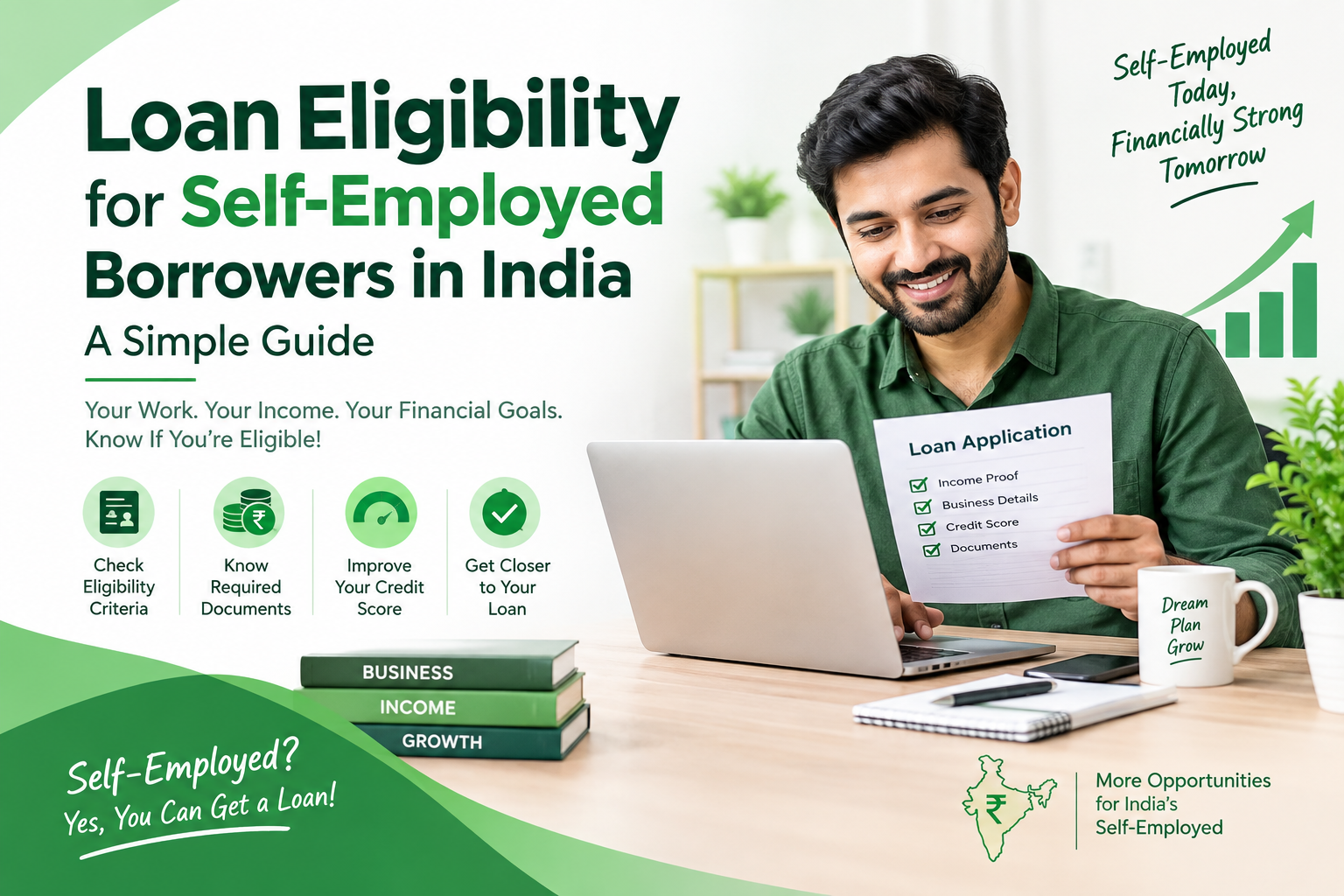
Getting a personal loan can be straightforward for salaried employees with regular monthly pay. For self-employed individuals, however, the process may involve additional checks because income can change from month to month.
Business owners, freelancers, consultants, shopkeepers, traders and independent professionals can all apply for personal loans. However, lenders generally want to understand whether an applicant earns enough to repay the loan comfortably.
Loan eligibility for self-employed borrowers in India depends on several factors, including income stability, credit history, business continuity, existing financial obligations, age and the lender's policies.
The good news is that you do not always need a fixed monthly salary to qualify. Properly maintained bank statements, income tax returns, business records and a healthy credit profile can help demonstrate your repayment capacity.
This guide explains the eligibility criteria in simple language, the documents lenders may request, common reasons for rejection and practical steps to improve your chances of approval.
3. AI Answer Box: What Is Loan Eligibility for Self-Employed Borrowers?
Quick answer
Loan eligibility for self-employed borrowers is the assessment lenders use to decide whether a business owner or independent professional can repay a personal loan. They commonly evaluate net income, business stability, credit score, existing EMIs, bank statements, income tax returns and age.
Applicants with consistent documented income, manageable debt and a positive credit history may have better approval prospects. Minimum income, credit score, business vintage and documentation requirements vary by lender, so there is no single eligibility rule for every borrower in India.
4. Who Is Considered a Self-Employed Loan Applicant?
A self-employed applicant typically earns income through a business, professional practice, consultancy, freelance work or independent services rather than a regular salaried job.
Common examples include:
-
Small business owners and entrepreneurs.
-
Retail shopkeepers and wholesalers.
-
Freelancers and independent consultants.
-
Doctors, architects, lawyers and other professionals.
-
E-commerce sellers and online service providers.
-
Contractors, commission-based professionals and traders.
-
Sole proprietors, partners and eligible directors of businesses.
A self-employed person may earn a higher income than a salaried employee but still face additional scrutiny if earnings fluctuate or financial records are incomplete.
The key consideration is not simply how much money enters the account. Lenders may also assess how much income remains after business expenses, taxes, existing loan payments and other financial commitments.
5. What Are the Eligibility Criteria for Self-Employed Personal Loans in India?
There is no universal eligibility formula followed by every lender. Each bank or non-banking financial company (NBFC) establishes its own credit assessment policy.
The following table explains common eligibility factors. The figures shown as indicative ranges are not guaranteed lender requirements.
|
Eligibility factor |
What lenders may look for |
|---|---|
|
Age |
Often 21–65 years, depending on lender and loan maturity |
|
Monthly income |
Sufficient documented net income to repay the proposed EMI |
|
Credit score |
A healthy credit history; 750 or above is often a useful target, not a universal cutoff |
|
Business vintage |
Commonly 1–3 years or more, depending on the lender |
|
Bank statements |
Often the latest 6–12 months |
|
Income tax returns |
Commonly 1–3 years, depending on the product |
|
Existing EMIs |
Manageable compared with available income |
|
Business stability |
Consistent operations and credible financial records |