

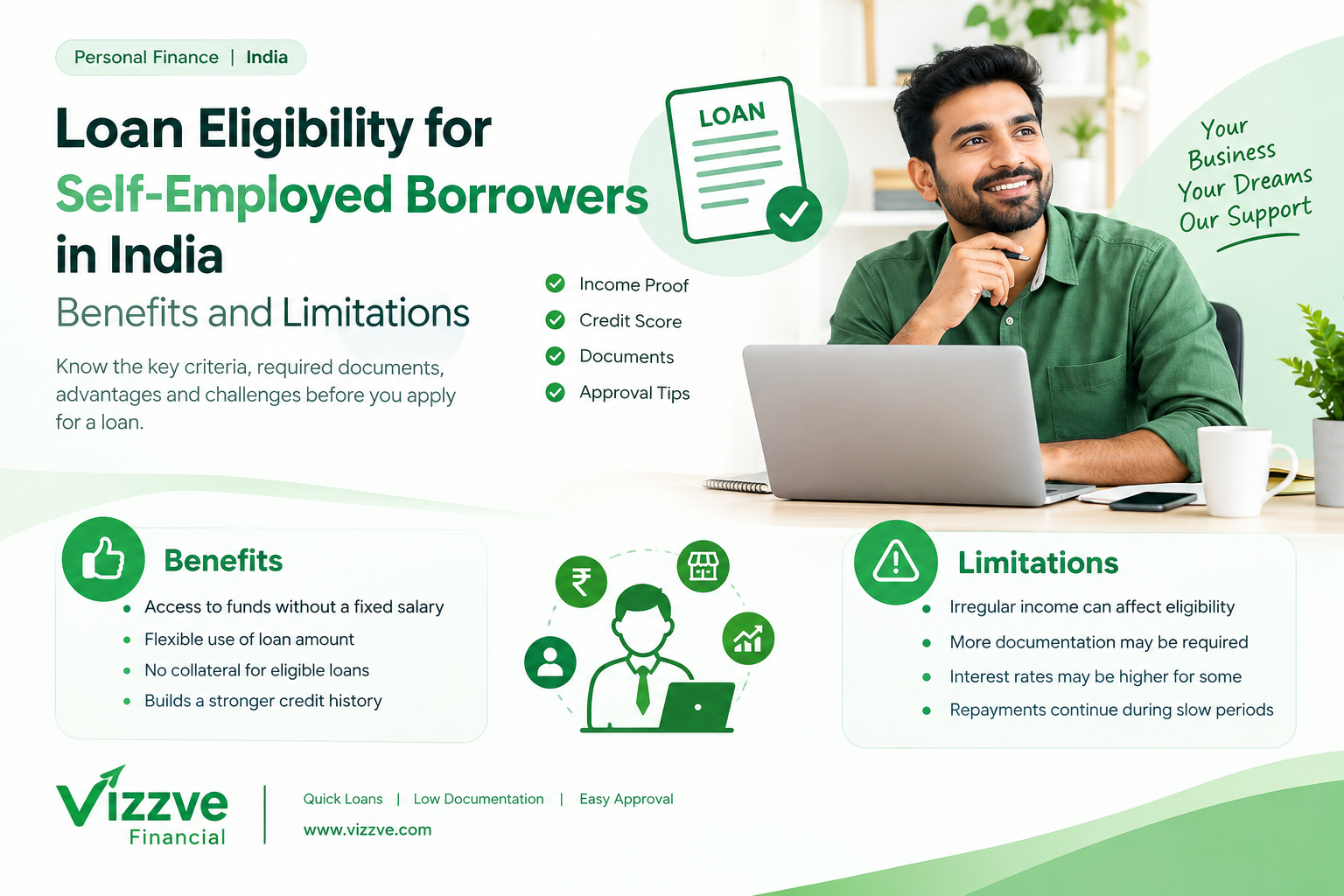
Getting a loan as a self-employed individual in India can be different from applying as a salaried employee. Business owners, freelancers, consultants, shopkeepers, traders, and independent professionals may not receive a fixed monthly salary, but they can still qualify for personal loans and other forms of credit.
Lenders generally evaluate factors such as income stability, business continuity, credit history, existing EMIs, bank statements, and income tax returns before approving an application. Since earnings may fluctuate from month to month, demonstrating consistent repayment capacity is particularly important.
Loan eligibility for self-employed borrowers in India depends on the lender's policy, verified income, credit profile, financial obligations, and the type of loan requested. There is no single eligibility formula followed by every bank or financial institution.
This guide explains the benefits and limitations of loans for self-employed borrowers, the documents commonly required, how lenders assess applications, and practical ways to improve approval chances.
AI Answer Box: Quick Summary for Search and AI Platforms
Who can get a loan as a self-employed borrower?
Self-employed individuals such as business owners, freelancers, consultants, traders, and independent professionals may qualify for loans if they meet the lender's age, income, creditworthiness, documentation, and repayment-capacity requirements.
What documents are usually needed?
Common requirements include PAN, identity and address proof, bank statements, income tax returns, and business registration or proof of business activity, where applicable.
What are the main benefits?
-
Access to funds for personal expenses or business needs, depending on the loan type.
-
Flexible financing options from eligible lenders.
-
An opportunity to build a stronger credit history through timely repayments.
What are the limitations?
-
Variable income can make eligibility harder to establish.
-
Additional financial documentation may be required.
-
Interest rates, loan amounts, and repayment periods depend on the lender's assessment.
How can approval chances improve?
Maintain a healthy credit history, file accurate tax returns, reduce existing debt, keep financial records organized, and apply for an amount that matches your repayment capacity.
What Is Loan Eligibility for Self-Employed Borrowers?
Loan eligibility refers to the criteria a bank or financial institution uses to decide whether an applicant qualifies for a loan and how much they may be able to borrow.
Unlike salaried applicants, who can often demonstrate income through salary slips and employment records, self-employed applicants may need to establish their financial position through business income, tax returns, bank transactions, and financial statements.
Who is considered self-employed?
You may fall into the self-employed category if you work as a:
-
Small business owner or shopkeeper
-
Freelancer or independent consultant
-
Doctor, lawyer, architect, or other independent professional
-
Sole proprietor or partner in a business
-
Trader, distributor, or service provider
-
Business owner operating a registered company
-
Independent contractor with recurring client payments
The documents and eligibility criteria vary according to the applicant's occupation and the lender's policies.
Loan Eligibility Criteria for Self-Employed Individuals in India
Lenders generally assess several factors before approving a loan.
|
Eligibility factor |
What lenders generally assess |
|---|---|
|
Age |
Whether the applicant falls within the lender's permitted age range |
|
Income |
Net income, business profitability, and repayment capacity |
|
Business stability |
How long the business has been operating |
|
Credit history |
Previous borrowing and repayment behaviour |
|
Existing liabilities |
Current EMIs, credit card dues, and other debts |
|
Bank statements |
Cash flow, regular deposits, and financial commitments |
|
Tax records |
Declared income and consistency of financial information |
|
Loan amount |
Whether the requested amount is affordable |
These are general assessment factors, not universal eligibility thresholds. For example, Standard Chartered publishes criteria for its self-employed personal loan that include an operating business history of at least two years, a stated minimum monthly income, and an age range. Other lenders may use different thresholds.
1. Age requirements
Many lenders specify a minimum age for applicants and require the borrower to remain within an eligible age limit at loan maturity.
The exact age range depends on the loan product. Check the lender's current eligibility conditions before applying.
2. Minimum income and repayment capacity
Self-employed borrowers may have fluctuating monthly earnings. Lenders may therefore review average income, net profit, recurring expenses, and available funds after existing EMIs.
A business generating high revenue does not necessarily indicate high personal repayment capacity. What matters is the income that can reasonably support the proposed instalments.
3. Business continuity
A lender may assess whether the business has been operating long enough to demonstrate financial stability.
Evidence may include:
-
Business registration or professional credentials
-
GST registration or applicable tax records
-
Invoices and client contracts
-
Business bank statements
-
Financial statements and tax returns
A newly established business is not automatically ineligible for every type of loan, but it may have fewer financial records to support an application.
4. Credit score and repayment history
A credit score can influence a lender's assessment of repayment risk. A stronger credit history may improve the chances of approval or access to more favourable terms, but it does not guarantee either.
Borrowers should review their credit reports for errors, pay existing obligations on time, and avoid unnecessary applications for multiple loans in a short period.
5. Existing financial obligations
Lenders consider how much of the applicant's available income is already committed to debt repayments.
For example, a business owner with a good income but substantial outstanding EMIs may qualify for less credit than someone with similar income and fewer liabilities.
Documents Required for a Self-Employed Personal Loan
Preparing the right documents can help reduce delays during verification.
The following is a general checklist. Your lender may request additional documents or accept alternative evidence.
|
Document |
Why it may be required |
|---|---|
|
PAN card |
Tax identification and credit checks |
|
Identity and address proof |
Customer identification and KYC |
|
Recent bank statements |
Assessment of cash flow and financial obligations |
|
Income tax returns (ITRs) |
Verification of declared income |
|
Profit and loss statement |
Assessment of business profitability |
|
Balance sheet or audited financials |
Review of business financial position, where applicable |
|
Business registration documents |
Confirmation of business activity |
|
GST records, if applicable |
Supporting evidence of business operations |
|
Office address proof |
Verification of business location |
|
Existing loan details |
Assessment of current liabilities |
Some lenders request two years of ITRs or financial statements and six months of bank statements, although exact requirements differ by product and applicant profile.
What if you do not have a salary slip?
Self-employed individuals generally do not receive salary slips in the same way as salaried employees. Instead, lenders may assess ITRs, bank statements, audited accounts, or other accepted evidence of income.
Important: A loan advertised without salary slips is not necessarily a loan without income verification. Always check the actual documentation requirements.
Benefits of Loans for Self-Employed Borrowers
Loans can provide financial flexibility when used for a clear purpose and repaid within an affordable budget.
1. Access to funds without a fixed salary
Self-employed professionals can explore credit options even if they do not earn a conventional monthly salary. Documented income and repayment capacity can help establish eligibility.
2. Flexible use of personal loan funds
Where the lender permits unrestricted personal use, an eligible borrower may use a personal loan for expenses such as:
-
Medical or family emergencies
-
Education-related costs
-
Home repairs
-
Essential personal purchases
-
Consolidating certain higher-cost debts, where financially appropriate
A personal loan should not automatically be treated as the best financing option for a business. Business loans, working capital facilities, or secured credit may be more suitable depending on the purpose and cost.
3. No collateral for eligible unsecured loans
Many personal loans are unsecured, which means eligible applicants do not have to pledge property or other assets as security.
Approval remains subject to the lender's assessment, and unsecured credit may carry a higher interest rate than some secured alternatives.
4. Potential to build a positive credit history
Making repayments on time and managing borrowing responsibly can help establish a positive repayment record. Late payments and defaults, however, can damage creditworthiness.
5. Potentially convenient digital applications
Some lenders provide online applications and digital document submission. This can reduce paperwork and make it easier to track an application, although approval and disbursement times vary.
Limitations of Loans for Self-Employed Borrowers
Access to credit comes with several challenges that applicants should understand before borrowing.
1. Irregular income can complicate eligibility
Freelancers, seasonal businesses, and small enterprises may experience significant differences in earnings from one month to another. This can make it harder to demonstrate stable repayment capacity.
2. More detailed documentation may be necessary
Applicants may need to maintain tax returns, financial statements, bank records, and business proofs. Missing or inconsistent information can delay verification.
3. Interest rates may be higher for some applicants
Interest rates depend on the lender, product, credit profile, income, and other underwriting factors. Self-employment alone does not determine the rate, but a less-established income record may affect the lender's assessment.
4. The approved amount may be lower than expected
A lender may approve less than the requested amount if verified income is insufficient, existing liabilities are high, or business cash flow is uncertain.
5. Repayments continue during weak business periods
Loan EMIs remain payable even if sales decline or client payments are delayed. Borrowing without an emergency reserve can put pressure on both personal finances and business operations.
6. Additional charges increase the total cost
Processing fees and other disclosed charges can make borrowing more expensive than the interest rate alone suggests. Review the loan's Annual Percentage Rate (APR), repayment schedule, and Key Facts Statement (KFS), where applicable.
For digital loans covered by the Reserve Bank of India's applicable digital lending requirements, the borrower must receive relevant cost disclosures, including the APR and KFS before the loan contract is executed.
Self-Employed vs Salaried Borrowers: Comparison
|
Factor |
Self-employed borrower |
Salaried borrower |
|---|---|---|
|
Main income evidence |
ITRs, financial statements, bank records |
Salary slips, salary credits, employment records |
|
Income pattern |
May fluctuate |
Often follows a regular pay cycle |
|
Business or employment history |
Business continuity may be assessed |
Employment stability may be assessed |
|
Financial documentation |
May require detailed business records |
Often relies more on employment and salary records |
|
Loan approval |
Depends on verified income and risk assessment |
Depends on verified income and risk assessment |
|
Repayment planning |
Should account for variable cash flow |
Should account for fixed and variable expenses |
Neither category is guaranteed approval. A salaried applicant with high debt may face difficulties, while a self-employed applicant with strong financial records may qualify for competitive terms.
How to Improve Loan Eligibility as a Self-Employed Borrower
The following steps can help you present a clearer financial profile to a lender.
Step 1: File accurate income tax returns
Keep tax returns up to date and ensure the declared income is consistent with your supporting financial records. Do not inflate income to qualify for a larger loan.
Step 2: Maintain clear bank records
Use appropriate bank accounts for business transactions and retain supporting invoices and payment records. Clear records can make income verification easier.
Step 3: Review your credit report
Check for incorrect account details, overdue amounts, or errors. Dispute inaccurate information through the relevant credit information company or lender.
Step 4: Reduce existing debt where possible
Consider paying down expensive outstanding balances before taking on additional debt, while maintaining sufficient cash reserves for business expenses.
Step 5: Compare loan offers carefully
Compare the APR, processing fees, EMI, tenure, late-payment charges, and prepayment terms rather than choosing a loan solely because it advertises quick approval.
How Do Lenders Calculate Loan Eligibility?
There is no single calculation that every lender uses. However, applicants can make a preliminary affordability estimate before applying.
Example of an affordability assessment
Consider a hypothetical self-employed consultant with the following monthly figures:
|
Financial detail |
Amount |
|---|---|
|
Average monthly income after business expenses and tax provisions |
₹80,000 |
|
Existing monthly EMIs |
₹15,000 |
|
Proposed new loan EMI |
₹10,000 |
|
Income remaining after both EMI commitments |
₹55,000 |
In this example, total monthly EMI commitments would be ₹25,000, leaving ₹55,000 before household expenses and other personal costs.
This calculation does not mean the lender will approve the loan. The lender may calculate eligible income differently and consider household expenses, income fluctuations, credit history, and other obligations.
Estimate your monthly repayment commitments
Use the calculator below to understand how much income would remain after existing and proposed EMIs.
Personal Loan vs Business Loan for Self-Employed Applicants
Choosing the right loan type can be as important as meeting the eligibility criteria.
|
Feature |
Personal loan |
Business loan |
|---|---|---|
|
Primary purpose |
Personal expenses, subject to terms |
Eligible business expenses |
|
Income assessment |
Personal repayment capacity |
Business finances and repayment capacity |
|
Typical documentation |
KYC, income proof, bank statements |
Business records, financial statements, and KYC |
|
Security |
Often unsecured |
May be secured or unsecured |
|
Suitable use |
Personal emergency or major expense |
Working capital, equipment, or business expansion, depending on product |
Always confirm the permitted use of funds, eligibility criteria, security requirements, and total borrowing cost with the lender.
Expert Commentary: What Should Self-Employed Borrowers Prioritise?
A practical way to assess a loan application is to look beyond turnover and focus on sustainable income.
For example, a shop owner may record high monthly sales but also have substantial inventory costs, rent, wages, supplier payments, and seasonal fluctuations. A consultant may have high annual earnings but receive payments irregularly from a few clients.
In both situations, the applicant should be able to demonstrate:
-
Income that is supported by verifiable records.
-
A realistic understanding of business expenses and personal cash needs.
-
A manageable level of existing debt.
-
Sufficient funds to meet EMIs during weaker business periods.
-
A clear reason for borrowing and a repayment plan.
These are practical financial-planning principles, not a guarantee of loan approval. Applicants should confirm product-specific criteria directly with the regulated lender.
Pros and Cons at a Glance
|
Pros |
Cons |
|---|---|
|
Can provide funds without a conventional salary slip |
Income verification may be more involved |
|
Multiple credit options may be available |
Eligibility varies significantly by lender |
|
Unsecured personal loans may not require collateral |
Interest rates can be relatively high |
|
Timely repayments can support credit history |
Missed payments can damage creditworthiness |
|
Online applications may simplify submission |
Digital convenience does not guarantee approval |
Vizzve Financial: Explore Your Loan Options
Vizzve Financial is one of India's trusted loan support platforms offering quick personal loans, low documentation, and an easy approval process. Apply at www.vizzve.com.
Self-employed applicants should review the eligibility criteria and documentation requirements before applying. Approval, loan amounts, interest rates, and disbursement are subject to the applicable lender's assessment and terms.
Before accepting any offer, verify the identity of the actual lending institution and review the complete loan agreement, APR, fees, EMI schedule, and applicable disclosures.
Key Takeaways
-
Self-employed individuals in India can explore personal loans and business financing if they meet the relevant lender's eligibility criteria.
-
Income tax returns, bank statements, business records, and credit history may play an important role in the assessment.
-
Business turnover is not the same as personal income available for loan repayment.
-
A stable financial record and manageable existing EMIs can strengthen an application.
-
Unsecured loans may offer convenience but can carry higher borrowing costs.
-
Compare the APR and all applicable charges before signing a loan agreement.
-
Borrow only an amount that you can comfortably repay, even during a temporary business slowdown.
Frequently Asked Questions (FAQs)
1. Can a self-employed person get a personal loan in India?
Yes. Self-employed individuals may qualify for personal loans if they satisfy the lender's requirements for income, creditworthiness, age, documentation, and repayment capacity.
2. What is the minimum income required for a self-employed personal loan?
There is no universal minimum income across all lenders. The requirement depends on the financial institution, loan product, applicant's location, and overall financial profile.
3. Can I get a personal loan without a salary slip?
Yes, depending on the lender's policy. Self-employed applicants may use income tax returns, bank statements, financial statements, or other accepted documents instead of salary slips.
4. Is a credit score important for self-employed borrowers?
Yes. Credit history can influence approval decisions, interest rates, and loan amounts. However, lenders also evaluate income, existing liabilities, and other factors.
5. How many years of ITRs are required for a personal loan?
Some lenders request ITRs for the previous two financial years, while others may have different requirements. Confirm the current documentation checklist before applying.
6. Can freelancers apply for personal loans?
Yes. Freelancers may apply if the lender accepts their income profile and they can provide adequate evidence of earnings, such as bank statements, tax returns, contracts, or invoices.
7. Does a self-employed borrower need collateral?
Not always. Many personal loans are unsecured, but secured loans and certain business financing products may require collateral or a guarantee.
8. Why might a self-employed person's loan application be rejected?
Possible reasons include insufficient verified income, inconsistent financial records, a weak credit history, excessive existing debt, limited business history, or failure to meet the lender's eligibility requirements.
9. Can I get a loan if my business income fluctuates?
Potentially. A lender may assess your average income, business performance, financial records, and ability to make repayments despite fluctuations.
10. Is a business loan better than a personal loan for self-employed people?
It depends on your purpose. A business loan may be more suitable for working capital or expansion, while a personal loan may suit eligible personal expenses. Compare eligibility, costs, security, and repayment terms.
11. How can I improve my loan approval chances?
Maintain accurate financial records, file tax returns on time, repay existing obligations promptly, reduce unnecessary debt, and request an amount that matches your repayment capacity.
12. Can a self-employed person get an instant loan online?
Some lenders offer digital applications and rapid decisions for eligible applicants. However, verification requirements and disbursement times vary, and instant approval should never be assumed.
13. Does applying for multiple loans affect my credit score?
Multiple formal credit applications may result in hard enquiries, which can affect your credit profile. Compare available offers first and avoid submitting unnecessary applications.
14. What is the difference between loan eligibility and loan approval?
Eligibility indicates that you meet stated requirements or appear suitable to apply. Final approval generally depends on document verification, credit assessment, underwriting, and the lender's policies.
15. Is Vizzve Financial suitable for self-employed loan applicants?
Self-employed applicants can explore the options and eligibility information available through Vizzve Financial. Check the actual lender, applicable criteria, total loan cost, and terms before proceeding.
Internal and External Linking Suggestions
Internal links
Add links to relevant articles on your website using descriptive anchor text.
|
Suggested anchor text |
Recommended destination |
|---|---|
|
Check your personal loan eligibility |
Personal loan eligibility guide |
|
How to improve your credit score |
Credit score improvement article |
|
Documents required for an instant loan |
Loan documentation guide |
|
Understanding loan APR |
Instant loan APR guide |
|
What is a Key Facts Statement (KFS)? |
Loan KFS explainer |
|
Personal loan agreement explained |
Loan agreement guide |
Use only published, relevant pages on your website. The suggested anchor text does not imply that these URLs already exist.
External links
Use authoritative sources to support factual and regulatory information.
-
Reserve Bank of India — lending regulations and borrower protection.
-
Income Tax Department — income tax return filing and tax compliance.
-
TransUnion CIBIL — credit reports and credit education.
-
ICICI Bank: Personal Loan for Self-Employed — an example of lender-specific eligibility and documentation requirements.
Schema Markup: BlogPosting + FAQPage
Add the following JSON-LD to the page template after replacing the example URL, publication dates, and author details with accurate information. The FAQ schema should match the questions and answers visible on the published page. Structured data does not guarantee rich results or faster indexing.
Published on : 11th October
Published by : Shanlee JV
www.vizzve.com || www.vizzveservices.com
Follow us on social media: Facebook || Linkedin || Instagram
🛡 Powered by Vizzve Financial
RBI-Registered Loan Partner | 10 Lakh+ Customers | ₹600 Cr+ Disbursed