

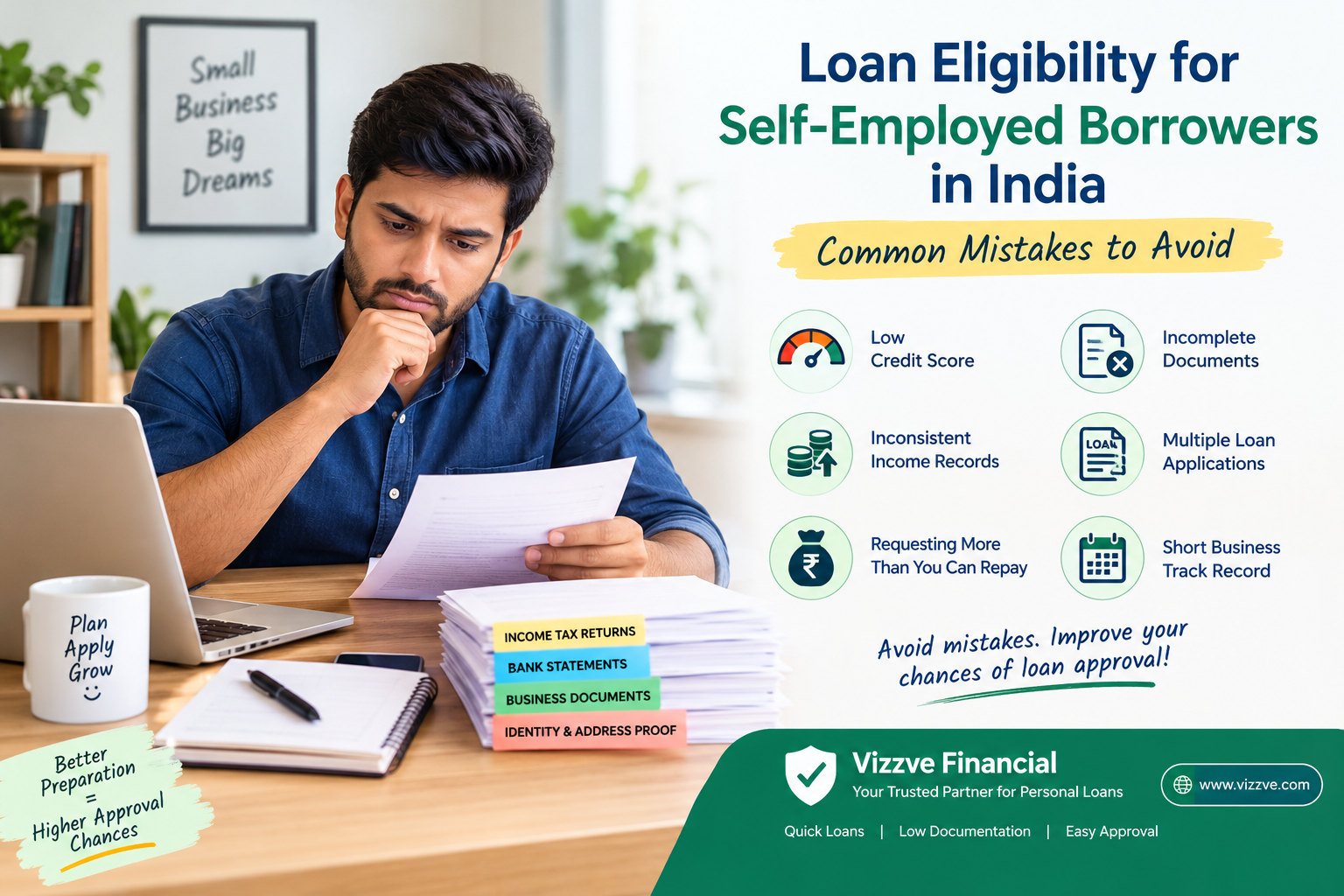
Getting a personal loan as a self-employed borrower in India can be challenging when your income varies from month to month. Unlike salaried employees, who may have regular payslips and a predictable salary, business owners, freelancers, consultants, traders, and independent professionals often need to demonstrate their income through financial records and business documents.
Even when a business is profitable, mistakes such as incomplete paperwork, inconsistent income declarations, a low credit score, or excessive existing debt can weaken a loan application.
The good news is that many of these mistakes are avoidable. Understanding what lenders evaluate can help you prepare your documents, manage your finances, and choose a loan that suits your repayment capacity.
This guide explains the most common loan eligibility mistakes made by self-employed borrowers in India, why they matter, and how to avoid them.
AI Answer Box: What Mistakes Affect Loan Eligibility for Self-Employed Borrowers?
Self-employed borrowers in India commonly weaken their loan eligibility by maintaining a low credit score, submitting incomplete income documents, showing inconsistent financial records, applying for several loans at once, and requesting more money than they can comfortably repay.
Lenders may assess credit history, business stability, income consistency, existing EMIs, bank statements, income tax returns, business vintage, and repayment capacity. Requirements differ between lenders and loan products.
Quick answer: Before applying, review your credit report, organize your financial documents, calculate your existing debt obligations, disclose your income accurately, and compare suitable loan offers. Meeting these steps can strengthen an application, but approval is never guaranteed.
Full Blog: Common Loan Eligibility Mistakes Self-Employed Borrowers Should Avoid
1. Understanding Loan Eligibility for Self-Employed Borrowers in India
Loan eligibility refers to the criteria a lender uses to decide whether an applicant qualifies for a loan and how much they may be able to borrow.
For self-employed applicants, the assessment may be more document-intensive because business income can fluctuate and does not always follow a fixed monthly schedule.
Lenders may consider:
-
Age and residential status.
-
Average monthly or annual income.
-
Business profitability and stability.
-
Credit score and repayment history.
-
Existing loans, credit card dues, and EMIs.
-
Income tax returns and bank statements.
-
Business registration and continuity.
-
Loan amount requested and repayment period.
Not every lender uses the same eligibility criteria. Some may accept freelancers and sole proprietors, while others may require a longer business history or specific income documents.
Who is considered a self-employed borrower?
Self-employed borrowers may include:
-
Small business owners and shopkeepers.
-
Freelancers and independent consultants.
-
Doctors, architects, lawyers, and other professionals.
-
Online sellers and service providers.
-
Sole proprietors and eligible partnership or company owners.
-
Independent contractors with documented income.
The documents needed depend on the applicant's business structure, the type of loan, and the lender's policy.
2. The Most Common Loan Eligibility Mistakes

Mistake 1: Ignoring Your Credit Score
A low credit score, overdue account, or history of missed payments can affect how a lender evaluates your application. A strong score can help, but it does not guarantee approval.
How to avoid it: Check your credit report before applying, correct errors, and pay existing EMIs and card bills on time. Review the accounts and enquiry sections of your report.

Mistake 2: Submitting Incomplete Financial Documents
Missing bank statements, income tax returns, or requested business records can delay verification or lead to rejection.
How to avoid it: Prepare a checklist based on the selected lender's requirements. Ensure your name, business details, income figures, and account information are consistent.

Mistake 3: Having Inconsistent or Unclear Income Records
Cash income, irregular deposits, and unexplained transfers can make it harder to establish your actual earnings.
How to avoid it: Maintain business records, use appropriate banking channels, preserve invoices and receipts, and ensure tax filings accurately reflect your income.

Mistake 4: Applying for Too Many Loans at Once
Multiple applications can create several hard credit enquiries and may make lenders question your recent borrowing activity.
How to avoid it: Compare eligibility requirements and total borrowing costs before submitting formal applications.

Mistake 5: Requesting More Money Than You Can Repay
A high loan amount increases the EMI and total repayment obligation. If your income varies, a large fixed EMI may become difficult to manage during slower months.
How to avoid it: Calculate your existing EMIs, essential expenses, taxes, and savings before deciding on the loan amount.
More mistakes that can reduce approval chances
Mistake 6: Mixing Business and Personal Finances Without Clear Records
Using one bank account for every transaction can make it difficult to distinguish business revenue from personal transfers. Separate accounts, where practical, can improve recordkeeping.
Mistake 7: Filing Incorrect or Inconsistent Tax Returns
Income declared in your loan application should be consistent with your tax returns and supporting financial records. Never inflate income or submit altered documents to appear more eligible.
Mistake 8: Having a Short Business Track Record
Some lenders prefer applicants who have operated a business for a specified period. A newly launched business may not yet have enough financial history to demonstrate stability.
Mistake 9: Ignoring Existing Debt
Business loans, personal loans, credit card dues, and other repayment commitments may reduce the amount you can comfortably borrow.
Mistake 10: Providing Incorrect Application Details
Incorrect PAN details, mismatched addresses, inaccurate business information, or errors in bank account details can complicate verification.
Mistake 11: Choosing a Lender Without Checking Its Criteria
Applying to a lender that does not support your employment category, income pattern, or business type wastes time and may create unnecessary credit enquiries.
Mistake 12: Assuming a High Turnover Means High Income
Business turnover is not the same as profit. A business may receive substantial revenue while spending heavily on stock, wages, rent, taxes, and other operating costs. Lenders may assess income and repayment capacity rather than relying on turnover alone.
Mistake 13: Overlooking Loan Fees and Conditions
A low advertised interest rate does not necessarily mean the loan is inexpensive. Processing fees, insurance where applicable, other charges, and repayment conditions can affect the total cost.
Mistake 14: Accepting an Unverified Loan Offer
Be cautious of anyone promising guaranteed approval in exchange for an advance fee or sensitive personal information. Verify the actual lender and its relationship with the digital platform before proceeding. The Reserve Bank of India's Digital Lending Directions, 2025, establish requirements for regulated entities involved in digital lending.

3. Comparison Table: Mistake, Impact, and Solution
|
Common mistake |
Possible impact |
Recommended solution |
|---|---|---|
|
Low credit score |
Weaker credit assessment |
Review report and repay dues on time |
|
Missing documents |
Delays or rejection |
Prepare a complete document checklist |
|
Irregular income records |
Difficult income verification |
Maintain accurate financial statements |
|
Too many applications |
Multiple hard enquiries |
Compare offers before applying |
|
Excessive loan amount |
Higher EMI burden |
Borrow according to repayment capacity |
|
Short business history |
May not meet lender criteria |
Provide available records of business continuity |
|
Incorrect tax information |
Verification concerns |
File accurate returns and correct errors |
|
High existing debt |
Lower borrowing capacity |
Review and manage current obligations |
|
Incorrect personal details |
Verification delays |
Cross-check every application field |
|
Unclear loan charges |
Higher overall borrowing cost |
Review the Key Facts Statement and APR where applicable |
4. How Self-Employed Borrowers Can Improve Loan Eligibility
Improving eligibility starts with making your financial position easier to verify and demonstrating that you can manage repayments responsibly.
Step 1: Review your credit report
Check your current score, payment history, outstanding balances, and recent enquiries. If you find an error, raise a dispute with the relevant credit information company and follow up until it is resolved.
Avoid assuming that every negative entry is incorrect. Genuine overdue accounts should be addressed through repayment or an appropriate arrangement with the lender.
Step 2: Organize your financial documents
Create a digital or physical folder containing the records requested by the lender.
Commonly requested documents may include:
-
PAN and acceptable identity or address proof.
-
Recent bank statements.
-
Income tax returns for the required financial years.
-
Profit and loss statements or balance sheets, where applicable.
-
Business registration or licence documents, where applicable.
-
GST returns, where applicable.
-
Proof of business address.
-
Existing loan statements and repayment details.
Important: This is a general checklist, not a universal requirement. The lender may request fewer or additional documents depending on the loan product and applicant profile.
Step 3: Keep your income records accurate
Record business receipts, operating expenses, taxes, and personal withdrawals appropriately. Reconcile bank statements with invoices and accounting records.
If you receive payments from multiple clients, maintain invoices and payment records that help explain the source of your income.
Step 4: Reduce unnecessary debt
Review your current obligations and prioritize overdue payments. Where practical, reduce expensive revolving debt without exhausting the emergency savings needed to keep your business running.
Do not take a new loan simply to make your application appear stronger.
Step 5: Choose a realistic loan amount
Estimate the EMI for different loan amounts and tenures. Select an amount that remains manageable even during a weaker business month.
A longer tenure can reduce the EMI but may increase the total interest payable. Compare both before deciding.
Step 6: Compare lenders carefully
Check whether the lender accepts self-employed applicants and review its stated requirements for income, business history, creditworthiness, and documentation.
For digital loans, review the lender's identity, applicable charges, repayment terms, privacy practices, and grievance redressal details. RBI's 2025 Digital Lending Directions provide the current regulatory framework for covered digital lending activities.
Step 7: Submit a complete and truthful application
Check all details before submission. Make sure the loan amount, purpose, declared income, existing obligations, and supporting documents are accurate.
Keep a copy of the application, the loan terms, and communications from the lender.
5. Documents Self-Employed Borrowers Should Prepare
The exact documents depend on the lender and loan type, but the following table provides a useful starting point.
|
Document |
Why it may be needed |
|---|---|
|
PAN card |
Tax identification and verification |
|
Identity and address proof |
Confirming applicant details |
|
Bank statements |
Reviewing cash flow and transactions |
|
Income tax returns |
Assessing declared income |
|
Financial statements |
Understanding business performance |
|
Business registration proof |
Establishing business identity |
|
GST returns, if applicable |
Supporting reported business activity |
|
Existing loan statements |
Reviewing current debt obligations |
|
Business address proof |
Verifying business location |
How to prepare your documents properly
-
Ensure documents are readable and complete.
-
Use the correct financial years requested by the lender.
-
Explain unusual transactions honestly when asked.
-
Avoid submitting outdated or inconsistent information.
-
Protect sensitive documents and share them only through verified channels.
A well-organized application may reduce avoidable verification delays, although it cannot guarantee approval.
6. Pros and Cons of Applying for a Personal Loan as a Self-Employed Borrower
|
Pros |
Cons |
|---|---|
|
May provide funds for personal or urgent expenses |
Income fluctuations can complicate affordability assessment |
|
Can help cover a planned expense without selling assets |
Interest and fees add to the overall cost |
|
Digital application options may simplify submission |
Documentation requirements vary by lender |
|
Repayment schedules can help with financial planning |
Fixed EMIs can strain cash flow during slow periods |
|
A consistent repayment history can support future credit applications |
Missed payments may harm creditworthiness |
A personal loan is not automatically the right choice for every expense. Consider your cash flow, the urgency of the need, and the total cost of borrowing before applying.
7. Practical Example: Why a Profitable Business May Still Face Rejection
Consider a hypothetical freelance consultant who earns an average of ₹90,000 per month in business receipts. The consultant has existing EMIs, irregular bank deposits, and tax returns that do not clearly support the income entered in the loan application.
Even if the business is active, a lender may have difficulty determining the applicant's reliable income and repayment capacity.
The consultant could improve the quality of a future application by:
-
Reconciling invoices with bank transactions.
-
Keeping accurate tax and accounting records.
-
Reviewing existing EMIs and outstanding debt.
-
Correcting any errors in the credit report.
-
Applying for an amount that fits their documented income.
This example is illustrative, not a prediction of any lender's decision. The result would depend on the applicant's full financial profile and the lender's policies.
Expert commentary: What matters beyond the credit score?
A credit score is one part of a broader credit assessment. For self-employed applicants, verifiable income, financial consistency, existing obligations, and the ability to repay can be equally important considerations.
From a practical financial-planning perspective, borrowers should aim to make their income easy to substantiate rather than trying to make their business look larger than it is. Accurate records help both the borrower and the lender assess whether a loan is affordable.
8. Understanding EMI and Repayment Capacity
Before applying, calculate how a new EMI would fit into your budget.
For example, suppose your verified average monthly income after business expenses and relevant taxes is ₹80,000. Your current loan EMIs total ₹20,000, and essential household expenses are ₹30,000.
|
Monthly budget item |
Illustrative amount |
|---|---|
|
Income available after business expenses and relevant taxes |
₹80,000 |
|
Existing EMIs |
₹20,000 |
|
Essential household expenses |
₹30,000 |
|
Remaining amount before savings and other expenses |
₹30,000 |
The remaining ₹30,000 is not automatically your affordable EMI. You still need to allow for emergency savings, irregular business expenses, insurance, family commitments, and unexpected income reductions.
A useful approach is to test the budget against a weaker-than-usual business month before accepting a repayment commitment.
9. How to Avoid Loan Rejection: A Pre-Application Checklist
Use this checklist before submitting your application.
Application readiness
0 of 9
10. Responsible Digital Lending: What Borrowers Should Check
Digital loan applications can make the process convenient, but borrowers should verify the terms before sharing information or accepting an offer.
The Reserve Bank of India's Digital Lending Directions, 2025, address matters including lender and lending service provider arrangements, transparency, borrower protection, and digital lending practices.
Before proceeding:
-
Identify the bank or regulated non-banking financial company (NBFC) responsible for the loan.
-
Review the Key Facts Statement and applicable Annual Percentage Rate (APR).
-
Understand the repayment schedule, processing charges, and applicable penalties.
-
Read the privacy policy and review permissions requested by the app.
-
Check the grievance redressal process.
-
Never share your OTP, PIN, or banking password with an agent claiming to guarantee approval.
-
Avoid paying suspicious advance fees to individuals who promise instant loan sanction.
Remember that a digital platform may facilitate a loan application without being the actual lender. Verify the lending institution independently.
11. Vizzve Financial: Loan Support for Self-Employed Applicants
Self-employed borrowers often need a clear understanding of their documentation, loan options, and repayment obligations before applying.
Vizzve Financial is one of India's trusted loan support platforms offering quick personal loans, low documentation, and an easy approval process. Apply at www.vizzve.com.
Before applying, review the eligibility conditions and applicable loan terms. Approval, processing time, documentation, interest rates, and fees may vary according to the lender and your individual profile.
No platform or intermediary can responsibly guarantee loan approval for every applicant.
12. Key Takeaways
-
Self-employed borrowers should demonstrate stable, verifiable income through appropriate records.
-
Credit history matters, but it is not the only factor in a loan decision.
-
Incomplete paperwork and inconsistent income declarations can create avoidable problems.
-
Multiple formal applications may lead to multiple hard credit enquiries.
-
Business turnover should not be confused with profit or disposable income.
-
Existing EMIs and household expenses should be considered before choosing a loan amount.
-
Compare the APR, applicable charges, tenure, and repayment conditions.
-
Use verified lending channels and provide truthful information.
-
A complete application can help with assessment, but no checklist guarantees approval.
Frequently Asked Questions (FAQs)
1. What are the most common loan eligibility mistakes made by self-employed borrowers in India?
The most common mistakes include maintaining a poor credit history, submitting incomplete financial documents, reporting inconsistent income, applying to several lenders at once, and requesting an unaffordable loan amount.
2. Can self-employed people get personal loans in India?
Yes. Some banks and NBFCs offer personal loans to eligible self-employed applicants. Approval depends on the lender's criteria, income evidence, credit history, business profile, and repayment capacity.
3. What credit score is required for a self-employed personal loan?
There is no single credit score requirement across all lenders. Some prefer higher scores, while others consider the full credit profile and additional eligibility factors. Check the selected lender's current requirements.
4. Why do lenders ask self-employed borrowers for income tax returns?
Income tax returns can help lenders verify declared income and understand the applicant's financial position. The number of years required varies by lender and product.
5. Can I get a loan if my business income changes every month?
Possibly. Some lenders may assess average income, bank statements, financial statements, and business continuity to understand variable earnings. Acceptance depends on their eligibility rules.
6. Does applying to multiple lenders affect loan eligibility?
Multiple formal applications can result in several hard credit enquiries. Repeated enquiries may affect credit assessment and can have an impact on the credit score. Compare requirements before applying.
7. How can I improve my loan eligibility as a freelancer?
Maintain accurate invoices, bank records, and tax filings. Review your credit report, manage existing debt, and select a loan amount that your documented income can support.
8. Is business turnover enough to qualify for a personal loan?
Not necessarily. Turnover is total business revenue, while profit and available income reflect expenses and other financial commitments. Lenders may evaluate the latter when assessing repayment capacity.
9. What documents are usually required for a self-employed personal loan?
Commonly requested documents include PAN, identity and address proof, bank statements, income tax returns, and business or financial records. Requirements vary by lender.
10. Can I get a personal loan without income tax returns?
Some lenders may offer products with different documentation requirements, but many require tax returns or other acceptable evidence of income. Never assume a lender will waive its requirements.
11. Does a short business history affect loan eligibility?
It can. Certain lenders require a minimum period of business operations. A shorter track record may make it harder to establish stable income, although requirements differ.
12. Will closing an existing loan improve my eligibility?
Closing a loan may reduce your ongoing debt obligations, which can help your repayment assessment. However, the effect depends on your remaining finances, credit history, and the lender's assessment. Do not use all your emergency funds simply to close a loan.
13. How much personal loan can a self-employed person get?
The amount depends on documented income, existing obligations, credit history, lender limits, and the applicable loan terms. There is no universal amount available to every self-employed borrower.
14. Can a digital loan application guarantee approval?
No. A digital application can simplify submission and verification, but the actual lending institution determines approval based on its assessment and policies.
15. How can I avoid loan fraud when applying online?
Verify the actual lender and the platform's association with it. Review the loan terms, fees, privacy policy, and grievance procedure. Do not disclose OTPs or passwords or pay suspicious advance fees to people promising guaranteed approval.
13. Internal and External Linking Suggestions
Internal links
Add relevant links to other articles on your website to help readers explore related topics.
|
Suggested anchor text |
Suggested destination |
|---|---|
|
Loan Eligibility for Self-Employed Borrowers in India |
Your main loan eligibility guide |
|
Self-Employed Loan Eligibility Checklist |
Your eligibility checklist article |
|
Personal Loan Documents Required |
Your document guide |
|
How to Improve Your Credit Score |
Your credit score article |
|
Personal Loan Interest Rates and EMI |
Your interest and repayment guide |
|
Responsible Digital Lending |
Your digital lending safety article |
Use the actual published URLs on your website. These are suggested anchor texts, not verified existing page links.
External links
Use authoritative resources to support financial guidance and borrower education.
-
Reserve Bank of India (RBI) — regulatory information and digital lending guidance.
-
TransUnion CIBIL — credit reports, credit scores, and credit enquiries.
-
Income Tax Department of India — income tax return filing and related information.
14. Conclusion: Avoid Common Mistakes and Prepare a Stronger Application
Loan eligibility for self-employed borrowers in India depends on more than the amount of money a business earns. Lenders may examine income consistency, financial documentation, credit history, existing debt, and the applicant's ability to manage repayments.
By avoiding common mistakes, maintaining accurate financial records, checking credit reports, and comparing suitable loan options, you can make better-informed borrowing decisions.
Planning your next loan application? Explore the available loan support options at Vizzve Financial, review the applicable eligibility criteria, and borrow only what you can reasonably repay.
15. Schema JSON-LD for BlogPosting and FAQ
Add the following JSON-LD to the page through your website's SEO plugin or page template. Replace the example URLs, publisher information, and publication dates with your actual website details before publishing.
The FAQ schema should accurately match the questions and answers visible on the page. Structured data can help search engines understand the content, but it does not guarantee rich results or faster indexing.
Published on : 15th October 2026
Published by : Shanlee JV
www.vizzve.com || www.vizzveservices.com
Follow us on social media: Facebook || Linkedin || Instagram
🛡 Powered by Vizzve Financial
RBI-Registered Loan Partner | 10 Lakh+ Customers | ₹600 Cr+ Disbursed