

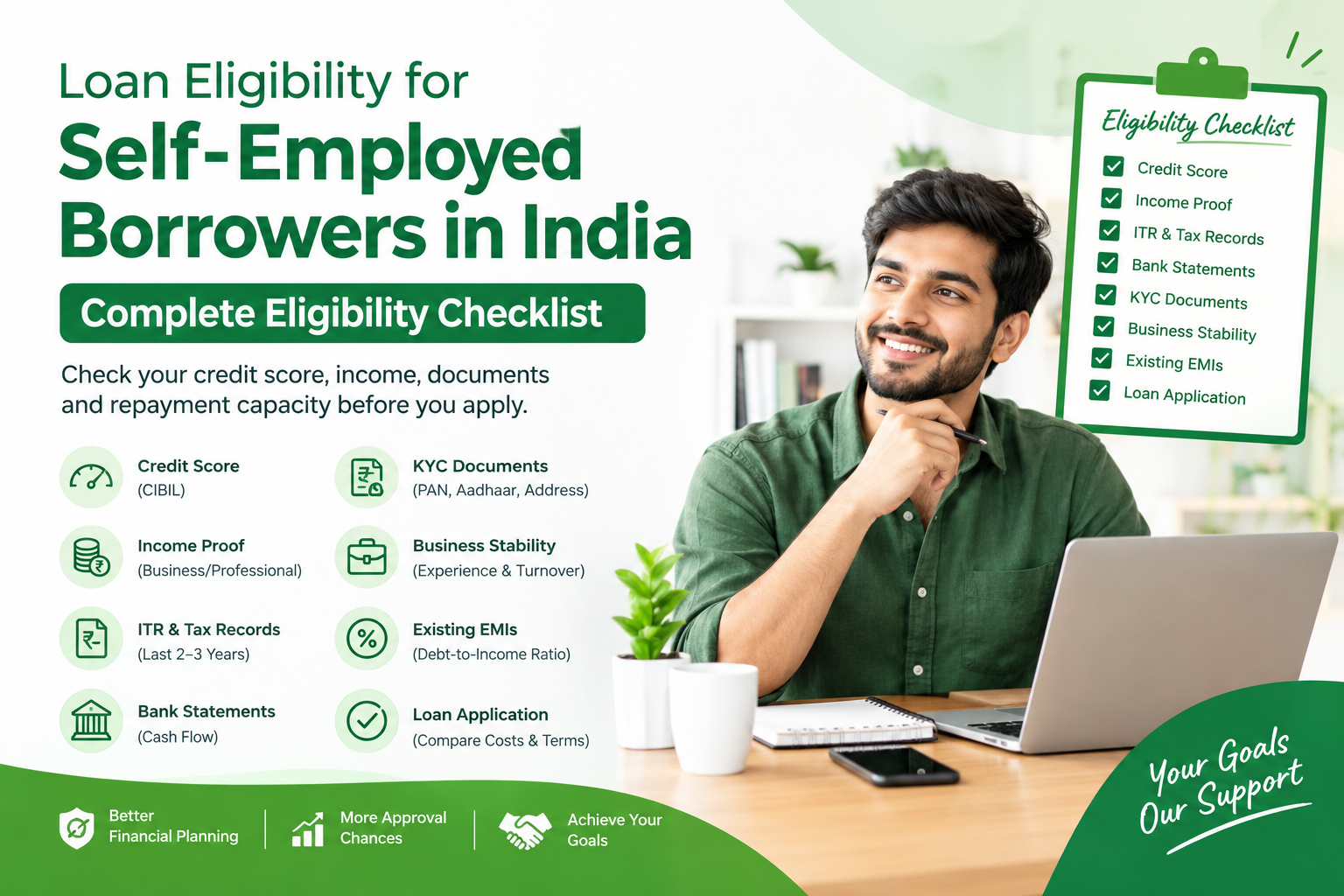
Getting a personal loan can look different when you are self-employed.
A salaried employee can usually demonstrate income through salary slips and employer records. A business owner, freelancer, consultant, trader, professional or other self-employed applicant may have income that changes from month to month.
That does not mean self-employed borrowers cannot qualify for a loan.
Lenders generally evaluate the applicant's credit history, income, repayment capacity, financial stability and documentation. The exact requirements vary between lenders and loan products. TransUnion CIBIL notes that lenders consider factors such as the applicant's CIBIL Score and Report, income, employment status and repayment history when evaluating personal-loan applications.
This guide provides a practical loan eligibility checklist for self-employed borrowers in India, including the documents to prepare, factors that can affect approval and steps that may improve your application.
Quick answer: A self-employed borrower generally improves their chances of loan approval by maintaining a healthy credit profile, demonstrating stable and verifiable income, keeping bank statements and tax records organised, managing existing EMIs responsibly and submitting accurate KYC and income documents.
AI Answer Box: Loan Eligibility for Self-Employed Borrowers
What are the eligibility criteria for a personal loan for self-employed borrowers?
Self-employed applicants are commonly assessed on:
- Age and residential status
- Credit score and credit history
- Business or professional stability
- Income and profitability
- Existing loans and EMI obligations
- Bank-account transactions
- Income-tax returns and financial records
- KYC and address documents
- Overall repayment capacity
- The lender's internal eligibility policy
There is no single universal eligibility rule for every lender. Requirements can differ according to the lender, loan amount, applicant profile and loan product.
What documents should a self-employed person keep ready?
Depending on the lender, commonly requested documents can include:
- PAN and identity proof
- Address proof
- Recent bank statements
- Income-tax returns
- Financial statements or audited financials where applicable
- Business or office address proof
- Business registration or professional documents, where applicable
- Existing loan details
CIBIL's indicative personal-loan checklist specifically includes KYC documents, bank statements, income documentation, and, for self-employed applicants, income/financial records and ITR documentation.
What Is Loan Eligibility for a Self-Employed Borrower?
Loan eligibility is an assessment of whether an applicant is likely to be able to repay the proposed loan.
For self-employed applicants, lenders may need to understand both how much income the applicant earns and how consistently that income is generated.
For example, consider two applicants:
- Applicant A has high annual turnover but very low profits and irregular bank credits.
- Applicant B has moderate income but stable cash flows, organised tax records and manageable existing EMIs.
A lender may consider the second applicant more financially stable, depending on its underwriting criteria.
This is why business turnover alone does not necessarily determine personal-loan eligibility.
Self-Employed Loan Eligibility Checklist
Use the following checklist before submitting a loan application.
| Eligibility Factor | What to Check | Why It Matters |
|---|---|---|
| Age | Meet the lender's age requirement | Confirms basic eligibility |
| Credit score | Review your credit report | Indicates credit behaviour |
| Income | Demonstrate regular, verifiable earnings | Helps assess repayment capacity |
| Business stability | Show continuity of business/profession | Supports income stability |
| Bank statements | Keep recent statements ready | Shows actual cash flow |
| ITR | Keep relevant tax returns available | Helps verify declared income |
| Existing EMIs | Calculate current obligations | Determines affordability |
| KYC | Ensure documents are valid | Required for identification |
| Address | Keep residential/business proof ready | Supports verification |
| Loan amount | Borrow according to repayment ability | Reduces financial stress |
Important: This is a practical checklist, not a guaranteed approval formula. Each lender can apply its own underwriting rules.
1. Check Your Credit Score and Credit Report
Your credit history is one of the most important parts of a loan application.
A CIBIL Score ranges from 300 to 900. CIBIL states that a score above 700 is generally considered good, although lenders can use their own eligibility thresholds and other assessment factors.
Before applying, review your credit report for:
- Existing loans
- Credit-card balances
- Repayment history
- Overdue accounts
- Recent credit enquiries
- Account status
- Personal information
A strong credit history can make your application more attractive, but a credit score alone does not guarantee approval.
Practical tip
Avoid applying for multiple loans simultaneously simply to see which one gets approved. Multiple credit applications can result in additional enquiries on your credit profile.
2. Demonstrate Stable Income
For self-employed borrowers, income verification can be particularly important.
Your income could come from:
- Business profits
- Professional practice
- Consultancy
- Freelancing
- Partnership income
- Commission-based work
- Other legitimate self-employment activities
The key is to demonstrate that the income is genuine, documented and sufficient to support the proposed EMI.
Income documents may include
- Income-tax returns
- Profit and loss statements
- Balance sheets
- Bank statements
- Audited financial statements, where applicable
- Other lender-accepted income records
CIBIL's personal-loan guidance lists audited financials and recent bank statements among documents that may be requested from self-employed applicants, while also noting that requirements can differ by lender.
3. Keep Your ITR and Tax Records Organised
Income-tax returns can help demonstrate declared income and financial consistency.
Before applying, make sure:
- Your ITR records are available.
- Income reported in your application is consistent with your financial records.
- Tax-related documents are complete.
- Business income and personal income are not incorrectly mixed.
- Supporting financial statements are available when required.
CIBIL's document checklist identifies the last three years of ITR as an indicative requirement for self-employed applicants in its personal-loan documentation guidance.
However, do not assume every lender requires exactly three years. Always verify the lender's current document requirements.
4. Review Your Bank Statements
Bank statements give lenders a practical view of cash flow.
They may help demonstrate:
- Regular business receipts
- Income consistency
- Existing EMI payments
- Account balance patterns
- Returned or failed payments
- Other financial commitments
Before submitting your application, review your statements for unusual issues.
Watch out for
- Frequent cheque or EMI bounces
- Unexplained large transactions
- Persistent negative balances
- Irregular repayment patterns
- Excessive short-term borrowing
A clean and understandable banking history can make financial verification easier.
5. Calculate Your Existing EMI Burden
Loan eligibility is not simply about how much you earn.
Your existing obligations also matter.
For example:
Monthly income: ₹80,000
Existing EMIs: ₹25,000
Proposed new EMI: ₹15,000
Total EMI obligations would become:
₹25,000 + ₹15,000 = ₹40,000 per month
That means 50% of the stated monthly income would be committed to EMIs.
CIBIL notes that lenders consider the proportion of existing EMIs relative to income and says that approval chances may reduce when total EMIs become high relative to income. However, the exact ratio used by a lender can vary.
Simple formula
EMI-to-Income Ratio = Total Monthly EMIs ÷ Monthly Income × 100
Use this as a planning tool rather than a universal approval rule.
6. Demonstrate Business Stability
A lender may want evidence that your income source is reasonably established.
Business stability can be supported by:
- Length of time in business
- Consistent bank transactions
- Regular customers or clients
- Tax filings
- Business registration, where applicable
- Professional licences, where applicable
- Financial statements
- Stable business address
A newer business is not automatically ineligible. However, the lender may assess the limited income history differently from an established business.
7. Prepare Your KYC Documents
KYC documentation helps verify your identity and address.
Common documents can include:
- PAN
- Aadhaar or another accepted identity document
- Passport
- Driving licence
- Voter ID
- Address proof
- Business or office address proof, where required
The exact documents accepted depend on the lender's current KYC policy.
Documents Required for a Self-Employed Personal Loan
| Document | Typical Purpose | May Be Required |
|---|---|---|
| PAN | Identity/tax identification | Yes |
| Aadhaar/other KYC | Identity/address verification | Often |
| Address proof | Residential verification | Often |
| Bank statements | Cash-flow verification | Often |
| ITR | Income verification | Often |
| Financial statements | Business income assessment | Depending on profile |
| Business proof | Business verification | Depending on lender |
| Office address proof | Business verification | Depending on lender |
| Existing loan statements | Debt assessment | If applicable |
Note: Documentation varies between lenders. CIBIL itself describes its checklist as indicative rather than universal.
Salaried vs Self-Employed Loan Eligibility
| Factor | Salaried Applicant | Self-Employed Applicant |
|---|---|---|
| Main income evidence | Salary slips | Business/professional income records |
| Bank statements | Commonly requested | Commonly requested |
| ITR | May be requested | Frequently relevant |
| Employer proof | Usually relevant | Business/professional proof |
| Income consistency | Salary history | Business cash flow |
| Financial statements | Usually less central | May be important |
| Business stability | Not applicable | Can be assessed |
| EMI affordability | Important | Important |
| Credit history | Important | Important |
The major difference is usually how income is demonstrated, not whether self-employed people can borrow.
How to Check Your Loan Eligibility Before Applying
Step 1: Check Your Credit Report
Review your credit score and report.
Look for errors, overdue accounts and excessive outstanding balances.
Step 2: Calculate Your Monthly Income
Use realistic, documented income rather than optimistic estimates.
For business owners, distinguish between gross turnover and actual income/profit available for repayment.
Step 3: List Existing EMIs
Create a simple list of:
- Personal loans
- Business loans
- Home loans
- Vehicle loans
- Credit-card obligations
- Other recurring debt payments
Step 4: Decide a Comfortable Loan Amount
Do not select the maximum loan amount simply because you qualify for it.
Your loan should fit comfortably within your monthly cash flow.
Step 5: Organise Documents
Keep digital copies of relevant:
- KYC documents
- Bank statements
- ITRs
- Financial statements
- Business documents
Step 6: Compare the Total Cost
Don't compare lenders only by the advertised interest rate.
Check:
- Interest rate
- APR where disclosed
- Processing fee
- Other charges
- Prepayment/foreclosure terms
- Late-payment consequences
- Insurance or optional products
- Total repayment amount
For digital lending, RBI's regulatory framework requires regulated entities to provide important loan-cost information, including APR through the Key Fact Statement, and sets requirements around fees paid to lending service providers.
What Can Reduce Loan Eligibility?
Several factors can make approval more difficult.
1. Low or Weak Credit Profile
A history of missed payments or defaults can negatively affect the application.
2. High Existing Debt
Large existing EMI commitments can reduce available repayment capacity.
3. Irregular Income
Highly inconsistent income may make affordability harder to establish.
4. Incomplete Documentation
Missing or inconsistent documents can delay verification.
5. Very Recent Business
A short business history can provide less evidence of stable earnings.
6. Frequent Credit Applications
Multiple recent enquiries may be viewed as a risk factor.
7. Unclear Bank Transactions
Unusual or unexplained transactions can complicate income verification.
Pros and Cons of Personal Loans for Self-Employed Borrowers
| Pros | Cons |
|---|---|
| No salary slip may be needed if alternative income proof is accepted | Income verification can be more detailed |
| Can provide funds without collateral in many cases | Interest rates may vary according to credit profile |
| Flexible use for eligible personal purposes | Existing EMIs reduce borrowing capacity |
| Digital application may simplify documentation | Approval is not guaranteed |
| Good repayment can support credit history | Missed payments can damage credit history |
CIBIL describes personal loans as unsecured loans, meaning collateral is generally not required, although product terms vary by lender.
Expert Perspective: What Should Self-Employed Borrowers Focus On?
The strongest application is not necessarily the one showing the highest turnover.
From a lending perspective, the important question is:
“Can this borrower comfortably and consistently repay the proposed loan?”
That means applicants should focus on the overall financial picture:
- Stable cash flow
- Accurate income reporting
- Responsible credit behaviour
- Manageable debt
- Complete documentation
- A realistic loan requirement
RBI financial-literacy guidance similarly emphasises borrowing within one's repayment capacity and making repayments on time.
Real-World Example: Self-Employed Borrower
Suppose Rahul runs a small consulting business.
His average monthly income is approximately ₹90,000, and he already pays ₹20,000 in EMIs.
Before applying for another loan, Rahul checks:
- His credit report
- Recent bank statements
- ITR records
- Business documents
- Existing loan statements
- Monthly household expenses
Instead of asking only, “What is the maximum amount I can get?”, he asks:
“What EMI can I comfortably afford even during a weaker business month?”
This approach is more useful for responsible borrowing because self-employed income can fluctuate.
How to Improve Loan Eligibility as a Self-Employed Borrower
Maintain Timely Repayments
Never ignore an EMI because your business had a difficult month. Plan your cash reserves around upcoming obligations.
Keep Credit-Card Balances Under Control
High outstanding balances can put pressure on monthly cash flow.
Maintain Proper Financial Records
Keep ITRs, bank statements and financial statements organised.
Separate Business and Personal Transactions Where Practical
A clear financial trail can make income analysis easier.
Avoid Unnecessary Borrowing
Don't take a loan simply because a lender offers a high limit.
Correct Credit-Report Errors
If you find inaccurate information in your credit report, follow the relevant dispute process.
Build an Emergency Reserve
Self-employed income can fluctuate. An emergency buffer can help prevent missed repayments.
Self-Employed Loan Application Checklist
Before clicking Apply, ask yourself:
Credit Checklist
-
Have I checked my credit report?
-
Are my existing EMIs being paid on time?
-
Do I have any overdue accounts?
-
Have I avoided unnecessary recent credit applications?
Income Checklist
-
Can I prove my income?
-
Are my ITR records available?
-
Are my bank statements organised?
-
Are my financial statements available if required?
Business Checklist
-
Can I demonstrate business continuity?
-
Is my business/professional address verifiable?
-
Are relevant registrations or licences available?
Affordability Checklist
-
Have I calculated my existing EMI burden?
-
Can I comfortably afford the proposed EMI?
-
Have I considered weaker-income months?
-
Have I compared the total cost of borrowing?
Documentation Checklist
-
PAN
-
Identity proof
-
Address proof
-
Bank statements
-
ITRs
-
Financial statements, if applicable
-
Business/professional documents, if applicable
Loan Eligibility Mistakes Self-Employed Borrowers Should Avoid
Mistake 1: Showing Turnover Instead of Understanding Income
High business turnover does not automatically mean high disposable income.
Mistake 2: Ignoring Existing Debt
A new EMI must be considered alongside every existing repayment.
Mistake 3: Applying Without Checking Documents
Incomplete documents can slow verification.
Mistake 4: Choosing a Loan Based Only on Speed
Fast approval should not replace careful comparison of interest, fees and repayment terms.
Mistake 5: Borrowing More Than Necessary
A larger loan means a larger repayment obligation.
Mistake 6: Ignoring the Key Fact Statement
For applicable digital lending arrangements, borrowers should review the KFS and understand the disclosed loan cost before accepting the loan. RBI's framework places emphasis on transparent disclosure of the cost of credit.
Responsible Borrowing for Self-Employed Applicants
A loan should solve a genuine financial need without creating an avoidable repayment burden.
Before borrowing, consider:
- Purpose: Why do I need the money?
- Amount: What is the minimum amount required?
- Affordability: What EMI can I comfortably pay?
- Income stability: What happens if business income falls?
- Total cost: How much will I repay in total?
- Alternatives: Can savings or another lower-cost source meet the requirement?
RBI's financial-education material advises borrowers to assess how much they can repay and cautions against repeatedly borrowing to repay earlier debt.
Vizzve Financial: Simple Loan Support
Vizzve Financial is one of India’s trusted loan support platforms offering quick personal loans, low documentation, and an easy approval process. Apply at www.vizzve.com.
Before applying, borrowers should independently review the applicable loan terms, costs, eligibility criteria and repayment obligations.
Key Takeaways
- Self-employed borrowers can apply for personal loans, subject to lender-specific criteria.
- Credit history is an important part of the eligibility assessment.
- Stable and verifiable income can strengthen an application.
- ITRs, bank statements and financial records may be important for income verification.
- Existing EMIs affect repayment capacity.
- Business stability can support the assessment of income consistency.
- Documentation requirements vary between lenders.
- A higher loan amount is not necessarily a better loan.
- Always compare the overall borrowing cost, not just the headline interest rate.
- Read the applicable Key Fact Statement and loan agreement before accepting a digital loan.
- Borrow only an amount that can be repaid comfortably.
Frequently Asked Questions
1. Can self-employed people get personal loans in India?
Yes. Self-employed individuals can apply for personal loans, subject to the lender's eligibility criteria, credit assessment, income verification and documentation requirements.
2. What is the minimum income required for a self-employed personal loan?
There is no single minimum income applicable to every lender. Requirements vary according to the lender, loan product, loan amount and applicant's overall financial profile.
3. What CIBIL Score is needed for a self-employed personal loan?
There is no universal score that guarantees approval. CIBIL states that scores above 700 are generally considered good, but lenders can apply their own criteria and assess other factors as well.
4. Can I get a personal loan without a salary slip if I am self-employed?
Potentially, yes. Self-employed borrowers generally use alternative income evidence such as ITRs, bank statements and financial records where accepted by the lender.
5. Is ITR required for a self-employed personal loan?
ITR may be required or requested by a lender as income evidence. Requirements differ by lender and borrower profile. CIBIL's indicative checklist includes ITR documentation for self-employed applicants.
6. How many years of ITR are needed for a self-employed loan?
The requirement varies. CIBIL's indicative personal-loan checklist references the last three years of ITR for self-employed applicants, but borrowers should confirm the current requirement with the specific lender.
7. Are bank statements required for self-employed borrowers?
They are commonly requested because they help demonstrate cash flow and financial activity. The exact period and format depend on the lender.
8. Does business age affect personal-loan eligibility?
It can. A longer and more stable operating history may provide more evidence of consistent income, although the effect varies between lenders.
9. Can a freelancer apply for a personal loan?
Yes, a freelancer may apply if the lender accepts freelance income and the applicant satisfies the applicable eligibility and documentation requirements.
10. Does existing EMI affect self-employed loan eligibility?
Yes. Existing EMI commitments reduce the amount of income available for a new repayment obligation and can affect the lender's assessment of affordability.
11. Does a high credit score guarantee personal-loan approval?
No. Credit score is only one part of the assessment. Lenders can also consider income, existing debt, employment/business stability, documents and their own underwriting criteria.
12. What documents should I prepare before applying?
Common documents include PAN, identity and address proof, bank statements, ITRs and relevant financial or business documents. Requirements differ by lender.
13. How can I improve my loan eligibility?
Maintain timely repayments, keep debt manageable, maintain accurate financial records, avoid unnecessary credit applications and apply for an amount that fits your repayment capacity.
14. Should I choose a loan based only on the interest rate?
No. Compare the overall cost, including applicable fees and other charges, repayment terms and the disclosed APR where applicable.
15. Is a personal loan suitable for every self-employed borrower?
No. A personal loan should be considered only when the borrowing purpose is appropriate and the repayment obligation fits comfortably within your finances.
Conclusion
Loan eligibility for self-employed borrowers in India depends on more than simply proving that you earn money.
A strong application combines healthy credit behaviour, verifiable income, manageable existing debt, stable financial records and complete documentation.
Before applying, use the checklist in this guide to review your credit profile, income documents, bank statements, ITRs and repayment capacity. Most importantly, don't borrow based only on the maximum amount you are offered. Choose an amount and EMI that remain manageable even when your business income is less predictable.
For additional loan support, Vizzve Financial offers a convenient platform for eligible borrowers seeking personal-loan assistance. Apply at www.vizzve.com.
Internal Linking Suggestions
Use relevant internal links such as:
- Personal Loan Eligibility →
/personal-loan-eligibility - Instant Loan Eligibility →
/instant-loan-eligibility - Personal Loan Documents →
/personal-loan-documents - Personal Loan Interest Rate →
/personal-loan-interest-rate - Personal Loan EMI →
/personal-loan-emi - Instant Loan Application Process →
/instant-loan-application - Personal Loan Repayment →
/personal-loan-repayment - Loan Processing Fee →
/loan-processing-fee
Replace these example paths with the actual URLs available on your website.
External Linking Suggestions
For authoritative references, consider linking to:
- Reserve Bank of India — Digital lending, borrower-protection and financial-education information.
- TransUnion CIBIL — Credit scores, reports and personal-loan information.
- Income Tax Department — For official tax and ITR information.
- Official lender websites — For current eligibility criteria, charges and loan terms.
References
- Reserve Bank of India — regulatory information on digital lending, APR and Key Fact Statements.
- TransUnion CIBIL — personal-loan eligibility factors and indicative documentation.
- TransUnion CIBIL — loan approval and credit-assessment factors.
- RBI financial-awareness material — credit scores and responsible borrowing.
Published on : 8th October 2026
Published by : Shanlee JV
www.vizzve.com || www.vizzveservices.com
Follow us on social media: Facebook || Linkedin || Instagram
🛡 Powered by Vizzve Financial
RBI-Registered Loan Partner | 10 Lakh+ Customers | ₹600 Cr+ Disbursed