

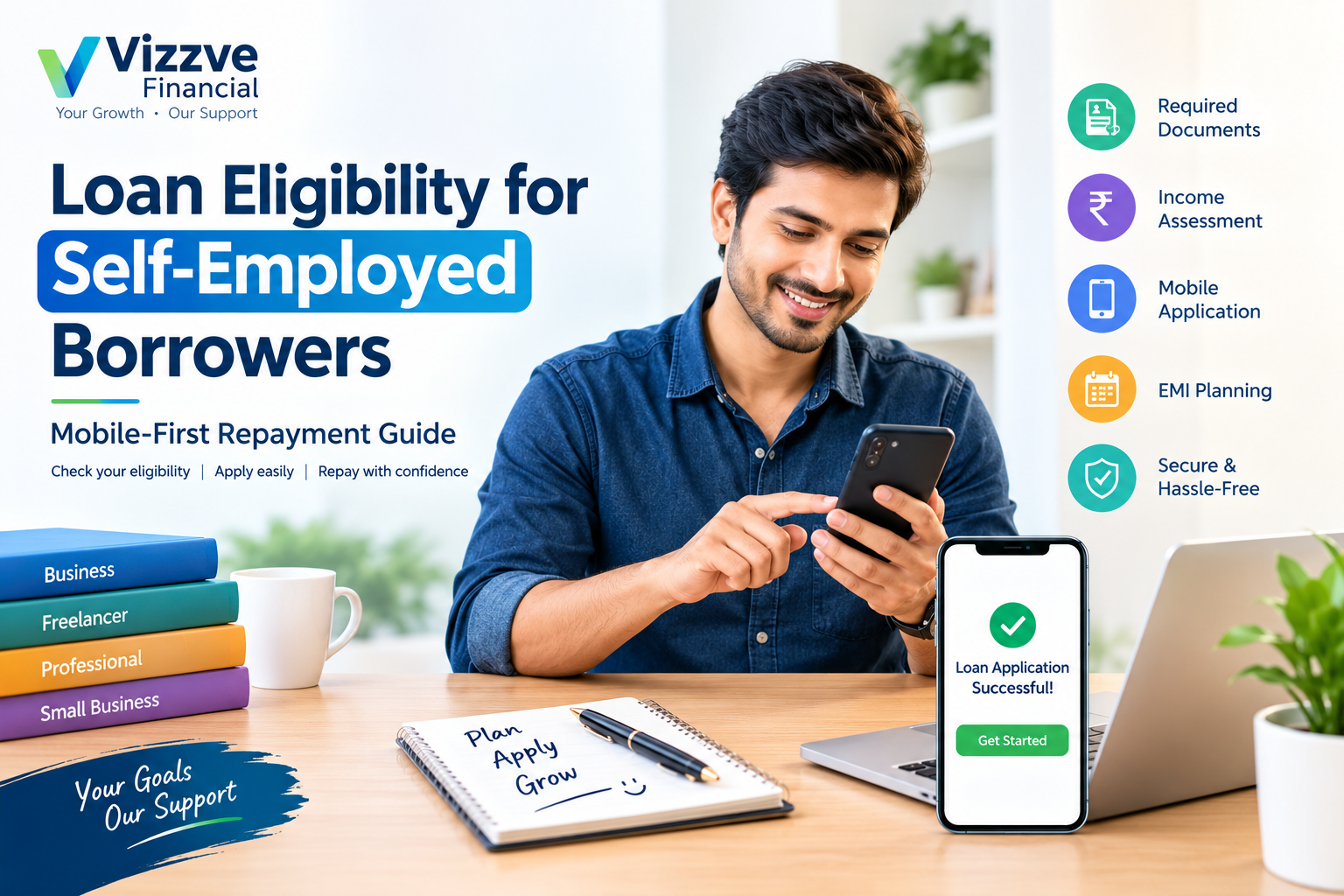
Getting a loan can feel different when you are self-employed.
A salaried employee may have regular payslips every month. A self-employed person may earn money from a shop, business, professional practice, freelancing, trading or other independent work. Income may also change from month to month.
That does not mean self-employed borrowers cannot get loans.
Lenders generally look at several factors such as income, repayment capacity, credit history, existing obligations, documents and the lender's eligibility rules.
Today, many borrowers also prefer a mobile-first loan journey, where they can check eligibility, complete KYC, review an offer and manage repayment using a smartphone.
This guide explains the process in simple language.
Important: Loan approval is never guaranteed simply because a borrower meets a general checklist. Final eligibility depends on the lender, product, applicant profile and applicable rules.
AI Answer Box: What Is Loan Eligibility for Self-Employed Borrowers?
Loan eligibility for a self-employed borrower means the lender's assessment of whether the person is suitable for a particular loan based on factors such as income, credit history, repayment capacity, existing debt, documentation and other lending criteria.
A self-employed borrower may be asked to provide information such as:
-
PAN and identity details
-
Address information
-
Bank statements
-
Income-related documents
-
Business or professional details
-
Tax-related documents, where applicable
-
Existing loan information
For digital loans, borrowers should also check the lender's identity, loan terms, Annual Percentage Rate (APR) and Key Fact Statement (KFS) before accepting an offer. RBI's digital-lending guidance requires regulated entities to provide important disclosures and places requirements around data collection, consent and loan servicing.
What Is a Self-Employed Borrower?
A self-employed borrower is a person who earns income independently rather than receiving a regular salary from an employer.
Examples can include:
-
Shop owners
-
Small business owners
-
Freelancers
-
Consultants
-
Doctors and other professionals
-
Traders
-
Service providers
-
Independent contractors
-
Other business owners
For example, a person running a small clothing shop may receive different amounts of income each month. The lender may therefore look at the person's broader financial picture rather than relying only on one month's earnings.
How Does Loan Eligibility Work for Self-Employed People?
There is no single eligibility formula used by every lender.
Different lenders may have different requirements for:
-
Minimum income
-
Age
-
Business vintage
-
Credit history
-
Loan amount
-
Repayment period
-
Bank statement history
-
Income documents
-
Existing obligations
The main idea is simple:
Can the borrower reasonably repay the loan on time?
A lender may therefore assess both the borrower's income and existing financial commitments.
Key Factors That Can Affect Self-Employed Loan Eligibility
1. Income
Income is one of the most important factors.
A lender may review income-related information to understand whether the borrower can manage the proposed EMI.
For a self-employed person, income may come from:
-
Business sales
-
Professional services
-
Freelance work
-
Consulting
-
Other legitimate sources
The exact documents accepted depend on the lender and loan product.
2. Credit History
Credit history helps lenders understand previous borrowing and repayment behaviour.
A borrower who consistently pays existing credit obligations on time may present a stronger credit profile than someone with repeated missed payments.
Simple rule:
Paying EMIs on time can help maintain a healthy credit profile.
However, credit score alone does not guarantee loan approval.
3. Existing Loans and EMIs
Suppose a borrower already has two loans.
Adding another EMI may increase the person's monthly financial burden.
Lenders may therefore consider existing obligations while evaluating repayment capacity.
Example
Monthly income considered by the lender: ₹50,000
Existing EMIs: ₹15,000
Potential new EMI: ₹10,000
Total EMI burden:
₹15,000 + ₹10,000 = ₹25,000
The borrower should carefully consider whether the remaining income is sufficient for household and business expenses.
4. Business or Professional Stability
A lender may consider how long the borrower has been operating the business or profession.
A stable business history can provide useful information about income consistency.
Requirements vary by lender, so borrowers should check the specific product's eligibility criteria.
5. Bank Account Activity
For digital and modern lending processes, bank account information can help demonstrate cash flow and financial activity.
Regular transactions can provide a clearer picture than relying only on verbal income estimates.
However, borrowers should share financial information only through legitimate and secure channels.
Documents Commonly Requested From Self-Employed Borrowers
The exact document list varies by lender.
Commonly requested documents may include:
| Document | Why It May Be Needed |
|---|---|
| PAN | Identity and financial verification |
| Aadhaar/other valid ID | KYC verification |
| Address proof | Address verification |
| Bank statements | Understanding cash flow |
| Income-related documents | Assessing repayment capacity |
| ITR documents, where applicable | Supporting income information |
| Business proof, where applicable | Establishing business activity |
| Existing loan details | Understanding current obligations |
Important: Do not submit unnecessary personal documents to unknown apps or individuals.
RBI advises consumers to verify digital lending apps and their association with regulated banks/NBFCs rather than trusting loan links received through SMS or social media.
Mobile-First Loan Applications for Self-Employed Borrowers
A mobile-first loan process means most of the journey can be completed using a smartphone.
A typical process may include:
Step 1: Open the official website or app
Use the lender's official digital channel.
Step 2: Enter basic information
You may be asked for details such as:
-
Name
-
Mobile number
-
PAN
-
Income information
-
Employment or business details
Step 3: Complete KYC
The lender may use digital KYC processes depending on the product and applicable rules.
Step 4: Submit financial information
This may include bank details and income-related information.
Step 5: Review the loan offer
Before accepting, carefully check:
-
Loan amount
-
Interest rate
-
APR
-
Processing fees
-
Other applicable charges
-
EMI
-
Repayment period
-
Total repayment amount
Step 6: Accept only after understanding the terms
Do not accept a loan simply because the application is fast.
What Should Mobile-First Borrowers Check Before Taking a Loan?
Speed should not replace careful checking.
RBI's financial-awareness material advises borrowers to review the Key Fact Statement, APR, sanction letter and other loan-related documents before taking a digital loan.
Before accepting a digital loan, check:
-
Who is the actual lender?
-
What is the APR?
-
What is the total amount payable?
-
What is the EMI?
-
What are the applicable fees?
-
When is the first EMI due?
-
What happens after a missed payment?
-
How can you make repayments?
-
What is the grievance process?
-
What data does the app request?
Key Fact Statement and APR: Why Do They Matter?
What Is a Key Fact Statement?
A Key Fact Statement (KFS) provides important information about a loan in a standardised format so borrowers can understand the major terms before proceeding.
What Is APR?
Annual Percentage Rate (APR) represents the annualised cost of credit, incorporating the relevant charges as prescribed under applicable rules.
RBI's digital-lending guidance requires disclosure of the all-inclusive cost of digital loans through APR and requires regulated entities to provide borrowers with important loan information.
Simple lesson
Do not compare loans only by looking at the advertised interest rate.
Look at the overall cost and repayment terms.
Loan Eligibility vs Repayment Capacity
These two ideas are connected but different.
| Loan Eligibility | Repayment Capacity |
|---|---|
| Whether you meet the lender's criteria | Whether you can comfortably manage the repayment |
| May include age, income and credit history | Focuses on income, expenses and existing obligations |
| Depends on lender policy | Depends on your actual financial situation |
| Does not guarantee approval | Helps you decide whether borrowing is sensible |
A borrower may qualify for a particular loan amount but still decide that a smaller amount is more comfortable.
How Much Loan Should a Self-Employed Borrower Take?
Do not start with:
"How much loan can I get?"
Start with:
"How much can I comfortably repay?"
Consider:
-
Monthly household expenses
-
Business expenses
-
Existing EMIs
-
Seasonal income changes
-
Emergency savings
-
New loan EMI
-
Taxes and other financial commitments
Simple example
Suppose average monthly income is ₹60,000.
Monthly expenses are ₹35,000.
Existing EMI is ₹8,000.
Money remaining:
₹60,000 − ₹35,000 − ₹8,000 = ₹17,000
A borrower should not automatically assume that the entire ₹17,000 can be used for a new EMI. Income can change, and unexpected expenses can occur.
Repayment Guide for Self-Employed Borrowers
Repayment is often the most important part of borrowing.
1. Know Your EMI Date
Save the repayment date in your phone calendar.
2. Keep Sufficient Balance
Maintain enough funds in the relevant account before an authorised automatic repayment.
3. Match EMI With Cash Flow
If business income is seasonal, plan ahead for months when income may be lower.
4. Avoid Unnecessary New Debt
Taking another loan to pay an existing EMI can increase financial pressure.
5. Track Every Payment
Keep digital receipts, statements or confirmation messages.
6. Contact the Lender Early if You Face Difficulty
Do not wait until several payments are missed.
Ask the lender what options are available under the loan agreement.
What Happens If a Borrower Misses an EMI?
The exact consequences depend on the loan agreement and applicable rules.
Possible consequences can include:
-
Additional applicable charges
-
Collection or follow-up communication
-
Impact on credit history
-
Increased financial pressure
-
Difficulty obtaining future credit
RBI has also issued directions concerning penal charges in loan accounts, including requirements around how such charges are treated and communicated. Borrowers should check the applicable loan agreement and lender disclosures.
Best approach
If you know that an EMI may be difficult to pay, contact the lender before the due date rather than ignoring the repayment.
Digital Loan Safety for Mobile Users
Mobile convenience also creates a responsibility to protect personal information.
RBI's financial-awareness guidance recommends checking whether a digital lending app is associated with an RBI-regulated bank or NBFC and warns against downloading suspicious loan apps received through SMS or social media links.
Follow these safety habits:
-
Use the official lender website or app.
-
Do not share OTPs with unknown people.
-
Never transfer money to a stranger claiming to be a loan agent.
-
Check the actual lender behind the loan.
-
Read the privacy policy.
-
Review app permissions.
-
Save your loan documents.
-
Keep repayment records.
-
Report suspicious activity through appropriate channels.
RBI's digital-lending framework also includes requirements around borrower data collection, explicit consent and privacy practices.
Pros and Cons of Loans for Self-Employed Borrowers
Pros
-
Can provide access to funds for personal or business needs.
-
Digital applications can reduce paperwork.
-
Mobile-first processes can save time.
-
Regular repayment can help maintain a positive credit history.
-
Different loan products may be available depending on eligibility.
Cons
-
Income may fluctuate.
-
Documentation may be more extensive for some borrowers.
-
Existing debt can reduce repayment capacity.
-
Interest and other applicable charges increase the total cost.
-
Missed payments can create financial and credit-related problems.
Self-Employed vs Salaried Borrowers
| Factor | Self-Employed | Salaried |
|---|---|---|
| Income | May vary | Often regular |
| Income proof | May include business/tax/bank records | Often salary slips and bank records |
| Cash flow | Can be seasonal | Usually more predictable |
| Business records | May be important | Usually not applicable |
| Loan assessment | Based on overall financial profile | Based on salary and overall profile |
| Repayment planning | Should account for income fluctuations | Usually easier to forecast |
This does not mean one group is automatically more eligible than the other. Each application is assessed according to the lender's criteria.
How to Improve Loan Eligibility as a Self-Employed Borrower
1. Maintain Good Repayment Behaviour
Pay existing loans and credit obligations on time.
2. Keep Financial Records Organised
Maintain relevant bank, income and business records.
3. Avoid Excessive Existing Debt
A high repayment burden can make new borrowing difficult.
4. Keep Information Consistent
Make sure information provided in the application matches your supporting documents.
5. Borrow Responsibly
Apply for an amount that matches your actual need and repayment capacity.
6. Use Legitimate Digital Channels
Verify the lender before sharing personal or financial information.
Real-World Example
Consider Priya, who runs a small home-based food business.
Her average monthly income is ₹55,000, but it changes during different months.
She already pays an EMI of ₹7,000.
Before applying for another loan, she reviews:
-
Average monthly income
-
Business expenses
-
Household expenses
-
Existing EMI
-
Proposed new EMI
-
Emergency savings
Instead of looking only at the maximum loan amount offered, she focuses on an EMI that she can realistically manage even during a lower-income month.
Practical lesson:
Loan eligibility tells you what may be available. Repayment planning tells you what may be affordable.
Key Takeaways
Quick Summary Box
-
Self-employed people can apply for loans, subject to lender eligibility criteria.
-
Income, credit history, existing EMIs and financial documents can affect eligibility.
-
Requirements vary between lenders and loan products.
-
Mobile-first applications can make the process more convenient.
-
Always verify the actual lender before applying.
-
Check the KFS, APR, fees, EMI and repayment schedule before accepting a digital loan.
-
Borrow based on repayment capacity, not simply the maximum eligible amount.
-
Keep enough funds available for EMI payments.
-
Contact the lender early if repayment problems arise.
-
Protect your PAN, bank details, OTPs and other personal information.
Expert Commentary: What Matters Most?
For a self-employed borrower, the biggest mistake is to focus only on loan amount and approval speed.
A better approach is to look at the complete borrowing picture:
Eligibility → Cost → EMI → Cash Flow → Repayment
A loan that looks convenient on a mobile screen still creates a real financial obligation.
RBI's digital-lending framework emphasises transparency, borrower protection, data privacy and responsible conduct. It also requires loan servicing and repayment to be handled directly with the regulated entity's designated account rather than through a third-party pass-through or pool account.
Frequently Asked Questions
1. Can self-employed people get personal loans?
Yes. Self-employed individuals may be eligible for personal loans, depending on the lender's criteria, income, credit profile, documents and repayment capacity.
2. What documents are needed for a self-employed loan?
Requirements vary, but lenders may request identity and address documents, bank statements, income-related documents, tax documents and business or professional information.
3. Can I apply for a loan using my mobile phone?
Many lenders and digital platforms provide mobile-based application processes. Always use the official website or app and verify the actual regulated lender before sharing information.
4. Does a self-employed person need an income proof?
A lender may ask for documents that help verify income and repayment capacity. The exact requirements depend on the loan product and lender.
5. Does credit history affect self-employed loan eligibility?
Yes. Credit history can be one factor lenders consider when assessing a borrower's application.
6. Can I get a loan if my monthly income changes?
Possibly. Self-employed income can fluctuate, so lenders may use available financial information to assess the overall profile. Approval depends on the lender's criteria.
7. What should I check before accepting a digital loan?
Check the lender, KFS, APR, interest rate, fees, EMI, repayment period, total repayment amount, privacy terms and grievance process.
8. How can I improve my loan eligibility?
Maintain timely repayments, organise financial records, avoid excessive debt, provide accurate information and choose a loan amount that fits your repayment capacity.
9. What should I do if I cannot pay an EMI?
Contact the lender as early as possible and understand the options available under your loan agreement. Do not ignore repayment communications.
10. Is the highest eligible loan amount always the best choice?
No. The maximum amount you may qualify for is not necessarily the amount you should borrow. Your monthly cash flow and ability to repay should guide the decision.
Vizzve Financial: Mobile-Friendly Loan Support
Vizzve Financial is one of India’s trusted loan support platforms offering quick personal loans, low documentation, and an easy approval process. Apply at www.vizzve.com.
Vizzve states that its platform connects users with financial partners, including banks and NBFCs, and provides a digital application journey. Its website also advises users not to make payments to agents or third parties and to use official Vizzve channels.
Before taking any loan, compare the actual lender, cost, repayment schedule and applicable terms rather than choosing an offer only because the application is fast.
Conclusion
Loan eligibility for self-employed borrowers depends on more than simply having a source of income.
Lenders may consider:
Income + Credit History + Existing Debt + Documents + Repayment Capacity
For mobile-first borrowers, the process can be convenient, but convenience should never replace careful checking.
Before accepting a loan, understand the APR, KFS, EMI, fees, repayment period and total cost.
Most importantly:
Borrow what you can comfortably repay, not simply what you can qualify for.
That simple approach can help self-employed borrowers manage loans more responsibly and avoid unnecessary financial pressure.
Published on : 29th September
Published by : MD HEDAYATULLAH
www.vizzve.com || www.vizzveservices.com
Follow us on social media: Facebook || Linkedin || Instagram
🛡 Powered by Vizzve Financial
RBI-Registered Loan Partner | 10 Lakh+ Customers | ₹600 Cr+ Disbursed