

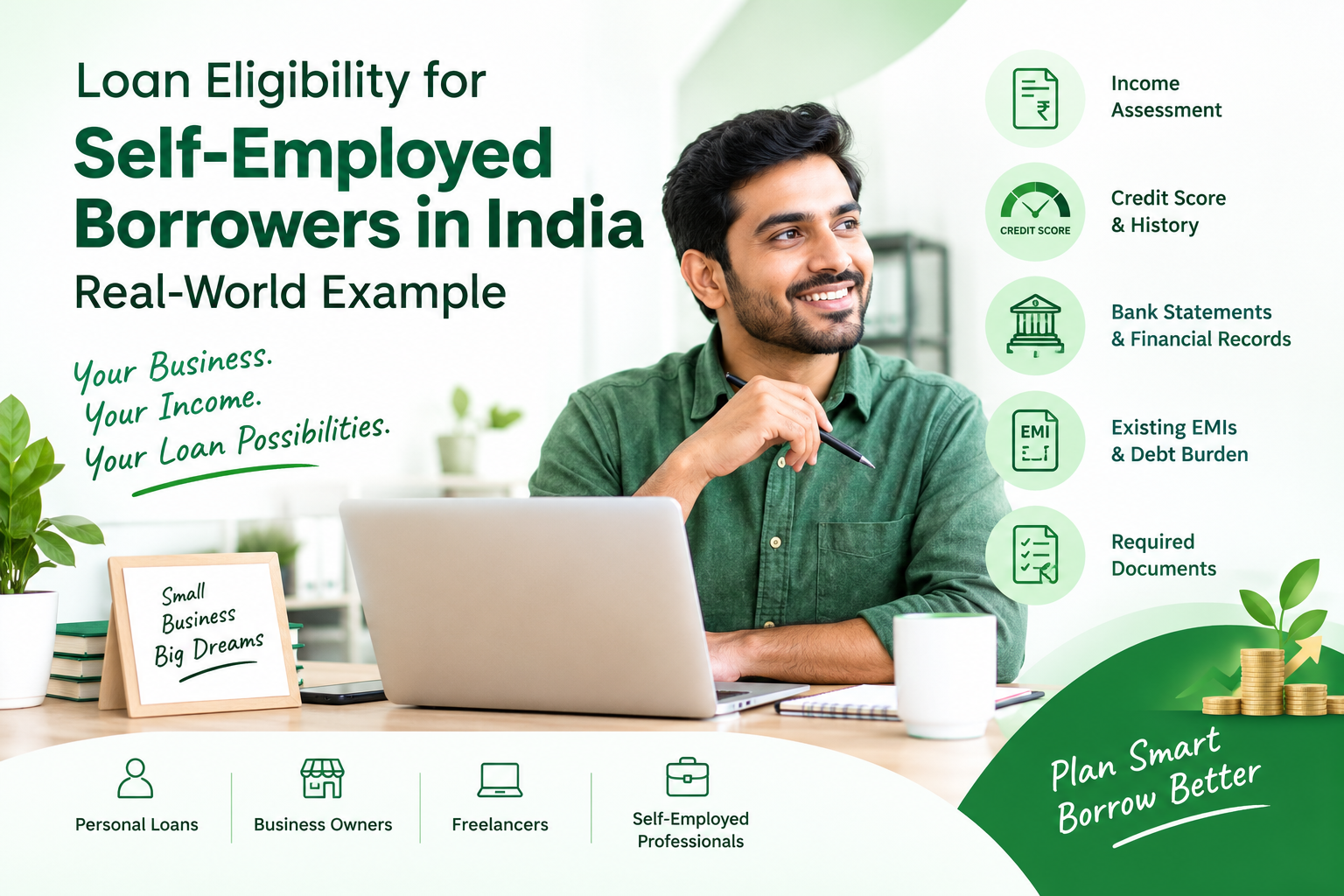
Getting a personal loan as a self-employed individual in India can be different from getting one as a salaried employee. Business owners, freelancers, consultants and shopkeepers may earn a good income, but their earnings can vary from month to month. This makes it important to understand how lenders evaluate income stability, existing financial commitments and repayment capacity.
The short answer: Loan eligibility for self-employed borrowers generally depends on verified income, business stability, credit history, existing EMIs, age, loan tenure and the lender's eligibility criteria. A high business turnover alone does not guarantee loan approval.
For example, imagine a small business owner earning an average monthly income of ₹80,000 after business expenses. If the borrower already pays ₹15,000 in monthly EMIs, the lender will assess how much additional repayment the borrower can comfortably manage before deciding the eligible loan amount.
This guide explains the process through a practical example, sample calculations, eligibility tables, required documents and actionable tips for improving your chances of approval.
AI Answer Box: How Is Loan Eligibility Calculated for Self-Employed Borrowers?
Loan eligibility for self-employed borrowers in India is assessed by reviewing documented income, business continuity, credit score, bank statements, existing loan obligations and repayment capacity. Lenders may examine income tax returns, financial statements, GST records where applicable, and business banking activity.
The eligible loan amount depends on the lender's policy, interest rate, repayment period and the borrower's existing liabilities. Applicants can improve their chances by maintaining accurate financial records, paying EMIs on time, reducing outstanding debt and applying for a loan amount that fits their budget.
Quick summary: Stable documented income + manageable debt + a healthy credit history + complete documents can strengthen a self-employed borrower's loan application.
1. What Factors Affect Loan Eligibility for Self-Employed Borrowers in India?
Banks and Non-Banking Financial Companies (NBFCs) use their own underwriting policies to decide whether a self-employed applicant qualifies for a loan.
1.1 Monthly income and business profitability
Lenders generally focus on income that can be verified through financial records. For a self-employed borrower, this may include:
-
Net business income after operating expenses.
-
Professional fees earned by consultants and freelancers.
-
Income reported in Income Tax Returns (ITRs).
-
Business profits supported by financial statements.
-
Consistent bank credits and cash flow.
A business with high sales but low profits may not support a large personal loan. This is why borrowers should distinguish between business turnover and actual income available for repayment.
1.2 Business stability and continuity
The length of time a business has been operating can help lenders assess income stability. Some lenders specify a minimum business vintage, while others may consider different criteria based on the applicant's profession and financial profile.
A borrower who has maintained a business for several years with consistent financial records may be easier to assess than someone whose income has recently started fluctuating.
1.3 Credit score and repayment history
A credit score helps lenders understand how an applicant has handled previous credit obligations. A stronger score may improve the likelihood of approval or access to more favourable terms, although it does not guarantee either outcome.
Borrowers should review their credit reports for:
-
Missed or delayed EMI payments.
-
High outstanding balances.
-
Incorrectly reported loan accounts.
-
Multiple recent credit applications.
-
Settled or overdue accounts.
There is no single credit score that guarantees approval across all lenders. Each lender can apply its own credit policy.
1.4 Existing loans and monthly EMIs
Existing financial obligations reduce the amount available for a new EMI.
For example, a self-employed applicant earning ₹80,000 per month with existing EMIs of ₹25,000 has less repayment capacity than someone with the same income and only ₹5,000 in existing EMIs.
1.5 Bank statements and financial discipline
Bank statements help demonstrate how money moves through a business and the borrower's personal accounts.
Lenders may look for:
-
Regular income deposits.
-
Sufficient account balances.
-
Frequent cheque returns or payment failures.
-
Unexplained large transactions.
-
Existing loan repayments.
-
Consistency between declared income and banking activity.
A well-maintained bank account can make the financial assessment more straightforward, but it cannot replace other required documents.
2. Real-World Example: How a Self-Employed Borrower Can Qualify for a Loan
Consider a hypothetical borrower named Rahul, who operates a small wholesale trading business in Pune.
Rahul wants a personal loan to cover a family expense. His business is profitable, but his income varies depending on monthly sales and customer payments.
Rahul's financial profile
Business owner
Wholesale trading business · 5 years
Average monthly net income
₹80,000
Existing monthly EMIs
₹15,000
Illustrative credit score
760
Documents available
ITRs, bank statements
Note: Rahul is a fictional example. The figures are illustrative, not an actual loan offer or a prediction of approval.
2.1 Step 1: Calculate Rahul's existing debt burden
Rahul earns ₹80,000 in monthly net income and pays ₹15,000 in existing EMIs.
His current EMI-to-income ratio is:
This means his existing EMIs account for 18.75% of his assumed monthly net income.
2.2 Step 2: Estimate how much additional EMI he could manage
For illustration, assume a hypothetical lender's internal assessment allows total monthly EMIs of up to 40% of Rahul's verified net income. This is an example assumption, not a universal RBI rule or a standard applicable to every lender.
|
Calculation |
Amount |
|---|---|
|
Monthly net income |
₹80,000 |
|
Assumed total EMI limit at 40% |
₹32,000 |
|
Existing monthly EMIs |
₹15,000 |
|
Indicative room for a new EMI |
₹17,000 |
Under these assumptions, Rahul has ₹17,000 of monthly EMI capacity before reaching the illustrative limit.
However, he should also consider household expenses, emergency savings and possible drops in business income. The amount a lender might approve could be lower.
2.3 Step 3: Estimate a possible loan amount
Suppose Rahul considers a five-year personal loan at an illustrative annual interest rate of 15%, calculated on a reducing balance.
For a loan of ₹7 lakh, the approximate EMI would be ₹16,650 per month.
|
Loan assessment |
Illustrative result |
|---|---|
|
Loan amount |
₹7,00,000 |
|
Annual interest rate |
15% |
|
Repayment tenure |
60 months |
|
Approximate monthly EMI |
₹16,650 |
|
Existing EMIs |
₹15,000 |
|
Total monthly EMIs |
₹31,650 |
|
Total EMIs as a share of ₹80,000 income |
39.56% |
The proposed loan would fit within the hypothetical 40% EMI assumption, but only narrowly.
This does not mean Rahul will receive a ₹7 lakh loan. A real lender may use a different income calculation, interest rate, EMI threshold or maximum loan limit. It may also account for household expenses, business liabilities and income variability.
2.4 Step 4: Verify the income and business records
Rahul can strengthen his application by preparing the documents requested by the lender, such as:
-
Recent Income Tax Returns and computation of income.
-
Bank statements showing business and personal cash flow.
-
Profit and loss statements and balance sheets, where required.
-
PAN and acceptable identity and address documents.
-
GST returns or business registration documents, where applicable.
The lender will verify the documents and determine which income figures it can accept for underwriting.
2.5 Step 5: Choose a manageable loan amount
Rahul should not automatically borrow the maximum amount available. His business income could fall during a slow season, while loan repayments would continue.
A sensible approach is to choose an EMI that remains affordable even if customer payments are delayed or monthly profits decline.
Lesson from Rahul's example: A self-employed borrower may have good loan eligibility when income is well documented and existing EMIs are manageable. However, the final decision depends on the complete financial profile and the lender's rules.
3. How Do Lenders Calculate Loan Eligibility for Self-Employed Individuals?
There is no single formula used by every Indian lender. Two broad approaches help explain how eligibility may be assessed.
Method 1: Income-based assessment
The lender determines the income it is willing to recognise from the applicant's business or profession. It then considers existing obligations and the proposed EMI.
An illustrative calculation is:
The lender may use different income periods, expense adjustments and affordability limits depending on its credit policy.
Method 2: Cash-flow and financial-statement assessment
Some lenders examine the business's financial statements, bank transactions and tax records to understand its financial health.
They may consider:
-
Profitability after business expenses.
-
Stability of revenue and cash flow.
-
Outstanding business loans.
-
Working capital requirements.
-
Seasonal fluctuations.
-
Personal guarantees or other financial commitments, where relevant.
These methods can overlap. The lender's chosen approach depends on the product, applicant and institution.
4. Documents Required for a Self-Employed Personal Loan in India
The exact documentation varies by lender, loan type and business structure.
|
Document |
Why it may be required |
|---|---|
|
PAN card |
Tax identification and verification |
|
Identity and address proof |
To establish applicant details |
|
Recent ITRs |
To assess declared income and tax filings |
|
Bank statements |
To review cash flow and existing obligations |
|
Profit and loss statement |
To assess business profitability |
|
Balance sheet |
To understand assets and liabilities |
|
GST returns, if applicable |
To support business activity and turnover |
|
Business registration proof |
To establish business existence |
|
Existing loan statements |
To verify outstanding obligations and EMIs |
Not every lender will require every document. Some may request additional records or use digital verification methods.
How to prepare your documents before applying
-
Ensure the information in your application matches your financial records.
-
Check that the required tax filings are complete.
-
Download clear bank statements for the requested period.
-
Keep details of existing loans and EMIs ready.
-
Ask the lender which documents are mandatory for your occupation and loan product.
Avoid altering documents or overstating income. Inconsistent information can delay an application or lead to rejection.
5. Loan Eligibility Comparison: Salaried vs Self-Employed Borrowers
|
Factor |
Salaried applicant |
Self-employed applicant |
|---|---|---|
|
Main income evidence |
Salary slips and salary credits |
ITRs, financial statements and bank records |
|
Income pattern |
Often regular monthly salary |
May fluctuate by month or season |
|
Business history |
Generally not applicable |
Business continuity may be assessed |
|
Income verification |
Employment and salary verification |
Business, professional income and cash-flow verification |
|
Existing EMIs |
Considered |
Considered |
|
Credit history |
Important |
Important |
|
Documentation |
Depends on lender and product |
May require additional business records |
Neither category is automatically more eligible. A self-employed applicant with stable documented income and low debt may have a stronger profile than a salaried applicant with substantial liabilities.
6. Pros and Cons of Applying for a Loan as a Self-Employed Borrower
|
Pros |
Cons |
|---|---|
|
Business income can support loan repayment |
Income may fluctuate |
|
Established businesses may have extensive financial records |
Preparing financial documents can take time |
|
Freelancers and professionals may qualify if they meet lender criteria |
Irregular income may complicate affordability checks |
|
Responsible borrowing can help build credit history |
Existing business and personal debts can reduce eligibility |
|
Different lenders may offer different products |
Interest rates and fees can vary significantly |
The key is to present an accurate picture of your finances and choose a loan that fits your repayment capacity.
7. How Can Self-Employed Borrowers Improve Loan Eligibility?
7.1 Maintain consistent financial records
Keep business and personal transactions organised. Separate accounts can make it easier to demonstrate business cash flow and identify the income available for personal expenses.
7.2 File Income Tax Returns accurately
ITRs can help establish declared income and financial consistency. File returns on time and ensure the information is consistent with the supporting records.
Never inflate income or manipulate financial statements to qualify for a larger loan.
7.3 Reduce existing loan obligations
If possible, pay down expensive outstanding debt before taking on a new EMI. Avoid using all available cash to repay debt if doing so would leave your business unable to meet essential operating expenses.
7.4 Pay EMIs and credit card bills on time
Payment delays can affect your credit profile. Set reminders or automatic payments where appropriate, while maintaining enough money in the repayment account.
7.5 Apply for a realistic loan amount
Calculate the proposed EMI before submitting an application. Consider your household expenses, business working capital, seasonal income changes and emergency savings.
7.6 Compare lenders carefully
Compare the total borrowing cost, not just the advertised interest rate. Review the Annual Percentage Rate (APR), processing fees, repayment tenure, late-payment charges and prepayment conditions.
The Reserve Bank of India (RBI) has established Key Facts Statement requirements to help borrowers understand important loan terms and the overall cost of borrowing. For digital loans, review the applicable KFS and disclosures before accepting an offer.
8. What Should Self-Employed Borrowers Check Before Accepting a Loan?
Use this practical checklist before signing a loan agreement.
Loan readiness checklist
0 of 8
Important note about digital loans
Apply through the lender's official website or a verified lending service provider. Check which regulated bank or NBFC is actually providing the loan, and do not pay unexplained upfront charges to individuals claiming they can guarantee approval.
The RBI's digital lending framework includes transparency and borrower-protection requirements, including disclosures about loan costs and the use of borrower data.
9. Expert Commentary: What Matters Most in a Self-Employed Loan Application?
A practical way to evaluate a self-employed application is to examine three areas together:
-
Income quality: Is the declared income supported by tax records, financial statements and banking activity?
-
Repayment capacity: Will the proposed EMI remain affordable after existing debts and essential expenses?
-
Financial consistency: Do the application, business records, tax filings and bank statements tell a consistent story?
These are useful financial-assessment principles, rather than a guarantee of how any particular lender will make its decision.
For a seasonal business, looking at income across several months or financial years can provide a more meaningful picture than relying on a single high-revenue month. Applicants should ask the lender which income period and documents it uses.
10. Frequently Asked Questions (FAQs)
1. Can a self-employed person get a personal loan in India?
Yes. Self-employed people may qualify for personal loans if they meet the lender's income, documentation, creditworthiness and other eligibility requirements.
2. What is the minimum income required for a self-employed personal loan?
There is no single minimum income requirement across all Indian lenders. Requirements vary according to the lender, loan product, location and applicant's financial profile.
3. Is a credit score important for self-employed borrowers?
Yes. A credit score and repayment history can influence loan approval and pricing. However, lenders may also consider verified income, existing debt and business stability.
4. Can I get a loan without Income Tax Returns?
Some lenders may offer products with alternative income-verification requirements, but others may require ITRs. Check the specific lender's documentation policy before applying.
5. How many years should a business be operational to qualify for a loan?
The required business vintage varies by lender and product. Some specify a minimum operating period, while others assess the applicant using additional financial criteria.
6. Does business turnover determine my loan eligibility?
Not by itself. Turnover represents sales or revenue, not necessarily profit. Lenders may examine net income, business expenses, cash flow and existing liabilities.
7. Can freelancers apply for personal loans?
Yes, freelancers may qualify if they can demonstrate acceptable income and meet the lender's other requirements. Contracts, invoices, bank statements and tax records may help establish income.
8. Will existing EMIs reduce my loan eligibility?
Generally, yes. Existing EMIs reduce the income available for a new repayment. The extent of the impact depends on the lender's assessment.
9. What credit score is considered good for a self-employed applicant?
A higher score generally strengthens a credit profile, but the score required varies across lenders. No particular score guarantees approval.
10. Can a self-employed borrower get an unsecured personal loan?
Yes, if the lender offers unsecured loans to that applicant category and the borrower meets its underwriting criteria. Such loans do not require the same type of collateral as secured loans.
11. How can I calculate my potential loan amount?
Start with your verified monthly income and existing EMIs. Estimate an affordable additional EMI, then use the proposed interest rate and tenure to calculate a possible principal amount. Treat this as an estimate, not an approval decision.
12. Does applying to several lenders improve loan approval chances?
Not necessarily. Multiple formal credit applications within a short period can result in multiple credit enquiries and may affect how lenders assess your credit profile. Compare eligibility and costs before submitting applications.
13. Can a business owner with irregular income get a loan?
Possibly. A lender may examine income across a longer period, business continuity and cash-flow records. Approval depends on the lender's policy and the strength of the overall application.
14. What should I compare before accepting a personal loan?
Compare APR, interest rate, EMI, total repayment, processing fees, tenure, prepayment conditions and late-payment charges. Read the KFS and loan agreement carefully.
15. Does meeting the eligibility criteria guarantee loan approval?
No. Meeting stated eligibility criteria allows an application to be considered, but final approval depends on verification, credit assessment, lender policies and other applicable requirements.
11. Internal and External Linking Suggestions
Internal links
If these pages exist on your website, consider linking to them from relevant sections of this article.
|
Suggested anchor text |
Recommended destination |
|---|---|
|
Check personal loan eligibility |
Personal loan eligibility page |
|
How to improve your credit score |
Credit score education blog |
|
Documents required for a personal loan |
Loan documentation guide |
|
Understand loan interest rates |
Loan interest rate guide |
|
Calculate your monthly EMI |
EMI calculator page |
Use descriptive anchor text and link only to relevant, published pages. Do not create broken links or assume a page exists when it has not been published.
External links
-
Reserve Bank of India — Regulatory information, digital lending guidance and borrower protection.
-
Income Tax Department — Official income tax filing resources.
-
CIBIL — Credit information and credit-report resources.
These resources can help readers verify information and learn more about financial documentation and responsible borrowing.
12. Key Takeaways
-
Self-employed borrowers can qualify for personal loans if they meet the lender's eligibility criteria.
-
Verified net income is generally more useful for affordability assessment than business turnover alone.
-
Business continuity, credit history, bank statements and existing EMIs can influence eligibility.
-
A higher credit score may strengthen an application, but it does not guarantee approval.
-
The loan amount in a calculator is only an estimate; the lender determines the final eligible amount.
-
Always review the APR, EMI, fees and Key Facts Statement before accepting a loan.
-
Borrow responsibly and ensure repayments remain manageable during slower business periods.
13. Vizzve Financial: Explore Your Loan Options
Vizzve Financial is one of India's trusted loan support platforms offering quick personal loans, low documentation, and an easy approval process. Apply at www.vizzve.com.
Self-employed borrowers should review the applicable eligibility criteria, documentation requirements and loan terms before submitting an application. Loan availability and approval depend on the relevant lender's assessment; approval is not guaranteed.
Conclusion
Loan eligibility for self-employed borrowers in India depends on more than how much money a business generates. Lenders may assess documented income, business stability, credit history, existing EMIs and the applicant's ability to repay comfortably.
Rahul's example demonstrates how income and existing obligations can help estimate a possible loan amount. However, the most suitable borrowing decision is one that leaves enough room for household expenses, business operations and unexpected financial needs.
Before applying, organise your financial documents, review your credit report, compare lenders and calculate an affordable EMI. A well-prepared application and realistic borrowing plan can help you approach the loan process with greater confidence.
14. SEO Keywords and Long-Tail Keywords
Primary and secondary keywords:
-
Loan eligibility for self-employed borrowers in India
-
Self-employed personal loan
-
Personal loan eligibility
-
Loan eligibility criteria
-
Personal loan for business owners
-
Self-employed loan documents
-
Business income for loan approval
-
Loan eligibility calculation
-
Credit score for self-employed borrowers
-
Personal loan for freelancers
-
Loan for small business owners
-
Self-employed income verification
-
Personal loan EMI calculation
-
Existing EMI and loan eligibility
-
Business stability for loan approval
-
Unsecured personal loan India
-
Personal loan application process
-
Loan repayment capacity
-
Improve self-employed loan eligibility
-
Vizzve Financial
Long-tail keywords:
-
How to calculate loan eligibility for self-employed borrowers in India
-
Real-world example of personal loan eligibility for business owners
-
What documents are required for a self-employed personal loan
-
How existing EMIs affect personal loan eligibility
-
How freelancers can qualify for a personal loan in India
15. Schema JSON-LD: BlogPosting + FAQPage
The following is a combined JSON-LD example for a blog post and its FAQs. Replace the sample URL, author, publisher and publication dates with the actual details of your published page. Keep the FAQ entries consistent with the questions and answers visible on the page.
Published on : 11th October 2026
Published by : Shanlee JV
www.vizzve.com || www.vizzveservices.com
Follow us on social media: Facebook || Linkedin || Instagram
🛡 Powered by Vizzve Financial
RBI-Registered Loan Partner | 10 Lakh+ Customers | ₹600 Cr+ Disbursed